You have a video that works perfectly in English, and now you want viewers in Spain, Brazil, or Japan to feel the same way about it. Swapping in translated subtitles rarely gets you there. What is dubbing localization, then? It is the work of replacing the original spoken dialogue with a target-language performance while adapting the whole experience for the new audience—translation, voice, timing, cultural choices, and audio mixing working together so the finished video feels native rather than imported.
That distinction matters because dubbing localization is far more than word-for-word translation. It combines audiovisual translation, voice production, synchronization, cultural adaptation, and audio post-production so the content behaves as though it was made for its new market from the start.
Table of contents
Dubbing, translation, and localization are not the same job
People use these words interchangeably, but they describe different scopes of work, and confusing them leads to budgets and expectations that never line up.
| Term | Main purpose |
|---|---|
| Translation | Converts words from one language to another |
| Dubbing | Replaces the original spoken dialogue with a new-language performance |
| Voice-over | Adds a translated voice track, often with the original audible underneath |
| Subtitling | Displays translated text on screen while the original audio remains |
| Localization | Adapts the complete media experience for a language, region, and audience |
| Dubbing localization | Pairs target-market adaptation with a replacement spoken performance |
Here is the practical difference. Translating "Let's grab a coffee" literally will usually be understood in another language. But a localization decision might swap it for a more natural local expression based on the characters, their ages, the setting, and how they relate to each other. The words are correct either way; only one of them sounds like something a real person would say in that market.
Localization also reaches past dialogue into idioms and jokes, units and currencies, names and honorifics, on-screen text and graphics, regional accents, and anything that conflicts with local expectations or rules. That is why a video can be dubbed accurately and still feel badly localized: the voice is in the right language, but the humor, references, or graphics still belong to the original audience. The European Association for Interpreting and Translation Studies frames dubbing as a form of audiovisual translation in which the original soundtrack is replaced while meaning, voice characteristics, and synchronization with visible speech are preserved, and it identifies three forms of synchrony—content, visual, and character. If you want the broader picture of adapting an entire media experience, our guide to media localization maps where dubbing sits inside that larger decision.
How dubbing localization actually works
Workflows differ by project, but professional dubbing localization almost always moves through the same connected functions. Understanding them helps you see where quality is won or lost.
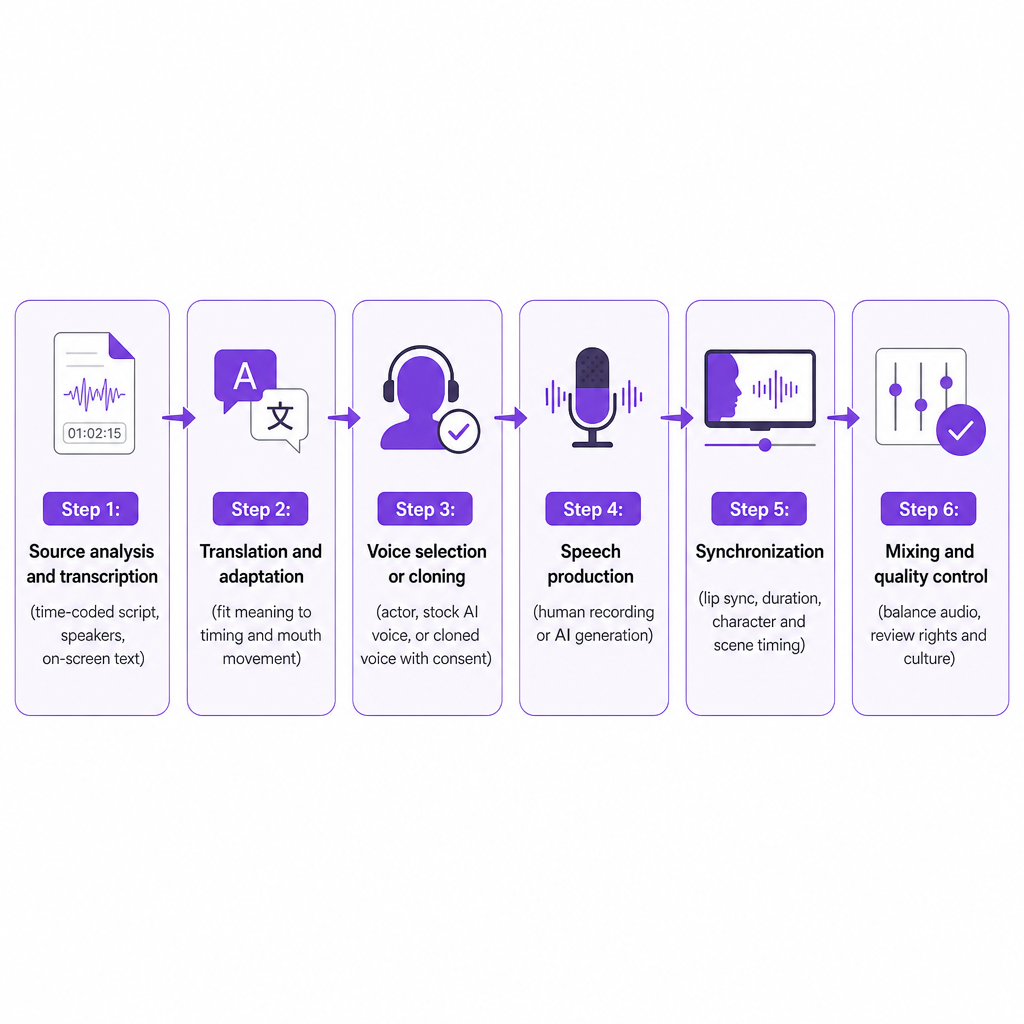
It starts with source analysis and transcription. The original video gets reviewed to identify spoken dialogue, speaker changes, timing and pauses, background music, on-screen text, and any jokes or culturally specific references. A time-coded transcript becomes the foundation for everything after it. Clean source audio makes this far easier; when dialogue is buried under music or noise, a speech-separation tool can produce a cleaner voice track before translation begins.
Next comes translation and adaptation, and this is where dubbing earns its reputation for being hard. The script is translated into the target language, but it also has to work when spoken aloud and still fit the picture. An adapter weighs sentence length, speaking speed, pauses and breaths, character personality, emotional intensity, and mouth movements. A literal translation can be grammatically perfect yet far too long for the scene, so phrases get shortened, restructured, or replaced without losing their purpose. The constant tension is faithfulness to the source against sounding natural on screen.
Then the team decides how each speaker will sound: a professional voice actor, a stock synthetic voice, a custom AI voice, a cloned version of the original speaker, or different voices for different characters. Voice cloning can carry a speaker's vocal identity across languages, but sounding similar to someone is not the same as holding the right to reproduce their voice. Permission and documented rights come first, always.
After voice selection, speech is produced. In a traditional workflow, actors perform the adapted script while watching the footage, often guided by a director on pronunciation, emotion, and pacing. In an AI workflow, the system generates speech from the translated script and may preserve tone, pitch, accent, speaking style, and emotional delivery. Either way, synchronization follows: matching speech to visible mouth movements where it counts, fitting translated lines into the available time, matching delivery to the person on screen, and aligning pauses and reactions. Perfect lip sync is not equally important everywhere—a dramatic close-up demands careful mouth matching, while a narrated tutorial prioritizes clarity and natural pacing.
Finally, the dubbed dialogue is mixed back with music, effects, and ambience, and a quality pass checks translation accuracy, pronunciation of names and technical terms, voice consistency, timing, audio balance, untranslated on-screen text, cultural fit, and voice rights. The goal is not merely understandable speech. A good dub simply stops pulling the viewer's attention away from the content.
Where AI changes the dubbing localization workflow
AI dubbing localization uses artificial intelligence to automate some or all of the transcription, translation, voice generation, voice cloning, synchronization, and rendering stages. In a typical AI-assisted pass, the system detects or transcribes the original speech, separates or identifies dialogue segments, translates into the chosen languages, generates target-language speech, clones or selects voices, aligns the new audio with the video, and exports a localized version.
The real advantage shows up when you need several language versions quickly rather than one prestige dub. A YouTuber can localize a tutorial for Spanish- and Portuguese-speaking viewers; a small business can ship product demonstrations across regions; an e-learning team can adapt a training course without re-recording every lesson; a filmmaker can produce multilingual versions of a short; a developer can automate localized audio through an API.
What AI does not do is make the localization decisions for you. It accelerates production, but a person still has to judge whether the translation, voice, tone, cultural references, and final mix are right for the market. Treat automatic publishing of every generated version with suspicion—that is exactly how translation errors, inconsistent voices, and awkward phrasing slip in front of an audience. If you are comparing one assembled platform against a stack of separate tools for this kind of work, our breakdown of an all-in-one platform versus separate AI tools lays out the trade-offs.
When dubbing localization is the right call
Dubbing localization tends to win when your audience needs to listen rather than read. That covers a wide range of formats: YouTube and creator content, product demonstrations, advertising, corporate training, e-learning, explainers, video podcasts, documentaries, short films, app tutorials, and social clips.
It is especially worth it when the video carries substantial spoken information, when viewers need to watch a demonstration while listening, when the content targets children or language learners, when you want to publish multiple versions of one video, when the audience is unlikely to engage with subtitles, or when voice identity and consistent narration matter to the brand.
Subtitles can be the smarter choice in the opposite situations—when the budget is tight, the content changes frequently, the original performance is central to the experience, or the audience actually prefers to hear the source language. For a focused comparison of output quality, control, cost, and accessibility between the two, see AI Dubbing vs Manual Subtitling: Which Fits You.
Matching the approach to your content
There is no single correct method. The right one depends on your content type, audience, quality bar, and how much you need to produce.
Traditional human dubbing fits feature films and premium series, stories where emotional performance carries the scene, projects that demand precise lip sync, and content with complex humor or culturally sensitive material. It assumes a dubbing director, actors, and specialized linguistic review.
AI-assisted dubbing fits situations where you need multiple languages or frequent updates, where speed and scale matter, where the content is instructional or creator-led, where you are testing demand in new markets, and where consistent voices across a large library are a priority—provided you have a review process for the output.
Voice-over or narration fits when the speaker is not on screen, the video is mainly instructional, exact lip sync is unnecessary, the original audio can sit quietly underneath, and you want a simpler, less expensive localized version.
Subtitles fit when the original vocal performance should stay untouched, the video has little dialogue, the audience is comfortable reading while watching, or you need to localize fast with minimal audio production.
Many projects blend these. A brand might dub the spoken narration, subtitle the text shown on screen, and keep specific product names in the original language. The mix is the point, not the purity of any one method.
The risks that quietly ruin a dub
Done well, dubbing localization makes content more accessible. Done carelessly, it erodes trust in ways that are easy to miss until the comments roll in.
- Literal translation keeps the dictionary meaning but drops the joke, tone, or reference. Adapt for meaning and audience effect, not individual words.
- Pronunciation errors on names, places, acronyms, and technical terms trip up both humans and AI. Build a pronunciation guide for important terms and review them in context.
- Voice rights and consent become a legal and ethical problem the moment a voice is reproduced without permission. Get documented consent and confirm the intended use, territory, duration, and commercial rights are covered.
- Cultural mismatch—an idiom, gesture, or image that lands in one market and offends in another—is why native-language review matters most for advertising, humor, healthcare, finance, education, and political content.
- Flat emotional delivery can make a technically accurate line sound wrong. Compare the emotional intent of the original and the localized version, not just the transcript.
- Lip-sync limits come from languages differing in word length and syllable structure; an accurate translation may simply not fit the original mouth, so lines get reshaped while preserving meaning.
- Audio contamination happens when dialogue is baked into music and effects, so removing it damages the background. Clean source stems beat a single compressed video file every time.
Before you publish a localized dub, it is worth confirming the target language and regional variant are correct, the script preserves the original intent, jokes and references are adapted, names and specialist terms are pronounced correctly, the voice matches the speaker or brand, the performance reflects the original emotion, dialogue starts and ends on time, close-ups have acceptable lip sync, the audio mix is balanced, on-screen text is localized where needed, voice-cloning permission is documented, and a native speaker has signed off on the final version.
Localizing with DubSmart AI
We built DubSmart AI to pull these media creation and localization functions into one workflow instead of a scattered tool stack. Our AI Dubbing product supports multilingual video localization from more than 60 source languages into 33 target languages, with speaker voice cloning, editable timings and text, and export of the finished project—you upload a video or YouTube link, adjust speakers, timings, and text, then download the result.
For programmatic work, our AI Dubbing API handles automated dubbing into 33+ target languages, multiple target languages in a single request, and voice-cloning options for hands-off pipelines. Teams building custom integrations can also use our Voice Cloning API to create reusable voices from audio samples and apply them in text-to-speech or dubbing.
The right fit still comes down to your priority: fast multilingual output, voice consistency, human-level creative adaptation, automated publishing, API integration, or tight control over editing and review. For high-stakes campaigns and narrative productions, treat AI-generated dubbing as a production accelerator rather than a replacement for linguistic and creative quality control. Tell us your source language, target markets, format, and volume, and we can point you to the workflow that matches the job.
Frequently asked questions
What is dubbing localization in simple terms?
It is adapting a video for a new language and audience, then replacing the original spoken dialogue with a natural target-language performance that fits the picture and the culture.
Is dubbing localization the same as translation?
No. Translation changes the words. Dubbing replaces the spoken audio, and localization also weighs culture, tone, timing, visuals, regional language, and audience expectations.
What is the difference between dubbing and voice-over?
Dubbing usually replaces the original dialogue and is synchronized with the video. Voice-over often adds translated narration while the original audio stays audible underneath, and it may not need precise lip sync.
Can AI dub a video into multiple languages?
Yes. AI dubbing systems can transcribe, translate, generate voices, and produce versions in several target languages at once. Our AI Dubbing product processes content from 60+ source languages into 33 target languages.
Is dubbing better than subtitles?
Neither is universally better. Dubbing is often more accessible for viewers who prefer listening or need to watch the screen closely, while subtitles are usually simpler, cheaper, and better at preserving the original performance.