
Media localization is how a video, podcast, or course made in one language becomes something that feels native to viewers in another—not a subtitle bolted on, but content that sounds and reads like it was created for that audience from the start. If you are asking what is media localization, the short answer is this: it is the adaptation of audiovisual content—dialogue, narration, on-screen text, graphics, timing, and sometimes whole scenes—so that people in a different market get the same emotional and informational impact as the original. Translation moves words. Localization moves meaning, tone, and cultural fit.
That distinction matters because most content that "goes global" stops at word-for-word translation and then wonders why engagement stalls. The layer that turns content people can understand into content people feel was made for them is the entire point of localization—and it is now within reach of small teams, not just studios.
Table of contents
What media localization actually means
In professional terms, media localization is the adaptation of creative, audio, and video content to meet the linguistic, cultural, and technical expectations of a specific region or audience. It covers films, series, ads, podcasts, e-learning modules, social clips, and any other multimedia that combines words, sound, and imagery.
What separates it from simple translation is scope. Localization modifies dialogue, on-screen text, narration, graphics, and occasionally scenes so the content resonates naturally and respectfully in the target culture. That can mean reworking idioms so a joke still lands, swapping a brand reference a local audience would not recognize, rethinking color symbolism, or adjusting pacing to match viewing norms. A literal caption might be accurate and still feel foreign; a localized version reads like it belongs.
For digital creators and businesses, this is the difference between a video that is merely understandable in another language and one that competes on equal footing with local content. It is the mechanism that makes a channel, course, or campaign truly multilingual rather than subtitled.
The real decision: do you need it, and in what form?
The honest question for most teams is not whether localization exists—it is which kind fits the goal. The depth you choose changes cost, timeline, and impact.
Creators expanding a YouTube channel internationally weigh three paths: keep the original language with subtitles, add localized voiceovers, or fully dub into multiple languages with consistent channel branding. Small businesses and marketing teams face a related choice—should localized ads sound like a native host from each market, or should the brand's core voice carry across languages? E-learning and corporate training producers often decide between simple captioning, partial localization such as voiceover for key modules, or complete multimedia localization where slides, examples, and assessments are adapted to local norms and regulations.
Independent filmmakers and podcasters decide how much of the original performance to preserve and how far to adapt dialogue, sound design, and marketing for each territory. Developers and agencies face a more technical fork: embed localization directly into their products and pipelines using APIs for text-to-speech, voice cloning, and dubbing, or handle audio manually for every language.
Seen this way, localization is a strategy question before it is a production task: how far should your content go to feel native in each market, and what mix of tools gets you there without breaking your budget or release cadence?
How media localization works: mechanisms and options
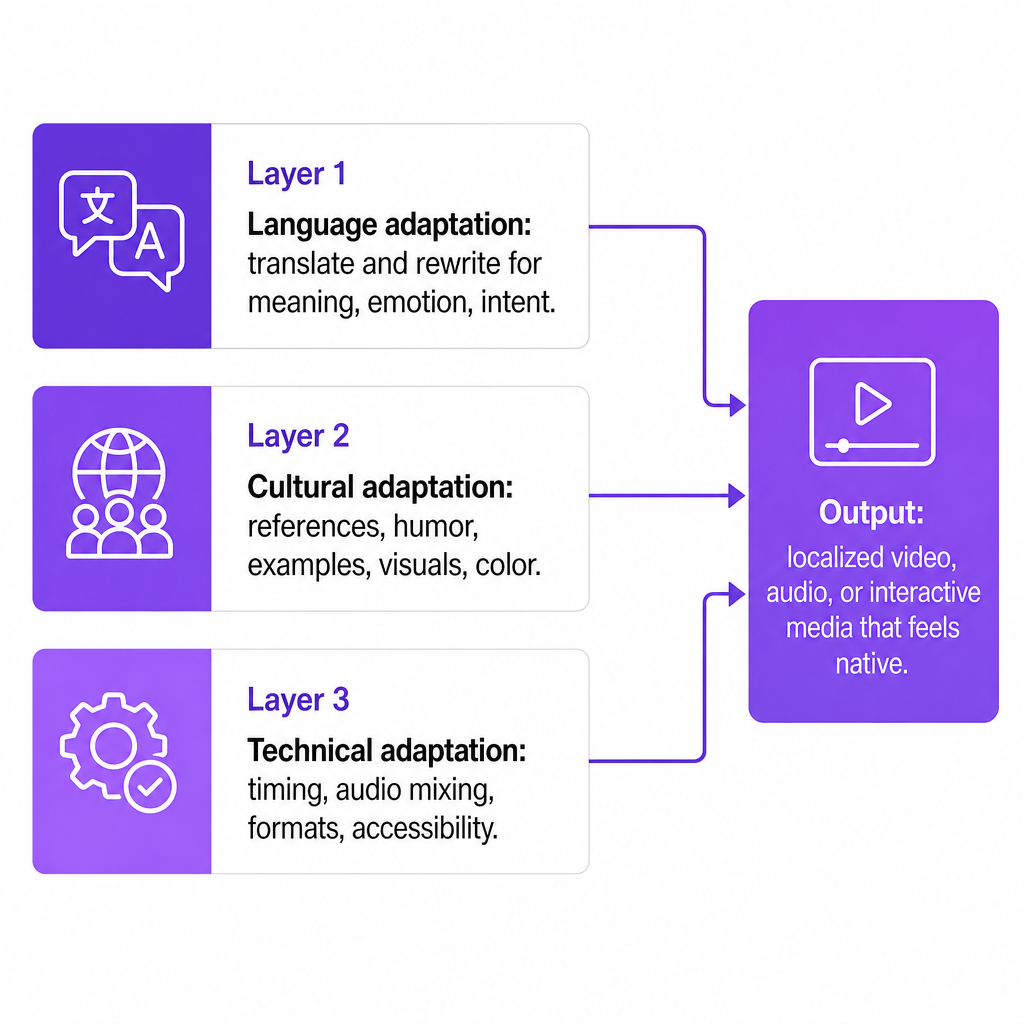
Most projects combine three underlying mechanisms. Language adaptation translates and rewrites scripts to preserve meaning, emotion, and intent rather than literal wording. Cultural adaptation revises references, humor, examples, and visuals to align with local norms and avoid confusion or offense. Technical adaptation adjusts timing, audio mixing, file formats, and accessibility so the output meets each platform's or broadcaster's requirements. Those three come together differently depending on the content type and the depth you need.
Dubbing and voiceover
Dubbing replaces or overlays the original spoken audio with localized speech synchronized to the picture. Traditional workflows require native-language voice actors, studio recording, audio editing, and careful lip-sync and timing. AI dubbing automates much of this by analyzing the source audio, generating translations, and producing synthetic speech aligned to the video. Modern systems use voice cloning to preserve the original speaker's tone, pitch, accent, and style in the new language, so dubbed versions still sound like the creator or brand rather than a generic narrator.
Our AI Dubbing translates and dubs videos into more than 33 languages and applies voice cloning to replicate each speaker's voice—so a creator keeps a consistent channel identity across every market while delivering localized speech in each language.
Subtitling and captioning
Subtitling adds on-screen text translations of spoken dialogue, timed to specific frames. Captions extend that by including non-speech cues such as sound effects and music for accessibility. In localization work, subtitles must be linguistically accurate, culturally appropriate, and technically precise—matching each line's timing, reading speed, and on-screen space. For many creators, subtitles are the first cost-effective step toward international reach, especially when full dubbing is not yet feasible.
On-screen text, graphics, and interactive elements
Localization also covers text and imagery baked into the content: lower thirds, titles, UI labels, diagrams, charts, and in-video calls-to-action. Effective work updates that on-screen text, adjusts layouts for languages that run longer or shorter, and adapts graphics or colors to local expectations. Interactive media—apps, e-learning modules, web experiences—adds another layer: buttons, menus, instructions, and feedback all need localizing so users navigate naturally in their own language.
Audio cleanup, transcription, and supporting tools
Before any of this, source audio usually needs preparation: separating voices from background noise, generating transcripts, and identifying speakers and segments. These pre-processing steps make dubbing, subtitling, and cloning far more accurate. Our Speech to Text produces clean transcripts, and our Speech Separator isolates voices from music and noise—both feeding directly into downstream localization instead of forcing manual export and re-import between tools.
Where we fit in media localization
DubSmart AI is an all-in-one AI-powered media creation and localization platform, headquartered in Boca Raton, Florida, that consolidates AI dubbing, voice cloning, text to speech, speech to text, speech separation, text-to-image, and image-to-video into one workflow. We serve more than 500,000 users who need scalable multilingual production—individual creators, YouTubers, businesses, and developers.
For localization specifically, the pieces work together:
- AI Dubbing localizes content into 33+ target languages, using voice cloning to carry each speaker's voice across languages.
- Voice cloning reproduces any number of voices with high precision, so brand voices, creator personas, or character voices can be reused market to market.
- Text to Speech offers 300+ natural-sounding AI voices plus unlimited voice cloning, generating realistic speech from scripts.
- Speech to Text and Speech Separator transcribe and clean audio to prepare accurate dubbing and subtitles.
- Text-to-image and image-to-video tools create or adapt visual assets inside the same production flow.
We use a credit-based pricing model with rollover credits, a free tier for testing, paid plans for regular production, and enterprise options for larger teams. For developers and agencies, our AI Dubbing API and Voice Cloning API let voice AI drop directly into products or pipelines. Because these capabilities share one environment, teams can move from English-only source content to multilingual dubbed and subtitled versions without stitching together separate vendors—reducing the operational friction that once made full localization affordable only to studios.
How to choose your localization approach
Deciding how far to localize comes down to a few practical criteria. Weigh them against your goals rather than defaulting to the most expensive or the cheapest option.
Audience and channel strategy. Start with who you want to reach and where they watch. If the goal is global accessibility for an existing audience, high-quality subtitles may be enough. If you want active growth in specific markets—Spanish-speaking viewers, French-speaking learners—native-language audio matters more. For personality-driven channels, preserving the creator's voice across languages through cloning becomes a genuine differentiator.
Content type and format. Narrative film, story-driven series, and podcasts usually benefit from full dubbing or carefully mixed voiceovers to keep immersion. Tutorials, product explainers, and training often combine localized narration with translated slides and captions. Interactive e-learning and apps need granular localization of UI text and feedback, which is where transcription, TTS, and dubbing APIs earn their place. Short-form social may need only localized hooks, captions, and the occasional dubbed version of a top clip.
Languages and scalability. One or two languages with rare updates might justify bespoke studio work. Covering tens of markets with frequent releases makes automation essential. Dubbing into 33+ languages with 300+ voices and unlimited cloning is built for that scale, and rollover credits suit periodic large pushes—launching a course or a season—without wasting unused capacity.
Quality, control, and brand voice. Broadcast-level film localization often demands extensive human review and creative direction. For digital marketing, training, and creator content, high-quality synthetic voices and AI dubbing can meet audience expectations while cutting cost and time sharply. Voice cloning adds a control dimension: define a signature voice once and reuse it consistently instead of relying on different actors who vary across campaigns and languages.
Budget, time, and workflow fit. Human translation, studio recording, mixing, and QA can be slow and costly, especially for frequent drops. AI-driven workflows shorten turnaround and fit publishing schedules that run weekly or daily. If you need predictable costs and a single environment for audio, visual, and dubbing tasks, an integrated platform generally beats assembling one-off vendor projects.
Risks and responsibilities you should plan for
Even with strong AI tools, localization carries real risks worth naming before you start.
Linguistic and cultural missteps can damage trust or cause offense when a translation misses nuance or ignores local norms. Over-literal translation distorts meaning; over-adaptation can misrepresent the original or break brand guidelines. Technical errors—poor lip-sync, mismatched subtitles, wrong audio levels—make content feel unprofessional. In compliance-sensitive fields like health, finance, or workplace training, inaccurate localization can create legal or regulatory exposure, so case-specific verification matters there.
Voice cloning adds ethical responsibility. Creators and organizations need clear consent for any cloned voice and must protect those models from misuse. Our position is straightforward: cloning is for narrating and localizing legitimate work, not for impersonating people without authorization.
The practical safeguard is pairing AI with human judgment—reviewing localized scripts, spot-checking dubbed output, and keeping guardrails around who can trigger cloning and dubbing. Centralizing the workflow in one platform makes those standards easier to hold at scale, because approvals and controls sit next to the tools rather than scattered across vendors.
Frequently asked questions
What is media localization in one sentence?
Media localization is the process of adapting audio, video, and multimedia content for different languages and cultures so it feels like it was made locally, not just translated.
How is media localization different from translation?
Translation focuses on words. Media localization adjusts language, visuals, timing, and cultural references to preserve meaning, emotion, and intent for each audience.
Do I need dubbing, or are subtitles enough?
Subtitles are often enough for accessibility and low-budget global reach. Full dubbing or localized voiceovers usually perform better when personality, immersion, or brand voice are central to the content.
How does AI dubbing with voice cloning help creators and brands?
It lets you replicate a creator's or brand's voice across languages, speeding up multilingual production while keeping a consistent identity in every market.
What do you provide for media localization?
We combine AI dubbing, voice cloning, text to speech, speech to text, speech separation, and visual generation in one platform—supporting dubbing from 60+ source languages into 33+ target languages, with 300+ voices and APIs for direct integration.