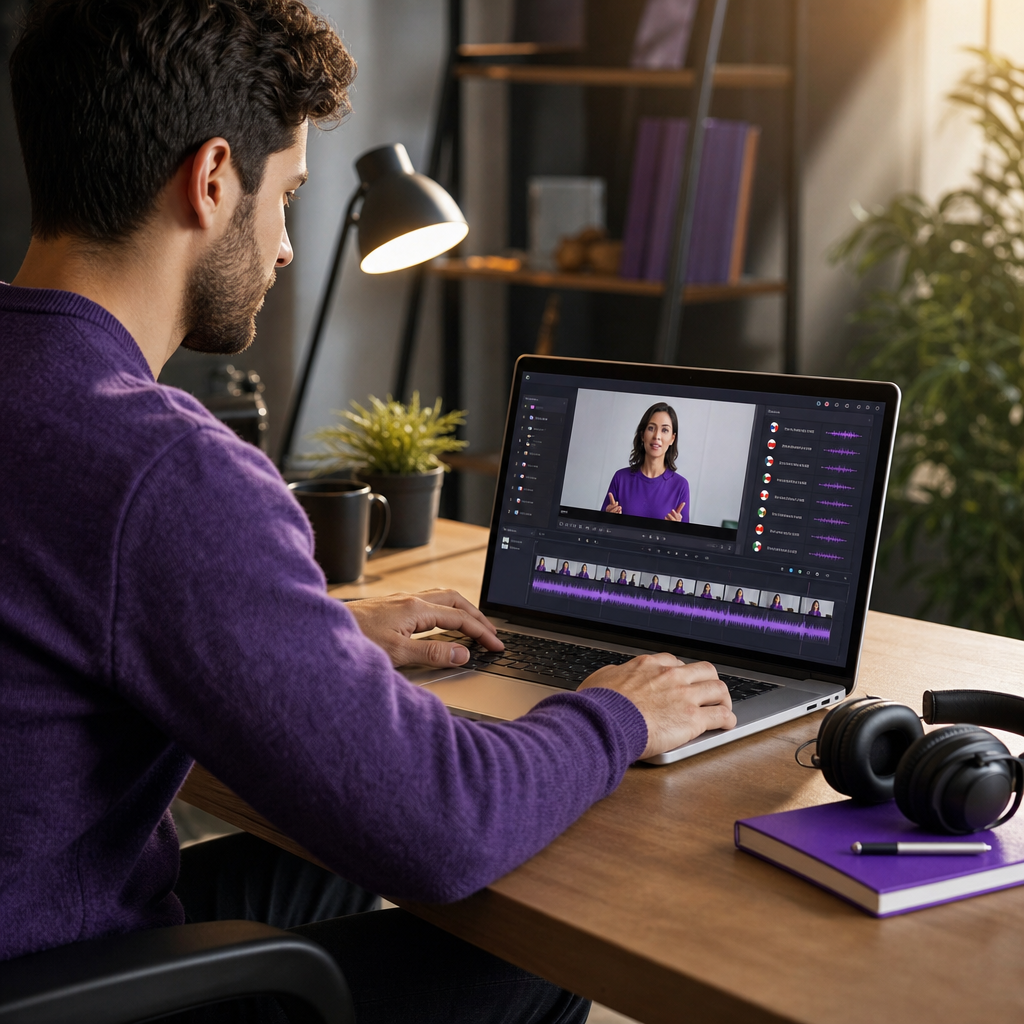
You can take one marketing video into five markets without reshooting a single frame. That is the real promise behind the question of how to localize marketing videos: adapt the spoken message, assign a voice in each target language, and re-sync that audio to the existing footage so the campaign feels native rather than translated. AI dubbing handles the heavy lifting here, but the decision you are actually making is where to apply automation and where a human review protects your brand, your claims, and your conversion rate.
The mistake most teams make is treating localization as word-for-word translation. A dubbed marketing video has to carry the campaign's message, tone, timing, brand voice, visual context, and call to action at once. Get the words right but the pacing wrong and the voiceover runs past the scene; get the pacing right but the tone wrong and the offer stops persuading. This guide explains how the mechanism works, which option fits which project, and how to choose languages and quality checks that match a business goal rather than a feature list.
Table of contents
What localizing a marketing video actually involves
Video localization adapts a finished video for viewers in another language or market. In practice that means translating dialogue, narration, and on-screen text; dubbing the audio in one or more languages; preserving or recreating the original speaker's voice; adjusting timing so translated speech fits each scene; and adapting idioms, examples, currencies, and calls to action. It also means reviewing pronunciation, cultural references, and any legal claims before the video goes live.
Subtitles and dubbing solve different problems. Subtitles translate the words on screen and keep the original performance; dubbing replaces or overlays the spoken audio with a new-language track. For product demos, social ads, explainers, testimonials, and training content, dubbing tends to feel more natural to audiences who would rather listen in their first language than read along. If you are still weighing those two paths, our breakdown of AI dubbing versus manual subtitling walks through where each one earns its place.
What makes AI dubbing distinct is that it chains several tasks together: speech recognition, translation, voice synthesis, speaker identification, and audio-video timing. The output is either a localized audio track or a complete dubbed video, built from your original media rather than a fresh production.
How AI dubbing turns one video into many
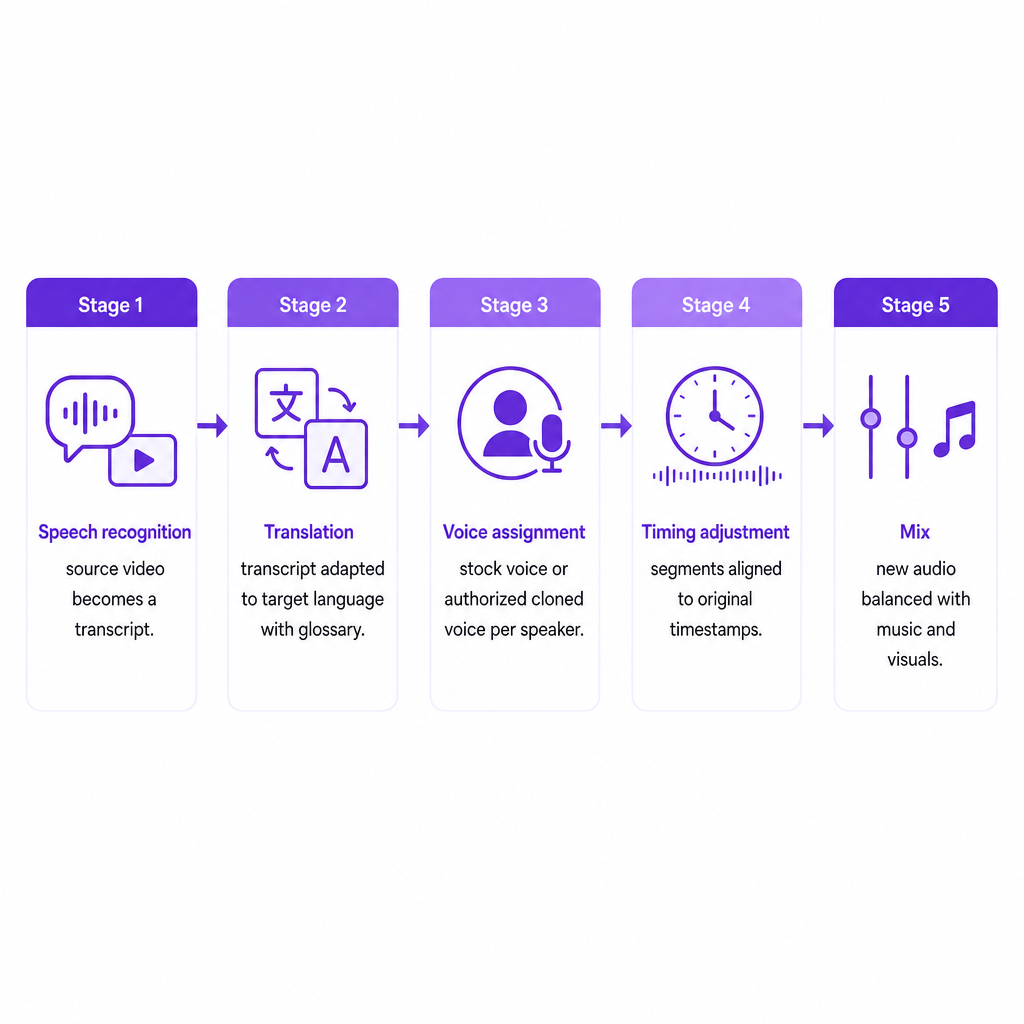
An AI dubbing system works through a connected sequence, and each stage sets up the next.
It starts with speech recognition, which converts the spoken dialogue into a working transcript for translation and editing. Accuracy here depends on background music, accents, overlapping speakers, industry terminology, audio quality, and any code-switching in the source. A clean recording makes everything downstream more reliable. When music or ambient sound bleeds into the dialogue, isolating speech first helps; our Speech Separator pulls dialogue away from other audio elements before transcription, and our Speech to Text tool produces the transcript you will edit.
Translation comes next, and marketing translation is where literal substitution fails. The localized version has to preserve intended meaning, brand terminology, emotional tone, product names, calls to action, and speaking length, while respecting local conventions. A short English call to action can expand considerably in another language; if nobody edits for timing, the voiceover sounds rushed or overruns the scene. The single most useful input you can supply before translation is a glossary: approved product names, technical terms, slogans, company names, and anything that must stay untranslated.
Then speakers and voices are assigned. You can use a stock AI voice for general narration and early testing, a cloned voice to preserve a presenter or recurring brand narrator, or different voices per speaker for interviews, testimonials, and dialogue-driven ads. Our AI Dubbing product can clone each speaker's voice and dub content into 33 target languages, with source material drawn from more than 60 languages. Cloning only belongs here with authorization: get the speaker's permission, confirm the permitted commercial uses, and keep a record of it, so the voice never implies an endorsement the person did not approve.
Timing adjustment aligns translated speech to the video's existing structure. The system divides the recording into segments, matches them to the original timestamps, and regenerates individual sections when needed. This matters most when a speaker is on screen, a product demo must match a visual action, an ad has strict duration limits, or the original includes deliberate pauses. Our studio workflow lets you edit text and timings, regenerate segments, adjust speech rate, and change background sound volume.
Finally, the localized audio is mixed with music, effects, and visuals. The background track usually needs to come down so the new dialogue stays clear, and the goal is to keep the campaign's energy without letting music overpower the narration. Review the first and last few seconds closely, since abrupt audio transitions are most noticeable at the edges.
Choosing between stock voices, cloning, human recording, and API
The right method depends on the content, the audience, and how many videos you need to produce. These four options are not ranked best to worst; they answer different questions.
| Option | Best for | Main trade-off |
|---|---|---|
| Stock AI voice | Explainers, animated ads, tutorials, early market tests | Generic identity; choose by tone and accent, not just language |
| Voice cloning | Founder-led marketing, recurring presenters, brand narrators | Needs authorization and per-language review of emphasis |
| Human recording | Expressive acting, regulated claims, dialect precision | Higher cost and slower turnaround |
| API localization | Many videos or dubbing wired into a content pipeline | Requires developer integration |
Stock voices are the simplest starting point for narration. Pick one by tone, age impression, energy, pronunciation, and regional accent rather than only gender or language. Voice cloning keeps a recognizable speaker identity across languages, which suits YouTube channels, course creators, and campaigns built around a signature narrator; just remember a cloned voice is not automatically a flawless performance, so check pronunciation, emotion, and pacing in every language and rewrite phrases that sound unnatural. If you are deciding between a flexible synthetic narrator and a cloned identity, our comparison of text to speech and voice cloning for narration covers the call directly.
Human-recorded localization still earns its place for highly expressive performance, legally sensitive messaging, dialect expertise, or precise lip synchronization. You can also combine approaches: use AI for first versions and market testing, then commission human performances for your highest-value markets.
API-based localization fits when you need volume or automation. Teams use it to create language versions automatically after an upload, add dubbing to a content management system, generate multilingual product tutorials, or produce regional versions for an agency's clients. Our AI Dubbing API supports video uploads, target-language selection, voice settings, speaker management, translated-text editing, timestamp changes, segment regeneration, and downloadable results, and it documents support for common formats including MP4, MOV, AVI, MKV, WebM, MP3, WAV, and AAC.
How to choose which languages to launch first
Resist the urge to dub into every available language at once. Select markets from evidence: existing views or website traffic by country, sales and conversion data, customer-support demand, category search interest, regional launch plans, audience language preferences, local competition, and whether you have reviewers or native speakers available.
Start with a pilot. Produce one to three priority languages, then compare the localized video's watch time, completion rate, click-through, conversion, and qualitative feedback against the original. A language with a huge potential audience is a poor first choice if the product is unavailable there or the offer cannot be fulfilled locally. Localization works best when the video, landing page, support, pricing, and product experience are localized together rather than in isolation.
What to review before you publish
AI-generated dubbing should clear three distinct reviews, and skipping any one of them is where campaigns quietly lose trust.
The language review checks names and product terms, numbers, dates, units and currencies, pronunciation of technical vocabulary, formality and regional usage, idioms and humor, grammar and flow, and the translation of the call to action. A native-speaking reviewer should listen to the complete video, not just read the transcript, because unnatural emphasis, wrong pauses, and words that sound different when spoken only surface in delivery.
The audio and timing review covers voice clarity, background-noise balance, music volume, speaker changes, pauses and breathing, segment boundaries, clipping, and synchronization with on-screen actions. Pay special attention to short words near cuts, where a translated line can finish too late or start too early and feel disconnected from the scene.
The brand and conversion review asks whether the tone matches the original campaign, the offer is valid in the target market, the URL or contact method is appropriate, the call to action is culturally natural, the localized voice sounds credible, and captions match the dubbed audio. A technically accurate translation is not automatically persuasive; localization should preserve the intended action, not only the sentence structure.
Risks worth managing up front
AI dubbing accelerates production, but a few risks deserve attention before you scale.
Translation errors appear with ambiguous phrases, technical terms, humor, and culturally specific references. An approved glossary, context-rich source scripts, and native review reduce them. Cultural mismatch is related but broader: a grammatically correct translation can still be wrong for a local audience when humor, claims, colors, or idioms do not transfer, so ask a local reviewer to judge the complete message.
Voice and consent problems carry legal and reputational weight. A recognizable voice used without permission can create real harm, and the Federal Trade Commission identifies voice cloning as a technology that can be misused for impersonation, fraud, and misuse of biometric data. Use only voices you have permission to use, keep consent records, define the approved languages and channels, and set a process for withdrawing or updating a voice.
Finally, guard against overpromising quality and brand inconsistency. AI can struggle with emotional acting, interruptions, unusual names, and overlapping dialogue, so reserve human review for the decisions that affect trust and conversion. To keep campaigns consistent across languages, write a short voice brief covering tone, pace, pronunciation, formality, energy, words to emphasize, and words to avoid, then store the approved localized scripts and voice settings for reuse.
For narration-only projects, compare our Text to Speech and Voice Cloning tools: reach for stock TTS when you want a flexible narrator, and for voice cloning when preserving an authorized speaker's identity is central to the campaign. A creator might dub a product review into several languages, a small business could localize a product explainer for a regional launch, and an agency could wire dubbing into a content pipeline through the API. The path you pick should follow the objective you set at the start, not the longest feature list.
Frequently asked questions
What is the fastest way to localize a marketing video?
Start with a clean source video, generate an accurate transcript, supply a terminology glossary, and use AI dubbing to produce the first language versions. A native-speaker review should still happen before you publish.
Is AI dubbing better than subtitles for marketing?
It depends on the audience and channel. Dubbing is more accessible for viewers who prefer spoken content or watch without reading captions, while subtitles are often cheaper and preserve the original performance. Many campaigns use both.
Can AI dubbing preserve the original speaker's voice?
Yes. Voice cloning can recreate an authorized speaker's vocal identity in another language, with quality depending on the source recording, target language, timing, and review. Always get permission before cloning or commercially using a person's voice.
How many languages should a business launch first?
Begin with the languages supported by audience, sales, and operational evidence. A focused pilot in one to three priority markets is easier to review and measure than a broad launch with no localization controls.
Can developers automate marketing video localization?
Yes. An API can connect uploads, language selection, voice settings, project creation, editing, status monitoring, and result downloads to an existing application or content workflow using our AI Dubbing API.