
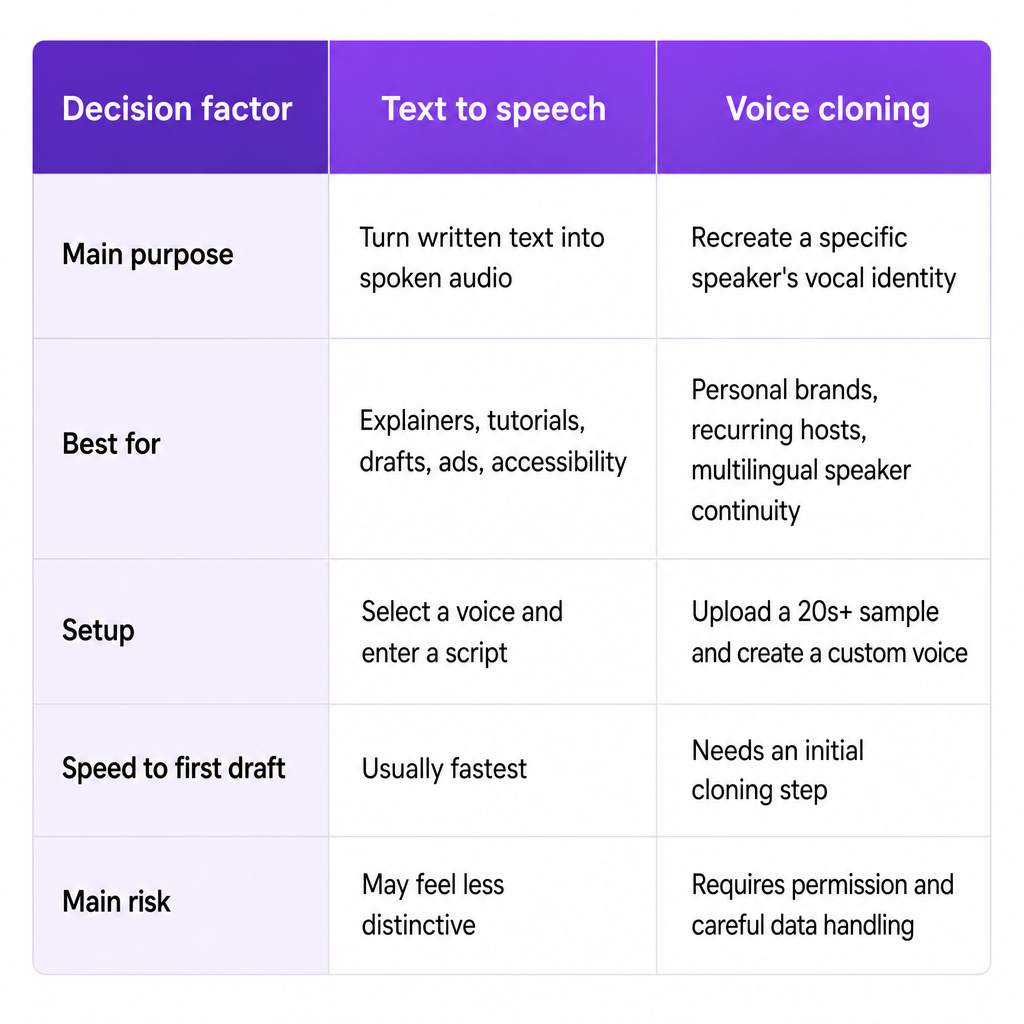
Picking between tts vs voice cloning for narration comes down to one honest question: do you need a reliable voice for the content, or a specific speaker's identity in it? Standard text to speech gives you fast, flexible narration from a ready-made library. Voice cloning recreates a recognizable voice so the same person seems to speak across new scripts, videos, and languages. For a lot of creators and teams, the smart move is both: prototype with a stock voice for speed, then switch approved work to a consented clone once brand identity or speaker continuity starts to matter. The rest of this guide shows exactly where each one wins.
Table of contents
The fastest way to stop going in circles on this choice is to separate two things people constantly blur together: the style of a voice and the identity behind it. A standard TTS voice hands you a production-ready style. It can read warm, authoritative, energetic, conversational, or neutral, and you pick it because it fits the script. A cloned voice hands you continuity with a particular person. Listeners recognize it as a creator, instructor, founder, or narrator, and you pick it because that identity is part of the product.
That difference changes more than how a clip sounds. It changes your operational load. Style is something you swap freely; identity is something you protect, document, and keep consistent across every new file. Hold that split in mind and most of the decisions below answer themselves.
How text to speech narration actually works
Text to speech converts written text into synthesized speech. The system reads your script, interprets pronunciation and sentence structure, and renders an audio track in a voice you choose from a catalog. You are not capturing a specific person reading the words; you are generating fresh speech in the style of a prebuilt voice.
In practice you control a handful of levers: language, accent, vocal profile, tone, speaking speed, and delivery style. That flexibility is the whole point. When a price, product name, statistic, or lesson changes, you edit the text and regenerate only the affected section instead of booking a studio again. Our Text to Speech tool runs that loop end to end: enter text, pick a speaker from 300+ AI voices, generate, edit the project, and download, with speech-rate controls and text cues for emphasis.
Reach for standard TTS when the voice itself does not have to be recognizable. It fits first drafts and test versions, channels that publish frequently and need rapid updates, workflows where several people write or manage scripts, and content that calls for different voices across characters or sections. It is also the natural pick when you want to probe multiple languages, accents, or delivery styles, or when you are producing instructional, informational, and accessibility-focused material. A small business shipping weekly product tutorials, for example, can keep one consistent stock voice and update features and calls to action without ever coordinating a recording.
How voice cloning narration actually works
Voice cloning builds synthetic speech that resembles a specific person. The system analyzes a sample for pronunciation, pitch, rhythm, tone, and speaking style, then uses those characteristics to generate new speech from text. This is not trimming a finished voiceover into a timeline. It produces a reusable voice model that can speak scripts the speaker never recorded.
The sample does most of the heavy lifting. Our Voice Cloning page notes you can create a custom voice from an audio file of at least 20 seconds, and a clean recording free of background noise gives better results. The speaking style in that upload carries through: a monotone reference tends to yield flatter narration, while a sample with the energy and emotion you actually want gives the model a stronger target. Once created, the voice can be reused in both Text to Speech and AI Dubbing projects.
Choose cloning when the speaker's identity is part of the brand or product. It fits a YouTube host who needs to publish more often without recording every line, a podcaster correcting small sections instead of re-recording an episode, a company that wants one consistent founder or instructor voice, and a course that must carry the same instructor across multiple languages. An online teacher can record a clean sample once, then use a consented clone to refresh lessons, fix outdated facts, or build versions for international learners. For a deeper look at reusing an identity across formats, see our guide on AI dubbing vs voice cloning for repurposing content.
The core split: voice style or voice identity
If you remember nothing else, remember this frame, because it resolves most edge cases faster than any feature chart. Standard TTS is a selection problem: you are choosing a style off a shelf, and you can change your mind next week at no cost. Cloning is a continuity commitment: you are locking to one identity and agreeing to maintain, govern, and defend it over time.
That is why a founder-led brand behaves differently from a faceless explainer channel even when the scripts look identical. The explainer only needs a competent voice, so TTS carries it. The founder brand trades on recognition, so the cloned voice becomes an asset worth the extra setup and paperwork. When you feel stuck, ask whether swapping the voice next month would hurt the audience's relationship with the content. If yes, you are in cloning territory. For a closer comparison of these two routes head to head, our explainer on choosing between a cloned voice and a stock TTS voice breaks down the criteria in more depth.
Which to use, by production goal
The right answer shifts with what you are actually making. Here is how the choice lands across the most common narration jobs.
YouTube creators. TTS fits faceless channels, explainers, list videos, and news-style content where no host identity is on the line. Cloning fits channels viewers tie to a specific presenter, letting you keep the recognizable sound while skipping re-records for corrections, intros, and short-form variations. For multilingual expansion, pair a custom voice with AI Dubbing instead of inventing a separate narration identity per language.
Small businesses and marketing teams. Lean on TTS for campaign variations, product explainers, social ads, and frequent copy changes. Bring in cloning when a founder, ambassador, or spokesperson is central to trust. A clone can voice approved script variations, but it never replaces review of claims, pronunciation, and brand tone.
E-learning and corporate training. TTS shines when courses span many modules, subjects, or frequent updates, since stock voices make it easy to assign different voices to different courses or roles. Cloning fits programs where learners expect one instructor throughout, or where you refresh an existing course without losing the familiar vocal identity. Either way, human review of names, technical terms, abbreviations, and numbers stays essential.
Podcasts and independent films. Use TTS for scratch tracks, narration tests, and placeholder work before the final speaker is locked. Use cloning for consistent pickups, alternate versions, or approved localization of a host or performer, with rights and intended use documented before production starts.
Developers and agencies. TTS is usually the simpler API entry point: send text, choose a voice, receive speech. Cloning fits apps that need persistent custom voices per client, brand, or character. Our Voice Cloning API accepts uploads in MP3, WAV, AAC, M4A, and FLAC, returns a custom voice you can reference in TTS or AI Dubbing, and exposes operations to list and delete custom voices.
Which one sounds more natural
Neither option is automatically the natural one. A high-quality stock voice can easily beat a clone built from noisy audio, and a bad sample reproduces its own flaws: background hum, uneven delivery, an emotional tone that does not match the script. Naturalness is an output you test, not a label you assume.
Judge the result against concrete criteria rather than a first impression:
- Pronunciation: does it get names, acronyms, numbers, and technical terms right?
- Prosody: does the rhythm suit the script?
- Consistency: does the voice stay stable across clips and languages?
- Emotion: does the delivery match the narration's purpose?
- Clarity: is it intelligible on phones, laptops, and headphones?
- Editability: can you regenerate one sentence without making the whole track drift?
- Localization: does it still fit when adapted for another market?
For TTS, run several stock voices against the same paragraph and compare. For cloning, test a representative script with the hard words, emotional range, and pacing of the finished project, not just a short greeting. The greeting almost always sounds fine; the real work is where clones reveal their weaknesses.
Rights, consent, and disclosure you can't skip
Cloning carries responsibility that plain TTS does not, because it can reproduce an identifiable person's voice. Only clone a voice when you hold the permission and rights for the intended use, and make that permission specific. Good consent covers who owns the source recording, where the synthetic voice may appear, whether commercial use is allowed, which languages and territories are included, whether advertising or dubbing is permitted, how long the permission lasts, how the model and source files are stored, and what happens when the license ends.
We treat consent and ethical use as part of our voice-cloning approach, and our API supports deleting custom voices and their associated audio data. Confirm the current terms that apply to your account and project before you upload a sample. The legal backdrop is still moving, too: the U.S. Copyright Office has identified realistic voice replicas as digital replicas and recommended additional federal protection against unauthorized ones, as laid out in its report on copyright and digital replicas.
There is also a disclosure layer. YouTube's guidance on disclosing AI-generated content names synthetically generating a person's voice to narrate a video as realistic altered or synthetic content that creators must disclose. So do not present a cloned voice as an unaltered recording if that could mislead viewers. The FTC has separately warned that voice cloning makes impersonation scams more believable, which is exactly why authorization and transparent use are not optional niceties.
A decision rule you can apply today
If the audience needs a good voice, choose TTS. If the audience needs this specific speaker, choose voice cloning.
Start with TTS when speed, variety, experimentation, and frequent script changes dominate. It is faster to test, easier to revise, and opens a broad range of voices with no sample required. Move to cloning when recognition, continuity, and speaker identity are the point, such as a creator-led channel, instructor-led course, founder-led brand, podcast host, or multilingual spokesperson. Use only an authorized sample, review the generated audio closely, and follow disclosure rules where they apply.
Many teams land on both, and deliberately so: prototype with a stock voice, then migrate approved, recurring content to a custom voice once the production justifies the setup. That hybrid is especially effective for YouTube channels, online courses, branded campaigns, and multilingual libraries. We bring both into one workflow, so you can begin with flexible narration from 300+ voices, create custom voices from audio samples, and reuse them in TTS or AI Dubbing as the project matures.
Frequently asked questions
Is voice cloning the same as TTS?
No. TTS converts written text into speech using a selected synthetic voice. Voice cloning creates a custom voice model intended to resemble a particular speaker, which can then generate TTS narration.
Is TTS better than voice cloning?
Not universally. TTS usually wins on speed, voice variety, testing, and frequent updates. Cloning wins when a specific speaker's identity must stay consistent across new content.
How much audio is needed to clone a voice with DubSmart?
Our Voice Cloning page says the upload should contain at least 20 seconds of audio. A clean recording without background noise is recommended for better results.
Can I use a cloned voice for multilingual narration?
Yes. Cloned voices can be reused in AI Dubbing across our supported languages. Test pronunciation and cultural fit in each target market before publishing.
Should YouTube creators disclose AI narration?
Check YouTube's current disclosure controls. YouTube identifies synthetically generating a person's voice for narration as realistic altered or synthetic content that may require disclosure.