
Repurposing content for a new audience rarely demands the same voice technology twice, which is exactly why the ai dubbing vs voice cloning for repurposing question keeps coming up. Here is the short answer we give creators and teams every week: AI dubbing localizes an existing piece of content, while voice cloning preserves a specific speaker's identity when you generate new or translated speech. One is a localization workflow. The other is a voice-identity capability. They overlap often enough that the most common production setup actually uses both.
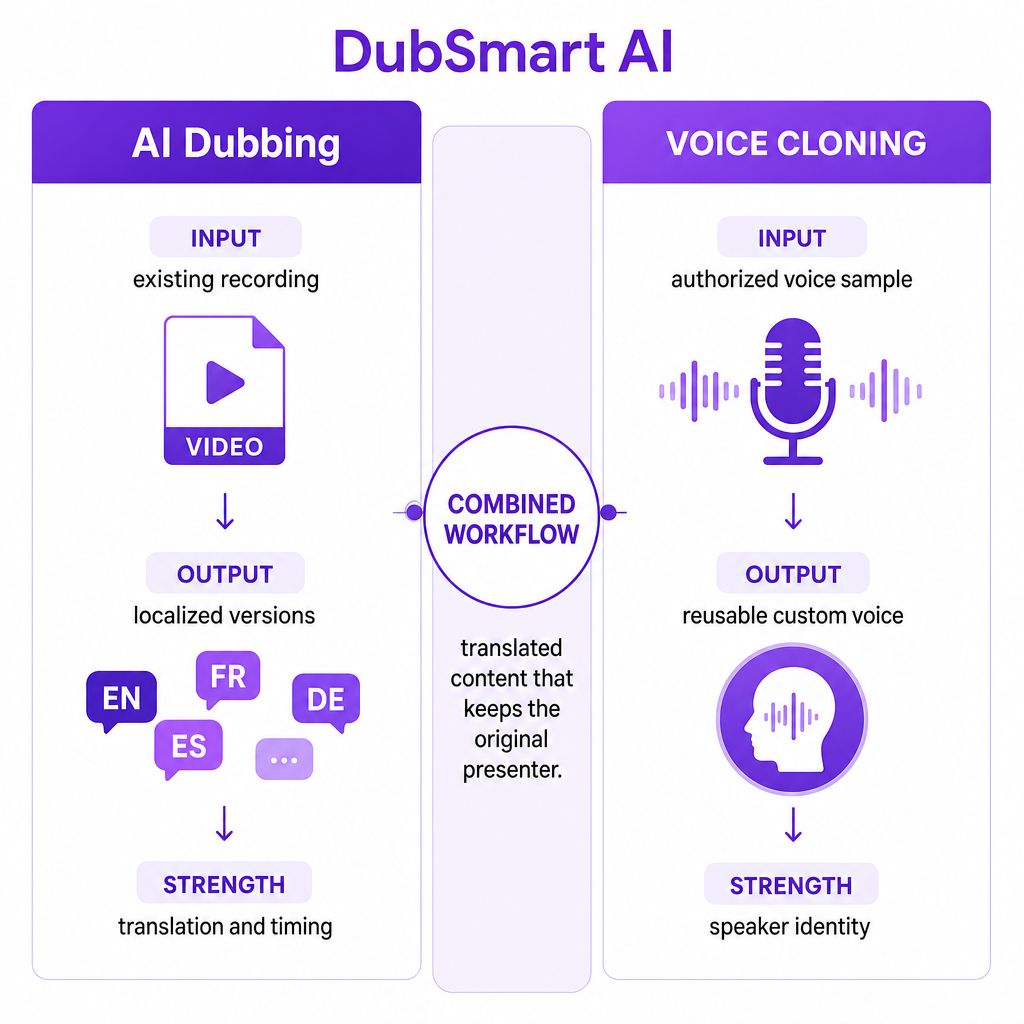
AI dubbing localizes an existing piece of content. Voice cloning preserves the speaker's identity when creating new or translated speech.
That split decides almost everything downstream: your timeline, your review process, your rights paperwork, and whether you reach for a browser studio or an API. Below we define each technology, show where they meet, and give you a decision framework you can apply to a real repurposing job today.
Table of contents
The essential difference, in one view
Strip away the marketing and the two technologies answer different questions. AI dubbing asks: how do I make this existing recording understandable in another language? Voice cloning asks: how do I make new speech sound like this authorized speaker? The table below keeps those lanes clear before we go deeper.
| AI dubbing | Voice cloning |
|---|---|
| Converts existing spoken content into another language or localized version | Creates new synthetic speech that resembles a specific speaker |
| Starts with a video, audio file, or source recording | Starts with an authorized voice sample |
| Combines transcription, translation, voice generation, timing, and audio replacement | Combines voice analysis, model creation, and text-to-speech generation |
| Best for multilingual versions of existing content | Best for maintaining speaker identity across new scripts and formats |
| May assign or clone voices to speakers during dubbing | Produces a reusable custom voice for TTS or dubbing projects |
The overlap in that last row is where confusion starts. A cloned voice can live inside a dubbing workflow, which makes cloning a potential component of dubbing rather than a competitor to it. If you want the full head-to-head on cost, speed, and compliance, our breakdown of AI dubbing versus human dubbing covers the staffing side of that choice.
What AI dubbing actually does
AI dubbing is more than text-to-speech pointed at a transcript. It has to understand an existing recording and produce a replacement performance that fits the original scene. A typical pipeline chains several stages: speech-to-text to capture what each speaker says, speaker detection or separation to keep voices distinct and isolate dialogue from background audio, machine translation of the transcript, voice synthesis in the target language, timing adjustment so the new dialogue fits the cut, and an audio mix that balances speech, music, and ambience. Cloning the original speaker's voice is an optional extra stage, not a requirement.
Picture a US creator with an English product tutorial who wants Spanish, French, and German versions. The goal is not a fresh script. It is to preserve the original video's meaning, structure, and timing while opening it to new audiences. Our AI Dubbing workflow accepts an uploaded video or audio file, or a YouTube link, then lets you edit speakers, text, timings, and audio before download. It supports dubbing from more than 60 source languages into 33 target languages, and it can assign a cloned voice to each speaker during the process.
If your repurposing job is mainly about translation and release speed, this is the lane to start in. We walk through the full production path in our guide on how to change voice language in a video, and multilingual channel owners can map the bigger picture in how to make a multilingual YouTube channel.
What voice cloning actually does
Voice cloning builds a synthetic voice model from recordings of a real speaker. The model analyzes pronunciation, speaking rhythm, pitch, intonation, vocal texture, pausing patterns, and expressive style, then generates new speech from text that resembles the source speaker without asking them to record every line by hand. With our Voice Cloning, you can upload at least 20 seconds of relatively clean audio to create a clone, and cloning is available across 33 languages.
One detail matters more than people expect: the emotional style of your sample carries into the output. A monotone clip tends to produce flat speech, while an expressive clip gives the model more stylistic information to work with. Choose the sample that matches the delivery you want, not just the cleanest file you own.
A cloned voice earns its keep when the same speaker needs to appear consistently across many assets, such as channel intros and updates, multilingual course narration, podcast corrections, product explainers, audio newsletters, marketing variations, and API-generated app content. Because that voice can also run inside the dubbing pipeline, cloning behaves as a building block of dubbing rather than a rival to it. For a broader map of what creators do with a custom voice, see the best uses for AI voice cloning.
How the two work together
Take a creator with a published 20-minute English educational video. A dubbing workflow transcribes it, identifies the speakers, translates the transcript, generates speech in the target language, then adjusts timing and mixes the new dialogue with the original audio bed. If that creator also wants the translated version to keep their vocal identity, the system drops a voice clone into the speech-generation stage. Same pipeline, one extra ingredient.
The cleanest way to hold the difference in your head is by the question each one answers:
- AI dubbing answers: how do I make this existing content understandable in another language?
- Voice cloning answers: how do I make new speech sound like this authorized speaker?
- The combined workflow answers: how do I localize this content while keeping the same recognizable presenter?
Our cloned voices are built for use in both Text to Speech and AI Dubbing, which is what makes the combined path practical rather than a workaround. That reuse is the whole point: one authorized voice, many destinations.
Which fits your repurposing job
The right choice depends on what is actually changing: the language, the script, the speaker identity, or all three. The matrix below maps common repurposing jobs to the better-fitting approach.
| Repurposing requirement | Better fit | Reason |
|---|---|---|
| Translate an existing video into Spanish | AI dubbing | Source recording and timing already exist |
| Publish the same presenter in several languages | Dubbing with voice cloning | Localization and speaker continuity both matter |
| Create ten new videos from one presenter's script | Voice cloning | You need new speech, not a translated recording |
| Replace one sentence in a published podcast | Voice cloning | A custom voice produces a matching pickup without a rerecord |
| Localize a course with multiple instructors | Dubbing, possibly several clones | The workflow manages source, speakers, translation, timing |
| Generate branded spoken responses in an app | Cloning API or TTS API | The core need is programmatic speech generation |
| Dub a film, interview, or panel | AI dubbing | Multiple speakers, dialogue timing, and mixing are central |
| Produce neutral narration in many languages | Dubbing or multilingual TTS | A recognizable original voice may be unnecessary |
Choose AI dubbing when the source content is the asset: you already have a finished video or podcast, existing dialogue to translate, multiple speakers, a music bed to preserve, and a multilingual release schedule. It is especially useful for testing demand in a new market without producing an entirely fresh video.
Choose voice cloning when the speaker's identity is the asset: a founder's voice across product videos, an instructor updating lessons, a podcaster fixing a factual error, localized intros and outros, or personalized audio generated at scale. Cloning cuts recording overhead, but it is not a substitute for editorial review. A model can reproduce vocal characteristics and still mispronounce a name, miss context, or deliver the wrong emotion.
Quality criteria that decide commercial output
A serious comparison goes past whether the output "sounds realistic." For repurposed content that has to perform, six criteria separate a usable asset from an embarrassing one.
Meaning and translation accuracy. A fluent voice cannot rescue a mistranslated message. Scrutinize product names, technical terms, numbers and measurements, calls to action, legal or safety language, idioms, humor, and regional references. A literal translation can be grammatically correct and commercially useless; marketing and training content usually need adaptation, not word-for-word conversion.
Speaker consistency. Decide whether the same person should sound identical across original and localized versions, multiple episodes, campaign assets, short-form clips, and future updates. If yes, cloning adds value. If you only need clear localized narration, a stock synthetic voice is often enough.
Timing and editability. Translated speech rarely runs the same length as the source line. A workable dubbing tool must let editors adjust segment timing, speech rate, text, regenerated sections, and background levels. Our Dubbing Studio exposes exactly those controls: edit text and timestamps, change speech rate, regenerate individual segments, and adjust background sound.
Emotional delivery. Voice identity and emotional performance are separate problems. A clone can resemble the speaker yet fail to carry urgency, humor, empathy, authority, suspense, or enthusiasm. Feed it a sample that demonstrates the intended delivery; a calm sample suits a course, an energetic one suits a launch video.
Lip-sync and visual fit. For presenter-led or character-led video, translated audio must fit the visible performance: mouth movement, pauses, shot changes, reaction timing, subtitle alignment, and speaker transitions. Off-camera narration tolerates loose sync; close-up dialogue does not.
Production speed and scale. AI pays off as assets and languages multiply, so compare the total workload rather than generation time alone. How many languages and speakers are involved? How often will content update? Can the team regenerate one sentence without rebuilding the project? Is an API required, and can the same voice be reused under the proper rights? We publish separate AI Dubbing, Voice Cloning API, Text to Speech API, and AI Dubbing API products; check those pages directly for current authentication, input and output formats, rate limits, and plan details before you build.
Rights, disclosure, and governance you cannot skip
Speed makes it easy to skip the paperwork, and that is where projects get into trouble. Only clone a voice when you hold the speaker's authorization and the rights for the intended use, languages, channels, duration, and territory. Permission to record someone is not permission to build a reusable synthetic copy of their voice. For business use, keep documentation covering the voice owner's identity, the permitted use, distribution channels, geographic territories, contract duration, compensation terms, whether the voice may run in advertising, whether the model may be called through an API, and how deletion or withdrawal works. Consent and responsible use are part of how we approach cloning, but securing the rights for your material and samples stays with you.
Treat uploaded recordings as sensitive. Voice samples can carry biometric and personal information, so limit access to source files, never upload material you are not authorized to use, and confirm how any provider stores, processes, and deletes voice data. NIST flags synthetic voices as a risk area because cloned audio can enable impersonation and fraud, and its guidance stresses determining consent and addressing the risks tied to synthetic content.
Platform rules add another layer. YouTube currently requires creators to disclose realistic AI-generated or meaningfully altered content in relevant cases; its own examples indicate that cloning your own voice for voiceovers or dubs does not require disclosure under that example, while realistic synthetic content that could mislead viewers may. Policies change, so verify the destination platform's current rules before publishing, and remember that disclosure never replaces copyright permission, personality rights, trademark clearance, or advertising compliance. You can read YouTube's own policy in its disclosure help article.
Finally, keep a human in the loop. Review every localized asset for translation errors, wrong names, mispronounced brands, incorrect numbers, culturally inappropriate wording, unnatural pauses, inconsistent terminology, voice artifacts, audio clipping, and misassigned speakers. For regulated, safety-critical, political, medical, or legal content, bring in qualified reviewers and subject-matter experts.
How DubSmart handles both sides
We combine AI Dubbing, Voice Cloning, Text to Speech, Speech to Text, Speech Separator, and other media tools in one platform, which spares a creator or small team from shuttling files between separate transcription, translation, voice, and editing apps. Our public product pages state that AI Dubbing supports dubbing from 60+ languages into 33 languages, that it can use cloned voices for speakers and provides project editing controls, that Voice Cloning works from at least 20 seconds of clean audio, that cloned voices run in both Text to Speech and AI Dubbing, and that Voice Cloning and AI Dubbing APIs are available as separate developer products.
For a small project, the browser workflow is usually enough. Agencies, platforms, and development teams should evaluate the API documentation, usage limits, data handling, commercial rights, error handling, and current credit or plan terms before committing to an automated integration. Not sure which lane your next repurposing job belongs in? Tell us the source format, target languages, speaker count, and update frequency, and we can point you to the right setup.
Frequently asked questions
Is AI dubbing the same as voice cloning?
No. AI dubbing localizes existing spoken content by combining transcription, translation, speech generation, timing, and mixing. Voice cloning creates a reusable synthetic voice from an authorized speaker sample. Cloning can be used inside a dubbing workflow, but they are not interchangeable.
Is voice cloning better than AI dubbing for YouTube?
It depends on the goal. Use AI dubbing to translate existing videos into new languages. Use voice cloning when you need the same presenter's voice for new scripts, corrections, or localized intros. For multilingual channel growth, combining both is often strongest.
Can I use AI dubbing without cloning my voice?
Yes. A dubbing workflow can use a stock synthetic voice or another approved voice instead of cloning the original speaker. Cloning is optional when speaker identity is not essential to the piece.
How much audio is needed to clone a voice with DubSmart?
Our Voice Cloning page states you can upload an audio file of at least 20 seconds. We recommend audio without background noise, and the speaking style in your sample influences the emotional quality of the generated voice.
Does AI-generated dubbing need to be disclosed on YouTube?
Sometimes. YouTube's current guidance requires disclosure for realistic AI-generated or meaningfully altered content in relevant cases. It lists cloning your own voice for voiceovers or dubs as an example that does not require disclosure, while other realistic synthetic content may. Check the current policy before publishing.