Pick a stock TTS voice when you need fast, flexible narration and nobody needs to recognize the speaker. Pick a cloned voice when a specific person's sound carries trust, continuity, or brand recognition. That single trade-off between speed and identity sits at the center of the cloned voice vs stock TTS voice decision, and most creators overthink it because they treat the two as rivals instead of tools for different jobs.
Here at DubSmart AI we build both into one workflow, so this guide focuses on the decision itself: what each option actually is, how it works, and the concrete criteria that tell you which one fits a given project. By the end you should be able to look at any script and know within seconds whether you need a ready-made voice or a custom one.
Table of contents
What separates a cloned voice from a stock TTS voice
The difference comes down to one thing: voice identity.
A stock TTS voice is a ready-made synthetic voice you pick from a library. You paste a script, choose a voice and language, and generate audio. It is built to be reusable across many projects and audiences, which is exactly why it feels neutral rather than personal.
A cloned voice is a synthetic version of one specific speaker. The system analyzes a recording of that person and reproduces their tone, pronunciation, rhythm, and vocal character in new speech. The output is tied to an authorized individual rather than a platform default.
That distinction drives every downstream decision about setup, flexibility, continuity, and governance.
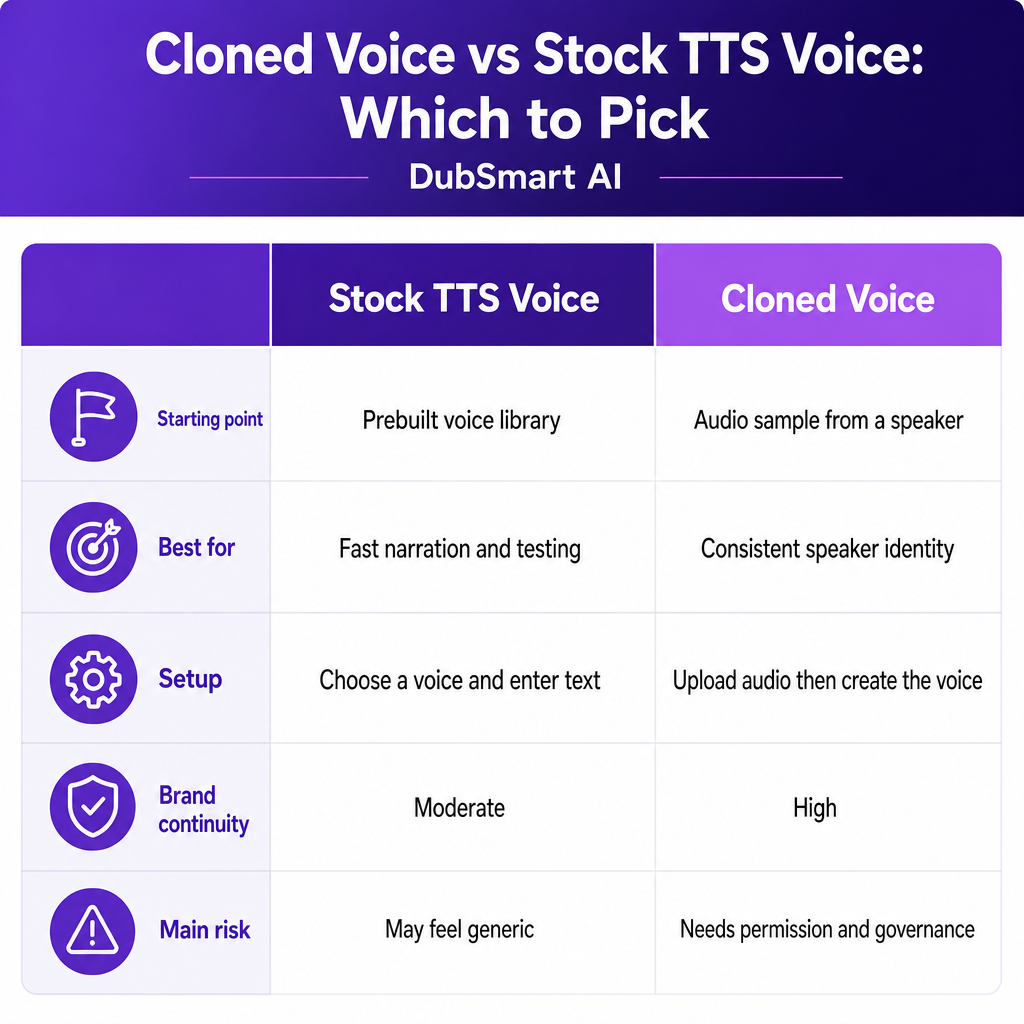
| Factor | Stock TTS voice | Cloned voice |
|---|---|---|
| Starting point | Prebuilt voice library | Audio sample from a speaker |
| Best for | Fast narration and testing | Consistent speaker identity |
| Setup | Choose a voice, enter text | Upload audio, then create the voice |
| Brand continuity | Moderate | High |
| Main risk | May feel generic | Needs permission and governance |
If you want a deeper breakdown of how the underlying tools diverge, our explainer on voice cloning vs text to speech compares identity, setup, scale, and governance in detail.
How each option actually works
Understanding the mechanics makes the decision obvious, because each path front-loads effort in a different place.
Stock TTS converts text into speech with a voice that already exists. You write or paste a script, choose a voice and language, adjust delivery if needed, and export. There is no dataset to maintain and no speaker to call back for a small script change. Our Text to Speech tool offers more than 300 human-like voices and controls such as speech rate, emotion prompts, and emphasis formatting, so you can audition several directions in minutes.
Voice cloning front-loads the effort instead. It starts with a recording of the speaker; the system analyzes their vocal characteristics and creates a reusable custom voice you can then drive with new text. On DubSmart you can upload an audio file of at least 20 seconds to create a clone, and a clean recording free of background noise produces better results. The speaking style in the sample matters too: a monotone clip tends to generate flatter speech, while a sample that carries the emotion you want helps reproduce that style. Our Voice cloning tool makes that custom voice available afterward for both Text to Speech and AI Dubbing.
The practical consequence is timing. Stock TTS gives you audio today with zero setup. Cloning asks for a recording, permission, and a quality check up front, then pays that effort back across every future generation.
The six criteria that decide it
Run a project through these six questions and the answer usually resolves itself.
1. Does the voice itself carry meaning? If viewers care who is speaking, cloning wins. A YouTube educator, podcast host, or founder who built trust through their voice loses something when a generic narrator replaces it. If the voice is only delivering information, such as a software tutorial or internal announcement, stock TTS is enough.
2. How much content will you produce? For a single 30-second ad, grabbing a stock voice is faster than preparing a clone. For hundreds of videos, lessons, or episodes, a cloned voice removes repeated recording work and keeps continuity across the whole library.
3. Do you need multilingual localization? Both handle multiple languages, but they solve different problems. With stock TTS you select a fitting voice for each target language, which helps when a regional style matters more than the original speaker. With cloning the goal is to preserve the original speaker across languages. Our voice cloning supports 33 languages, and our AI Dubbing service dubs content from 60+ source languages into 33 target languages.
4. How much emotional control do you need? A clone does not invent emotion it never heard. If the source clip is flat, the output tends to be flat, which is why we recommend recording the emotion and speaking style you want reproduced. Stock voices are easier to test across several tones when you need a calm explainer one day and an energetic ad the next. Whichever you lean toward, test both with the same script and listen for pronunciation of names and technical terms, sentence rhythm, emotional credibility, emphasis, and consistency across long passages.
5. How fast do you need the first draft? Stock TTS has the shortest path from script to audio because the voice is ready. Cloning adds a preparation step, then becomes efficient for recurring production. For a one-time deadline, start with stock TTS; for a continuing content system, invest in a clone when identity has lasting value.
6. Who controls the speaker's identity? Cloning demands governance. Only clone a voice when you have the speaker's permission and the right to use the recording and output for the intended purpose. Keep documentation covering whose voice was recorded, what they authorized, where the voice may be used, whether commercial and advertising use is permitted, and how the voice should be disabled if authorization ends. This matters most for agencies and developers producing content for clients, and a voice that sounds like a real person can mislead audiences if synthetic narration is never disclosed.
What different creators should pick
The same trade-off lands differently depending on what you make.
YouTube creators: Clone your voice if the channel is built around your personality, so intros, corrections, shorts, and multilingual versions stay recognizable. Reach for stock TTS on faceless channels, niche experiments, or formats that need distinct character voices.
Small businesses and marketing teams: Start with stock TTS for product videos, social ads, sales enablement, and internal drafts, because it is fast and easy to A/B test for tone and pacing. Move to a cloned founder or brand voice when the same narrator appears across campaigns and customer education.
E-learning and corporate training teams: Use stock TTS for modular content that changes often or needs several instructional voices. Use a cloned voice when learners expect continuity from one instructor across a large library, so separate modules feel like a single course.
Filmmakers and podcast creators: Clone when preserving a host's or character's identity is essential; our AI Dubbing workflow is designed to clone each speaker's voice for multilingual localization. Use stock TTS for scratch tracks, previews, minor roles, or early edits before final casting.
Developers and agencies: Choose a stock Text to Speech API when your app needs a selection of voices and rapid prototyping without onboarding speakers. Choose a Voice Cloning API when your product needs authorized custom voices created from audio samples.
When using both is the smarter move
Stock TTS and voice cloning are not mutually exclusive, and the strongest production systems mix them deliberately.
A realistic setup might pair a cloned host voice for main YouTube narration with stock voices for supporting characters. A course could run a cloned instructor voice on core lessons and stock voices on role-play dialogue. A team might draft early scripts in stock TTS, then generate the final approved version in a clone. For localization, cloned voices preserve the narrator across languages while stock regional voices step in when a local narrator fits better.
This hybrid keeps creative flexibility where speed matters and protects identity where recognition matters, without forcing one compromise across the whole project.
The one rule that settles most choices
When the criteria feel balanced, this rule breaks the tie:
If the speaker is part of the product, choose a cloned voice. If the speech is the product, choose a stock TTS voice.
The speaker is part of the product when their identity builds trust, recognition, or continuity: creators, instructors, founders, hosts, and fictional characters. The speech is the product when the priority is clear, affordable, rapidly editable narration: explainers, product updates, internal training, prototypes, and high-volume variations.
Most first projects start better with stock TTS because it is immediate and easy to change. Graduate to a cloned voice once the narrator's sound becomes a real asset in your brand, channel, course, or localized content. For teams that need both speed and continuity, our stock library handles flexible narration while our voice cloning and dubbing tools handle authorized, multilingual consistency.
Frequently asked questions
Is a cloned voice better than a stock TTS voice?
Not universally. A cloned voice wins on identity and consistency; a stock TTS voice wins on speed, variety, and low-commitment production. The right pick depends on whether the speaker's identity matters for that project.
How much audio is needed to clone a voice with DubSmart?
The minimum sample is 20 seconds. For better quality we recommend a clean recording without background noise, and a sample that carries the emotion and style you want reproduced.
Can a cloned voice speak another language?
Yes. Our voice cloning supports 33 languages, and our AI Dubbing service dubs content from 60+ source languages into 33 target languages while preserving the original speaker's identity.
Can I use a cloned voice for AI dubbing?
Yes. A cloned voice can be used in both Text to Speech and AI Dubbing, and our dubbing tool can also clone each speaker's voice automatically during multilingual localization.
What is the safest way to use voice cloning?
Clone only an authorized speaker, document the permitted use, protect the source audio, review every generated output, and disclose synthetic narration wherever your platform, client, or applicable rules require it.