
Ask how neural text to speech works and the short answer is this: it converts written text into lifelike audio by running your script through deep neural networks that model how humans actually speak—pronunciation, rhythm, and intonation together. Instead of stitching together pre-recorded fragments the way older systems did, neural TTS generates speech from scratch, learning patterns directly from large datasets of real human recordings paired with text. That distinction is why modern synthetic voices sound like a narrator you could listen to for a full video rather than a robotic announcement. At DubSmart AI, we build on this same neural approach to power our Text to Speech, connecting it to voice cloning and dubbing so a single script can travel from one language into many.
This guide walks through the mechanism stage by stage, then translates it into practical decisions: where a neural voice is strong enough to stand alone, where you still want a human performance, and how the pieces fit together inside our platform.
Table of contents
What "how neural text to speech works" really means
Neural text to speech is a form of speech synthesis that uses deep neural networks to generate speech from scratch. The key departure from rule-based or concatenative methods is that the system learns from large datasets of human recordings paired with text, so it can predict both how words should sound and how a person would naturally deliver them. That learned behavior is what captures prosody—stress, rhythm, pauses, and emotional tone—making the resulting voice comfortable over long listening sessions. Major cloud providers describe these neural voices as human-like synthesized speech whose articulation reduces listening fatigue in assistants, accessibility tools, and read-aloud experiences.
Our Text to Speech engine follows this neural path. It analyzes your script, breaks it into phonemes, infers rhythm and intonation, then uses neural models to render smooth audio instead of the flat delivery associated with legacy TTS. The result is realistic speech generated from text in seconds, drawn from a library of 300+ voices tailored to different tones and use cases.
Why neural TTS matters for creators and teams
For YouTube creators, small businesses, e-learning producers, filmmakers, podcasters, and developers, the real question is not only how the technology works but whether to lean on it in a production pipeline. Neural TTS matters because it moves synthetic voices out of "utility" territory—GPS directions, basic prompts—and into performer territory: good enough to front-line content, narrate full courses, and carry branded messaging without sounding obviously artificial. Pair it with translation and dubbing and it becomes a multiplier, letting one script reach dozens of languages at a fraction of the cost and time of traditional studio work.
We designed DubSmart around exactly that decision. Text to Speech, Voice Cloning, AI Dubbing, Speech to Text, Speech Separator, Text to Image, and Image to Video sit in one pipeline, so spoken content moves from upload to multilingual export without juggling separate tools. You choose how much to automate and how much to customize at each stage—script, voice, language, mix—inside a single environment.
Where that lands depends on what you make:
- Expanding a YouTube channel into new languages: neural TTS plus dubbing lets you reuse scripts and timing while swapping in localized voices.
- Localizing marketing or training videos: you get consistent brand narration across languages without booking voice talent for every update.
- Producing e-learning or corporate training: long-form narration becomes scalable and easy to revise when content changes.
- Running a podcast or indie film: you can create multilingual versions, narration inserts, or accessibility tracks.
- Building applications: our APIs turn neural speech into a callable service for IVRs, agents, and content tools.
Understanding the mechanism helps you judge where a neural voice can stand alone and where a human recording should remain the source for cloning or dubbing.
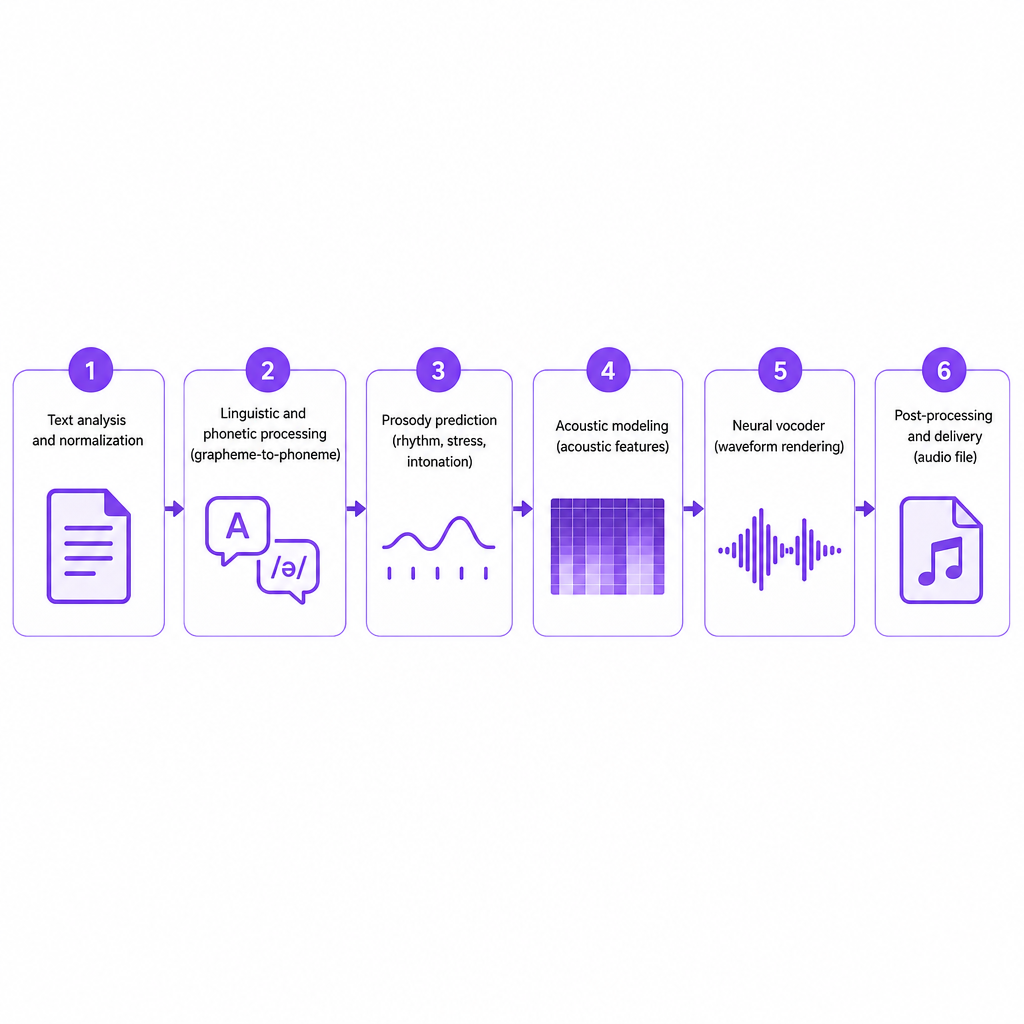
Under the hood: the neural TTS pipeline
Engines differ in detail, but they share a broadly similar pipeline described in technical documentation and responsible AI disclosures from major providers, and our own explanations of how AI voiceovers are made align with it.
Text analysis and normalization
First the system ingests your text and normalizes it into a speakable form. That means expanding numbers ("2026" becomes "twenty twenty-six"), dates, and abbreviations; resolving ambiguous tokens such as "US" versus "us" based on context; and reading punctuation and structure to plan pauses and emphasis. Our engine interprets punctuation and structure to infer rhythm and flow rather than treating text as a flat character stream. This stage carries real weight for longer scripts—courses, explainers, podcasts—where paragraph structure and headings shape how a human would naturally read.
Linguistic and phonetic processing
The normalized text is converted into phonemes, the basic sound units of a language. A grapheme-to-phoneme model maps characters to sounds, handling pronunciation rules, exceptions, and multilingual input. This is what lets our Text to Speech accept scripts across many languages and produce the correct phonetic sequence for the selected one, whether you use a built-in voice or a cloned voice. Our neural voices cover more than 33 languages, including English, Portuguese, Spanish, French, German, Chinese, and Japanese.
Prosody prediction
Prosody—rhythm, stress, and intonation—is the difference between a robotic voice and a human-like performance. Neural models learn prosodic patterns directly from recordings, so they can decide where to pause and for how long, choose which words carry emphasis, and adjust pitch and energy across a sentence or paragraph. High-definition neural voices go further, detecting sentiment in the text and adjusting tone while holding a stable persona, which is what enables conversational or empathetic delivery for support content and narration. Our engine infers prosody before synthesizing audio for the same reason: to avoid flat delivery and produce speech you could listen to for an entire module.
Acoustic modeling
Once phonemes and prosody are set, a neural acoustic model converts that representation into acoustic features—a blueprint for the sound wave. Responsible AI disclosures note that, alongside recordings of a specific voice talent, these models also draw on a broader source library of many speakers. That mix helps the network learn general speech patterns while still capturing a particular voice's timbre, accent, and style. In our platform, this modeling is what lets 300+ voices sound distinct yet natural, and it underpins fast voice cloning, where the system learns a voice's acoustic and prosodic signature from a short sample.
Vocoder and audio rendering
The acoustic features pass to a neural vocoder, which renders them into a full audio waveform. Newer vocoders produce high-fidelity speech that is nearly indistinguishable from studio recordings, with clear consonants, smooth vowels, and minimal artifacts. The combination of neural acoustic model plus vocoder is the reason neural voices sound far more natural than the older technology used in traditional screen readers and IVRs. We use similar advances so generated audio is ready to publish directly or drop into a mix with music and sound effects.
Post-processing and delivery
Finally the system may apply post-processing—noise shaping, loudness normalization, or format conversion—before returning the audio file. For API workflows, this is wrapped in a RESTful endpoint that accepts text and voice parameters and returns a ready-to-use asset. Our Text to Speech follows exactly this flow: paste or send text, choose language and voice, adjust delivery where controls are exposed, generate, and download standard-format audio. The same engine sits under our AI Dubbing, where transcription, translation, and synthesis are chained to create multilingual versions.
Options inside DubSmart: voices, cloning, dubbing, and APIs
Knowing the mechanics explains why our feature set is built the way it is.
Text to Speech for direct narration
Our Text to Speech tool is the core interface for turning scripts into audio. You paste or upload text in any supported language, pick from the 300+ natural-sounding voices, set language and basic delivery controls where available, and generate speech in seconds. It covers YouTube hooks and full video narration, explainer and promo voiceovers for small businesses, clear e-learning and training modules, and podcast intros, outros, and mid-rolls. If you are weighing tools for that job, our roundup of the best AI dubbing software for creators shows how narration and localization connect.
Voice cloning: keeping your brand or host voice
Voice cloning builds on the same neural steps—phonemes, prosody, acoustic features—but optimizes the network to match a specific timbre and style, so you can generate new lines in that voice without re-recording. Our fast voice cloning creates custom voices you can use inside Text to Speech or AI Dubbing, which means localized content still sounds like your host, narrator, or brand. That continuity matters most for channels and companies that have invested in a recognizable voice identity.
AI Dubbing: chaining speech to text, translation, and TTS
AI dubbing uses the TTS engine as the final step in a longer chain: transcribing existing audio, translating the transcript, then synthesizing new speech in the target language. Our AI Dubbing keeps dubbing, text-to-speech, speech-to-text, and cloning inside one workflow so content moves from upload to multilingual export without leaving the platform. In practice you can upload a video or podcast, have it transcribed and separated from background audio, translate into one or more languages, then generate dubbed tracks using stock or cloned voices that preserve timing and tone. For a walkthrough on spoken content, see our guide on how to translate a podcast into another language.
APIs for developers and agencies
We expose neural TTS and dubbing through APIs so developers and agencies can integrate voice generation into their own products. Our Text to Speech API is a RESTful service that accepts a POST request with text content and voice preferences and returns high-quality audio, with access to premium neural voices in more than 33 languages. The AI Dubbing API extends that to automated multilingual dubbing. For agencies handling localization across clients, these endpoints standardize voice generation while still customizing languages and personas per brand.
Decision criteria: choosing and using neural TTS well
Once the mechanism is clear, the practical work is deciding when and how to use it.
Naturalness and listening comfort. The core test is whether the voice is natural enough for your audience to accept as the main narrator. Deep neural networks and HD voices are built to reduce listening fatigue, but the right pick still depends on content type. Use our large voice library to test personas—energetic, calm, playful, authoritative—and for long-form courses or podcasts, favor voices whose prosody feels conversational rather than announcement-like.
Language coverage and accent fit. For multilingual expansion you need both the language and an accent appropriate for the target audience. Our neural voices span more than 33 languages across major markets. When choosing localized tracks, decide whether you want a neutral or region-specific accent, and test samples with native speakers where possible.
Brand consistency versus flexibility. Cloning carries a specific voice across languages and projects, but it introduces responsibilities around consent and disclosure. Use it when a consistent persona is central to your brand, and document who owns and controls that voice—especially in enterprise or agency work.
Workflow integration. Neural TTS delivers the most value when it slots into how you already work. Because our tools combine text-to-speech, cloning, dubbing, speech to text, and media utilities, you can automate much of the localization chain while still editing scripts and audio. Solo creators may find the browser tools sufficient; developers and agencies get programmable endpoints for scaling.
Risks, limits, and responsible use
Even advanced models have boundaries worth planning around.
- Emotional nuance: HD voices respond to sentiment, but may miss subtle cues or complex performances a skilled actor would deliver. Critical brand messaging or narrative drama may still warrant human recording as the source.
- Pronunciation edge cases: Rare names, novel terms, or mixed-language scripts can challenge grapheme-to-phoneme models, so build in manual checks.
- Cloning ethics: Responsible AI guidance stresses that custom voices should be built and used with explicit consent, clear contracts, and audience disclosure. Imitating people without permission raises legal and ethical concerns.
- Bias and representation: Training data shapes how voices handle accents and dialects, so check that your chosen voices fairly represent your audience and avoid reinforcing stereotypes.
Because our integrated workflow makes it easy to generate and deploy synthetic speech, internal review matters more, not less—particularly when you handle client or employee voices. A concrete path helps: a creator can write one English script, generate an English voiceover, then dub Spanish, Portuguese, and German versions for additional channels while keeping the same timing and delivery. A training team can build modular narration and re-generate it quickly whenever policies change. That is the real payoff of understanding the pipeline—you know which stage to control and which to let the model handle.
Frequently asked questions
What is neural text to speech in simple terms?
Neural text to speech is AI that turns written text into speech using deep neural networks trained on large datasets of human recordings, producing voices that sound much closer to real people than older TTS systems.
How is DubSmart's Text to Speech different from basic TTS?
We use neural models that analyze your script, infer prosody, and synthesize speech from scratch, supported by 300+ natural voices and fast voice cloning, so the output works as a primary narrator for videos, courses, and podcasts.
Can DubSmart keep my own voice in other languages?
Yes. Our voice cloning can learn your voice from recordings and then use it in text-to-speech and AI dubbing, so localized versions of your content still sound like you or your brand narrator.
How does AI dubbing work with neural TTS?
AI dubbing chains speech-to-text transcription, translation, and neural text-to-speech, turning your existing audio into multilingual dubbed tracks in a single workflow, using either stock voices or your cloned voice.
Is neural text to speech safe and ethical to use?
Used with consent, clear disclosure, and appropriate safeguards, neural TTS is a strong tool for accessibility and localization. Responsible AI guidance emphasizes respecting voice talent rights and avoiding deceptive uses of synthetic voices.