AI dubbing cost for a YouTube channel can land anywhere from free to a few hundred dollars a month, and the number that matters most is rarely the video length you first think of. The real driver is your localized minutes: original video length multiplied by how many languages you publish. On DubSmart AI, AI Dubbing bills at roughly 1,000 credits per localized minute, so a 10-minute video dubbed into three languages represents about 30 localized minutes, or 30,000 credits. That single formula turns a fuzzy budgeting question into arithmetic you can run before you commit to a plan.
This guide explains what actually moves the bill, how our credit model maps to dubbing minutes, and how to match a plan to your publishing rhythm without overpaying or running dry mid-launch.
Table of contents
What actually drives the cost
Video length is only the starting point. Five variables decide what you pay:
- Video duration. A 20-minute video consumes twice the dubbing minutes of a 10-minute one. Simple, but easy to underweight when you plan around "one video."
- Number of target languages. Each language is a separate localized version and another chargeable minute. This is the multiplier most creators miss.
- Monthly publishing volume. A weekly channel has a very different footprint from someone localizing a back catalog in one push.
- Voice choice. Stock voices are enough for many narration-led channels; voice cloning matters when the creator's voice is the brand.
- Production workflow. Regenerating lines, timing fixes, subtitles, API access, and faster rendering all shape which plan is the right fit.
Our AI Dubbing workflow accepts a YouTube link or an uploaded audio or video file, then lets you edit speakers, timings, and text before downloading the finished project. That editing step is where you'll spend extra credits regenerating segments, so it belongs in your estimate, not just the first pass.
How our credit model maps to dubbing minutes
DubSmart runs on a shared credit pool rather than per-feature invoices. AI Dubbing costs roughly 1,000 credits per localized minute, and those same credits also fund Text to Speech, Speech to Text, the Speech Separator, and image generation. That flexibility is useful, but it means a plan that looks generous for dubbing shrinks fast if you're also transcribing, cleaning audio, or generating thumbnails from the same balance.
Here is how our published U.S. plans translate into approximate dubbing capacity.
| Plan | Monthly price | Monthly credits | Approx. dubbing minutes | Extra-credit rate |
|---|---|---|---|---|
| Free | Free | 2,000 | 2 | Not stated |
| Starter | $16.66 | 50,000 | 50 | $1.20 / 1,000 |
| Standard | $41.66 | 150,000 | 150 | $1.00 / 1,000 |
| Pro | $83.33 | 350,000 | 350 | $0.50 / 1,000 |
| Enterprise | $208.33 | 1,000,000 | 1,000 | $0.25 / 1,000 |
| Custom | Custom | From 2,500,000 | From 2,500 | Custom |
Paid plans carry unused credits forward; the Free Plan does not. Subscriptions can be canceled anytime, and annual billing saves 17%. If you divide each paid plan's price by its included dubbing capacity, the effective cost per localized minute works out to roughly $0.33 on Starter, $0.28 on Standard, $0.24 on Pro, and $0.21 on Enterprise (estimates, assuming the credits go to dubbing rather than other tools). Those are the cost of the included capacity, not extra per-minute charges stacked on top. For a deeper look at how carryover works across billing cycles, our explainer on how rollover credits work breaks down the mechanics.
Run the math before you pick a plan
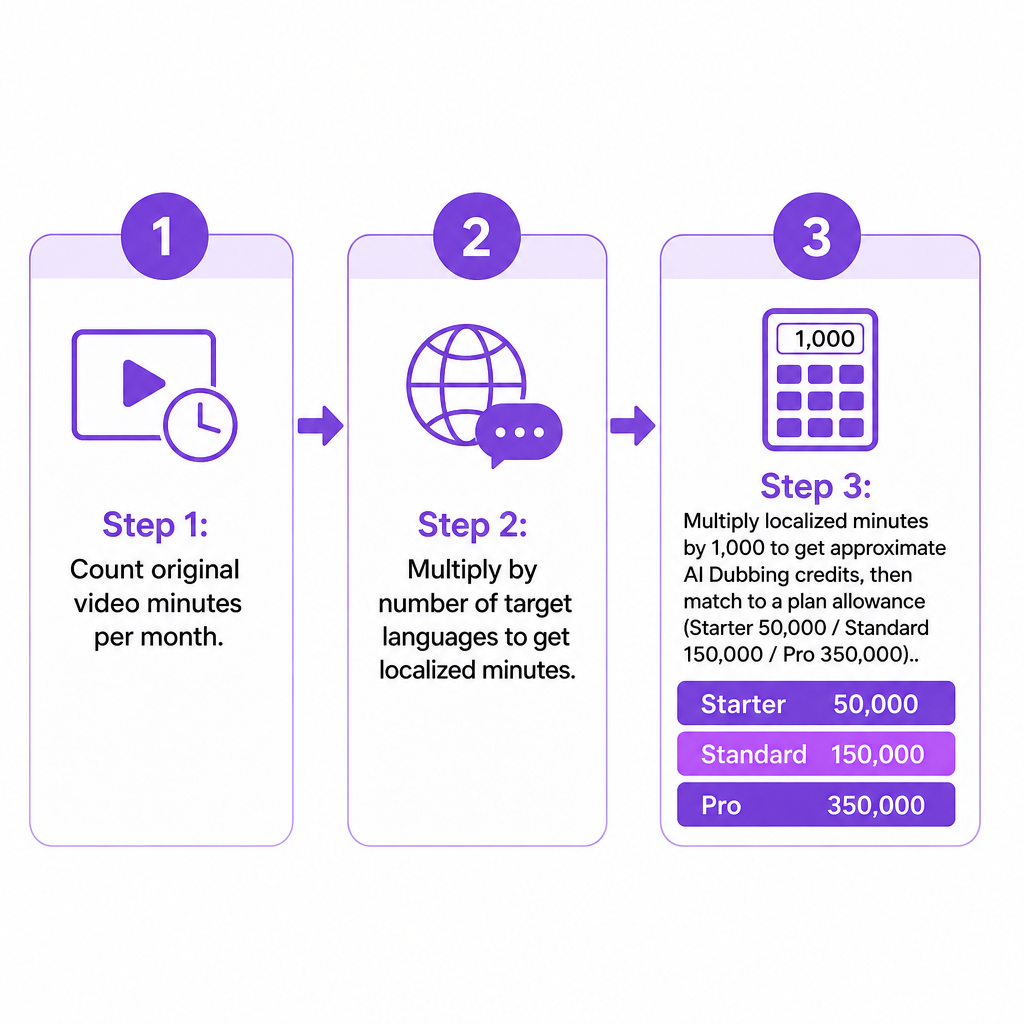
The estimate is two short calculations. First, total localized minutes:
Original video length × number of target languages = total localized minutes
Then convert to credits:
Total localized minutes × 1,000 = approximate AI Dubbing credits
One 10-minute video in three languages. A 10-minute English video dubbed into Spanish, French, and German is 30 localized minutes, or about 30,000 credits. That fits inside Starter's 50,000-credit allowance, as long as you aren't burning a big chunk of the balance on other tools.
A weekly channel. Say you publish four 12-minute videos a month and dub each into two additional languages: 48 original minutes × 2 languages = 96 localized minutes, or roughly 96,000 credits for dubbing alone. Standard's 150,000 monthly credits give real headroom here, where Starter would leave almost nothing for regeneration or other tools.
A multilingual back catalog. A channel with 100 videos averaging eight minutes, localized into four languages, is 100 × 8 × 4 = 3,200 localized minutes. That's a one-time project, not a monthly workload. Spreading it across several billing cycles, buying extra credits, or moving to a Custom plan makes more sense than picking a plan off your normal upload schedule.
Why languages matter more than video length
It's tempting to think, "My video is only 10 minutes." But a 10-minute video in eight languages is roughly 80 dubbing minutes. The language count, not the runtime, usually sets your plan tier.
| Original length | Target languages | Localized minutes | Approx. credits |
|---|---|---|---|
| 5 min | 1 | 5 | 5,000 |
| 10 min | 2 | 20 | 20,000 |
| 10 min | 3 | 30 | 30,000 |
| 20 min | 3 | 60 | 60,000 |
| 30 min | 5 | 150 | 150,000 |
These assume the full video is dubbed at about 1,000 credits per localized minute; revisions and shared tool usage can push actual consumption higher. If a multi-language channel is your goal, our guide on how to make a multilingual YouTube channel covers the publishing side that the credit math alone won't.
Matching a plan to your channel
Free Plan — testing a concept. Roughly two dubbing minutes, enough to check whether the translated voice fits your style, whether speaker recognition works on your footage, how much editing a clip needs, and whether a localized pilot lands with viewers. Output carries a watermark on image or video, and there's no rollover.
Starter — a small or experimental channel. About 50 dubbing minutes a month, unlimited voice cloning, no watermark, and rollover. A fit for occasional localization or a handful of short videos in one or two languages, and a clean way to work in a paid workflow without a large commitment.
Standard — a consistent schedule. About 150 dubbing minutes. A practical starting point for a channel that publishes regularly and localizes each upload into several languages. The weekly example above — 96 localized minutes before revisions — sits comfortably here with room to redo lines.
Pro — multiple channels or higher volume. About 350 minutes, plus AI Dubbing API access, faster rendering, and an account manager. Suited to professional creators running several channels, agencies, or teams wiring dubbing into an internal publishing pipeline.
Enterprise and Custom — large catalogs and teams. Enterprise includes about 1,000 dubbing minutes, 4K YouTube upload support, API access, faster rendering, and an account manager. Custom plans start around 2,500,000 credits for larger or specialized workloads. If you're localizing a big back catalog, launching a course, or running a seasonal series, evaluate your peak demand, not just the monthly average.
What a cheap plan hides from your budget
The subscription price is the floor, not the full cost. A few common traps turn a cheap plan expensive:
- Underestimating language multiplication. Budgeting for 30 original minutes but publishing them in four languages means roughly 120 localized minutes.
- Spending shared credits elsewhere. The same balance funds Text to Speech, transcription, speech separation, and image generation. A plan that looks big for dubbing can tighten fast once it funds the whole workflow.
- Planning around averages. Monthly averages hide launch spikes. A channel that usually needs 40 minutes might suddenly need 300 for a multilingual series.
- Treating AI output as final. Awkward pronunciation or a shaky translation erodes viewer trust. A native-language review is cheap next to publishing an embarrassing version.
Beyond capacity, budget for human review of proper names, technical terms, humor, speaker assignment, audio levels, and timing. And account for the channel work dubbing doesn't do for you: translated titles, descriptions, thumbnails, subtitles, playlists, and analytics.
Voice cloning and its cost trade-offs
Voice cloning keeps a recognizable creator identity across languages. Our AI Dubbing workflow can clone each speaker's voice and dub from more than 60 languages into 33. For a channel, that splits into two choices: a stock AI voice, which is faster to test and fine for narration and explainers, or a cloned creator voice, which fits personality-driven channels where viewers tie the voice to you.
Cloning doesn't remove the editorial step — pronunciation, names, jokes, idioms, emotional delivery, and timing can still need correction. It also carries a hard rule: only clone a voice you have the right to use. Don't clone a presenter, actor, guest, or customer without permission, and confirm you can translate and republish the underlying video, music, and footage. If you're weighing the two methods for narration specifically, our comparison of TTS versus voice cloning for narration lays out the decision.
On disclosure: YouTube asks creators to flag realistic AI-generated or meaningfully altered content during upload, and its own examples state you don't have to disclose cloning your own voice for voiceovers or dubs. Content that could mislead viewers about what a real person said or did is the case to watch. Review the YouTube disclosure setting for each localized upload rather than assuming every dub is treated the same, and keep your original version, translation script, and approval record on hand.
Frequently asked questions
How much does it cost to dub a YouTube video with AI?
It depends on the plan and your localized minutes. The Free Plan includes about two dubbing minutes. Paid plans currently run from $16.66/month for Starter to $208.33/month for Enterprise, with Custom available for larger workloads.
Is AI dubbing charged per video or per language?
The practical unit is localized minutes. A 10-minute video dubbed into three languages is about 30 localized minutes, because each target-language version is processed separately.
Is AI dubbing cheaper than hiring voice actors?
It can cut generation cost and turnaround, especially across multiple languages or frequent revisions. Human review, translation oversight, rights clearance, and final editing may still be part of the budget.
Can a YouTube creator use a cloned voice?
Yes, when you have the necessary rights and consent. YouTube lists cloning your own voice for voiceovers or dubs among examples that don't require disclosure, while other realistic AI-generated or altered content may require it.
What is the simplest way to estimate my monthly cost?
Multiply your monthly original video minutes by the number of target languages, then compare the resulting localized minutes to plan allowances — adding room for revisions and any other DubSmart tools drawing on the same credit balance.