
Rollover credits let you carry unused paid-plan credits from one billing month into the next instead of watching them disappear at the cycle boundary. If you want a single-sentence answer to how does rollover credits work on DubSmart AI: your available credits next month equal the unused credits from this month plus your new monthly allowance. That small mechanic changes how you should think about plan size, because your effective capacity can follow an uneven production schedule rather than forcing you to overbuy for one busy month.
We built this guide to settle the practical questions that actually affect your bill: which plans include rollover, how credits convert into dubbing minutes and characters, when extra credits make more sense than a bigger plan, and which edge cases you should confirm before you commit a long project to accumulated credits.
Table of contents
What rollover credits actually are
Rollover credits are unused credits carried from one billing period into the next. They add usage capacity; they are not a discount, a refund, or a separate subscription. Think of them as leftover fuel that stays in the tank instead of evaporating.
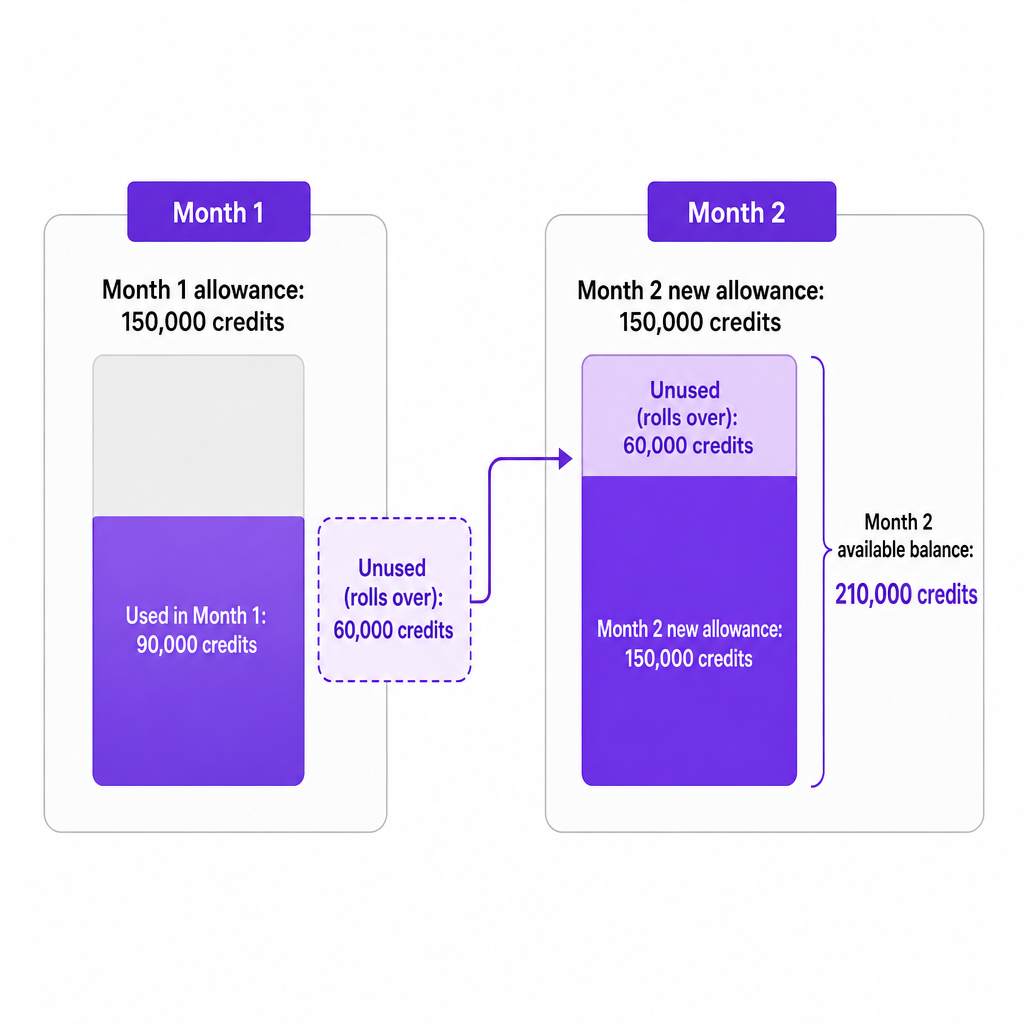
A worked example makes the mechanic concrete. Say your plan includes 150,000 credits per month. You use 90,000 in month one, leaving 60,000 unused. Those 60,000 carry into month two, where they sit on top of the new 150,000-credit allowance for a potential balance of 210,000 credits.
The commercial point is simple: your effective capacity tracks your workload. You do not have to buy the largest plan just because one month happens to contain an unusually heavy localization project. On DubSmart AI, every paid plan advertises unused-credit rollover, while the Free Plan does not provide extra or rollover credits.
How rollover credits work inside DubSmart AI
We use one shared credit balance across the platform's media tools. The same pool funds AI Dubbing, Text to Speech, Speech to Text, Speech Separator, Text to Image, and the other tools included with your plan, so rollover credits are not locked to a single feature.
Each tool draws from that pool at a published rate. The table below is the conversion you will reference most when estimating a project.
| Product or feature | Published credit cost |
|---|---|
| AI Dubbing | 1,000 credits per minute |
| Text to Speech | 1 credit per character |
| Speech to Text | 100 credits per minute |
| Speech Separator | 100 credits per minute |
| Text to Image | 200 credits per image |
We describe roughly 1,000 credits as about one minute of AI Dubbing or Text to Speech capacity, but note the difference in how they are metered. Dubbing is priced by the minute, while Text to Speech is priced by the character, so a dense script and a sparse one of the same spoken length will not cost the same.
A few short examples show how the pool behaves in practice. A five-minute video dubbed into one language is about 5 minutes × 1,000 credits = 5,000 credits. The same video dubbed into three languages is 5 × 3 × 1,000 = 15,000 credits, which is why multilingual budgeting should be estimated as finished minutes multiplied by target languages, not by source length alone. A 30-minute audio file run through Speech to Text is roughly 30 × 100 = 3,000 credits, and a campaign needing 20 generated images with our AI image generator is about 20 × 200 = 4,000 credits. All of these draw from the same shared balance, so unused credits from a quiet month can cover a busier one.
Which DubSmart plans include rollover
Every paid plan carries rollover; the Free Plan does not. The prices below are the published monthly-equivalent figures. Annual billing advertises savings of 17%, but the displayed table does not publish separate annual numeric prices.
| Plan | Monthly price | Monthly credits | Approx. dubbing/TTS minutes | Extra-credit rate |
|---|---|---|---|---|
| Free Plan | Free | 2,000 | 2 | — (no rollover) |
| Starter Plan | $16.66 | 50,000 | 50 | $1.20 / 1,000 |
| Standard Plan | $41.66 | 150,000 | 150 | $1.00 / 1,000 |
| Pro Plan | $83.33 | 350,000 | 350 | $0.50 / 1,000 |
| Enterprise Plan | $208.33 | 1,000,000 | 1,000 | $0.25 / 1,000 |
| Custom Plan | Custom | From 2,500,000 | From 2,500 | Custom |
All paid plans include the platform's core media tools. Higher tiers add benefits such as the AI Dubbing API, faster rendering, account-management support, and higher upload capabilities. The extra-credit rate also improves as you move up, which matters later when you decide whether to grow into a plan or buy overflow.
Rollover credits versus extra credits
These two mechanics solve different problems, and conflating them leads to the wrong purchase. Rollover credits are unused credits from your existing paid subscription, carried into the next month under the plan's rollover terms. Extra credits are additional usage you buy when your current balance runs short.
The extra-credit rate depends on your plan: $1.20 per 1,000 credits on Starter, $1.00 on Standard, $0.50 on Pro, and $0.25 on Enterprise, with Custom priced individually. So if you have exhausted your monthly allowance and need another 20,000 credits on the Pro Plan, the math is 20,000 ÷ 1,000 × $0.50 = $10. When you exceed your limit, you can either upgrade your plan or buy credits separately.
The practical rule: rollover rewards you for not wasting capacity you already paid for, while extra credits are a safety valve for a month that outgrows your plan. A steady overflow every month is usually a signal to size up rather than keep buying extras.
Do rollover credits lower your next payment?
No. Rollover increases your available usage balance; it does not reduce the subscription price or trigger a cash refund. If your plan costs $41.66 per month and you use only part of its 150,000-credit allowance, the leftover credits carry forward as extra capacity, but the subscription charge stays the subscription charge.
This distinction matters when you compare plans. A plan with rollover can be more economical for an uneven publishing schedule because fewer credits go to waste, but it is not the same as a metered model where you pay only for what you consume. You are still paying for the allowance each month; rollover simply makes unused portions useful later.
Who gets the most value from rollover
Rollover pays off when your production volume is uneven rather than flat. If you process roughly the same number of minutes every month, a right-sized plan matters more than carryover. The uneven schedules below are where it earns its keep.
YouTube creators expanding into multiple languages often publish several videos in a launch month and fewer afterward. For a five-minute video localized into four languages, the dubbing requirement is about 20,000 credits; a creator holding 35,000 unused credits can carry that capacity into the next batch instead of losing it at the billing boundary. If you are scaling a channel this way, our guide to localizing marketing videos with AI Dubbing covers the quality steps that sit alongside the budgeting.
Small marketing teams work around launches, seasonal promotions, and campaign deadlines, so a quiet planning month can bank capacity for a high-volume campaign month.
E-learning and corporate training teams release content in waves: a heavy launch followed by lighter maintenance and updates. Rollover smooths that curve.
Podcasters and independent filmmakers face unpredictable editing, transcription, speech-separation, and dubbing needs. A shared balance that also funds the Speech Separator can move across several production stages rather than being stranded in one function.
Developers and agencies apply the same credit model to automated workflows. We offer APIs for Text to Speech, Voice Cloning, and AI Dubbing, and our voice AI API pricing explanation confirms that web tools and APIs draw on the same shared credit system, so usage estimates based on characters, minutes, languages, or generated outputs carry over cleanly between them.
Estimating the right plan for your workload
The best plan follows your usage pattern, not your single largest possible project. Start by measuring four things: source minutes per month, target languages per video, additional tools you will use (transcription, speech separation, images, TTS), and how variable your workload is across the year.
For dubbing, the starting estimate is source minutes × target languages × 1,000 credits. Here is that formula on a realistic plan. A small business wants to localize eight five-minute videos into two languages each:
8 videos × 5 minutes × 2 languages = 80 localized minutes
80 localized minutes × 1,000 credits = 80,000 credits
That month needs more than the Starter Plan's 50,000 credits. The options are to move to the Standard Plan's 150,000 credits, draw on rollover banked from earlier months, stay on Starter and buy the shortfall as extra credits, or weigh the total cost against the campaign's expected value. For occasional spikes, rollover can keep a smaller plan practical; for consistently high volume, a higher tier gives a lower extra-credit rate and a more predictable budget.
One caution before you commit a big batch: our paid plans advertise free regeneration of AI Dubbing projects, so retrying or changing a voice on an existing project may not consume credits the way a new project does. Still, treat these as distinct actions — regenerating an existing project, starting a new one, adding a new target-language version, or running a separate tool like Speech to Text all behave differently. Confirm how a specific action is classified in your account before budgeting a large workflow.
Rollover limitations worth confirming
We publicly state that unused credits roll over on paid plans, but the public pricing page does not spell out every account scenario. Before you lean on accumulated credits for a long-term project, these are the open questions to check in your current account terms:
- Whether rolled-over credits eventually expire.
- Which credits are consumed first when rollover and new monthly credits coexist.
- Whether credits remain available after cancellation.
- How rollover is handled after an upgrade or downgrade.
- Whether unused Free Plan credits carry forward.
- Whether the rollover balance has a maximum cap.
The safest working assumption is to treat rollover as a paid-plan benefit for the next billing period, not as a permanently stored balance. Plans can be changed and subscriptions canceled at any time, so if a project depends on a large banked balance, confirm the terms or contact our support team first. And remember that a lower production cost never removes the need to review translations, pronunciation, timing, and cultural fit before you publish.
Frequently asked questions
Do DubSmart credits roll over?
Yes. Unused credits roll over to the next month on our paid Starter, Standard, Pro, Enterprise, and Custom plans. The Free Plan does not include rollover.
Does the Free Plan include rollover credits?
The Free Plan includes 2,000 credits per month, but it does not advertise paid-plan rollover and provides no extra credits.
How many credits equal one minute of AI Dubbing?
AI Dubbing is listed at 1,000 credits per minute. Dubbing a five-minute video into one language is about 5,000 credits.
Can rollover credits be used for Text to Speech?
Yes. Credits are shared across supported tools. Text to Speech is metered at 1 credit per character, so cost depends on script length rather than audio duration alone.
Do rollover credits expire?
Our public pricing page confirms rollover to the next month but does not publish a specific expiration period. Confirm the current terms before accumulating credits for a long-term project.
What is the cheapest paid plan with rollover credits?
The Starter Plan at $16.66 per month is the lowest-priced paid plan with rollover, including 50,000 monthly credits that carry unused balance forward.