
If you want voice AI API pricing explained without vague ranges, here is the honest version: with DubSmart AI, the same credits power our web tools and our APIs, so one subscription covers AI Dubbing, Text to Speech, and Voice Cloning across your whole workflow. As of 2026-09-30, published U.S. prices in USD run from a free 2-minute test tier up to an Enterprise plan around $249.90 per month for roughly 1,000 minutes, and the effective included dubbing rate lands near $0.21 to $0.40 per minute depending on tier and billing term. That range is real because our pricing is one credit system, not a maze of separate per-tool invoices.
Table of contents
How our credit system prices every API call
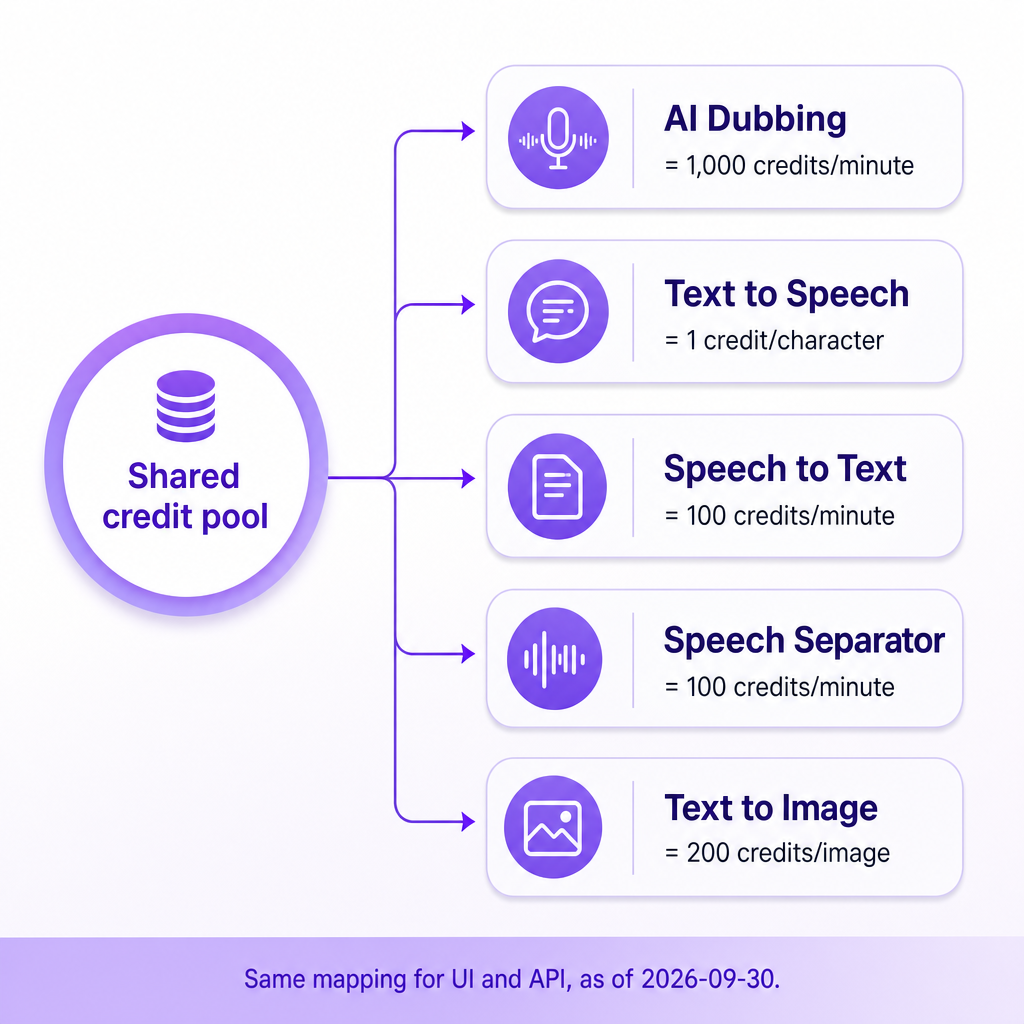
The core idea behind our pricing is that credits are shared. Whether you call the AI Dubbing API, the Text to Speech API, or the Voice Cloning API, you draw from one pool instead of buying separate products. That removes the usual guesswork of reconciling three billing meters.
The credit mappings are fixed and published as of 2026-09-30, so you can convert your workload into cost before you write a line of integration code:
- AI Dubbing (UI and API): 1,000 credits per processed minute of video or audio.
- Text to Speech (UI and TTS API): 1 credit per character of generated speech.
- Speech to Text: 100 credits per minute of transcribed audio.
- Speech Separator: 100 credits per minute of audio separation.
- Text to Image: 200 credits per generated image.
Because the mapping is identical across the browser and the API, there is no hidden API premium. The same 1,000 credits that dub one minute in the UI dub one minute through the AI Dubbing API. For developers, that turns a pricing question into simple arithmetic: pick a plan with enough monthly credits, spend them through API calls, and pay a per-plan overflow rate only if you exceed the allowance.
Current plans and effective per-minute cost
Here is where the numbers get concrete. All figures are in USD and reflect published prices as of 2026-09-30. Included minutes assume AI Dubbing at 1,000 credits per minute, and effective per-minute figures are estimates that divide the plan price by the included dubbing minutes.
| Plan (US) | Billing (2026-09-30) | Price (USD) | Included credits | Approx. dubbing min* | Approx. per-min* |
|---|---|---|---|---|---|
| Free | One-time | $0.00 | 2,000 | ~2 min | Trial only |
| Starter | Monthly | $19.90 | 50,000 | ~50 min | ~$0.40 |
| Starter | Annual | ~$16.66 | 50,000 | ~50 min | ~$0.33 |
| Standard | Monthly | $49.90 | 150,000 | ~150 min | ~$0.33 |
| Standard | Annual | ~$41.66 | 150,000 | ~150 min | ~$0.28 |
| Pro | Monthly | $99.90 | 350,000 | ~350 min | ~$0.29 |
| Pro | Annual | ~$83.33 | 350,000 | ~350 min | ~$0.24 |
| Enterprise | Monthly | $249.90 | 1,000,000 | ~1,000 min | ~$0.25 |
| Enterprise | Annual | ~$208.33 | 1,000,000 | ~1,000 min | ~$0.21 |
*Estimates based on the published mapping of 1,000 credits per minute of AI Dubbing; actual credit use can vary slightly by project. Annual figures show the effective monthly price, roughly a 17% reduction versus month-to-month.
The pattern is worth internalizing before you commit: the more you commit, the lower your effective rate. Enterprise annual lands near $0.21 per included minute, while Starter monthly sits near $0.40. Overflow beyond the allowance is billed per plan at approximately $1.20 (Starter), $1.00 (Standard), $0.50 (Pro), and $0.25 (Enterprise) per extra minute in 2026, which is why heavy overage on a low tier quietly becomes your most expensive minute.
What actually drives your API bill
Four levers move your monthly cost, and each maps directly back to the credit mappings above.
Total volume processed. Longer videos consume more dubbing minutes at 1,000 credits each, and longer scripts consume more TTS characters at 1 credit each. Volume is the biggest single driver, and it is also the easiest to forecast.
Plan tier and billing term. Higher tiers bundle more credits and reduce your overflow rate, and annual billing lowers the effective per-minute cost against month-to-month. If you already know your baseline monthly minutes, choosing annual on the right tier is the cleanest saving available.
Overflow versus included usage. Staying inside your allowance keeps effective rates around $0.21 to $0.40 per minute in 2026. Blowing past it on a low tier pushes you toward the higher overflow rates, up to about $1.20 per minute on Starter. When your overflow starts approaching the price of the next tier, upgrading is usually cheaper than paying overage.
Resolution and tool mix. The Enterprise plan explicitly supports 4K video at around $249.90 per month for roughly 1,000 minutes, while free and lower tiers suit HD workflows and prototyping. A project that separates audio, transcribes it, dubs into several languages, and generates visuals will draw credits from AI Dubbing, Speech Separator, Speech to Text, and Text to Image at once, so the tool mix per asset matters as much as raw runtime.
What each plan includes and excludes
Inclusions and exclusions below reflect published details as of 2026-09-30 for U.S. customers.
The Free plan grants 2,000 credits once, about 2 minutes of dubbing or TTS, with access to the core tools for testing: AI Dubbing, Text to Speech, Text to Image, Image to Video, Speech to Text, and Speech Separator. Output is watermarked, so it fits internal review and mockups rather than final delivery. There are no recurring monthly credits and no discounted overflow; once the 2,000 credits are gone, production continues on a paid plan.
The Starter, Standard, and Pro tiers each carry a monthly credit allowance of 50,000, 150,000, and 350,000 respectively, with unused credits rolling over to the next month. All three share the credit pool across every tool and include API access for integrating dubbing and TTS into apps and workflows. The trade-off is capacity: high-volume dubbing or TTS hits the extra-credit rate sooner on these tiers, and large-scale 4K localization pipelines are better matched to Enterprise.
The Enterprise plan includes around 1,000,000 credits, roughly 1,000 minutes per month with rollover, the lowest overflow rate at about $0.25 per extra minute in 2026, and 4K video dubbing support. Usage beyond 1,000 minutes or 1,000,000 credits typically moves into a tailored enterprise agreement.
One inclusion applies across every paid tier and deserves emphasis: unused credits roll over, which cuts waste for channels that publish in bursts rather than at a steady weekly cadence.
Which plan fits which use case
The cleanest way to choose is to map your real monthly output to the included minutes, then check whether overflow would justify the next tier up.
- Free (~2 minutes, watermarked): Test the pipeline end to end on one short video or podcast episode, and validate language quality and voice cloning before you spend.
- Starter (~50 minutes): Solo creators or small businesses publishing a few dubbed videos monthly, such as one or two 20 to 30 minute videos localized into a single language.
- Standard (~150 minutes): Channels with regular weekly uploads, or e-learning teams dubbing lessons into one or two languages at moderate volume.
- Pro (~350 minutes): Multi-channel creators, agencies, or education providers running several courses where multiple episodes are dubbed and voiced each month.
- Enterprise (~1,000 minutes, 4K): Businesses, platforms, or studios with sustained multilingual output across long-form series or courses in several languages, who also need 4K and the lowest overflow rate.
If you are integrating Voice Cloning or Text to Speech via API, estimate your monthly minutes and characters first, match them to the included credits, then factor whether overflow is large enough to justify jumping a tier. That single calculation prevents most overpaying.
The exact inputs we need to quote your integration
For a custom Enterprise deal or a large API integration, a precise USD quote depends on a few concrete inputs. Share these and we can match a plan, or design a custom agreement, against real usage rather than a broad guess.
- Content volume. Source minutes per month for AI Dubbing and Speech to Text, plus expected TTS character counts for scripts and training modules.
- Workflow design. How many tools run per asset (for example, Speech Separator, then Speech to Text, then AI Dubbing, then TTS voiceover), and how many output languages per project, since each language variant adds dubbing minutes and TTS characters.
- Quality and format. Target resolution (HD versus 4K) and codecs, plus audio formats and voice cloning requirements for your pipeline.
- Usage pattern. Whether demand is steady or bursty, so rollover credits work in your favor, and any expected peaks like course launches or campaign pushes.
- Integration details. Whether usage is primarily API-driven or split between UI and API, and any SLA, security, or compliance needs that shape enterprise terms.
With those numbers in hand, aligning total monthly credits, overflow rates, and the right toolset becomes straightforward. Send us your monthly minutes, character counts, target languages, and resolution, and we will map them to the tier or custom plan that keeps your effective per-minute cost as low as your volume allows.
Frequently asked questions
How much does it cost to test DubSmart with my own content?
Our free trial tier gives a one-time allocation of 2,000 credits, about 2 minutes of AI Dubbing or Text to Speech, with watermarked output, as of 2026-09-30 for U.S. users.
Are the Voice AI APIs billed differently from the web app?
No. We use one shared credit system, and the same credits that power the web tools apply to API calls with identical mappings: 1,000 credits per dubbing minute and 1 credit per TTS character.
What is the cheapest way to run high-volume dubbing via API?
As of 2026-09-30, our Enterprise plan provides around 1,000,000 credits (1,000 minutes) for $249.90 per month, plus the lowest overflow rate ($0.25 per extra minute) and 4K support, making it the most economical tier for sustained high volume.
Do unused credits expire each month?
On paid plans, unused credits roll over to the next month, which helps you handle uneven publishing schedules without losing value.
How can I estimate my monthly cost for the Voice AI APIs?
Multiply expected dubbing minutes by 1,000 credits and TTS characters by 1 credit, sum them, and compare to the included credits in Starter, Standard, Pro, or Enterprise. Any excess is priced at the per-plan extra-credit rate (~$1.20, $1.00, $0.50, or $0.25 per extra minute as of 2026).