
If you have one video that works and five markets that can't hear it, multilingual voiceover is how you close that gap. So what is multilingual voiceover in plain terms? It is the process of producing spoken audio for the same content in more than one language, so a single tutorial, product demo, course, or podcast reaches audiences who don't share your original language. A translated script is recorded by a voice actor, generated with text-to-speech, or produced with a consented voice clone, then synchronized back to the original media. The appeal is simple: you adapt one strong piece of content instead of rebuilding it from scratch for every market.
The decision this article helps you make is not just whether to localize audio, but how: human recording, stock AI voices, voice cloning, or speech-to-speech, and whether voiceover, subtitles, or full dubbing fits your content. We make those choices every day across our dubbing and voice tools, so the sections below focus on the mechanics, the trade-offs, and the review steps that separate a usable track from one you have to redo.
Table of contents
Voiceover, dubbing, and where the line sits
People use "voiceover" and "dubbing" as if they mean the same thing, and that confusion leads to the wrong production choice. Voiceover adds or replaces narration in another language while the original audio sometimes stays faintly audible underneath. It is the standard for documentaries, explainers, training videos, podcasts, and corporate content. Dubbing generally replaces the original dialogue entirely, so the viewer experiences the localized track as the main performance. Lip-sync dubbing goes further again, reshaping the translated lines and their timing to match visible mouth movements on screen.
The cleanest way to hold the distinction: multilingual voiceover is the broad production goal of delivering spoken content across languages, and dubbing is one method for reaching it. A short educational clip may only need a clean translated narration track. A character-led film or ad usually needs full dubbing, speaker separation, performance direction, and tighter synchronization. If you want the deeper breakdown of mouth-matching work specifically, our explainer on what lip sync dubbing involves covers where that extra effort pays off.
What actually happens inside a multilingual voiceover
A finished track hides several distinct jobs, and skipping any one of them is where quality slips. The source media is first analyzed to identify speakers, dialogue, music, effects, terminology, and timing. Spoken dialogue is then transcribed into a written script, either by hand or with speech-to-text. That script is translated and localized, which means adapting idioms, humor, measurements, examples, and tone so the result sounds native rather than merely correct. Only then is the voice produced, aligned to the picture, and mixed with the remaining music and effects. A final review checks meaning, pronunciation, names, numbers, timing, and cultural fit before anything ships.
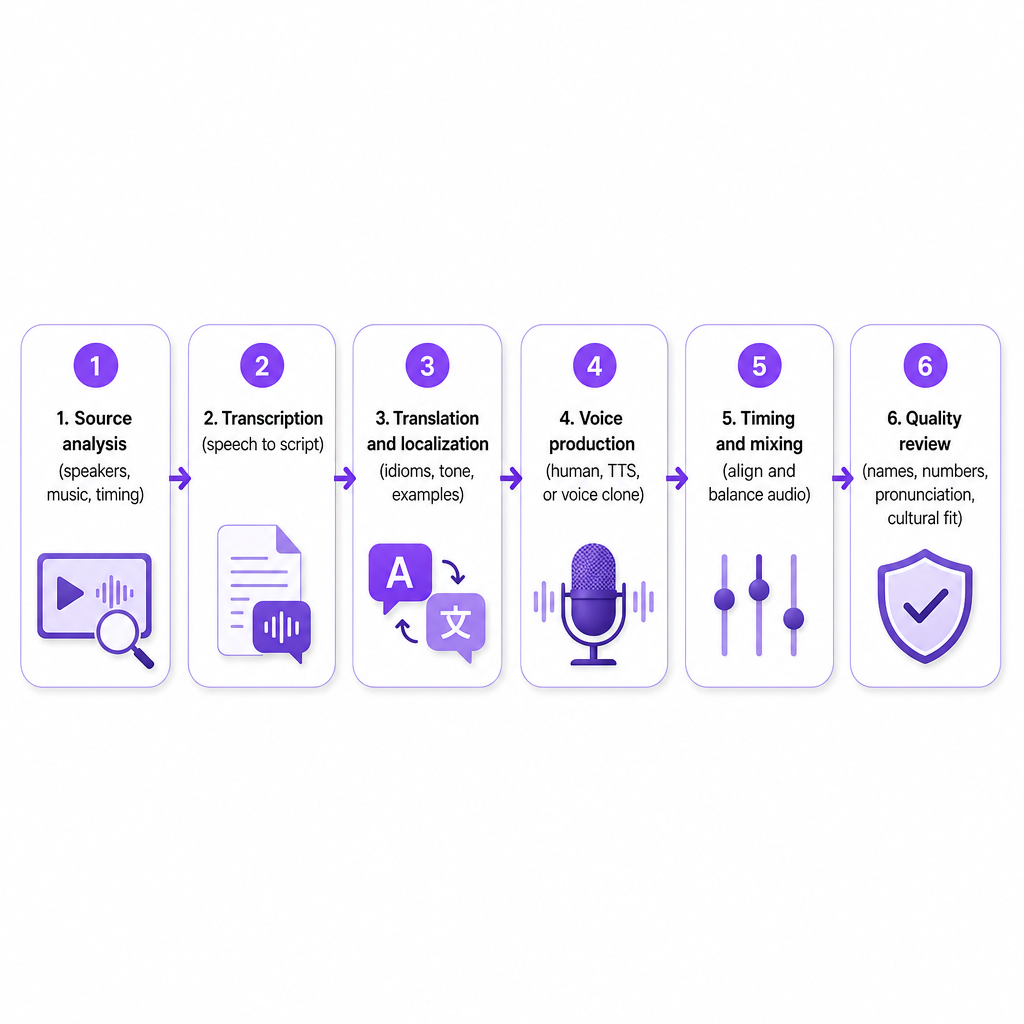
AI dubbing tools compress much of this into one workflow. Our AI Dubbing workflow accepts a YouTube link or uploaded file, lets you edit speakers, text, and timing, and exports the finished project, with support for content from 60+ source languages into 33 target languages. The transcription stage draws on the same engine behind our speech to text tool, which matters because an inaccurate transcript corrupts every step that follows it.
Four ways to produce the voice
Four distinct methods exist to get a translated script spoken, and each suits a different combination of budget, volume, and emotional stakes.
Human voiceover. A professional actor records each language version. This is the choice for brand campaigns, film and television, high-stakes training, and character-driven storytelling where emotional performance carries the content. You gain nuanced delivery, native phrasing, and genuine direction. You pay for it in cost, longer timelines, harder revisions, and scheduling across languages.
Stock AI text-to-speech. A synthetic voice reads the translated script. This fits YouTube explainers, product tutorials, internal training, drafts, and high-volume output where speed and a consistent voice identity matter more than a one-off performance. Revisions are trivial because you just edit text and regenerate. The trade-offs are that pronunciation may need review, emotional range varies, and some voices can sound generic without careful selection. Our Text to Speech library offers 300+ voices for exactly this kind of scalable narration.
AI voice cloning. The system builds a synthetic version of a specific speaker's voice and uses it to speak the translated script, preserving recognizable tone, pitch, accent, and style. It is built for creator-led channels, personal brands, course instructors, podcasts, and founders who need to sound like themselves across every language. The non-negotiable condition: a voice clone should only be created and used with the speaker's permission and documented rights. Our voice cloning tool works from a short sample, but consent is a requirement, not a formality.
Speech-to-speech conversion. This uses an existing performance as input and generates speech in another language, attempting to retain aspects of the original rhythm and delivery rather than starting purely from written text. It helps when expressive style matters, but it still demands translation review, pronunciation checks, timing adjustments, and permission to reproduce the speaker's voice.
Voiceover, subtitles, or full dubbing?
Before picking a production method, decide whether spoken localization is even the right format. The call usually comes down to content type, budget, and the viewing experience you want.
| Option | Best suited to | Main advantage | Main trade-off |
|---|---|---|---|
| Subtitles | Short-form video, interviews, low-budget testing | Lowest production effort | Viewers must read while watching |
| Voiceover | Explainers, documentaries, courses, podcasts | Clear spoken translation, simpler sync | Original audio may stay audible |
| Full dubbing | Narrative video, ads, entertainment | More immersive viewing | More production and QC work |
| Lip-sync dubbing | Close-up dialogue and performance | Tight speech-to-face alignment | Needs tighter adaptation and timing |
A working rule: choose subtitles when speed and cost dominate, voiceover when comprehension and hands-free viewing matter, full dubbing when the translated audio should fully replace the original, and lip-sync dubbing when visible mouth movements are central to the experience. Many publishers run voiceover and subtitles together, since one supports listeners and the other supports viewers who are deaf or hard of hearing, in noisy settings, or simply prefer reading.
How to choose a method for your content
Four practical filters narrow the choice faster than any feature list.
First, look at content type. Narration-heavy material is far easier to voice over than dialogue-heavy footage with frequent cuts and visible speakers. A talking-head tutorial needs speaker identification and timing tweaks; an animated ad needs performance matching and detailed synchronization.
Second, define the required quality level honestly. An internal draft, a social experiment, a public educational resource, a paid ad, a regulated communication, and a premium entertainment piece carry very different reputational, legal, and safety stakes. The higher the risk, the more human linguistic and editorial review you need built in.
Third, confirm language and dialect coverage. "Spanish," "English," or "Chinese" each cover several regional varieties, so verify that the service supports the specific language, accent, and market you are targeting. Our public AI Dubbing page states support for 60+ source languages and 33 target languages, while our API documentation separately describes 33+ target languages and 99+ source languages, so check the current list and relevant dialect availability for your project before committing to production.
Fourth, evaluate voice and timing control. Translated speech often runs longer or shorter than the original, so a usable system should let you edit the translated text, reassign speakers, adjust speech rate, change timestamps, tune background volume, and regenerate only the affected segment rather than the whole file. For recurring creators and brands, voice consistency across segments and languages usually matters more than the size of the voice library.
Risks that quietly ruin a localized track
A generated track can sound fluent and still be wrong. These are the failure modes worth guarding against, each with a concrete countermeasure.
- Literal translation. Word-for-word output can be grammatical yet unnatural or misleading. Have a native-speaking reviewer adapt idioms, humor, and calls to action.
- Wrong names and terms. AI can mispronounce people, products, acronyms, and locations. Build a pronunciation guide and review a short sample before generating the full project.
- Timing mismatches. A translated sentence may overrun the original pause or scene. Use tighter phrasing, adjust speech rate carefully, and edit segment timestamps.
- Voice identity and consent. Using a recognizable voice without permission creates legal and reputational exposure. Obtain written authorization and document where, how long, and in which languages the voice may be used.
- Cultural misfires. A joke or example that lands in one market can fail in another. Ask a qualified native reviewer to assess the complete localized version, not just the script.
- Overreliance on automation. Treat AI as a production accelerator, not the final editor; review transcript, translation, pronunciation, timing, mix, and export.
Disclosure deserves a separate note. In the United States, the FCC has confirmed that its restrictions on artificial or prerecorded voice calls apply to AI-generated human voices in covered calls, as stated in the FCC ruling on the TCPA and AI voices. That rule is specific to communications regulated under the Telephone Consumer Protection Act and does not automatically settle disclosure for a YouTube video, ad, course, or podcast. Even so, transparent labeling is sensible whenever an AI-generated or cloned voice could mislead an audience, and requirements vary by use case and jurisdiction, so verify what applies to yours.
How we fit into multilingual voiceover production
Our platform is built to handle the full voiceover chain in one place rather than stitching together separate tools. You upload audio or video, select target languages, manage speakers and timings, and download localized results. The AI Dubbing interface exposes editing for speakers, text, timings, speech rate, timestamps, background volume, and individual segments, which is what lets you fix a single mistranslated line without regenerating an entire project.
For developers and agencies, our AI Dubbing API supports multiple target languages in a single project request and provides project-editing and result-download endpoints. The documentation describes presigned uploads, project creation across languages, and downloadable results, lists common video and audio formats with a 5 GB maximum file size, and gives an example in which a five-minute video typically processes in about one minute, with actual timing depending on length and file size. That makes it practical to trigger language versions automatically once a video is approved.
The strongest workflow is not "generate every language and publish." It is to use automation for transcription, translation drafts, voice generation, and repetitive revisions, then apply human review to the language and content that matter most to your audience. For simple narration, this makes multilingual production fast and scalable; for premium, emotional, or high-risk content, human linguistic review and voice direction stay essential. The right method is the one that matches your quality requirements, audience, language variety, consent obligations, and review capacity.
Frequently asked questions
What is multilingual voiceover?
It is the creation of spoken versions of the same content in multiple languages, using human voice actors, AI text-to-speech, voice cloning, or speech-to-speech technology, synchronized back to the original media.
Is multilingual voiceover the same as dubbing?
Not exactly. Voiceover may leave the original audio faintly audible, while dubbing generally replaces the original dialogue. Lip-sync dubbing additionally aligns translated speech with visible mouth movements.
Is AI multilingual voiceover accurate?
It can produce useful results quickly, but accuracy depends on the source audio, translation, language pair, pronunciation, timing, and review process. Human checking is recommended for public, commercial, technical, and high-stakes content.
Can I use my own voice in multiple languages?
Yes. A voice-cloning system can generate translated speech that resembles your voice. Use only your own voice, or a voice for which you hold documented permission and the necessary rights.
How many languages do you support?
Our public AI Dubbing page lists dubbing from 60+ source languages into 33 target languages, while our API page describes 33+ target languages and 99+ source languages. Verify the current language and dialect list for your specific project before production.
Does multilingual voiceover replace localization?
No. Voiceover changes the spoken language, while localization adapts content for a market, which can also mean changing terminology, humor, graphics, measurements, examples, captions, and calls to action.