If you have ever watched a foreign-language film and felt the actor was genuinely speaking your language, you have seen lip sync dubbing in action. The illusion is deliberate, and it takes more than a swapped audio track to pull off.
So what is lip sync dubbing? It is the process of replacing original dialogue with translated speech while making the new words, timing, and mouth movements appear visually aligned. It blends translation, voice production, timing adaptation, and—when the workflow calls for it—visual modification of the speaker's mouth. Unlike a plain voice-over, lip sync dubbing aims to make the replacement dialogue feel as though it was spoken in the target language on camera.
Table of contents
What lip sync dubbing actually means
In conventional dubbing, the original dialogue is removed or reduced and replaced with a new performance in another language. The new audio may match the scene's overall timing, yet the actor's visible mouth movements can still give away that something changed. Lip sync dubbing exists to close that gap.
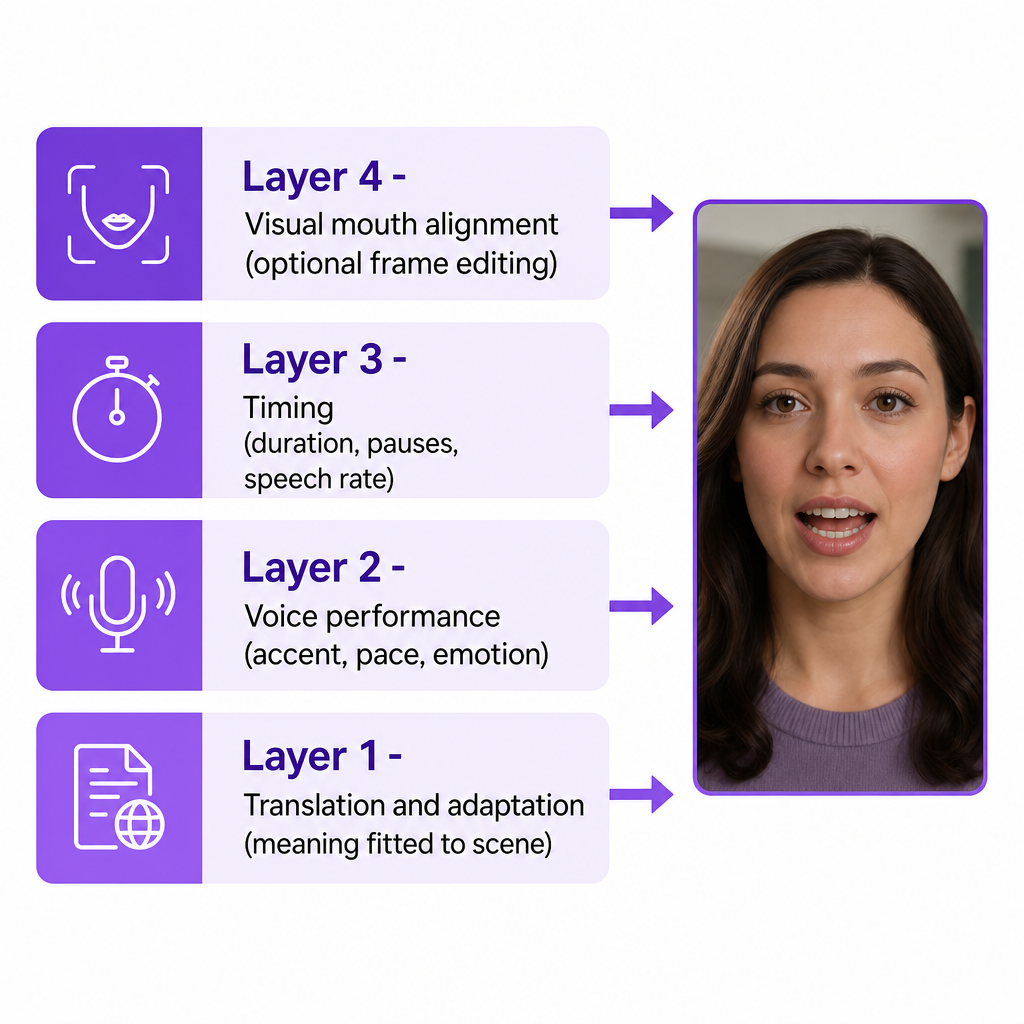
The translated dialogue is adapted to fit several things at once: the actor's visible mouth movements, the duration of each line, the pauses and shifts in speaking speed, important mouth shapes such as closed-lip sounds, and the character's expressions and emotional delivery. In dubbing research, these requirements are described through distinct types of synchronization—phonetic synchrony covers the relationship between translated speech sounds and visible articulation, while isochrony covers the duration of a line and its pauses. Broader quality also depends on rhythm, body movement, and emotional cohesion.
The practical takeaway is that lip sync is not just starting and stopping audio at the right moment. It is a combined audio, language, and visual-matching problem, and each layer can fail independently.
Lip sync dubbing versus voice-over
A voice-over places translated narration or dialogue over the original video. The speaker's mouth generally stays unchanged, and the new voice does not need to match every visible articulation. Lip sync dubbing goes further by adapting the translation, performance, timing, or visuals to reduce the apparent mismatch between the new speech and the actor's mouth.
| Feature | Voice-over | Lip sync dubbing |
|---|---|---|
| Original audio | Often remains quietly underneath | Usually replaced or reduced |
| Visible mouth movements | Need not match the new language | Must look compatible with new speech |
| Translation flexibility | Relatively high | Constrained by timing and mouth shapes |
| Production complexity | Lower | Higher |
| Best for | Narration, interviews, tutorials | Close-ups, scripted scenes, films |
A video does not always need lip sync to work. For a tutorial built on screen recordings, a clear voice-over is often preferable. For a close-up interview or a dramatic scene, visible mouth mismatch becomes far more distracting. For a broader introduction to the underlying localization process, see What Is Video Dubbing? A Clear Beginner's Guide.
How a lip sync dubbing workflow runs
A lip sync dubbing workflow normally combines language processing, speech generation, timing adjustment, and—optionally—visual alignment. The stages overlap, but each one carries its own failure points.
The source speech is first transcribed and split into speaker turns or timed segments. Accurate segmentation matters because every translated line must land in the moment the character actually speaks. Background noise, overlapping voices, music, and unclear pronunciation all make this stage harder.
The dialogue is then translated and adapted. A literal translation is rarely dubbing-ready; the target line may run too long, too short, or clash with visible mouth shapes. Adaptation leans on shorter or longer phrasing, natural synonyms, reordered sentence structure, adjusted pauses, and equivalent idioms. The goal is to preserve meaning while producing a line that can be spoken within the original scene.
Next, a target voice is generated or recorded. The adapted script is performed by a human voice actor or produced with speech technology, and the voice still has to carry the right accent, pace, emotional tone, intensity, and character identity. Our AI Dubbing tool supports dubbing from 60+ source languages into 33 target languages and can clone each speaker's voice for multilingual output, with editing of speakers, text, and timings before export.
Timing and speech rate are adjusted after the voice exists, because an accurate translation can still finish seconds before the actor stops moving their mouth. Our AI dubbing workflow exposes editable timestamps, speech-rate adjustment, background-sound controls, and segment regeneration, so a single mismatched line can be fixed without rebuilding the whole project.
Finally, the visuals may be aligned to the new speech. In traditional dubbing the video itself is left untouched and the performance is adapted to fit existing mouth movements. Newer AI lip-sync systems can instead modify the visible mouth region: a model analyzes the target audio and the video frames, predicts suitable mouth movements, and synthesizes updated lip shapes while trying to preserve the speaker's identity, pose, and background. Research describes this as a localized video-editing task rather than a full regeneration of the clip. This stage helps most in close-ups, but it adds a quality-control requirement—the generated mouth must stay stable frame to frame and consistent with the rest of the face.
The four kinds of synchronization behind a good dub
"Lip sync" is used loosely, but strong dubbing actually depends on several related forms of alignment, and knowing them helps you judge where a dub falls short.
Phonetic or lip synchrony is the strictest meaning: matching visible articulation to the sounds of the translated speech. It matters most for bilabial sounds made with both lips such as p, b, and m, labiodental sounds like f and v, rounded vowels, and clearly visible words in close-up. A line can be grammatically perfect yet still look wrong if the mouth visibly closes at the wrong moment.
Isochrony means matching the duration of the original line, including its pauses and approximate start and end. This is harder than it sounds because languages express the same idea with different numbers of syllables, so a direct translation easily overruns the original speech.
Rhythmic synchrony concerns the internal pace of speech. A line can hit the correct total duration and still feel off if the words rush in one section and drag in another.
Kinesic synchrony aligns the performance with visible gestures and expressions. A character who whispers, laughs, shouts, or turns away from the camera needs a delivery that fits the action. Together, these four criteria explain why lip sync dubbing is more demanding than placing translated audio beneath a video.
When lip sync dubbing is worth the extra work
Lip sync dubbing earns its cost when the audience can clearly see a speaker's face and the visual performance carries the content. Strong candidates include narrative and short films, television and streaming content, interview clips with frequent close-ups, character-led YouTube videos, animated videos with visible speaking characters, on-camera brand and product videos, and e-learning lessons where an instructor stays on screen.
A simpler voice-over is usually the better call when the video is mostly screen capture or slides, the speaker is rarely visible, the content is instructional narration, the turnaround is short, or budget and processing constraints make visual mouth editing impractical. The deciding factor is the viewer's likely attention: if the mouth is small, obscured, off-screen, or shown only briefly, heavy lip-sync work adds cost without adding much perceived value.
What to evaluate before choosing a tool
Before committing to any lip sync dubbing tool, pressure-test it against the parts of the job that break quietly. Language coverage comes first—check both source-language recognition and target-language output, since a platform can support many languages while offering uneven voice, pronunciation, or editing control in each. We currently present AI dubbing for 33 target languages with source content from 60+ languages.
Translation and adaptation quality matters just as much, because a fluent translation is not automatically a good dubbing script. Judge whether meaning, names, terminology, tone, and natural sentence length survive the process. For technical, medical, legal, or regulated content, keep a human review pass even when the first draft is automated.
Voice identity and consent controls deserve real attention. Cloning can preserve continuity across languages, but you should have permission to clone and distribute a person's voice—especially for employees, clients, actors, public figures, and customer testimonials. A responsible workflow documents who controls the source recording, whether the speaker consented, which languages and channels are authorized, how long the voice may be used, and what happens when the agreement ends.
Timing and editability separate a usable tool from a demo. Look for control over timestamps, pauses, speech rate, speaker assignment, and per-segment regeneration, because automatic output is rarely perfect across a full video. If the tool edits the picture, inspect visual quality closely: mouth edges, teeth and tongue rendering, facial hair, rapid head movement, side profiles, occlusion from hands or microphones, and frame-to-frame stability. Audio mixing is the final check—confirm the workflow preserves or controls music, sound effects, room tone, original speaker bleed, and loudness across scenes. Our AI dubbing workflow includes background-sound controls alongside timing and text edits, which helps refine the final mix rather than treating dubbing as a blunt voice swap.
Export and integration options close the list. Creators often need downloadable video files, while agencies and developers need automation; our AI Dubbing API supports automated multilingual video workflows, and you should confirm current inputs, authentication, and output behavior on the product page before building against it.
Limitations and risks to plan for
Lip sync dubbing has predictable failure modes, and naming them early keeps published work safe. Translation length is the first: some languages need more syllables than others, so compressing speech too hard makes the voice sound unnatural, while leaving a translation unchanged can let the audio outlast the visible speech. A creative adaptation usually beats a literal one.
AI-generated mouths can show artifacts around the lips, teeth, jaw, or facial boundaries, and the risk climbs with fast movement, extreme camera angles, obstructed faces, overlapping speakers, low-resolution footage, and strong shadows. A human review pass is advisable before anything commercial goes out.
Voice cloning raises consent and identity concerns because a cloned voice can be mistaken for an authentic performance. Using someone's voice without authorization can create privacy, publicity-rights, contractual, or reputational problems, so keep clear consent records and avoid cloning voices you do not control.
Realistic synthetic content may also require disclosure. YouTube says creators must disclose realistic altered or synthetic content that viewers could mistake for real, including some uses of a realistic person's synthetic voice; its guidance lists exceptions, such as cloning your own voice for voice-overs or dubs, so review the current YouTube disclosure policy for your situation. Requirements also vary by platform, jurisdiction, contract, and project type. Finally, remember that perfect synchronization does not guarantee cultural localization: a flawlessly synced video can still feel foreign if the translation ignores local idioms, humor, or pronunciation expectations. Lip alignment is one part of localization, not a replacement for editorial review.
Frequently asked questions
What is lip sync dubbing in simple terms?
It replaces spoken dialogue with another language and adjusts the words, timing, voice, and sometimes the video so the new speech appears to match the speaker's mouth.
Does lip sync dubbing change the actor's face?
Not always. Traditional lip sync relies mainly on adapting the translation and timing. AI visual-dubbing systems may also edit the mouth area of the video to match the new audio.
Is lip sync dubbing the same as AI dubbing?
No. AI dubbing is the broader process of translating and creating replacement dialogue with AI. Lip sync is a feature within that process that aligns the performance with visible mouth movements, so not every AI dub is lip synced.
Can YouTube creators use lip sync dubbing?
Yes. Creators can use dubbed audio or video for multilingual content, but they should check YouTube's current disclosure rules when synthetic or altered media could be mistaken for authentic speech.
Can DubSmart create lip-synced dubs?
Our AI Dubbing tool aligns dubbed output with characters' lip movements and expressions, and it includes voice cloning, timing and text editing, speech-rate controls, and dubbing into 33 languages. Because capabilities vary by project and language, review the generated video before publishing.