
A credit-based pricing model is a usage-based system where you buy or receive a balance of credits and spend them on individual actions, instead of paying a separate fee for every feature. Each action consumes a defined number of credits, so one shared balance can cover several tools at once. For AI media work, this matters because the real question is rarely "what does the plan cost?" It's "how many credits will my workflow burn, what does each credit represent, and what happens when I run out?" This guide breaks down the mechanism, compares it to other pricing structures, and shows exactly how we apply it at DubSmart AI so you can forecast spend before you start producing.
Table of contents
What "credit-based pricing" actually means
Four elements work together in any credit model. There is a credit balance, the number of credits included, purchased, or granted to an account. There is a usage rate, the number of credits a specific action requires. There is consumption, which deducts credits as you use the product. And there are renewal, rollover, or top-up rules that decide what happens to unused or depleted credits.
That makes credits an intermediate unit sitting between money and product usage. You pay for a plan or a credit package, and the platform converts actions—generating audio, dubbing video, creating an image—into credit consumption. Stripe describes credits as prepaid or promotional usage applied across usage-based products, sometimes with overage charges once the balance runs out.
The catch is that a credit has no universal value. One platform may charge one credit per character of speech, another one credit per image, and a third several hundred credits per video minute. The number "50,000 credits" tells you nothing until the provider defines the conversion rate clearly. That definition is the single most important thing to read before you commit.
How the model works step by step
Most credit systems follow the same shape. You select a plan or receive promotional credits, the platform adds them to your account, and from there each billable action is measured, matched to its credit rate, and subtracted from your balance. When the balance drops, you keep using what remains, wait for a renewal allocation, roll credits over, upgrade, or pay for additional usage.
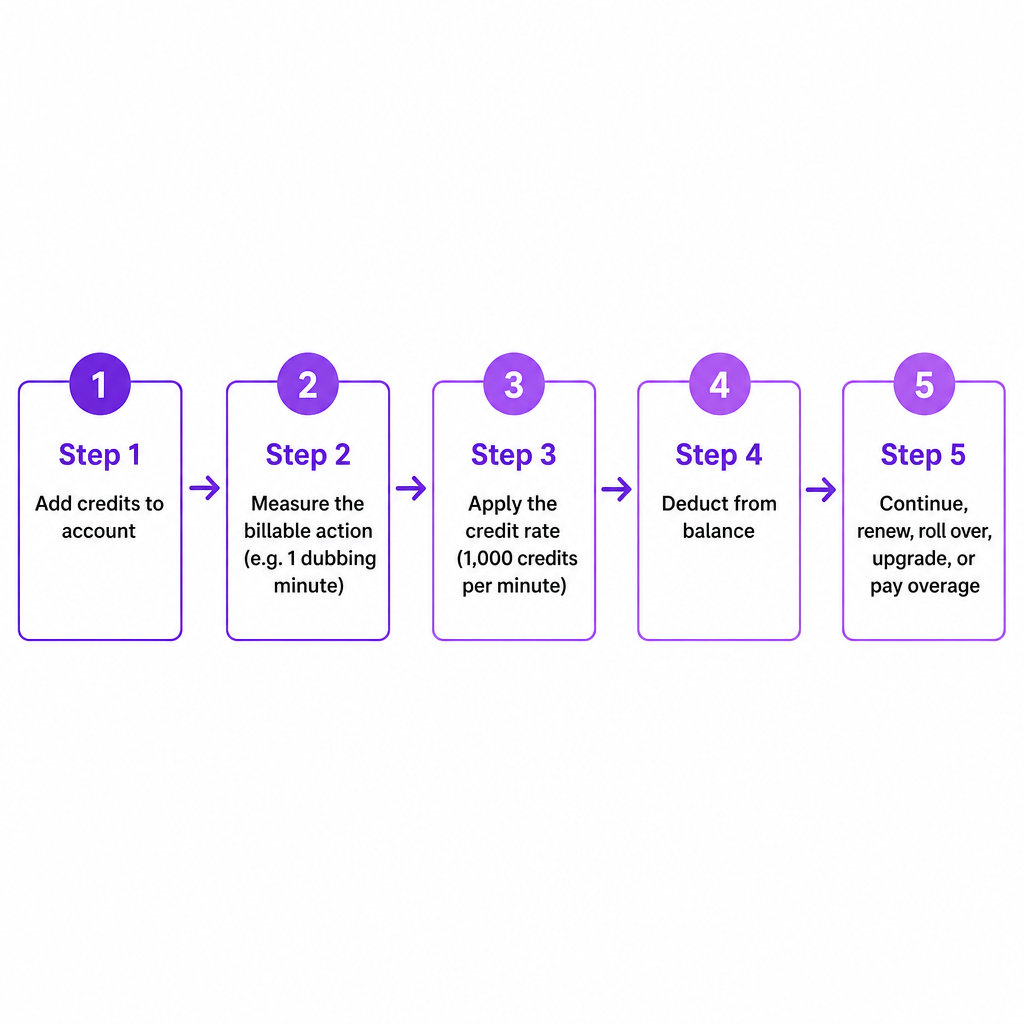
A quick example makes the math concrete. Suppose a platform charges 1,000 credits per minute of AI dubbing. A 12-minute video needs 12 × 1,000 = 12,000 credits. If you hold 50,000 credits, that single project consumes 24% of your monthly allocation. Some systems track this burn in real time; others reconcile at the end of the billing period. As Stripe notes, basic usage-based billing may settle credits at invoice time, while more advanced setups show real-time balance visibility.
How credit pricing compares to other models
Credit pricing sits between a flat subscription and direct usage billing. A flat fee is easy to understand but inefficient when you lean hard on some features and barely touch others. Pure pay-as-you-go reflects usage precisely, yet monthly totals get hard to forecast. Credits create a shared budget that links price to activity while letting you move across several tools without juggling separate invoices.
| Pricing model | How customers pay | Best suited to |
|---|---|---|
| Flat-rate subscription | One fixed fee for a defined feature set | Predictable, consistent usage |
| Per-seat pricing | A fee per user or account member | Team collaboration software |
| Pay-as-you-go | Direct payment for each unit consumed | Highly variable usage |
| Credit-based pricing | A balance spent across different actions | Products with several usage-based tools |
| Hybrid pricing | Subscription credits plus overage or top-ups | AI platforms and business APIs |
The practical takeaway is that credit pricing earns its keep when one account touches multiple tools. If you only ever use a single feature with stable volume, a flat specialized plan can be cheaper and simpler.
How we use credit-based pricing at DubSmart AI
We run one shared credit pool across our web tools and APIs. Credits spend on AI Dubbing, Text to Speech, Voice cloning, Speech to Text, Speech Separator, and AI image generator—rather than forcing you to buy a separate balance for each product. The same rates apply whether you work in the browser or call the API, so a dubbing minute costs the same either way.
| DubSmart AI feature | Published credit rate |
|---|---|
| AI Dubbing | 1,000 credits per processed minute |
| Text to Speech | 1 credit per generated character |
| Speech to Text | 100 credits per transcribed minute |
| Speech Separator | 100 credits per separated audio minute |
| Text to Image | 200 credits per generated image |
Because the rate card is fixed, estimating a project is straightforward: total credits = dubbing + TTS + transcription + separation + image generation. Say a creator wants to dub a 10-minute video into one language, generate 8,000 characters of extra narration, and transcribe the original. That works out to 10,000 credits for dubbing, 8,000 for TTS, and 1,000 for transcription—an estimated 19,000 credits. Running that math against a plan's monthly allowance before production starts is the whole point of the model.
Plans and allowances
Our published U.S. pricing, dated September 30, 2026, lists the following allowances. The approximate dubbing minutes assume every credit goes to AI Dubbing at 1,000 credits per minute; real mixed workflows will differ.
| Plan | Billing | Price | Included credits | Approx. dubbing capacity |
|---|---|---|---|---|
| Free | One-time | $0 | 2,000 | ~2 minutes |
| Starter | Monthly | $19.90 | 50,000 | ~50 minutes |
| Standard | Monthly | $49.90 | 150,000 | ~150 minutes |
| Pro | Monthly | $99.90 | 350,000 | ~350 minutes |
| Enterprise | Monthly | $249.90 | 1,000,000 | ~1,000 minutes |
The Free tier is a one-time 2,000-credit allocation with watermarked output. Paid plans renew monthly, and unused paid-plan credits roll over to the next month. Annual billing lowers the effective monthly price on each paid tier. If you want the full mechanics of carrying credits forward, our explainer on how rollover credits work covers the rules in detail.
Overflow matters too. Published additional-minute rates are about $1.20 on Starter, $1.00 on Standard, $0.50 on Pro, and $0.25 on Enterprise. A cheaper plan can quietly become the expensive option if your projects routinely exceed the included credits.
The benefits worth paying attention to
The clearest advantage is a shared budget across tools. You might spend on dubbing one week, TTS narration the next, and image generation later in the month, all from the same pool—no separate subscription or payment method per feature. That also makes spending more predictable: a team can set a monthly ceiling and estimate how much content that ceiling supports, which helps with YouTube localization, multilingual marketing, e-learning, podcast production, and automated content pipelines.
Credits also align cost with consumption more honestly than a flat fee. Someone producing two minutes of audio shouldn't pay the same as someone producing two hours, and credit burn connects the bill to actual activity. For teams still testing ideas, a shared balance lowers the barrier to experimentation—you can try dubbing, narration, and speech separation inside one platform before deciding where to invest.
For developers, a documented rate card is a planning tool. With our AI Dubbing API, Text to Speech API, and Voice Cloning API sharing the same credit mappings as the web tools, you can calculate the credits a typical request, batch, or customer account will consume before you ship the integration.
The risks and limits to watch
Credit pricing isn't automatically cheaper or simpler. Its value depends on how clearly the rates are defined and how closely you monitor usage.
The first trap is that credits can hide the real monetary cost. "50,000 credits" sounds generous until you convert it. At our rates, that balance equals roughly 50 dubbing minutes, or 50,000 TTS characters, or 250 generated images—very different amounts of work. Always translate credits into the unit you actually care about.
Related to that, features consume credits at wildly different rates. A plan that looks roomy for text-to-speech can feel tight for video dubbing, so judge a plan against your whole rate card, not one favorite feature. Overage charges can shift the economics further: if you regularly exceed your allowance, upgrading often costs less than paying per-minute extras on a smaller tier.
Unused-credit rules vary across the market too. Some providers roll credits over, some cap the amount, and some expire everything at period end. Before committing anywhere, confirm whether rollover exists, whether it's capped, whether promotional credits roll over, which credits are spent first, what happens after cancellation or downgrade, and whether annual and monthly plans differ. On our paid plans, unused credits roll over to the following month.
Finally, mixed workflows burn faster than people expect. Dubbing one video into five languages can create five separate outputs, and layering transcription, separation, narration, and generated visuals on top multiplies consumption. Forecast against the entire workflow, not just the source-video runtime. And remember that rates, allowances, and rollover policies are current commercial terms, not permanent guarantees—confirm them directly before a major integration.
Deciding whether this model fits you
Credit-based pricing tends to suit you when you use several related features from one platform, your usage shifts month to month, you want a defined budget, the provider publishes clear conversion rates, and you can monitor balances. Rollover or flexible top-ups make it stronger still, especially if you need both a web workflow and API access from the same balance.
A different model may serve you better when usage is extremely stable and a flat plan is simply cheaper, when you need uncapped usage with no metering, when the provider won't explain what a credit represents, when expiration forces waste, when overage is hard to forecast, or when your entire workload rides on one feature that a specialized provider offers far cheaper. Honest answers to those conditions tell you more than any headline price.
A practical credit-planning framework
Before picking a plan, estimate your usage in the platform's actual billable units: video or audio minutes to dub, number of target languages, text characters to synthesize, audio minutes to transcribe, audio minutes to separate, images to generate, combined API and browser usage, and your expected monthly peaks.
Then convert each activity into credits using this estimate:
Monthly credits = (dubbing minutes × dubbing rate) + (TTS characters × TTS rate) + (transcription minutes × transcription rate) + (separation minutes × separation rate) + (generated images × image rate)
Add a sensible buffer for revisions, test exports, failed generations, and campaign spikes, then compare the total against the plan allowance, rollover rules, and overage rate. For an uneven publishing calendar, rollover is genuinely valuable: a creator who ships little one month but localizes a full course the next can carry unused credits forward instead of losing them.
The forecast looks different by audience. YouTube creators should multiply video count, average runtime, and target languages—a 20-minute video dubbed into three languages is roughly 60 processed minutes before any extra TTS or transcription. Marketing teams should price in launch and seasonal peaks, which make rollover and overflow rates decisive. E-learning and training teams should total lesson minutes across every language plus revisions, not just the source runtime. Podcasters and filmmakers should calculate cleanup, transcription, narration, and dubbing feature by feature since all draw from one pool. Developers and agencies should model usage per customer, request, asset, and language, and set programmatic limits to prevent surprise overage.
Frequently asked questions
What is a credit-based pricing model?
It's a model where you pay through credits—purchased, included in a subscription, or granted free—and each product action consumes a defined number of them. One shared balance can cover several tools.
Is credit-based pricing the same as usage-based pricing?
It's a form of usage-based pricing. The difference is that credits act as an intermediate unit between money and usage, so the platform deducts credits by its rate card instead of billing you directly for every character, minute, or request.
Are credits the same as minutes?
No. They're different units. A provider might charge 1,000 credits per dubbing minute, while another feature uses credits per character, image, request, or audio minute.
How do I calculate my credit usage?
Multiply the amount of each activity by its credit rate, then add the results. At DubSmart, dubbing uses 1,000 credits per minute while Text to Speech uses one credit per generated character.
Do DubSmart credits roll over?
Yes—unused credits on our paid plans roll over to the next month. The Free tier is a one-time allocation rather than recurring monthly credits.
What happens when I run out of credits?
Depending on the plan, you can buy more credits, pay an overage charge, upgrade, or wait for renewal. We publish plan-specific overflow rates for additional dubbing usage.