
Scaling content production with AI means turning each script, video, and recording into many finished, multilingual assets without growing your team at the same pace. The practical answer to how to scale content production with AI is not stacking more tools on top of each other—it is consolidating voice, dubbing, transcription, and visuals into one workflow where every asset is designed from day one to be multiplied. At DubSmart AI, we built our platform around exactly that shift, so one master piece of content can become dozens of localized, repurposed versions without a proportional jump in headcount or budget.
The real decision isn't whether AI can generate media. It's whether you keep treating every video, episode, and course as a one-off production, or standardize on an AI-first workflow where content is built to scale across languages, formats, and channels.
Table of contents
What you are actually trying to scale
Before choosing any tool, it helps to name what scaling means for your channel or organization, because the three common versions pull in different directions:
- More versions of the same content — additional languages, formats, and lengths from one master.
- More total content — more episodes, lessons, or campaigns shipped each month.
- More channels — YouTube, TikTok, podcasts, learning platforms, and internal portals from the same source material.
Most creators and teams eventually need all three at once, which is why we designed DubSmart as a single place to create, localize, and scale media—voice, video, and images—rather than a single-purpose generator.
For the audiences we serve, scaling tends to take a recognizable shape. A YouTube creator turns one flagship video into dubbed versions for several markets, plus shorts and promos. A small business converts a handful of English explainers into full multilingual funnels of landing videos, ad creatives, and how-to clips. An e-learning team turns one course into consistent narration and localized editions across regions. Filmmakers and podcasters reuse masters for international releases and accessible versions. Developers and agencies embed voice and dubbing directly into their own products through our APIs.
The decision underneath all of these is the same: stop producing every asset as a fresh project, and start producing masters you intend to multiply.
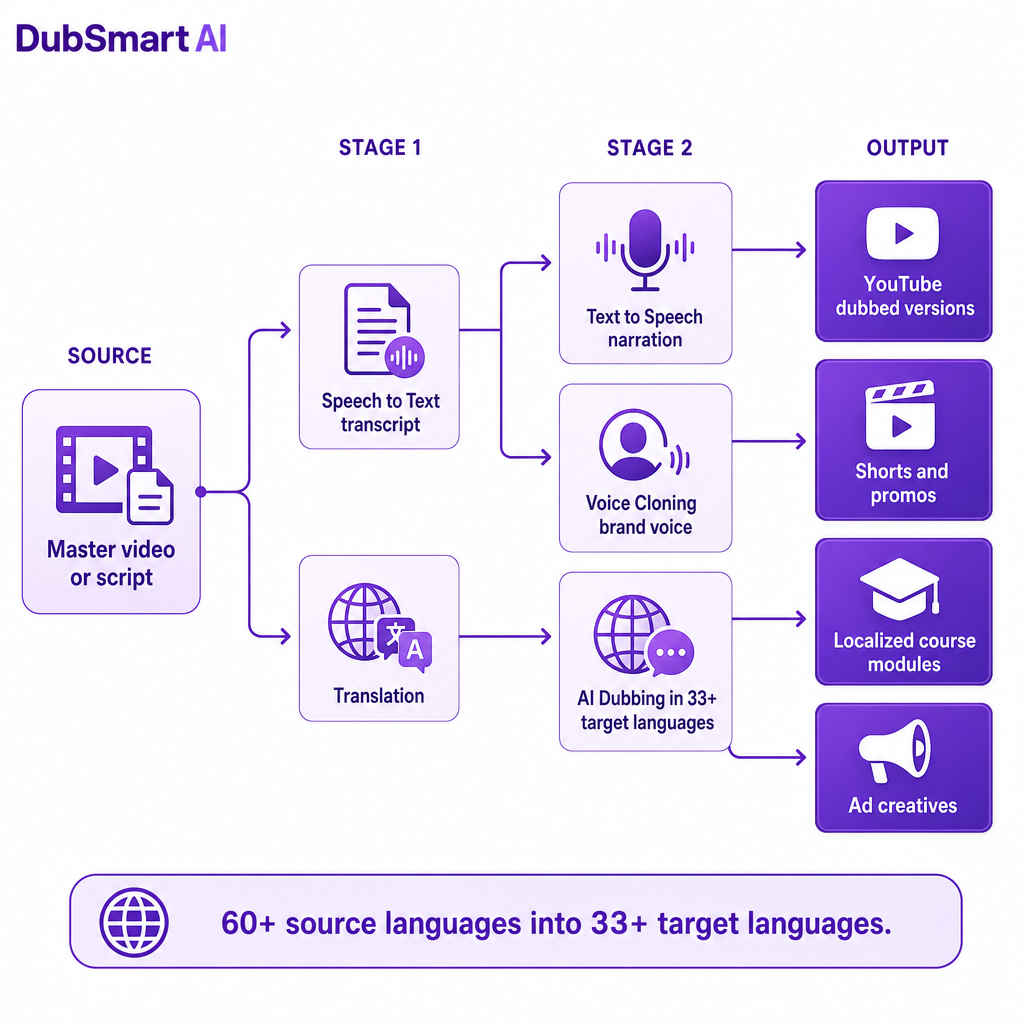
From manual production to an AI-accelerated workflow
A manual pipeline repeats the same costly steps for every asset: write the script, book and record human voiceover, edit, mix, master, then translate and re-record for each language before exporting and re-exporting for every revision. Each new language or format restarts most of that chain.
An AI-accelerated workflow keeps the creative decisions and automates the repeatable production. In our platform, the steps that used to require separate scheduling, software, and vendors live in one browser workspace:
- Text to Speech converts a written script into natural-sounding narration in seconds, drawing on a library of 300+ voices across many languages.
- Voice Cloning recreates a voice from a short sample so a brand or creator persona stays consistent across every project and language.
- AI Dubbing takes a source video or audio, transcribes it, translates it, and generates localized voice tracks in 33+ target languages from 60+ source languages.
- Speech to Text and Speech Separator clean and transcribe existing recordings, making archives searchable and ready to re-edit.
- Text to Image and Image to Video generate visuals from prompts and turn stills into motion, so you can ship campaigns without starting from footage.
The mechanism that actually produces scale isn't any one of these features. It's the consolidation: the output of one step feeds the next inside the same system, so a script becomes narration, narration becomes a dubbed catalog, and a transcript becomes new written and visual assets—without exporting between disconnected apps.
The core mechanisms that multiply your output
Narration without booking more talent
With our Text to Speech tool, you can paste a script, choose from hundreds of male, female, and neutral voices, and generate narration immediately. That changes how you plan: you can script first and generate audio later, test several tones before committing, and produce consistent series—course modules, podcast segments, onboarding flows—without lining up voice sessions.
Voice cloning extends this by letting you build a reusable custom voice from a short sample and apply it across both narration and dubbing. For a brand, that means one recognizable host voice across every language, even when the original talent isn't in the room, plus room for deliberate variants—a calmer internal-training voice alongside a punchier marketing one—while staying on-brand.
One master, many languages
Dubbing is the primary lever for turning a single piece of content into a global catalog. In practice, you upload a video or paste a link, our platform detects speakers, transcribes and translates the speech, and generates localized tracks using the same voice engine. You then adjust timings, speakers, and text segments in the editor before exporting your chosen format.
The features that make this scale rather than simply translate are multi-speaker detection—essential for interviews, panels, and scripted dialogue—broad language coverage, and tight integration with voice cloning so each dubbed version can keep the original speaker's identity or carry a consistent brand voice. For the step-by-step tactics, our guide on how to make a multilingual YouTube channel covers the operational workflow; this explainer focuses on why you adopt it.
Turning archives into new content
Scaling isn't only about new production. A large share of untapped output is already sitting in your recordings. Speech to Text creates accurate transcripts and subtitles, which makes old audio and video searchable, editable, and ready to repurpose. Speech Separator isolates voice from music and background noise, so you can clean, remix, or reuse a track without re-recording.
Together, these unlock podcast back catalogs that become blog posts, shorts, and dubbed episodes; recorded trainings that become structured modules with clean narration and subtitles; and rough footage that can be refined into higher-quality releases. If you want the hands-on process, our walkthrough on how to transcribe audio to text covers it directly.
Visuals at content velocity
Teams often hit the scaling ceiling in design and video, not audio. Our AI image generator produces on-brand images from prompts for thumbnails, social posts, and slides, while Image to Video converts stills into motion suitable for explainers, ads, and intros. Combined with narration and dubbing, this lets you move from script to AI voice to AI visuals to localized dub inside one system instead of stitching together separate apps for each stage.
How different teams structure their scaling strategy
Because the platform bundles these tools, the right strategy depends on where you start.
YouTube creators and independent filmmakers lean on dubbing to turn each flagship video into multiple language versions with multi-speaker support and consistent cloned voices, then pair that with short promos narrated by Text to Speech to keep the calendar full without extra shoots.
Small businesses and marketing teams treat the platform as a content multiplier: script or record one core explainer, then localize it and spin out product walkthroughs and ad creatives, with matching images and short videos so a multi-region launch doesn't require a proportional design budget.
E-learning and corporate training producers generate clear, consistent narration for modules, then localize courses through dubbing and add accurate subtitles with Speech to Text—keeping a large catalog coherent while supporting multilingual teams.
Podcasters and audio-first creators clean dialogue with Speech Separator, transcribe for editing and subtitles, and reuse those assets in dubbed or summarized episodes. When a release needs cinematic or broadcast-grade polish with human oversight, our professional dubbing studio layer adds that supervision.
Developers and agencies integrate our AI Dubbing API along with our Text to Speech and Voice Cloning APIs to embed scalable voice and localization inside their own products—a fit for learning platforms, OTT apps, and social video tools that need automated dubbing at volume.
Deciding when AI-first production is the right move
Five factors usually determine whether an AI-first stack earns its place over adding more freelancers and one-off tools.
| Decision factor | AI-first production fits when | What our platform contributes |
|---|---|---|
| Volume and frequency | You publish weekly series, multi-episode shows, or multi-module courses | A workspace built for high-volume creators and businesses |
| Language and market coverage | International reach or accessibility is a priority | Dubbing from 60+ source into 33+ target languages, with transcription and translation built in |
| Budget and cost structure | Per-session human costs are unpredictable | A credit-based model with rollover credits and a free tier to allocate across tools |
| Brand voice and quality | You need consistent host, character, or brand voices | Voice cloning plus a 300+ voice library, with a human-supervised studio option for critical cuts |
| Workflow and control | You want editorial oversight, not black-box output | Browser-based project editors, multi-speaker controls, and APIs |
If several rows describe your situation, centralizing on one platform is usually more sustainable than expanding a patchwork of vendors and single-purpose apps. If only one does, it may be worth adopting a single tool first and scaling the stack as your catalog grows.
Risks worth managing before you scale
Scaling with AI introduces real risks, and a few deserve a plan rather than a shrug.
Robotic or low-trust audio. Thin synthetic speech undermines credibility. Choosing voices by use case—different picks for ads, training, and podcasts—and testing before publishing keeps quality high across a large voice library.
Fragmented brand sound. Spreading work across many tools and freelancers splinters your identity. Reusable cloned voice profiles applied across dubbing and narration keep one recognizable sound.
Translation and cultural nuance. Automatic translation moves fast but can miss idiom and tone. For high-stakes content such as film, broadcast, or sensitive training, layer in human review—our professional studio service exists for exactly those cases.
Rights and consent for synthetic voices. Voice cloning raises licensing and consent questions. Treat cloned voices as assets that need documented permission, and keep usage inside a managed workspace rather than anonymous generators. For jurisdiction-specific obligations, confirm requirements for your own situation.
Misuse and deepfakes. Any capable voice engine can be abused when governance is weak. Keeping projects tracked inside one platform, under clear organizational policies, makes synthetic voice far easier to control than scattered ad hoc tools.
If you're still weighing AI narration against recording talent, our comparison of dubbing versus subtitles for video can help you decide how far to localize before you commit a whole catalog.
Frequently asked questions
What makes an all-in-one platform different from a single text-to-speech tool?
A single tool solves one step. We combine Text to Speech, Voice Cloning, AI Dubbing, Speech to Text, Speech Separator, Text to Image, and Image to Video in one workspace, so you move from script or source video to fully localized, multimodal content without switching apps or re-exporting between them.
How many languages can I realistically support?
Our AI Dubbing supports dubbing from 60+ source languages into 33+ target languages, backed by a 300+ voice library and voice cloning. That coverage makes it practical for a small team to run genuinely global channels.
Is this only for solo creators, or can teams use it?
Both. We serve individual creators and businesses, including professional dubbing workflows with human oversight and APIs for developers—so the same platform suits a solo YouTuber and an enterprise training team.
Can I integrate it into my own app or automation stack?
Yes. Our AI Dubbing, Text to Speech, and Voice Cloning APIs let developers and agencies embed scalable voice and localization directly into their products and pipelines.
How fast can I go from one language to a multilingual presence?
Timelines depend on your catalog size and review process. Because transcription, translation, voice generation, and project editing live in one place, a small team can turn a few core assets into many localized versions in days or weeks rather than months. For a tailored estimate, tell us your catalog size, target languages, and review requirements and we can map a realistic plan.