The honest answer to how much audio to clone a voice is shorter than most people expect: with DubSmart AI, you need at least 20 seconds of clean recording from one speaker. That minimum gets a usable clone off the ground, but it rarely tells the whole story. The length you should actually record depends on where the voice will live—a single social clip, a recurring channel narrator, a multilingual course library, or a brand spokesperson who has to sound identical across dozens of videos. Below, we separate the hard minimum from the practical target, explain what the model is really listening for, and give you a decision rule you can apply before you hit record.
Table of contents
The minimum versus the practical target
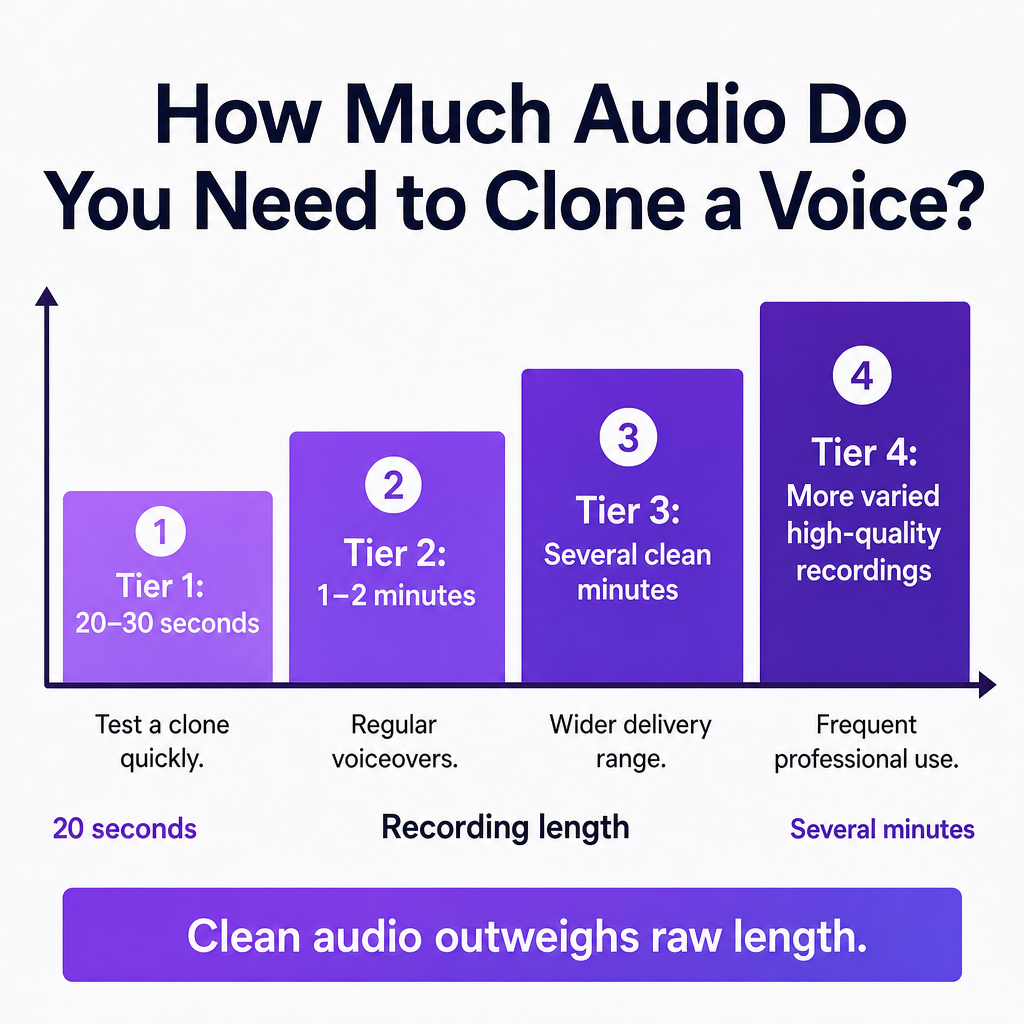
Twenty seconds is the floor, not the finish line. A minimum-length sample captures a speaker's basic identity, which is often fine for a quick test or a one-off clip. But the amount of material you give the model directly shapes how well the clone handles varied scripts. The right target scales with how demanding and repeated the output will be.
| Your goal | Practical audio target |
|---|---|
| Test a clone quickly | 20–30 seconds |
| Create regular voiceovers | 1–2 minutes |
| Capture a wider delivery range | Several clean minutes |
| Build a voice for frequent professional use | More varied, high-quality recordings |
The principle underneath the whole table is blunt: clean, consistent audio is usually worth more than a longer recording full of noise, echo, music, or multiple speakers. A tidy 30-second clip can outperform a messy 10-minute one. If you want the broader mechanics of how a sample becomes a reusable voice, our explainer on how voice cloning recreates a voice covers the full pipeline.
What “enough audio” actually means
“Enough” is not really a stopwatch number—it's a question of whether the model has enough useful speech to reconstruct the voice you want. When you clone a voice, the AI analyzes the recording to identify a set of characteristics and then uses them to generate new speech from text or translated dialogue.
Those characteristics include:
- Vocal tone and timbre
- Pitch and speaking rhythm
- Pronunciation and accent
- Pauses and cadence
- Energy, emphasis, and emotional delivery
A short sample fixes the speaker's core identity. A longer, more varied one adds information about how that person sounds when they explain, question, emphasize, pause, or shift emotional tone. So the real target is representative audio: material that shows the model the voice doing the kinds of things it will later be asked to do.
When to record more than 20 seconds
Reach past the minimum whenever the cloned voice will appear repeatedly, represent a brand, or carry longer-form content. For those cases a practical starting point is one to two minutes of clean speech, with more added if you need the voice to reproduce a broader range of delivery styles.
Longer samples pay off for narration-heavy work: YouTube videos, podcasts, online courses, corporate training, audiobook-style content, product explainers, multilingual dubbing, character dialogue, and repeated marketing campaigns. A creator who only records a calm introduction tends to get a clone that performs best in that one calm register. A creator who records explanations, questions, emphasis, and natural pauses hands the model far more examples of the voice in action. The aim is never to dump the maximum number of minutes—it's to supply audio that represents how the voice really behaves.
Why clean audio beats long audio
More audio helps only when the extra material is high quality and relevant. A 10-minute recording with room echo, keyboard clatter, background music, shifting microphones, or several speakers can be less useful than a short, clean clip. Louder noise is still noise, so turning up the gain never rescues a bad sample.
Additional audio earns its place when it is:
- Clearly spoken by one person
- Consistent in volume and microphone distance
- Free of music, sound effects, and overlapping voices
- Recorded in a quiet, low-echo environment
- Delivered at a natural pace
- Representative of the style you want to generate
A few recording habits protect quality more than any length target. Keep a single speaker in the clip; other voices confuse the analysis. Favor a small furnished room over a large empty one to cut reflections, and hold a steady mic distance throughout. Don't record one section up close and another from across the room, and skip padding the file with long silences or unrelated audio. If your only source is a noisy video, clean it first rather than hoping length compensates—our guide to removing background music from audio walks through that cleanup.
What your sample should actually say
Content matters as much as condition. The recording should hold clear, natural speech rather than isolated sounds or heavily chopped phrases. A strong sample mixes short and long sentences, a range of vowel and consonant sounds, numbers and dates, names and common terms, questions, emphatic statements, and natural pauses—ideally in the same kind of language the final content will use.
What that looks like in practice varies by creator. A YouTuber might record a short introduction, an explanation, a call to action, and a few lines at different emphasis levels. An e-learning producer could include instructional phrasing, definitions, lists, and transitions. A business spokesperson benefits from folding in brand terminology and the conversational style used in customer-facing content. Deciding whether you even need a clone here is a fair question; our breakdown of cloned voice vs stock TTS voice helps when a library voice would do the job faster.
Multilingual cloning and noisy source audio
For multilingual projects, the starting requirement is still the quality of the original voice sample. Translating generated speech into other languages does not remove the need for a clear source recording—a muddy English clip produces a muddy clone in every target language.
When you plan to localize, pay attention to the clarity of the original voice, the pronunciation of names and brand terms, the intended tone in each language, whether the speaker's style should stay formal, friendly, energetic, or conversational, and whether translated scripts have been reviewed before dubbing. On a larger localization project, test a short section in each target language before processing the full video; that surfaces pronunciation, pacing, and cultural-adaptation issues early. DubSmart's AI Dubbing workflow can use a cloned voice for translated content, and cloned voices can be used in both Text to Speech and AI Dubbing.
Source quality is the other half of this problem. You can often extract speech from a video, but background music, sound effects, room ambience, wind, audience noise, overlapping speech, and compression artifacts all make a clip a poor starting point. If the source is valuable but noisy, isolate the speech first. Our Speech Separator pulls a voice track away from other audio elements, and the cleaner that track, the more reliable the clone.
Consent and the right to clone a voice
You can only clone another person's voice when you have the appropriate permission and rights. Voice cloning carries real legal, ethical, privacy, and impersonation risks, so before uploading someone else's recording, get their informed consent and confirm how the voice may be used, distributed, and retained. The U.S. Federal Trade Commission's Voice Cloning Challenge rules required participants to clone voices only with the consent of the person whose voice was cloned.
For commercial work, document who owns or controls the voice, which recordings may be used, which content types and languages are permitted, whether commercial use is allowed, how long permission lasts, whether the person can withdraw it, and how synthetic content will be disclosed when appropriate. Don't clone a public figure, employee, customer, actor, or family member simply because you can access a recording of them. Access is not permission.
How much to record by creator type
The same minimum applies to everyone, but the practical target shifts with the production risk. Use the minimum when speed matters—early creative testing, short-form clips, internal prototypes, simple announcements—and record more whenever the voice must stay consistent across many videos or languages.
| Creator | Recommended sample |
|---|---|
| YouTube creators | 20s to test; 1–2 clean, expressive minutes for a recurring narrator |
| Small business / marketing | Consistent spokesperson clip with campaign terminology and energy; test a short voiceover first |
| E-learning / training | Longer, varied sample covering definitions, instructions, questions, transitions |
| Podcasters | Sample reflecting the host's normal pacing; check name and sponsor pronunciation |
| Filmmakers | Sample matching character direction, including whisper, intensity, or other dramatic qualities |
| Developers / agencies | A repeatable audio standard applied before accepting client samples |
Two practical notes sit behind that table. A neutral sample will not reproduce a performance that depends on whispering, irony, or fear, so filmmakers should capture the character, not just the voice. And for API-driven pipelines, a fixed intake standard prevents inconsistent results across clients; our Voice Cloning API creates custom voices from audio samples and makes them available to Text to Speech and AI Dubbing.
A short pre-upload check keeps results predictable. Confirm the sample runs at least 20 seconds, features one speaker, carries no music or overlapping voices, has minimal echo and background noise, keeps a steady mic position and level, contains natural speech rather than long silence, matches the intended style, and comes from a speaker who has consented to the intended use.
Use 20 seconds to test the concept, one to two minutes for dependable everyday narration, and more varied clean audio when the voice must perform consistently across long-form or multilingual content.
The minimum gets you started. Recording quality, speaker consistency, expressive range, and permission decide whether the result is ready to publish.
Frequently asked questions
How much audio do you need to clone a voice?
With DubSmart you need at least 20 seconds of audio. For better coverage of the speaker's delivery, aim for one to two minutes of clean, natural speech.
Is 10 seconds enough to clone a voice?
It may suffice for some systems, but it sits below DubSmart's stated minimum. Upload at least 20 seconds for a DubSmart clone.
Is one minute enough for voice cloning?
Often yes, for everyday narration, provided it is clean, consistent, and spoken naturally. A larger, more varied sample helps for expressive or professional use.
Does a longer recording make the clone more accurate?
Not automatically. Extra length helps only when it adds clean, relevant examples of the voice. Noise, echo, music, and multiple speakers reduce the value of added audio.
Do I need permission to clone a voice?
Yes. Obtain consent and confirm the applicable rights before cloning another person's voice, covering intended use, distribution, and commercial activity. The FTC's voice-cloning challenge rules also required consent from the person whose voice was cloned.
Can I use a voice clone for AI dubbing?
Yes. Created voices can be used in both Text to Speech and AI Dubbing.