
If you are pricing out transcription, the honest answer is that there is no single sticker price for Google Speech-to-Text. As of October 6, 2026 (USD), the core cloud API starts with 60 free minutes per month and then charges about $0.016 per minute of audio on standard models with data logging enabled, which works out to roughly $0.96 per hour before any other Google Cloud charges. That number is only the starting point, because your real bill shifts with API version, logging choice, storage, networking, and how your audio is chopped into requests. This breakdown walks through the drivers behind google speech to text pricing, what the per-minute rate does and does not cover, and how that minute-based math compares to our own credit-based Speech to Text workflow.
Table of contents
The honest range and why one flat price doesn't exist
For a typical creator sending standard logged audio to the cloud API, the effective range lands between $0 and about $0.96 per hour of transcribed audio before any additional Google Cloud services enter the picture. The free band covers the first 60 minutes of audio per month per billing account, and above that each minute is billed at $0.016 USD as of October 6, 2026. Multiply 60 minutes by that rate and you get the ~$0.96 hourly figure.
The reason there is no universal flat price is that six variables move the final number: how many billable minutes you send past the free tier, whether you enable data logging, which API version and model you choose, whether you run on the cloud or the On-Prem option, how many other Google Cloud services you attach, and the rounding rule that converts each request into billable seconds. Because all of these shift per account and can change over time, any budget should be tied to the current Google Cloud pricing page and your actual monthly volume rather than a remembered number.
How Google bills cloud Speech-to-Text
Google prices cloud Speech-to-Text on the amount of audio successfully processed, measured in time rather than characters. The billing unit matters more than most planning spreadsheets assume. According to the Speech-to-Text release notes, as of 2026 all models are billed with the same rule: each request is rounded up to the nearest one second, with no minimum audio length. That replaced an earlier approach that rounded each request up to the nearest 15 seconds, which still appears in some On-Prem references and older examples.
One-second rounding changes the economics of short content. A three-second social hook or micro-learning clip is billed as three seconds, not fifteen, so creators who publish many short files no longer pay a padding penalty on each request.
On the free and paid split, Google lists a standard "with data logging" SKU where the first 60 minutes of audio per month are free per billing account. Past that, every additional minute is charged at $0.016 USD as of October 6, 2026.
Data logging is its own cost lever. Google historically offers different rates depending on whether you opt in to logging for model improvement. Third-party summaries based on Google Cloud documentation report standard models at roughly $0.004 per 15 seconds (about $0.016 per minute) with logging enabled, and roughly $0.006 per 15 seconds (about $0.024 per minute) without it. Because the non-logged rate is not fully exposed on the public pricing snippet, treat it as "slightly higher than logged" and confirm the exact figure on the current pricing page before you commit a budget.
API version and feature set also enter the conversation. Google's main Speech-to-Text page notes that pricing depends on API version, channels, and batch methods, and describes a V2 API with Chirp models plus data residency options, priced around $0.016 per minute for certain use cases, aligning with the standard logged rate. Features such as audit logging or customer-managed encryption keys differ across versions, but the core price driver stays constant: minutes of audio processed, not the content type or language.
There is also an On-Prem option, priced by audio processed per month with requests rounded up to 15-second increments. Google's On-Prem page shows an example where three 7-second requests bill as 45 seconds (3 × 15 seconds) for $0.018 USD total, which implies an effective rate of about $0.006 per 15 seconds, or roughly $0.024 per minute as a calculated estimate from that listed charge. On-Prem is built for locked-down, self-managed environments and generally matters only to regulated enterprises with strict data residency or offline requirements.
What the per-minute rate includes and excludes
The minute price buys a specific slice of the stack. It covers transcription of audio into text using the selected models (standard, Chirp, and so on), access to batch or streaming recognition per your chosen version and configuration, and the 60-minute monthly free tier for standard logged cloud usage. New Google Cloud accounts also often receive a general $300 USD credit for proofs of concept across services, which can be applied to Speech-to-Text during early testing.
What the per-minute rate does not include is where surprise costs usually hide:
- Cloud Storage used to hold your audio files.
- Network egress for serving or exporting audio and transcripts.
- Other Google Cloud services in your pipeline, such as Cloud Functions, Pub/Sub, or databases.
- Taxes and regional billing adjustments.
Google also requires you to enable billing to use the speech and text APIs, though you are not charged unless you exceed the free quota or the general credits on your account. For a creator whose real goal is "upload a video, get a transcript, then dub it," those excluded infrastructure costs are the difference between a tidy per-minute line item and a multi-service bill that needs ongoing monitoring.
Minute billing vs. our credit-based Speech to Text
Our Speech to Text sits inside one media creation and localization platform that also covers AI Dubbing, Voice Cloning, Text to Speech, Speech Separator, Text to Image, and Image to Video. Instead of per-minute infrastructure billing, we use platform credits with rollover, a free tier, and enterprise plans. That structural difference is the real comparison, not a head-to-head on a single number.
| Dimension | Google cloud Speech-to-Text | Our Speech to Text |
|---|---|---|
| Billing unit | Minutes/seconds of audio per account, in USD | Platform credits spendable across tools |
| Scope | Transcription infrastructure you assemble | Transcription as one step in a localization pipeline |
| Extra costs | Storage, networking, other Cloud services billed separately | Covered within a single credit balance |
| Budget shape | Scales linearly with minutes plus cloud usage | Pre-purchased credits that roll over |
| Best fit | Developers wanting deep API/infra control | Creators and developers wanting one workflow |
The practical upshot is predictability. With minute billing, costs scale linearly with audio processed and with every other Cloud product you touch, so you monitor usage metrics and logs continuously. With credits, you pre-purchase a balance, track consumption across tools, and roll over what you do not use, which simplifies forecasting when your month mixes videos, podcasts, and courses. We serve both audiences: creators get a single interface, while developers can integrate transcription through our APIs alongside Text to Speech and AI Dubbing.
Rather than re-explaining how transcription works mechanically, our guides on how to transcribe audio to text and choosing a speech to text API cover workflow; use this page for the money math.
Exact inputs you need for a reliable quote
To turn google speech to text pricing into a real monthly budget on the cloud side, gather eight inputs: estimated billable minutes per month per project and account (after the first 60 free), your data logging decision, the API version and model, whether you use batch recognition, streaming, or both, your audio channel configuration (mono vs. stereo and channel count), your storage strategy for raw audio and transcripts, your network egress plans for exporting those files, and the rounding impact of your request mix (many short clips vs. fewer long files). With those, you multiply billable minutes by the correct USD rate and add the separate infrastructure line items.
For a like-for-like estimate on our side, tell us the total minutes you expect to transcribe monthly by content type, the source and target languages if you pair transcription with dubbing, whether you also plan to use Voice Cloning, Text to Speech, Speech Separation, or Image to Video in the same workflow, your team size and concurrency, your split between API and dashboard use, and your quality bar (editing-grade transcripts vs. production-ready subtitles). Those answers let us recommend a credit bundle that covers transcription and the related tools under one balance instead of separate minute budgets per product. If any of these are still unknown, send what you have and we will size a bundle around it.
Worked pricing examples
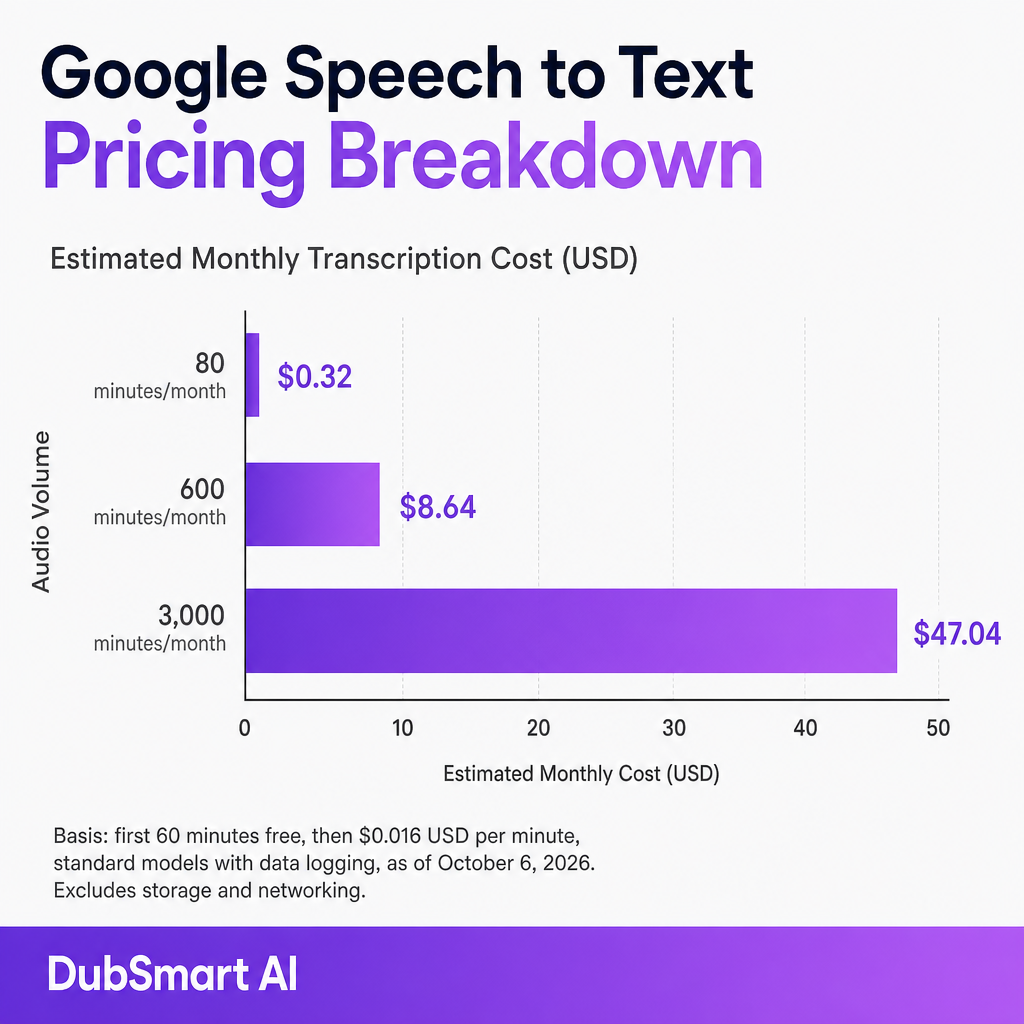
All figures below are simplified estimates using Google's published per-minute rate and assume standard models with data logging enabled; real bills vary with model choice, logging, and other services, and exclude Cloud Storage and network costs.
YouTube creator, one weekly 20-minute video. Monthly audio is 4 × 20 = 80 minutes. The first 60 are free, leaving 20 billable minutes at $0.016, for an estimated $0.32 per month in transcription.
Podcast producer, 10 hours per month. That is 600 minutes; 60 free leaves 540 billable minutes. The estimate is 540 × $0.016 = $8.64 per month.
Training team, 50 hours of webinars per month. That is 3,000 minutes; 60 free leaves 2,940 billable minutes, for an estimated 2,940 × $0.016 ≈ $47.04 per month.
Each of these shows only the transcription charge. Add storage and egress on the cloud side, and remember that a mixed localization month, where transcripts feed dubbing and voiceover, is exactly the scenario a single rolling credit balance is built to smooth out.
Frequently asked questions
Is Google Speech-to-Text free?
Google offers 60 minutes of transcription per month for free on standard models with data logging enabled, per billing account. New Cloud users may also receive a separate $300 USD credit for broader experimentation across Google services.
Are enhanced models more expensive than standard?
No. Google's release notes state that enhanced models are no longer priced differently from standard models; usage of all models is reported and priced like standard models.
How are short clips billed now?
All cloud Speech-to-Text requests are rounded up to the nearest one second with no minimum audio length, replacing older 15-second rounding for cloud usage. On-Prem references may still use 15-second increments.
Does the minute price include storage and networking?
No. The per-minute rate covers transcription only. Cloud Storage, network egress, and other Google Cloud services are billed separately under their own pricing.
How does this compare to your Speech to Text?
Google charges per minute (or second) of audio with separate infrastructure costs, while we use a credit-based model that covers Speech to Text plus dubbing, text to speech, voice cloning, and related tools inside one workflow, with rollover credits and enterprise options for larger teams.