When people search for ghostface text to speech, they usually want one thing: to turn a written script into a dark, threatening voice reminiscent of the masked caller from the Scream films. What they rarely realize is that this almost never means generating the official character voice. In the movies, that performance belongs to voice actor Roger L. Jackson, delivered through a voice-changing device inside the story. A text-to-speech tool does something different: it generates brand-new speech from your text using a synthetic or authorized voice model. So the real question isn't "how do I get the Ghostface voice?" It's "do I need a licensed performance, or an original horror voice with the same unsettling qualities—low register, deliberate pacing, loaded pauses, and a threatening delivery?"
That distinction shapes every choice that follows, from which voice you pick to what you can legally publish. We'll walk through how the sound is actually built, where DubSmart AI fits, and how to stay on the right side of voice-rights rules in the United States.
Table of contents
What ghostface text to speech actually means
At its core, ghostface text to speech is a horror-narration use case for a general-purpose AI voice engine. Creators reach for it to voice Halloween videos, fictional scary stories, game trailers, horror-comedy sketches, suspense podcasts, animated characters, and short films with original casts.
A text-to-speech system reads your written text, converts the words into pronunciation and language information, predicts speech features like rhythm, pitch, emphasis, and pauses, then synthesizes those features into an audio waveform. The output is a fresh recording generated from text rather than lines captured one by one from a human actor. Our Text to Speech tool runs exactly this process, using algorithms that mimic human intonation across more than 300 voices, multiple languages and accents, with controls for speech rate, emotion, and emphasis, plus downloadable audio.
The menacing character you're after isn't a single button. It emerges from how you combine the voice you choose with the way you write and process the script. If you're new to the underlying technology, our explainer on how neural text to speech works covers the pipeline in more depth.
Is it the real Ghostface voice?
Usually, no—and that matters more than it first appears. A "Ghostface voice" offered by an online generator tends to be one of four things: a generic horror voice built to sound dark and theatrical; a style imitation preset meant to evoke the pacing and attitude of the character; a voice-conversion effect that reshapes a recording with pitch and distortion; or an unauthorized replica trained to imitate a recognizable performer without clear permission.
These are not interchangeable, legally or technically. An original horror-inspired voice is fine for a character you invented. A realistic imitation of a known actor or a branded fictional character pulls in rights and licensing questions that have nothing to do with how good the audio sounds.
Our public Text to Speech page lists stock voices and voice-cloning features; it does not offer an official Scream Ghostface voice or a Roger L. Jackson voice. So treat any third-party page that slaps a "Ghostface" label on a preset as marketing, not proof of licensing. Don't present generated audio as official, endorsed, or performed by Jackson unless you hold separate authorization.
How the menacing sound is engineered
The recognizable effect comes from layered choices, not one slider. Each layer is a lever you can test independently.
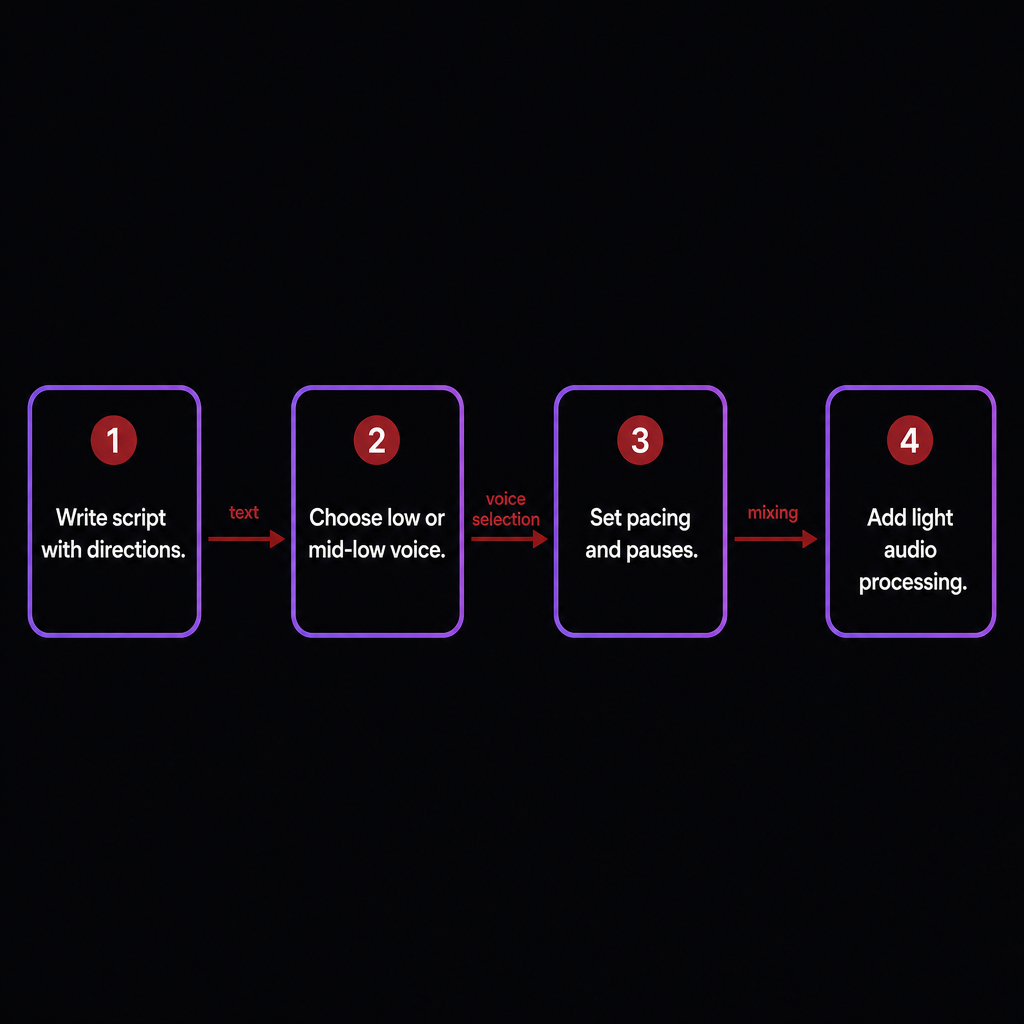
Vocal register. A lower pitch adds weight and threat, but dropping to the lowest available setting usually produces an unnatural, distorted result. Aim for a moderate reduction that keeps the words intelligible on phone speakers, laptop speakers, and headphones alike.
Controlled pacing. Ghostface-style dialogue feels deliberate. A slower delivery lets listeners anticipate the next line and makes short sentences land as confrontations. Speech rate is adjustable in our workflow, where the default 1.00x can be tuned per project. The smart move is to slow only the threatening lines; slowing everything flattens the tension and sounds artificial.
Pauses. Silence creates more dread than constant distortion. Insert punctuation, line breaks, or separate dialogue segments where the speaker should hesitate. "Do you like scary movies?" becomes far more unsettling as "Do you like… scary movies?" Short pauses work best right before a name, a reveal, a threat, or a question.
Emphasis through written direction. Synthetic voices respond to clear instructions better than vague ones. You can use dialogue tags such as "he said happily" or "he shouted angrily" to signal emotional tone, and capitalization to stress a vowel. For horror, describe the delivery in the script itself:
[quiet, controlled, threatening] You should not have answered.
Resist the urge to shout in all-caps everywhere. Overdone emphasis reads as yelling, not menace.
Sentence length. Short lines give the model more room for dramatic control. Compare "I have been watching you for several minutes, and I know exactly what you did last night" with:
I saw you. I know what you did.
The broken version hands the voice more chances to pause and shift intensity.
Audio processing. TTS generates the voice; editing shapes the horror. After you have a clean take, add subtle room reverb, telephone-band filtering, light saturation, controlled compression, background ambience, and carefully mixed music or effects. Apply these last. Heavy processing up front hides pronunciation problems and buries the words.
Stock voice, cloning, or a human performer
Text to speech and voice cloning solve different problems, and the wrong pick creates either a weak performance or a rights headache. This comparison maps the trade-offs.
| Option | Best for | Main input | Main risk |
|---|---|---|---|
| Stock AI voice | Fast narration, original characters | Text | Voice may not match the intended character |
| Voice cloning | Reusing an authorized narrator's identity | Clean voice sample and text | Consent and impersonation concerns |
| Voice conversion | Transforming an existing performance | Recorded speech | Can imitate a real person too closely |
| Human voice actor | Licensed character work, nuanced acting | Script and direction | Higher cost and production time |
We keep Text to Speech and Voice cloning as separate tools for this reason. Our Text to Speech product supports stock voices and lets you clone voices for use across languages, but our public pages do not establish any right to clone a celebrity, fictional character, or copyrighted performance without permission. For an invented horror character, a stock voice with sharp written direction is usually the safer and faster path. For a recurring channel narrator, clone your own voice or use a performer who has granted clear permission.
Building an original horror voice in DubSmart AI
Our Text to Speech workflow turns a script into generated audio: open Text to Speech, enter your text, select a speaker, generate the speech, edit the project, and download the result. For a Ghostface-inspired but original outcome, a few habits make the difference between a convincing villain and an obvious robot.
Choose the voice by behavior, not by name. Look for a voice that is calm rather than energetic, low or mid-low in register, articulate at slower speeds, capable of controlled emotional delivery, and appropriate for your character's age and identity. Avoid picking a voice just because a page labeled it "Ghostface"; that label often describes an imitation, not a licensed performance.
Write the performance into the script using restrained directions:
[low, calm, almost amused] You picked up. [pause] That was a mistake.
The aim is to guide tone without asking the system to reproduce a named actor's exact delivery.
Fix pronunciation before adding effects. If a name or number comes out wrong, rewrite it phonetically or spell it out—writing numbers as words helps when the system mispronounces them. Generate several versions of tricky lines; a clean, accurate take beats a heavily processed one nobody can parse.
Finally, compare short test samples before committing to a full episode. Run the same three lines through several voices and rates: a neutral statement, a whispered or quiet line, and a sudden threat. Pick the voice that stays believable across all three. A voice that dazzles in one sentence can turn mechanical over a longer script. If your story travels, our AI Dubbing can carry the voice into other languages—just review each one, since translation changes the rhythm and cultural weight of a threat.
Voice rights and ethics in the United States
Voice imitation involves more than copyright. The U.S. Copyright Office's report on digital replicas addresses technology that realistically reproduces a person's voice or appearance; it notes that copyright law does not preempt laws restricting unauthorized voice replicas and discusses publicity rights, especially where a person's identity is used commercially. You can read the primary source in the Copyright Office digital replicas report.
The safest practices are straightforward: don't clone another person's voice without permission; don't describe an imitation as the official voice; don't use a recognizable actor's voice to sell products without authorization; and never use generated audio for fraud, harassment, threats, or deception. Disclose AI involvement when the context could confuse viewers, keep records of consent and permitted uses for any voice sample, and review the rights attached to music, film clips, scripts, and character names separately.
There's a real-world reason to take impersonation seriously. The Federal Trade Commission has warned that voice cloning makes scams more believable, including schemes that impersonate relatives or executives to request money or information; its guidance on harmful voice cloning is worth reading. Even in entertainment, avoid realistic impersonation that could mislead a listener. This is general information, not legal advice; commercial projects involving a recognizable character or performer should be reviewed by qualified counsel or the relevant rights holders.
A simple decision framework keeps you clear: choose a stock AI voice when the character is original, you need fast narration, or you're producing frequent content. Choose an authorized voice clone when you own the source voice or have written permission, need consistent narration across episodes, and can document permitted uses. Hire or license a human performer when the project depends on recognizable character acting, when emotional nuance is central, or when the line between inspiration and imitation isn't acceptable for a commercial release.
Before you publish, run a quick gate: Is the voice presented as original rather than official? Can every word be understood without headphones? Do the pauses create suspense instead of awkward gaps? Does the character sound stable across scenes? Are names, numbers, and foreign words correct? Is the voice louder and clearer than the music? Could a viewer mistake the audio for an official recording? Do you have permission for every voice sample, track, clip, script, and character reference? And does it still land on mobile and short-form platforms?
Frequently asked questions
Is ghostface text to speech free?
Some tools offer free trials or limited generation, but availability and usage rights vary. We provide Text to Speech with stock AI voices and voice-cloning functionality; check your current account and credit terms before producing a commercial project.
Can I use a Ghostface AI voice on YouTube?
You can use an original horror-inspired AI voice as long as your script, audio, music, and visuals are properly licensed and the presentation doesn't falsely imply official Scream involvement. A recognizable imitation can create extra rights and platform risks.
Can DubSmart AI generate the official Ghostface voice?
Our public Text to Speech page does not identify an official Ghostface or Roger L. Jackson voice. Use the service to create an original horror narration or an authorized voice clone rather than assuming a generic "Ghostface" label is official.
Can I clone Roger L. Jackson's voice?
Not without explicit authorization from the relevant rights holder and performer. A realistic replica of a person's voice can raise publicity-rights and digital-replica issues, especially in commercial use.
What makes a voice sound scary?
Controlled pacing, meaningful pauses, restrained emphasis, clear pronunciation, and an appropriate register usually matter more than extreme pitch shifting. A clean, understandable performance beats a heavily distorted one.