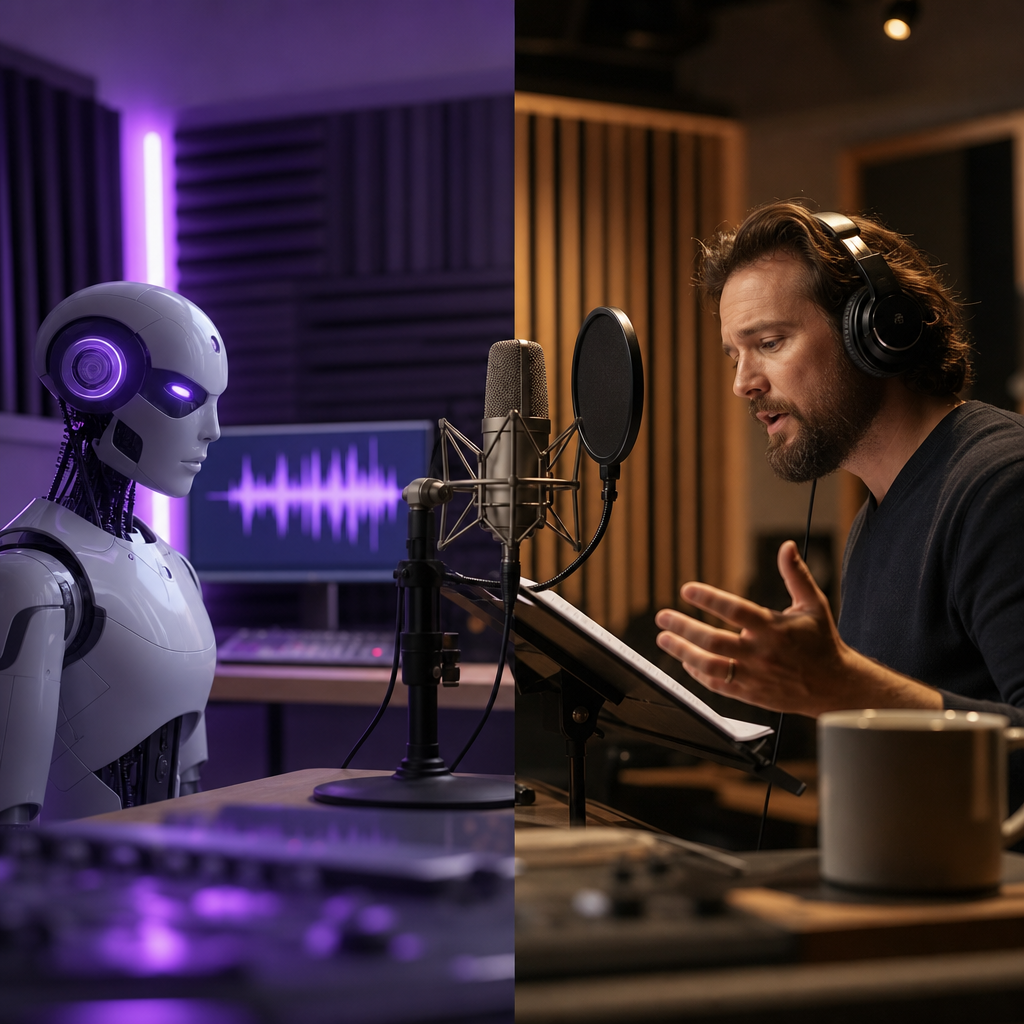
Picking a voice for your content rarely comes down to a single winner. The honest version of ai voiceover vs professional voice actor is a sorting question: which pieces of your library need genuine human emotion, and which need fast, scalable narration you can produce and localize on demand. Treat it that way and the debate stops being philosophical. It becomes a routing decision you can apply video by video, campaign by campaign.
Below we define the real alternatives without crowning one, compare them across the criteria that actually move results, and map out when each path fits — including the hybrid setups that most mature teams end up running.
Table of contents
The real alternatives, without picking a winner
For a US-based creator or team, three practical paths exist, and each trades off a different advantage.
AI voiceover (synthetic voice). Audio generated by text-to-speech and neural voice models trained on large datasets of human speech. You write or paste a script, pick a voice, adjust pace, tone, and emphasis, and generate narration in minutes. On our platform this path bundles 300+ natural-sounding voices, voice cloning from short samples so you can keep your own voice identity, dubbing and translation across dozens of languages in one workflow, and APIs for building voice into apps and automated pipelines.
Professional voice actor (human talent). A trained performer who interprets your script, brings acting craft, and records in a professional or treated home studio. Human actors excel at genuine emotion, subtle timing, and micro-changes in tone that make content feel alive and trustworthy. You usually collaborate through briefs, live direction, and revisions until the performance matches what your brand needs.
You as the voice (DIY recording). You record yourself with a decent microphone and basic editing tools. This preserves authenticity and skips casting, but it leans heavily on your comfort with performance and post-production. Many creators later pair this route with voice cloning so their personal voice becomes a scalable asset for future content instead of a recurring recording chore.
None of these is universally better. The work is deciding which one earns each slot in your content calendar.
Criteria that actually decide the call
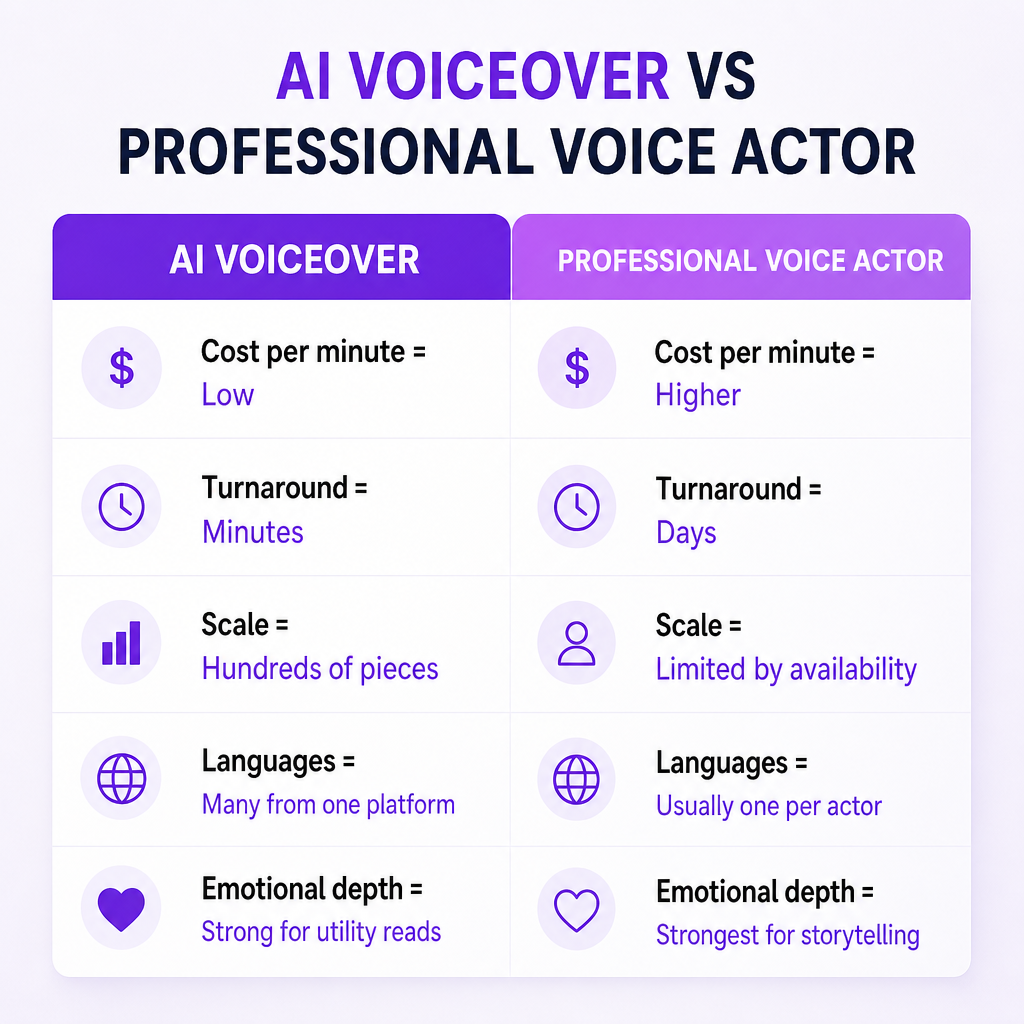
The comparison gets clearer when you score each path against the dimensions that change outcomes rather than the ones that sound impressive. The table below condenses the trade-offs; the notes after it add the nuance a grid can't hold.
| Criterion | AI voiceover | Professional voice actor |
|---|---|---|
| Cost per minute | Low; fits high-volume, modest-ROI content | Higher; session, studio, and revision costs |
| Turnaround | Minutes once the script is ready | A day to several days; rush at a premium |
| Scale | Hundreds of pieces, consistent output | Limited by availability and fatigue |
| Language coverage | Many languages from one platform | Usually one primary language per actor |
| Emotional depth | Strong for utility reads | Strongest for persuasion and storytelling |
Cost and budget flexibility. AI voiceover is consistently cheaper per minute, which makes it viable for long training series, large back catalogs, and frequent social clips where return per piece is modest. Human talent costs more because you pay for session rates, studio time, and direction, and that premium buys emotional nuance and a distinctive voice profile that can differentiate a brand.
Speed and turnaround. AI narration can be generated in minutes once the script is final, which suits rapid testing, time-sensitive explainers, and strict publishing schedules. Human voiceovers typically run from a day to several days for casting, recording, and revisions, with rush delivery at a premium — a trade that's reasonable for planned launches where extra refinement pays off.
Scalability and volume. Once configured, AI generates large volumes with identical voice characteristics across hundreds of assets, which is why it maps so well to e-learning catalogs, multilingual corporate training, and localizing a big YouTube archive. Human talent delivers consistent quality too, but availability, scheduling, and fatigue cap the volume, so scaling to many languages usually means multiple actors and heavier project management.
Language coverage and localization. AI engines serve many languages and accents from a single platform, letting you localize into tens of languages without assembling separate casts — the core of how we approach AI Dubbing for multilingual channels and global campaigns. Each human actor usually covers one primary language, so full localization means sourcing talent per locale. Human casts still win when deep cultural adaptation and idiomatic delivery drive conversions and audiences expect a native-sounding local voice.
Emotional depth and trust. Synthetic voices have grown highly realistic and work well for neutral, informative reads such as tutorials and news-style narration. Comparative reviews still note that AI falls short on deep emotional arcs, complex character acting, and subtle humor or irony. Human actors remain the preferred choice for brand-defining commercials, testimonials about real people, and narrative audiobooks or podcasts where the voice carries the whole experience.
Consistency and creative direction. AI output is identical every time you run the same script with the same settings, which is powerful for strict brand guidelines and long series; you can even lock a brand voice as a cloned model. Human performances vary slightly with mood and environment — charming for some brands, a risk for tightly controlled corporate narration. Direction also differs: with AI you steer through settings, style parameters, and instant regeneration, while a human actor gives you live back-and-forth, alternate takes, and judgment that can catch awkward phrasing or lift a script beyond a literal read.
Compliance and audience perception. Several platforms and policy summaries now expect synthetic media to be labeled, and some publishing environments explicitly flag AI voiceover as content that must be disclosed. Audiences tend to accept AI for utility content and push back when emotional messaging isn't clearly human. Human voiceovers generally need no special disclosure, and many organizations still link real voices with premium, trustworthy communication.
Where DubSmart AI fits on the AI voiceover path
For our core audiences — YouTube creators, small marketing teams, e-learning producers, indie filmmakers, podcasters, and developers — the AI option isn't a single voice generator. It's a connected stack.
- Text to Speech turns scripts into narration across 300+ voices in minutes.
- Voice cloning converts your voice, or a talent's voice, into a reusable AI voice so branding stays consistent without repeat sessions.
- AI Dubbing translates and re-voices entire videos into 33+ languages inside one workflow.
- Speech to Text and the Speech Separator clean audio, transcribe, and prep assets for dubbing or remixing.
- APIs let dev teams and agencies build voice generation, dubbing, and cloning straight into their products.
Together, this treats AI voiceover as a programmable layer in your content system rather than a one-off export. That distinction matters most when you're deciding how far to scale a single master script.
When AI voiceover is the better choice
Reach for AI voiceover when your conditions line up like this:
- You produce high-volume informational content — tutorials, product walkthroughs, explainer shorts — where clarity and speed outweigh dramatic performance.
- Deadlines are measured in hours or days, and your team needs immediate iteration.
- You want to test many versions of the same message, varying hooks, CTA phrasing, or length, before committing to a big media buy.
- You need many languages or regions from a single master script without coordinating multiple actors.
- Your budget is tight or variable, and a credit-based, usage-aligned model suits you better than per-session human rates.
For teams on our platform, this maps cleanly to using Text to Speech, voice cloning, and AI Dubbing for utility and scalable content, while keeping room to invest in human talent where the payoff is higher.
When a professional voice actor is the safer choice
Choose a professional voice actor when the stakes tilt toward emotion and brand:
- The goal is conversion or persuasion rather than information — brand films, launch campaigns, fundraising videos.
- Your positioning leans on warmth, empathy, luxury, or high trust, as in healthcare, finance, or premium consumer products.
- The script demands complex acting choices — humor, sarcasm, tension-and-release storytelling — that AI still struggles to reproduce convincingly.
- Your audience or stakeholders are explicitly skeptical of AI, and you'd rather sidestep any authenticity debate.
- You want live collaboration, improvisation, and a unique vocal personality that becomes synonymous with your brand.
Even here, AI still earns a backstage role. Once the flagship human performance exists, you can use speech-to-text for captions and AI tools to spin up localized variants without re-recording the original.
When neither option alone is enough
Most mature content teams stop treating this as either-or and run a blend instead.
Hybrid brand strategy. Record high-stakes flagship assets with a professional actor or your own voice, then clone that voice to localize into multiple languages and produce matching spin-off shorts, teasers, and training modules that keep the original voice identity.
Tiered content strategy. Set explicit tiers and route work by value. Tier A: human talent for ads, launch trailers, and hero content. Tier B: AI voiceover for evergreen tutorials, onboarding, and FAQ videos. Tier C: AI dubbing for international variants and new markets.
Experiment-first strategy. Prototype with AI voiceover to refine wording and pacing, then bring in a professional actor once the structure is battle-tested. That trims wasted studio time and hands the actor a polished script to perform.
Our unified workflow — speech-to-text, voice cloning, AI dubbing, and image and video tools — is built for these mixed setups, so you can move between AI and human inputs without rebuilding your stack. If podcast localization is part of the plan, our walkthrough on how to translate a podcast into another language shows that routing in practice.
Framing your next decision
Instead of asking whether AI beats a professional voice actor, sort your library around three questions: which projects genuinely require human emotional depth, which categories can be standardized and scaled with AI, and where one strong human voice can be extended through cloning and dubbing.
For the technical side of how synthetic narration is built and where it sits alongside human performance, pair this comparison with our explainer on how AI voiceovers are made rather than repeating that ground here.
Frequently Asked Questions
Will AI voiceover replace professional voice actors?
AI has reshaped utility narration and large-scale production, but it still lacks the emotional nuance and interpretive skill many high-impact projects need. The practical outlook is coexistence: AI handles volume and multilingual reach, while human actors carry the most emotionally demanding, brand-critical work.
Do platforms require me to disclose AI voiceovers?
Several platforms and policy summaries treat synthetic audio as content that often must be labeled under synthetic-media rules. For US creators, it's prudent to check current guidelines for YouTube, TikTok, podcasts, and OTT services, and to add clear disclosure for sensitive topics or storytelling. Verify the specifics for your platform, since policies change.
Will AI narration hurt my brand?
AI tends to work best when the brand promise centers on clarity, speed, and access — tutorials, e-learning, FAQs — and the content is informational rather than deeply emotional. It can dent perception when used for high-emotion, premium campaigns where audiences expect a uniquely human performance.
Can I keep my own voice but still scale with AI?
Yes. With voice cloning you record a short sample, create a synthetic version, and use it across text-to-speech and dubbing. You keep your identity and personality while gaining AI's speed and multilingual reach.
How should I budget without a detailed price breakdown?
Treat human narration as a strategic investment for a limited set of high-impact assets, and AI voiceover as a variable cost aligned with usage for everything else. Plan around a fixed number of human-led flagship projects plus ongoing AI-based localization, training, and social content that grows as your channel or organization does.