
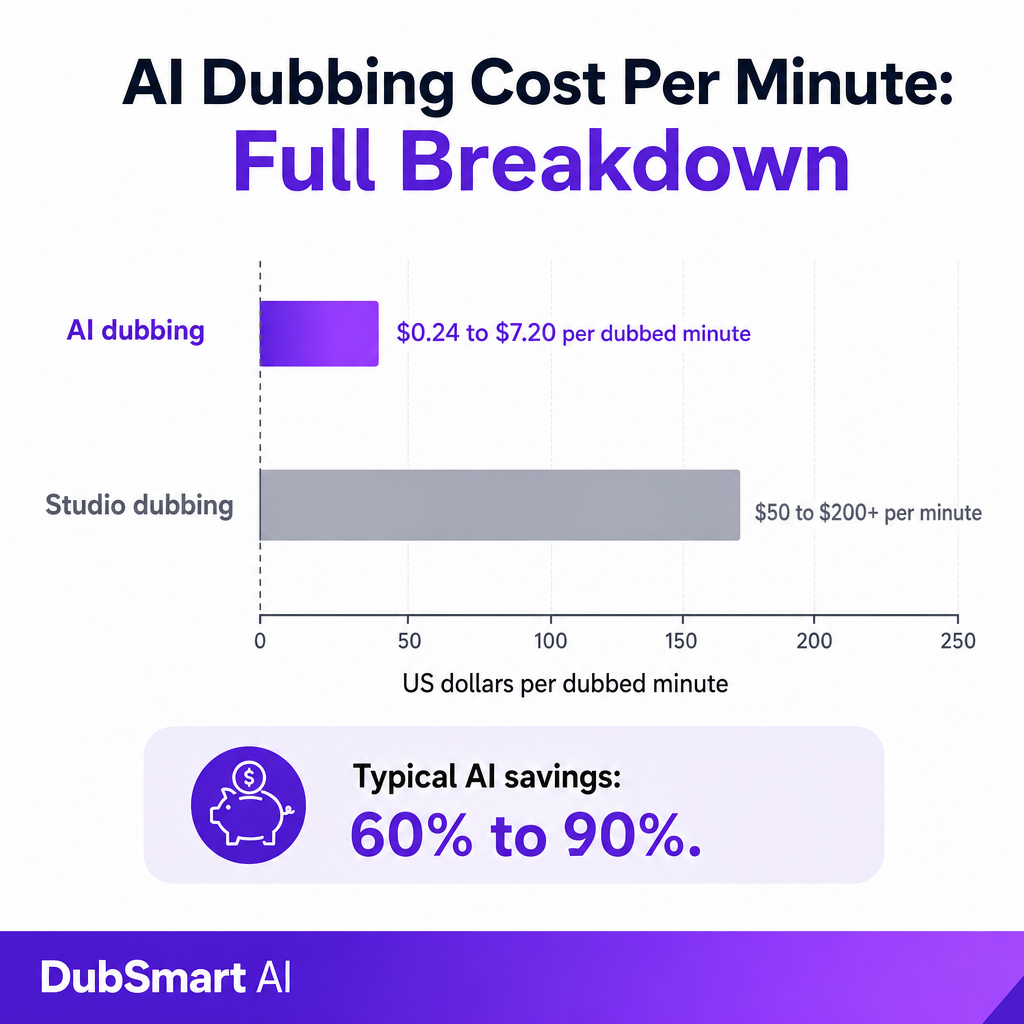
If you localize video for a living, the fastest way to lose control of a budget is to treat "per minute" as one fixed number. The ai dubbing cost per minute you actually pay in 2026 lands somewhere between roughly $0.20 and $7 per dubbed minute, and where you fall inside that range depends on three choices you make before you upload a single file: how many finished minutes you produce, how many languages you ship, and how much quality control you buy. Traditional studio dubbing still runs about $50–$200 per minute, so AI usually cuts localization costs by 60–90% for most content teams. The number below the headline matters more than the headline, and that is what this guide unpacks so you can turn a vague rate into a predictable line item.
Table of contents
What "AI dubbing cost per minute" really means for your budget
The phrase hides a decision. When you ask what AI dubbing costs per minute, you are really weighing three variables at once: the finished minutes you plan to localize, the number of target languages per asset, and the level of quality and control you need, from voice cloning to timing refinement.
Most modern platforms bill on the length of your source video multiplied by the number of output languages, not the raw minutes of the original. That single detail reframes the whole calculation. Your true cost per dubbed minute is the total bill divided by source minutes times the number of target languages. A five-minute clip shipped in four languages is twenty dubbed minutes, and your budget has to reflect that.
Across published benchmarks, entry-level dubbing features often fall between $0.10 and $3.00 per finished minute, while full feature sets that add lip-sync and premium options cluster between roughly $0.24 and $7.20 per dubbed minute. Against studio dubbing at $50–$200+ per minute, AI regularly reduces costs by 60–90%, which is why YouTube channels, e-learning libraries, and corporate teams have moved so quickly. For a 10-minute video dubbed into one language, that typically works out to roughly $1–$100 with AI versus $500–$2,000 in a studio, depending on the platform and options you enable.
How AI dubbing works and why minutes drive the price
The mechanism explains the meter. Understanding the pipeline makes it obvious why minutes and languages, not some abstract per-project fee, decide what you pay.
AI dubbing generally runs a three-stage chain. First, transcription and alignment convert your source speech into text and lock each word and sentence to timecodes, producing a time-accurate script. Second, translation and adaptation render that script into the target language and reshape it so it fits the original pacing while preserving tone and intent. Third, re-voicing sends the translated script through a synthetic voice model, either a stock voice or a cloned one, matching pauses and emphasis before the new track is mixed back into your video or podcast. You can read a fuller walkthrough of that pipeline in our explainer on how AI localization works.
Each stage is automated but computationally demanding, which is why platforms meter usage rather than charging flat fees. In practice you will see three billing shapes: per-minute billing on input or output media, credit-based systems where credits convert into minutes and often cover several voice features, and subscription bundles that include a fixed monthly pool. The billing model matters as much as the rate card, because it decides whether unused capacity survives to next month.
With our AI Dubbing workflow we run this entire chain, transcription through re-voicing, inside one environment covering 60+ source languages and 33 target languages, backed by a library of 300+ natural-sounding voices and fast voice cloning from short samples. Consolidating the stages removes the handoffs that quietly inflate the real cost of localizing a single asset.
How DubSmart AI structures cost per minute with credits
We price with a single currency instead of a different rate for every capability. Credits apply interchangeably across AI Dubbing, Text to Speech, Voice Cloning, Speech to Text, and the Speech Separator, so you spend from one pool rather than juggling separate minute counters per tool.
That design makes the math easy to project. Credits roll over, so unused capacity in a given period is not lost automatically. There is a free tier for testing and light use, plus enterprise plans for larger catalogs and integrations. From the public evidence available, 2,000 credits translate into about 2 minutes of AI Dubbing or Text to Speech, which implies that roughly 1,000 credits equal one localized minute of content.
Once you know the monetary value of a credit on your plan, your effective AI dubbing cost per minute is simply the cost of 1,000 credits. That figure travels with you into automation, too. Because we expose an AI Dubbing API, a Text to Speech API, and a Voice Cloning API, the same credit-to-minute logic holds when you dub inside your own apps or production pipeline, which keeps large-scale budgeting predictable rather than piecemeal.
The levers that move your effective per-minute cost
Four choices change your real rate regardless of which platform you use, and each one is worth deciding on purpose rather than by default.
Input minutes versus output minutes. Most tools price per output minute, meaning source length times languages. A 20-minute training module in five languages is 100 output minutes even though the original is only 20. At an effective rate of $1 per dubbed minute, that module costs about $100 in tool charges. Credits map naturally onto this, since you budget per finished localized minute regardless of the source language.
Audio-only versus lip-sync video dubbing. Some platforms charge less for audio-only dubbing, where you swap the voice track without visually retiming mouth movements, and more for precise lip-sync or precision modes. Audio-only and basic dubbing tend to sit around $0.50–$2.50 per minute, while advanced lip-sync or enhanced tiers can reach $3–$4.50+ per minute. If you serve podcasts, explainers, or screen-recorded content, you may not need paid lip-sync at all, keeping you near the low end. Narrative film and talking-head content are where better synchronization earns its extra spend.
Quality tiers and human review. Providers often offer a cheaper single-pass automated dub alongside higher-priced options with multiple AI passes or human QA. Those tiers push per-minute prices toward the top of the AI range, sometimes near $7 per dubbed minute, still far below studio work. Our platform is built for high-volume, consistent automation, so you can stay closer to the low or mid range while keeping control over voices and languages.
Billing model. On subscriptions, divide the monthly or annual fee by included minutes to find your effective rate. On pure pay-as-you-go plans, the published rate is your cost, though surcharges for extra languages or features can nudge it up. On credit-metered platforms, your rate depends on how many credits equal one dubbed minute and how those credits are priced on your tier. Our rollover credits and free tier help smooth seasonal spikes, so a course or channel with uneven volume can spread its effective per-minute cost over time instead of forfeiting unused capacity.
Decision criteria for a sustainable per-minute rate
The right rate is the one your content can pay back, so match spend to the value of the asset.
Content type and lifetime value should set your ceiling. A time-limited promo or one-off campaign has a short payoff window and rarely justifies premium tiers. Evergreen courses, flagship series, and core product explainers often earn more watch time and revenue over years, which makes paying slightly more per dubbed minute for better voices or synchronization a sound trade. Support for 33 target languages means once you localize a course or series, you can reuse those assets across regions without repeated studio fees.
Volume and language footprint decide whether aggressive localization stays viable. High-volume publishers running daily uploads or large libraries need low, predictable effective rates or budgets balloon fast. With entry-level AI rates between roughly $0.24 and $3 per dubbed minute, wide localization becomes realistic when you keep workflows efficient and skip expensive add-ons. Our credit system and APIs are built for exactly this scaling: each new asset adds linear credit consumption with no extra overhead.
Control over voice and brand often tips the decision for marketing and training work. Consistent voices across languages and series are a genuine differentiator, and fast voice cloning from short samples lets you hold a recognizable voice persona at AI pricing instead of paying studio rates for talent in every market. You can read how the underlying technology works in our overview of how AI recreates any voice. Combined with 300+ voices and the AI Dubbing API, that lets you standardize your audio identity across channels, courses, and apps without renegotiating VO contracts.
Time to market rounds it out. AI dubbing can process a typical video in minutes to a few hours, versus days or weeks for studio pipelines. In fast-moving niches like tech reviews, news commentary, or launch content, the ability to ship several languages quickly can outweigh squeezing out the lowest possible rate.
Where teams overpay, and how to avoid it
AI dubbing is cheap, but a few habits quietly erode the savings.
- Miscounting output minutes. Budgeting on source length while forgetting to multiply by target languages is the most common overrun. Always calculate the effective cost per dubbed minute with every language included.
- Underbuying quality. Choosing the cheapest tier can backfire when robotic or poorly timed audio drives audience drop-off. Paying a little more per minute for natural voices and clean timing usually beats recutting content later.
- Ignoring rights and compliance. With voice cloning, confirm you hold the right to clone a given voice and distribute the localized versions. Some regions impose specific rules around synthetic media, so verify requirements for your markets rather than assuming a single global standard.
- Workflow lock-in. Stitching separate tools for transcription, translation, dubbing, and mixing adds friction and makes migration painful. An integrated stack lowers these operating costs even when the nominal per-minute rate is similar, because you save on time, labor, and rework across the pipeline.
Ground your budget in output minutes, honest quality expectations, and workflow integration, and the AI price advantage holds up in practice instead of only on the rate card.
Frequently asked questions
How much does AI dubbing cost per minute today?
Across major AI dubbing tools, practical pricing runs from about $0.24 to $7.20 per dubbed minute depending on features, billing model, and quality tier. That is dramatically lower than traditional studio dubbing at $50–$200+ per minute.
Why is AI dubbing so much cheaper than studio dubbing?
AI replaces most human labor in transcription, translation, voice acting, and synchronization, and scales across large catalogs with minimal incremental overhead, which is why pricing benchmarks consistently show 60–90% savings versus studio workflows.
How does DubSmart AI calculate dubbing cost per minute?
We use a credit-based model. Public information indicates that 2,000 credits equals roughly 2 minutes of AI Dubbing or Text to Speech, so about 1,000 credits correspond to one localized minute. Your effective dollar cost per minute depends on how credits are priced on your plan.
Does DubSmart charge differently by language or feature?
Credits work across AI Dubbing, Text to Speech, Voice Cloning, and related tools, so you do not track separate minute counters per feature. You estimate the finished minutes and languages you will produce and allocate credits accordingly, using rollover and the free tier for experimentation.
Is there a free way to test AI dubbing before committing?
Yes. We offer a free tier so creators and teams can try AI Dubbing, Text to Speech, and voice cloning on a limited scale before upgrading, which is useful for channels and small businesses validating the impact of multilingual content.