Hoe u stemimitaties onder de knie krijgt: technieken die professionals gebruiken (plus AI-snelkoppelingen)
Je hebt een voice actor zien kijken een beroemde imitatie in drie seconden voltooien — toonhoogte, swagger, de vreemde klinkerneigingen, alles ervan — en je hebt je afgevraagd wat zij horen dat jij niet hoort. De kloof is geen talent. Het is diagnostisch. Werkende imitators proberen niet de stem na te bootsen die ze horen; ze deconstrueren de vijf mechanische lagen eronder. Amateurs achtervolgen het oppervlak en branden uit. Professionals isoleren één component tegelijk, oefenen dit gronddeels, en stapelen de rest dan op. Dat is het hele geheim, en het is het verschil tussen drie maanden gefrustreerde mimicry en een werkend karakterstem dat je echt kunt inzetten.
Aan het einde van dit stuk ken je de vijf mechanische lagen achter elke stem, de volgorde om ze te oefenen, de vijf fouten die maanden verspillen, en precies wanneer handmatige stemimitaties niet meer je tijd waard zijn — waar AI-stemmklooning en dubbing-tools het zonder verontschuldiging overnemen. Geen poortbewaking, geen mystiek, alleen de werkende methode.
Inhoudsopgave
- De vijf mechanische lagen achter elke stemimitatie
- Pro-oefendrills, in de volgorde waarin u ze eigenlijk moet leren
- Vijf fouten bij stemimitaties die maanden oefenen verspillen
- Handmatige stemimitaties vs. AI-stemtools — wanneer elke wint
- Hoe AI-stemmklooning meertalige imitatiewerk comprimeert
- Uw drielaags stemimitatie-actieplan — start deze week
De vijf mechanische lagen achter elke stemimitatie
Beginners proberen te kopiëren wat zij horen. Het hele geluid. De gestalt. Daarom falen ze. Professionals deconstrueren hoe de stem is opgebouwd — laag voor laag, dimensie voor dimensie. Spraakverschijnsel en fonetische pedagogie, gebaseerd op het baanbrekende werk van stemwetenschappers zoals Ingo Titze en Johan Sundberg, verdelen stemproductie in vijf onafhankelijke componenten. Dezelfde vijf dimensies worden uitgebuit in moderne spraaksynthesesystemen. Leer de lagen en je wordt beter in handmatige stemimitaties en beter in het sturen van AI-stemmodellen, omdat je het vocabulaire kent voor wat je echt wilt.
1. Toonhoogte (grondfrequentie). Hoe hoog of laag de stem zit, gemeten in Hz. Een typische volwassen man zit rond 85–180 Hz; een typische volwassen vrouw rond 165–255 Hz. Toonhoogte is de minst belangrijke factor voor onderscheiding, ondanks het feit dat het het eerste is wat beginners najagen. Als je alleen de toonhoogte verandert, klinkt het als jezelf die je een gestrekte kreet geeft — niet als het doel.
2. Resonantie (shaping van het vocale stelsel). Waar het geluid in je lichaam vibreert: borstkas (diep, gegrond), keel (nauw, neus-voelend), de sinusmasker (helder, cartoonachtig), of vooruit in de mond (conversationeel, neutraal). Resonantie is de grootste hefboom voor het veranderen van hoe een stem voelt zonder inspanning. Dit is waar de meeste van uw stemcontrole leeft. Verplaats de trillingen, verander het karakter — toonhoogte kan gelijk blijven.
3. Articulatie. Hoe medeklinkers worden afgekapt of verzacht, hoe klinkers openen of sluiten, waar de tong en lippen zitten. TechSmith's voiceover-trainingsmaterialen identificeren helderheid en dictie als kernpijlers van professionele stemevaluatie. Een afgeknipt "t" en een gesloten-mond klinker veranderen volledig de waargenomen karakter van een stem — dezelfde toonhoogte, dezelfde resonantie, ander identiteit.
4. Ritme en prosodie. Spreeksnelheid, pauseplaatsing, waar de nadruk valt. Onderzoek in toegepaste taalwetenschap bevindt consistent dat prosodie — ritme, nadruk, intonatie — een groter aandeel van waargenomen accent verklaard dan individuele klinkerveranderingen. Vertaling: een leerling die het ritmepatroon van een doelaccent kopieert, klinkt meer inheems dan iemand die elk klinker perfect maakt maar de cadans afvlakt. Ritme is wat een accent landt.
5. Fonautie-kwaliteit, of textuur. Ademig, ingedrukt, krakend, ruw, nasaal. De afwerkingslaag. Textuur is wat een stem zijn karakteristieke gevoel geeft — Christopher Walken's luchtachtige pauzes, Christian Bale's ingedrukte Batman-gegrom — maar het is ook de laag die het meest waarschijnlijk is om je te beschadigen als je deze op een onstabiele basis stapelt.
Twee uitgewerkte voorbeelden om dit concreet te maken.
De "taaie kerel"-stem. Borstresonnantie, afgeknipt artikulatie, tragere cadans, licht ingedrukte fonautie. Toonhoogte verandert nauwelijks. De meeste beginners laten hun toonhoogte in hun laarzen zakken en krijgen niets anders dan keelvermoeidheid. De werkende methode: houd je toonhoogte, verplaats de trillingen naar je borst, knip je medeklinkers af, vertraag. Klaar.
De "nerd sidekick"-stem. Maskerresonnantie (trillingen hoog in het gezicht), snelle precieze articulatie, lichte keelnauwte, opwaartse inflectie aan zinseinden. De hogere toonhoogte is niet iets dat je duwt — het is een bijproduct van de keelnauwte. Duw toonhoogte direct en je bent hees in tien minuten. Pas eerst resonantie en nauwte aan; toonhoogte volgt.
Hier is waarom dit verder gaat dan handmatige oefening. Moderne stemmklooning en tekst naar spraak systemen werken door dezelfde akoestische eigenschappen te isoleren en te reproduceren — toonhoogteprofiel, formantenplaatsing, prosodische timing, spectraaltextuur. Het begrijpen van het vijflagenmodel maakt je een betere beoefenaar van handmatige stemtechnieken en een scherper directeur van AI-tools. Wanneer je een model kunt vertellen "warmere borstresonnantie, tragere cadans, lichtere textuur" in plaats van "zorg dat het cooler klinkt," krijg je bruikbare output in de eerste generatie in plaats van de vijftiende.

Pro-oefendrills, in de volgorde waarin u ze eigenlijk moet leren
Volgorde is belangrijk. Het overslaan van lagen is waarom de meeste beginners in maand drie vaststelling en in maand vier stoppen. De progressie hieronder is ingedeeld voor veiligheid en vaardigheidsoverdracht — elke drill bouwt de spier op waarop de volgende afhangt. Dit zijn de stemtechnieken die werkende coaches toewijzen, in de volgorde waarin ze deze toewijzen.
- Toonhoogteregelingsdrills — Weken 1–2. Sirenes (glijden van je laagste comfortabele toonhoogte naar je hoogste op een "ng"-geluid), octaaf-springend neuriet, en duurzame toonhoogteverandering tegen een piano-app. Tien minuten dagelijks. Blijf in uw comfortabele bereik. Het National Center for Voice and Speech en richtlijnen van klinische laryngologie waarschuwen dat blijvende fonatie aan de uitersten van uw bereik het risico op stembandblessures verhoogt — en professionele stemgebruikers ervaren aandoeningen al met 2–3× het tarief van de algemene bevolking, volgens meta-analyses in het Journal of Voice. Bouw de regelaar uit voordat je hem duwt. Dit is fundamentele stemcontrole, geen prestatie.
- Resonantieplasingsdrills — Weken 3–4. Plaats een hand op je borst. Neuriet totdat je de trillingen daar voelt. Verplaats nu die sensatie omhoog in je keel. Vervolgens omhoog in je neus en sinusmasker. Vervolgens vooruit in je mond. Oefen het schakelen tussen twee plaatsingen op dezelfde zin: "Hallo, hoe gaat het" in borstresonnantie, vervolgens dezelfde lijn in masker. Dit is de drill met de enkele grootste hefboom in de hele progressie. Beheers dit en je kunt drie verschillende karakters suggereren zonder je toonhoogte een enkele Hz te veranderen.
- Articulatie-isolatie — Weken 5–6. Tongbrekers met overdreven mondvormen — "rood leer, geel leer," "unieke New York," "de zesde zieke sjeik van de zesde zieke schapen." Voice coach Leisa Goddard-Roles leert script-markering voor nadruk en uitspraakVarianten, inclusief de werkings-pro regel van het uitspreken van "the" als "thee" vóór klinkers en "thuh" vóór medeklinkers. Mark op een alinea deze week met pauzesymbolen, nadrukonderlijningen en uitspraaknotities. Lees het vijf keer koud.
Toonhoogte is wat beginners najagen. Resonantie is wat professionals controleren. Elke stem die je bewondert is van binnenuit gebouwd, niet van boven naar beneden.
- Ritme- en cadanspatronen — Weken 7–8. Neem de doelstem op. Transcribeer het ritme in slagen — lang-kort-pauze-kort-lang. Lees nu uw eigen script gebruikmakend van alleen dat ritmepatroon, in uw eigen natuurlijke stem. Geen toonhoogteverandering, geen resonantieverschuiving. Alleen de cadans. Laag vervolgens de andere elementen één voor één weer in elkaar. Dit is de drill die elke werkende impressionist u zal vertellen dat het geheim wapen is en degene die beginners overslaan.
- Textuuraanslagering — Week 9 en daarna. Alleen nadat de eerste vier stabiel zijn. Het toevoegen van ruwheid, adem of ingedrukte fonautie op een onstabiele basistem is precies wat vocale blessures produceert. Oefen textuur in korte bursts — 30 tot 60 seconden tegelijk — en rust dan uit. Als uw keel zich de volgende ochtend strak voelt of uw stem scheurt, bent u te lang doorgegaan.
Voice coach Darren McStay benadrukt in zijn 5 Simple Voice Acting Tips dat geweldig voice acting is gegrondvest in voorbereiding, ontspanning en consistente dagelijkse oefening — niet in trucs of snelkoppelingen. Vertaald naar oefenmath: 20 minuten dagelijks slaat 3 uur op zaterdag elke keer. Vokale pedagogie streeft over het algemeen naar 10–20 minuten techniek-oefening plus 10–20 minuten toegepaste oefening — lezen in karakter — met minstens één rustdag per week om de stembanken te laten herstellen.
De werkende impressionist achter de populaire How to Do Impressions tutorial volgt een parallel pad: onderzoek het karakter diep, experimenteer met vocale configuraties, consolideer het basisgeluid, laag in acteren en karaktergedrag, bouw vervolgens spierheugen op door herhaling. De mechanisch-laagprogressive en de prestatieprogressive hier onder lopen parallel — oefen de mechanica in de ochtend, pas ze toe in karakter in de avond.
Vijf fouten bij stemimitaties die maanden oefenen verspillen
De meeste plateaus zijn geen talent-plafonds. Het zijn methodische fouten. Dezelfde vijf fouten duiken in elke coachsessie op, en elke één ervan zal maanden voortgang stagneren als je het niet benoemt en doodt.
- Alles tegelijk proberen te kopiëren. Beginners vermengen toonhoogte, accent, textuur en ritme in één chaotische poging — en het resultaat klinkt niet naar de bron en voelt verschrikkelijk in de keel. Pick ONE laag per sessie. Match resonantie op maandag. Match artikulatie op dinsdag. Stapel de lagen over een week, niet binnen een enkele poging. Uw steminactingstechnieken worden scherper als de dimensies tijdens oefening apart blijven.
- Alleen toonhoogte veranderen. De meest voorkomende mislukkingsmodus met een grote marge. Toonhoogte hoger (of lager) duwen klinkt cartoonachtig en is biomechanisch onmogelijk om langer dan 30 seconden vol te houden zonder inspanning. Klinisch stemonzoek verbindt duurzaam extreme-toonhoogtewerk met verhoogd risico op stembandblessures, en professionele stemgebruikers zien al ongeveer 2–3× het tarief van stemaandoeningen van de algemene bevolking per Journal of Voice meta-analyses. Professionele aanpassingen aan resonantie en articulatie eerst, daarna licht toonhoogte bijstellen als afwerking — nooit als de lood.
- Uw natuurlijke bereik dwingen. Baritons die naar sopraan reiken (of sopranen voor bariton) beschadigen hun instrumenten binnen weken. Stemklinieken en het National Center for Voice and Speech bevelen geleidelijke opwarmingen aan en beperking van totale intensieve steminventarisering per dag. De slimme stap: verschuif resonantie en articulatie naar impliceer een ander bereik terwijl u in uw eigen comfortabele zone blijft. Een ervaren impressionist met een mid-bariton bereik kan geloofwaardig zowel hogere als lagere stemmen suggereren zonder hun comfortabele zone te verlaten — dat is het hele ambacht.
- Accenten nabootsen zonder ritme. Onderzoek in toegepaste taalwetenschap bevindt consistent dat prosodie — ritme, nadruk, intonatie — meer waargenomen accent verklaard dan alleen klinkerveranderingen. Beginners obsedeer over individuele klinkers (het Britse "a," de Boston "r") en klinkt nooit goed omdat de muziek eronder fout is. Kopieer het ritme eerst. Neem het doel op. Tik de cadans. Lees uw eigen script met alleen dat ritme. Raak vervolgens klinkers.
- Jezelf niet opnemen. Uw binnenoor liegt. Beengeleiding laat uw stem dieper en rijker klinken voor u dan voor iemand anders. Elke serieuze impressionist neemt elke trainingssessie op. TechSmith's voiceover workflow adviseert naar de volledige opname luisteren voordat u bewerkt, vervolgens snijden — en hetzelfde principe geldt voor oefening. Volledige take. Volledig luisteren. Diagnose vervolgens met het vijflagenraamwerk. Wat u voelde te doen en wat uit de microfoon komt, zijn bijna nooit hetzelfde op dag één.
Repareer twee van deze en je zult 80% van zelf onderwezen makers in een maand voorbij gaan. Dat is geen motiverende vulling — het is wat gebeurt wanneer u stopt met verspillen reps op doodlopende methodes en ze gaat besteden aan diagnostische. Dit is hoe u stemacting kunt verbeteren zonder uw instrument uit te branden.
Handmatige stemimitaties vs. AI-stemtools — wanneer elke wint
De valse keuze die iedereen tijd verspilt: "moet ik een voice actor inhuren of zelf impressies leren?" Dat raamwerk slaat de werkelijke beslissing over. De echte vraag is wat uw knelpunt is — tijd, consistentie, taaldekking of karakterechtheid. Elk antwoord wijst naar een ander instrument. Handmatige stemimitaties en AI-stemtools zijn geen rivalen; het zijn complementaire instrumenten met verschillende optimale use-cases. Kies bewust en u verstuurt sneller dan mensen die slechts één optie hebben.
| Dimensie | Handmatige stemimitaties | AI-stemtools |
|---|---|---|
| Tijd tot een bruikbare stem | Weken tot maanden dagelijkse oefening | Seconden tot minuten (20-sec kloon of bibliotheekpick) |
| Studiotijd per voltooide minuut | 2–4 uur met hernames en montage | Bijna real-time gegenereerd |
| Vocale inspanningsrisico | Hoog, vooral voor extreme stemmen | Geen |
| Consistentie over takes | Verslechtert met vermoeidheid en emotie | Identieke output elke keer |
| Accent en taaldekking | Beperkt tot getrainde accenten | 60+ bron, 33 doeltalen |
| Iteratiesnelheid | Traag — volledige take opnieuw opnemen | Seconden om opnieuw te genereren |
| Kostenmodel | Zelf-investering of per-voltooide-minuut talentkosten | Credits-based of abonnement |
| Dramatische emotionele nuance | Sterk — volledige prestatie controle | Verbeteren, maar vlakker in lange dramatische verhalen |
De professionele producenten die het snelst leveren, zijn niet degenen met de beste impressies of de beste AI-stack. Het zijn degenen die weten welk instrument de volgende 30 seconden script eigenlijk nodig heeft.
De tijdsmath. TechSmith's voiceover-productiebenchmarks en vakbondsproductierichtlijnen gaan ervan uit dat ongeveer 2–4 uur studiotijd per voltooide uur audio eenmaal u opnames, richting en nabewerking meerekent. Vendor case studies van AI Dubbing platforms melden 70–90% omzet reducties voor meertalige projecten in vergelijking met volledig handmatig casten en opnemen — beschouw dat als directioneel verkoopdata, niet als garantie. Voor een creator die een 10-minuuts YouTube-video in vijf talen dubbet, is dat ruwweg het verschil tussen een project van drie weken en een van drie dagen.
De consistentie trade-off. Klinisch stemonzoek toont aan dat menselijke stemkwaliteit verslechtert met vermoeidheid, vochthuishouding en emotionele toestand — en creators die extreme karakterstemmen onderhouden (raspige schurken, zeer hoog-toonhoogte bijfigures) dragen reëel blessurerisico mee dat zich samenstelt over lange opnamesessies. AI-stemmklooning produceert identieke output voor dezelfde input elke keer, wat verklaart waarom e-learning, IVR en corporate training workflows zwaar naar synthese zijn verschoven. Trade-press interviews met stemprofessionals noemen nog steeds consistent dat AI tekst naar spraak in lange dramatische scènes plat valt — subtiele adem, micro-inflectie en timing blijven waar vaardige mensen echt winnen.
De publieksmath. YouTube heeft gerapporteerd dat voor veel creators meer dan 70% van kijktijd afkomstig is uit buiten het thuisland van het kanaal — betekenis dat de opwaartse potentie van meertalige versies enorm is, en handmatige indrukgebaseerde dubbing over vijf talen is functioneel onmogelijk voor een solo creator. Het knelpunt is geen talent. Het is de klok.
Hoe AI-stemmklooning meertalige imitatiewerk comprimeert
Handmatige indrukken zijn lokaal. Begrensd door de accenten, talen en karakters die u hebt getraind. Op het moment dat een creator dezelfde karakterstem in het Spaans, Mandarijn en Portugees nodig heeft, storten handmatige indrukken in als leefbare workflow. Je huurt drie voice-actors in — traag, duur en inconsistent in karakterdoorgang over huren — of je brengt een jaar door met het leren van drie nieuwe accent-impressie combinaties, wat onpraktisch is voor elke echte tijdlijn. Dit is de structurele limiet waarvan AI-stemtools zich bevrijden. Niet een marginale snelheidsverhoging. Een categorieverandering.
Drie workflow-verschuivingen die de math veranderen
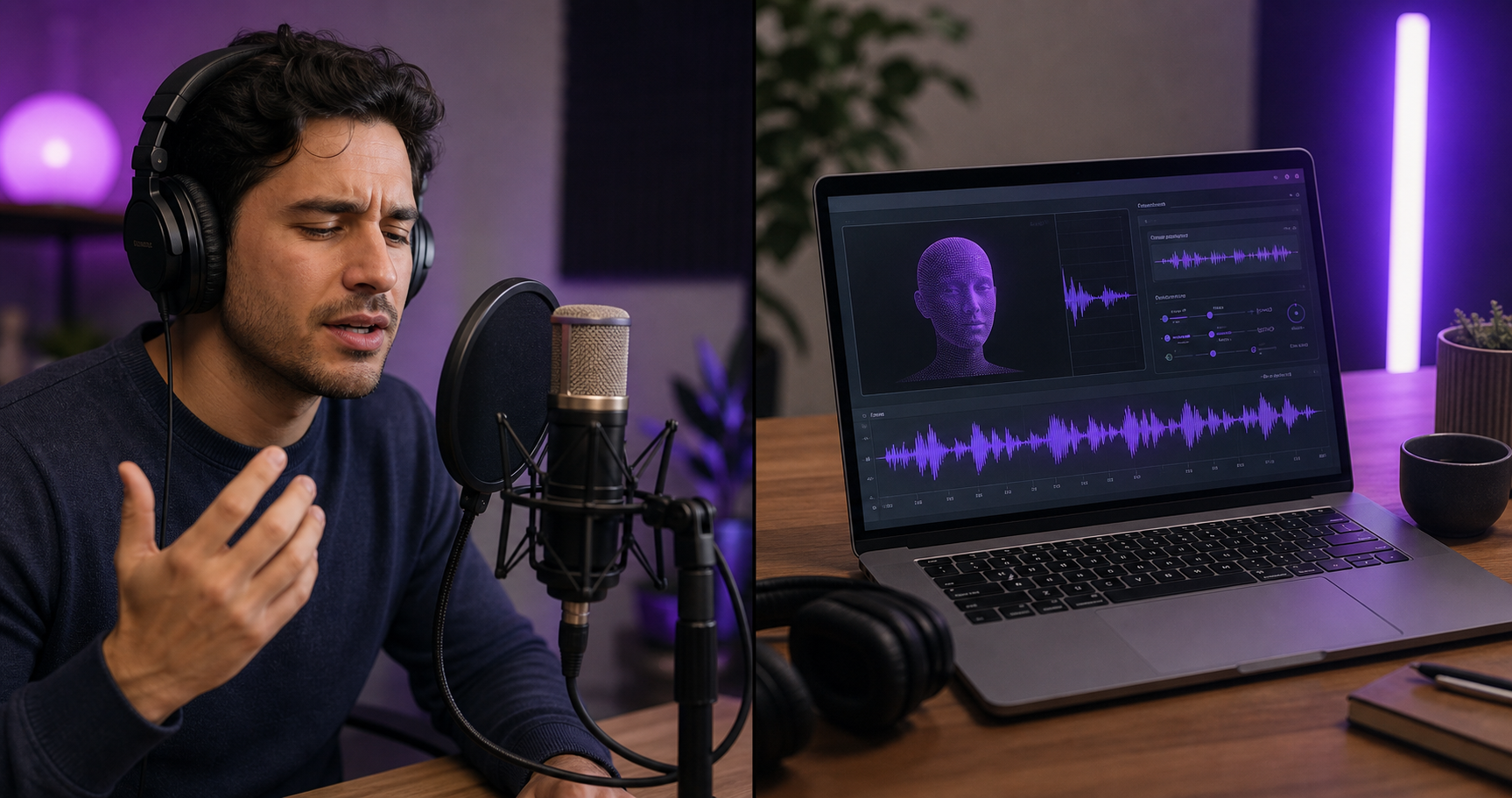
1. Klonen vervangt accentleren. Neem 20 seconden op van uw eigen stem in schone omstandigheden en een natuurlijke toon. Een AI-model kloont de akoestische handtekening. U genereert vervolgens elk script in elk van de 33 doeltalen in uw stem — de doorgang van toon, identiteit en merk blijft intact terwijl de taal verandert. Je hebt geen Mandarijnse prosodie geleerd. Het model handelt af. Koppel dit met AI Dubbing en een 10-minuutsvideo wordt een meertalig asset in een middag in plaats van een kwartaal.
2. Voorgebouwde stembibliotheek vervangt karakterkasten. Als u uw eigen stem niet wilt klonen, dekt een bibliotheek van 300+ stemmen karaktertypen, regionale accenten en demografische varianten. Selecteer, plak script, render. De caststap die traditioneel agentuurteruggave kost — audities, callbacks, contractvoorwaarden — wordt een dropdown. Voor piloten, prototypes en kortvormige inhoud is het snelheidsvoordeel overweldigend.
3. API's vervangen pipeline-herbouw. Voor creators en agencies die dit op productieschaal uitvoeren, laten het Text to Speech API, Voice Cloning API en AI Dubbing API u de volledige workflow in uw bestaande CMS, videopipeline of leerbeheersysteem insluiten. Nieuwe video-uploads activeren automatisch dubgetVersiongeneratie. De lokalisatiestap houdt op een project te zijn en wordt een eigenschap van de pipeline.
Wanneer handmatige stemimitaties nog steeds winnen
- Komedie en parodie waar vocale onvolkomenheid of zichtbare inspanning de grap is — SNL-stijl indrukken, karakterbits, sketches gebouwd rond de moeite van de acteur.
- Live streaming en improv waarbij real-time karakterwisseling belangrijk is en er geen script vooruit is om van te renderen.
- Zeer specifieke niches karakters — indie-spelvijanden, audio-drama leads, diep getextureerde eenmalige stemmen — waar bibliotheekstemen de specificiteit die u nodig hebt niet vastleggen.
- Dramatisch long-form waar, als trade-press interviews met stemprofessionals consistent opmerken, AI nog steeds subtiele timing, ademcontrole en micro-inflectie mist die een 40-minuut audioboek-hoofdstuk dragen.
Wanneer AI-stemtools winnen
- Meertalig schalen — dezelfde inhoud in 5+ talen, snel, met consistente karakterdoorgang.
- E-learning en bedrijfstraining waarbij modulegedrag-consistentie belangrijk is dan karakterprestatie.
- Podcast en videopijnlocalisatie voor globale creatorborden die anders uw inhoud in hun taal nooit horen.
- Herhaalde narrering — IVR, cursusmodules, toegankelijkheidssporen — waarbij vokale vermoeidheid handmatige takes zou afbreken bij uur twee.
- Pilottests — render vijf stemvarianten in een middag om A/B-test met publieksgroepen voordat u studiotijd tot handmatige opname voert.
Coaches in creatieve velden waarschuwen dat overmatige vertrouwen op AI-tools de ontwikkeling van fundamentele prestatievaardigheden kan stagneren. De gezondste creatorworkflow houdt handmatige vaardigheden scherp voor prestatiectexten — komedie, drama, livewerk — terwijl het AI voor schaalcontexten gebruikt waar consistentie en snelheid de bindende beperkingen zijn. Beide banen. Gekozen bewust.

Uw drielaags stemimitatie-actieplan — start deze week
Kies het niveau dat aan uw knelpunt voldoet. U kunt meer dan één tegelijk uitvoeren — en de meest strategisch scherpe creators doen dit precies.
Tier 1 — Handmatige stichting (Deze week, 15 minuten per dag)
- Kies ONE karakter of accent om naar te richten. Kies iets in uw natuurlijke bereik. Jaag niet naar uitersten in week een.
- Neem een 2-minuuts script op in de doelstem. Bewerk niet. Herneemt niet. Vang alleen de ruwe baseline vast.
- Luister terug met het vijflagenraamwerk — toonhoogte, resonantie, articulatie, ritme, textuur. Identificeer de ONE laag die het verst van het doel is. Schrijf het op.
- Besteed 15 minuten alleen aan die laag oefenen met behulp van de drills uit de oefenprogressive hierboven.
- Neem het script vrijdag opnieuw op. Vergelijken met maandagse take. Ga volgende week naar de volgende zwakste laag.
Tier 2 — AI voor actieve deadlines (Deze week, 1–2 uur totaal)
- Identificeer één bestaand stuk inhoud — een video, podcastaflevering, trainingsscript — die nu een stem of vertaling nodig heeft.
- Kies uw pad: kloon uw eigen stem (neem 20 seconden schoon audio op) OF kies een stem uit de bibliotheek van 300+ opties die past bij het karakter.
- Genereer de voiceover in uw doeltaal(talen) met behulp van AI dubbing.
- Voer een A/B-test uit: plak een 30-secondes segment van uw handmatige indruk naast de AI-uitvoer. Let op welke consistenter is. Let op welke minder tijd in beslag nam.
- Beslis: voor dit specifieke asset, welke versie gaat open?
Tier 3 — Integratie (Weken 2–4, bouw de hybride workflow op)
- Als u zich tot Tier 1 verbond: ga door met 15 minuten dagelijks. Stel een target van 12 weken in voor drie afzonderlijke karakterstemmen met ongeveer 80% doel consistentie.
- Als u zich tot Tier 2 verbond: kies een tweede taal en dub dezelfde asset. Bereken de uren die het zou hebben gekost om een voice-actor voor dezelfde output in te huren en vergelijk met uw AI-workflow-tijd.
- Voor uw volgende echte project, kaart het script regel voor regel: welke regels hebben handmatige prestatie nodig (emotie, komedie, karakterslaan) en welke hebben AI nodig (consistentie, meertalige dekking, herhaalde narrering).
- Bouw een persoonlijke rubric. Onder welke voorwaarden wint handmatig voor u? Onder welke voorwaarden wint AI? Schrijf het op. Verwijs ernaar voor het volgende project begint, niet tijdens het.
- Optioneel: als u visuele inhoud naast stem produceert, verken afbeelding naar video gegenereerd naar paar AI-stem met AI visuele voor volledige meertalige inhoudsets.
De creators die dit ambacht in 2025 bezitten, zijn niet de beste impressionisten of de zwaarste AI-gebruikers — zij zijn degenen die zonder erover na te denken tussen de twee kunnen schakelen.