AI Voice for Smart Cities: Facilitating Urban Management and Public Communication
게시됨 May 01, 2026~20 읽기

Why Voice Became the Default Interface for Fragmented City Systems

A flash flood warning goes out at 4:47 PM on a Tuesday. The city pushes it as an SMS blast and a banner alert in the municipal app. Half the affected residents never see it. They're driving home, working on a roof, walking a dog, sitting in a meeting with their phone face-down. By the time they read the message, the underpass on their commute is already three feet deep.

A block away, a transit rider stands at a bus stop refreshing a static schedule page. The page has not updated in eleven minutes. The bus she is waiting for was rerouted around the flooding eight minutes ago. Nothing in her hand tells her this.

Six miles north, a 78-year-old resident calls 311 for the fourth time to report a tree branch on a power line. Each time, the IVR menu tree loops her back to the main menu after she presses 2, then 4, then 1. She gives up and calls her daughter.

These are not technology failures. They are interface failures. Voice AI is already handling millions of real-time interactions in retail, banking, and healthcare — the infrastructure is mature, the latency is acceptable, and the synthesis quality is no longer robotic. The honest question for cities considering ai voice smart cities deployments isn't whether the technology works. It's whether the city's own data systems are organized enough to feed it. This piece walks through where voice AI fits in urban operations, what it actually takes to deploy, and the obstacles that derail most municipal pilots before they reach a second budget cycle.

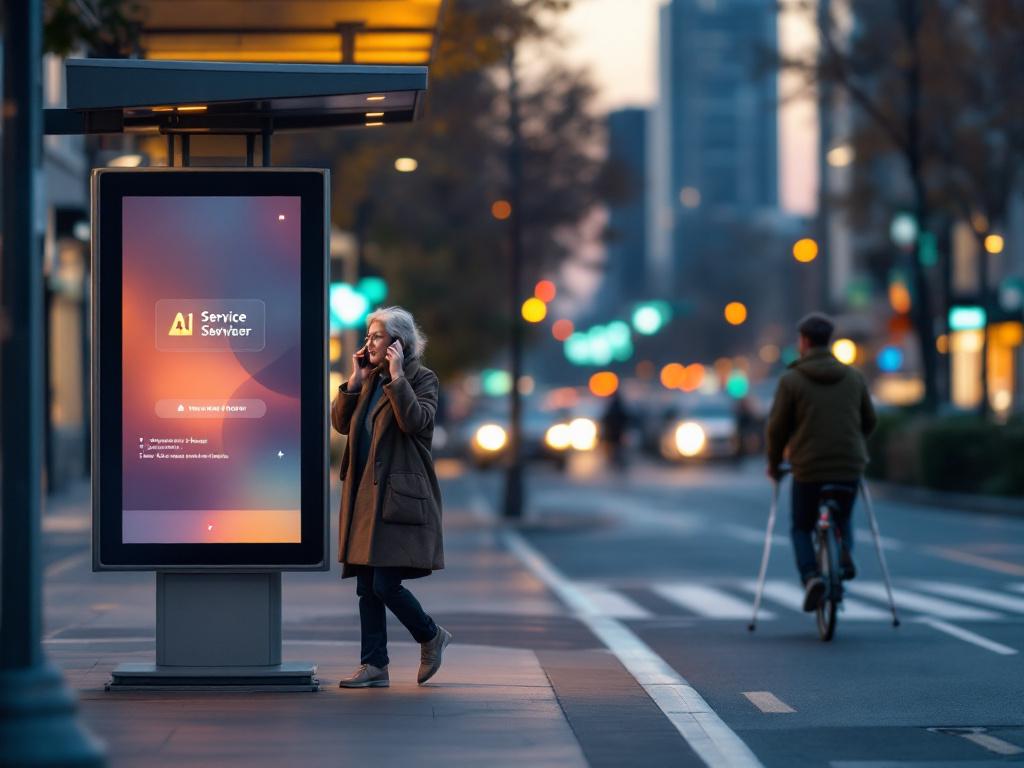
A city street at dusk — bus stop with a digital display showing a service alert, an older woman holding a phone to her ear, a delivery cyclist passing through frame, a person with a white cane on the curb. Mid-distance shot, real urban texture, no st

Table of Contents

Why Voice Became the Default Interface for Fragmented City Systems

Cities don't have a data problem. They have a delivery problem. Transit feeds, utility outage maps, emergency alerts, parking availability, snow operations, permit status, and 311 ticket histories all exist as data inside municipal systems. They live in separate databases, behind separate logins, exposed through separate apps and separate web portals. Citizens are expected to know which interface owns which problem. Most don't, and most won't learn.

The case for ai voice smart cities infrastructure rests on four arguments that hold regardless of vendor.

Voice captures attention in moments when screens cannot. Drivers, pedestrians at crossings, outdoor workers, parents pushing strollers, residents with vision impairments — all interact with the city in hands-busy or eyes-busy contexts. Text alerts assume a free hand and a clear line of sight. Voice doesn't. According to vendor analysis from Respeecher's smart cities writeup, London's TfL and Tokyo's emergency notification systems both prioritize audio channels for this reason. Treat that as a directional signal, not an audited claim — Respeecher is a voice synthesis vendor and its case studies are not independently verified.

Voice flattens the accessibility gap. Older residents, non-native speakers, residents with low literacy, and residents with vision impairments all face friction with text-first interfaces. Voice removes the literacy barrier and the screen-navigation barrier in one step. ADA Section 508 compliance is referenced as a deployment driver in vendor materials from Citibot, though the writer should note that actual 508 obligations vary by service type and jurisdiction. Frame voice rollouts as a compliance opportunity rather than a settled requirement, and have the city attorney confirm scope before procurement.

Voice can act as a translation layer between siloed systems. This is the conceptual heart of the argument. A single voice query — "Is my street getting plowed tonight?" — can pull from the snow operations system, the parking restriction database, and the alert feed in parallel. The citizen doesn't need to know which department owns which dataset. Modern voice technology urban management is most valuable not as a chatbot replacement but as a unified front door to fragmented backends. The voice layer is the abstraction that hides the org chart from the resident. That is a different procurement problem than buying a chatbot, and it should be sequenced differently.

Voice scales asymmetrically with population growth. A 311 call center scales linearly: more calls means more agents, more supervisors, more square feet, more headsets. Voice AI absorbs the routine queries — hours, status, location, eligibility — and routes only the genuinely complex calls to humans. The economics for a city of 250,000 differ from a city of 2.5 million, but the operating-cost curve flattens in both. Modern natural-sounding synthesized voices make this practical at municipal budgets in a way that wasn't true five years ago, when synthesized speech still triggered the "press 1 for English" reflex of impatience and disconnect.

The combination of these four arguments is what makes voice interesting now. Any one of them is a niche use case. All four together describe a different relationship between residents and the systems that serve them.

Voice AI's real value in a city isn't replacing the chatbot. It's becoming the single front door to backends that were never designed to talk to each other.

The next question is where to start. Not every city function benefits equally from voice, and the wrong pilot location will discredit the technology before it has a chance to prove itself.

Five Urban Functions Where Voice AI Solves a Specific, Measurable Problem

Not every city function benefits equally from voice. The five below are where vendor case studies and pilot programs cluster, and where the operational logic actually holds up to scrutiny.

Urban functionWhat's broken todayWhere voice AI fitsWhat changes when it works
Emergency alertsSMS/app push reaches only opted-in users; misses drivers and outdoor populationsReal-time voice broadcast to phone lines, smart speakers, street hardwareFaster citizen reporting; alerts reach non-app users
Transit & traffic infoStatic schedules, separate apps per agencyConversational queries ("next eastbound bus at Oak St?")Reduced 311 call volume on routine questions
Parking & street accessSignage and permit apps, no real-time availabilityVoice queries on availability, restrictions, permit statusLess circling; faster permit lookups
Utility outagesEmail notifications, manual phone treesProactive outbound voice + voice-based damage reportingBetter damage location data; faster restoration triage
311 / non-emergency requestsLong IVR menus, hold times, single-channelConversational intake with structured handoff to case systemsRoutine intake automated; agents handle escalations

Read the table for the structural pattern, not the cell-by-cell narration. The pattern is consistent: voice AI shines where current channels are either too narrow (emergency alerts that miss most of the population) or too rigid (IVR trees that don't fit the way people actually phrase problems).

A few critical observations. The Tokyo earthquake and typhoon system commonly cited in vendor materials — including Respeecher's analysis — is the most-referenced emergency alert example. Independent performance data for that system is not publicly available. Cities evaluating vendors should ask for unaggregated, time-stamped metrics, not summary slides.

For transit, vendor work like Cerence's voice infrastructure positioning focuses on station and vehicle announcements. The harder problem — connecting live operational data to a conversational query at the bus stop — remains an integration bottleneck, not a voice tech bottleneck. The value of strong voice technology urban management in transit depends almost entirely on whether the agency's GTFS-realtime feed is current to the minute.

Parking is the lowest-stakes pilot category and the best place to start. The failure mode is mild inconvenience. Nobody dies because the voice AI was wrong about whether a meter is occupied.

Utility outage reporting via voice generates structured location data faster than typed forms — a tree on a line, a flooded basement — but only if the backend can ingest structured location data in the first place. If the utility's outage map is updated manually by a dispatcher reading email, the voice front end won't change anything downstream.

The 311 use case has the strongest documented ROI in vendor materials, but be careful: vendor-reported "deflection rate" is not the same as citizen satisfaction. A deflected call is not necessarily a resolved problem. A citizen who hangs up because the bot answered confidently and incorrectly counts as a deflection in some vendor dashboards. That is a metric design problem, and it's addressable in the contract.

Pick one of these to pilot. Do not pilot three.

The Voice AI Stack: What a City Actually Needs to Buy, Build, or Integrate

Frame this as a buyer's checklist for a non-technical city manager. Each step is a decision, not a tutorial. The component breakdown below draws on Polimorphic's local-government voice AI guide, which is itself a vendor source — useful for taxonomy, not for benchmarks.

1. Decide where the voice AI runs. Cloud-hosted is faster to deploy, has a lower upfront cost, and lets the vendor handle infrastructure. On-premises is slower to deploy, more expensive in year one, and gives the city control over voice data. The decision trigger is not technical. It's political. If your city attorney or privacy officer will block a cloud contract that processes resident audio, you need on-premises from day one. Discovering this in month four kills the project. Have the conversation in month zero, in writing.

2. Map your data sources before you map your vendors. A voice AI that can't read the transit API is useless. Inventory the 5–10 systems the voice layer would need to query: transit GIS, 311 case management, utility outage map, permit database, alerts feed, computer-aided dispatch (CAD), parking enforcement, snow operations, public events calendar, and any GIS layer for street-level lookups. For each, document three things — does it have a real-time API, who owns it internally, and what's the data refresh interval. This inventory is the single highest-leverage activity in the entire project. Strong voice technology urban management lives or dies on the API map, not on the voice quality. A polished voice reading stale data is worse than no voice at all.

3. Pick the citizen channels. Phone is still the highest-reach channel, especially for older and lower-income residents. Smart speakers (Alexa, Google) reach a narrower audience and work best for opt-in services like trash schedule reminders. Mobile apps with a voice button added are useful for cities that already have a high-engagement civic app. Street-mounted hardware at transit stations and public squares is high-cost and narrow-use. Most cities should start with phone-based voice on the existing 311 number and expand outward only after that channel is stable.

4. Choose your voice generation approach. Generic stock voices are fast and cheap. A custom city voice — consistent across emergency alerts, transit announcements, and 311 — builds recognition over time. When residents hear the same voice on a snow alert and a trash schedule reminder, the city accumulates trust as a single institution rather than five disconnected departments. Modern text-to-speech APIs and voice cloning tools make a custom city voice practical at municipal budgets, and the same pipeline can translate and deliver in 33+ languages without re-recording. The decision: do you want every citizen interaction to sound like the same city, or like five different vendors stitched together? This is also where auditory public communication ai stops being a back-office tool and starts being a brand asset.

5. Define your moderation and escalation rules before launch. What happens when the voice AI can't answer? Default: handoff to a human agent with the full transcript already attached, so the citizen doesn't repeat themselves. What happens during an active emergency? Default: voice AI defers to human dispatch and never improvises content. What happens if a citizen abuses the system? Default: rate limiting, no engagement, no escalation. Who owns these rules — IT, communications, or the city attorney? Settle ownership before procurement, not after a public incident makes the local news.

A voice AI without live access to your city's data is a fancy answering machine. The integration work is the project. The voice is the easy part.

A 12-Month Phased Rollout That Survives Procurement, Politics, and Pilot Fatigue

The most common voice AI failure mode in cities is not technical. It's a pilot that runs six months, generates a glossy report with a vendor logo on the cover, and then dies because no one budgeted for the second phase. Plan the second phase before you sign the first contract. The phasing below is operational guidance, not a vendor-validated benchmark — public procurement records, not vendor pricing pages, are the only reliable source for actual timelines and costs.

Months 1–3: One use case, one channel, one metric. Pick the lowest-stakes use case from the table earlier — usually 311 overflow or routine transit queries. Run it on the existing 311 phone line. Don't introduce new hardware yet. Don't add a smart speaker skill. Don't redesign the city's mobile app. Define one baseline metric and one target: for example, "30% of incoming routine queries resolved without agent handoff within 90 days." Measure call answer time, citizen satisfaction via a post-call survey, and deflection accuracy — was the AI's answer actually correct, sample-audited weekly. Do not measure total query volume. That is a vanity metric that goes up whether the system works or not.

Months 4–9: Add one channel, or one use case, never both at once. If Phase 1 worked, the temptation is to add smart speakers, mobile, and three new use cases simultaneously. Don't. Add either a second use case on the same channel (transit info on the existing 311 line) or the same use case on a second channel (311 queries via a smart speaker skill). Doubling complexity in both dimensions at once is the pattern that breaks pilots. The team that ran Phase 1 successfully has roughly 2x capacity for Phase 2, not 4x.

Months 10–18: Connect to emergency systems — carefully. This is where voice AI's life-safety value emerges, and where the project becomes politically dangerous. The key technical question: does your computer-aided dispatch (CAD) system have an outbound API that the voice layer can subscribe to? If yes, voice can broadcast verified alerts to opt-in residents in seconds. If no, you'll be doing manual handoff between dispatch and the voice system, which negates the speed advantage and adds a failure point. Build auditory public communication ai into the emergency comms protocol with a documented handoff between human dispatchers and automated voice broadcast. Never let the AI generate emergency content without human approval. The first time the voice system improvises during an evacuation, the project ends — regardless of whether the improvisation was correct.

Ongoing: feedback loops, retraining, and dataset ownership. Voice AI performance degrades without retraining on local language patterns. Street names, neighborhood nicknames, accent variation, slang for city services ("the dump" vs. "transfer station," "the brown line" vs. "the 4 train"). Plan monthly retraining cycles in year one and quarterly in year two. Multilingual coverage compounds the retraining problem — every supported language needs its own local pattern updates, and modern multilingual voice delivery pipelines need access to the same locality data the English model uses. Critical contractual point: who owns the training dataset, the vendor or the city? If the vendor owns it, switching vendors in year three means starting from zero. Require data portability in the original contract, in writing, with a defined export format.

Budget reality: a 311 voice pilot for a city of 250,000 typically lands somewhere in the low six figures for year one when cloud-hosted, scaling roughly with population for larger cities. Independent benchmarks here are weak. Procurement officers should request anonymized contract data from peer cities before negotiating — a half-day of phone calls with three peer CIOs will produce better pricing intelligence than any vendor pitch deck.

Wide shot of a city emergency operations or 311 dispatch center — staff at workstations with multiple monitors, headsets visible. Real, slightly cluttered, not staged. Caption-ready scene that signals operational reality, not marketing.

The Five Metrics That Tell You If Voice AI Is Working

Vendors will report total queries, total minutes, total users. None of those numbers tell you if voice AI is improving city operations. These five do.

  • Time-to-inform on critical events. Measure: From event timestamp — outage detected, alert issued, road closed — to the moment 80% of affected residents have been reached via voice channel. Why it matters: This is the only metric that justifies voice AI's existence over text alerts during emergencies. Watch for: vendors reporting "messages sent" instead of "messages received." Those are not the same number, and the gap between them is where most emergency alert systems fail in practice.
  • Routine query deflection rate, with accuracy weighting. Measure: Percentage of inbound 311 queries resolved by voice AI without human handoff, weighted by whether the answer was correct (sample-audited monthly). Why it matters: A 70% deflection rate at 60% accuracy is operationally worse than a 40% deflection rate at 95% accuracy. The first number routes wrong answers to citizens at scale. The second saves agent time without breaking trust. Watch for: deflection rate reported alone, without an accuracy companion metric. That's the single most common vendor reporting trick.
  • Reachability across the digital divide. Measure: Percentage of residents in zip codes with below-median household income or above-median age 65+ who successfully completed a voice AI interaction in the last 90 days. Why it matters: Voice AI's strongest equity case is reaching residents who don't use city apps. If your usage data shows the opposite — concentration in tech-savvy neighborhoods — you have an equity problem, not a success story. Watch for: aggregate usage charts that don't break down by neighborhood demographics.
  • Multilingual coverage rate. Measure: Number of languages supported with native-quality voice output, divided by the number of languages spoken by 1%+ of the city's population. Why it matters: A voice system that only works well in English in a city with 18% Spanish speakers and 6% Mandarin speakers is widening the access gap, not closing it. Modern voice cloning and dubbing tools make multilingual coverage addressable at municipal scale; budget should reflect it from day one rather than appearing as a Phase 3 line item that never gets funded.
  • Cost per resolved interaction, vs. agent baseline. Measure: Total voice AI system cost (annualized) divided by number of correctly resolved interactions per year. Compare to fully-loaded cost of a 311 agent handling the same query mix. Why it matters: If voice AI costs more per resolved interaction than an agent, you have a marketing tool, not an operations tool. Watch for: vendor calculations that exclude integration costs, retraining costs, and the staff time spent supervising the system. The right denominator is correctly resolved interactions, not total interactions.

These five frameworks are derived from operational principles, not from validated multi-city studies. The research base for municipal voice AI is thin and vendor-dominated; cities should treat their own measurement design as part of the deployment, not an afterthought.

If the only number your vendor reports is total queries handled, you are buying a press release, not a public service.

The Five Obstacles That Kill Voice AI Pilots

Every voice AI pilot that fails in a city fails for one of these five reasons. None of them are about the voice technology itself. All of them are foreseeable. All of them can be addressed in the original RFP and contract.

ObstacleEarly symptomWhat to require in the contractInternal owner
Data silos across departmentsVoice AI gives wrong or stale answers; trust erodes within weeksData source inventory before vendor selection; APIs documented in scopeCIO / Chief Data Officer
Voice data privacy exposureCouncil pushback; legal hold on resident audioOn-prem option offered; retention capped; no vendor reuse for trainingCity Attorney / Privacy Officer
Accent and dialect recognition gapsSystem fails for non-native speakers and specific neighborhoodsVendor discloses training data demographics; budget for local retrainingIT + Community Relations
Equity and digital-divide blind spotsUsage concentrates in higher-income zip codesPilot includes underserved neighborhoods first; equity metrics from day 1Equity Officer / Mayor's Office
Vendor lock-in on data and voice assetsYear-three switching cost is prohibitive; custom voice trapped with vendorData portability clause; city retains ownership of trained voice modelProcurement + CIO

Data silos kill the most pilots. The voice layer is only as good as the data underneath it. If transit, utilities, and 311 don't expose APIs in compatible formats, the voice AI will sound stupid in front of voters — confidently delivering yesterday's outage status as if it's current. The fix is sequencing. Run the data integration RFP before the voice AI RFP, not after. The integration work is uglier and less photogenic than the voice demo, which is exactly why it gets skipped.

Privacy is the obstacle that escalates fastest from technical issue to political crisis. Resident audio is sensitive in ways that text is not. A recording captures voice biometrics, background context, and emotional state. Cities that don't address this in the contract face it later in a public records request, a council hearing, or a local news segment. On-premises hosting is one answer. Aggressive retention limits — delete raw audio after 30 days, retain only de-identified transcripts — are another. Both should be specified in the contract, not negotiated in the moment.

Accent and dialect gaps are also an equity issue, not just a technical one. A voice system that handles General American English fluently but fails on AAVE, regional accents, or non-native English is creating a service gap, not closing one. Test on local speakers before launch — actual residents from the actual neighborhoods that the pilot will serve, not the vendor's QA team in another state. Budget for ongoing retraining in the contract; assume the model will be wrong about local pronunciation on day one.

Equity blind spots are baked in by default. Pilots launched in downtown business districts produce great metrics and irrelevant data. The residents who already use city apps will use the voice system too. The residents who would benefit most — those who don't use the apps — won't show up in your usage charts unless you actively pilot in their neighborhoods. Pilot where the access gap is largest: low-income areas, areas with high senior population, areas with high non-English-speaker concentration. If the pilot doesn't work there, voice AI isn't ready, regardless of how well it performs downtown.

Vendor lock-in is the slowest-moving obstacle and the most expensive one. The custom city voice you build in year one is an asset. The trained query/response dataset that captures three years of resident interaction patterns is an asset. The voice cloning models built on city employee voices for emergency announcements are assets. If the vendor owns any of these, you cannot take them to a competitor in year four without starting over. Negotiate ownership upfront. The clause is short, the cost of skipping it is enormous, and no vendor will volunteer the language.

This is the procurement officer's section. Print it. Bring it to the vendor meeting. The five rows in the table are the five clauses that determine whether the voice AI pilot becomes a permanent piece of city infrastructure or a footnote in next year's audit report.

A procurement or planning meeting — laptop open with a contract on screen, printed RFP pages on the table, two or three people mid-discussion. Mid-distance, real office, not staged.