Deskriptor Suara Dijelaskan: 50+ Kata untuk Menggambarkan Suara AI dan Manusia
Anda sedang menggulir melalui perpustakaan 300+ suara AI, atau meninjau percobaan ketujuh dari narasi kepatuhan, atau duduk di utas Slack di mana pimpinan pemasaran Anda bersikeras suara merek harus "lebih hangat" sementara produser Anda terus mengatakan "lebih profesional." Tidak ada yang bisa mendengar apa yang dimaksud orang lain. Proyek macet — bukan karena suaranya salah, tetapi karena deskriptor suara yang digunakan tidak cocok, tidak terdefinisi, dan melayani pekerjaan yang berbeda untuk orang yang berbeda di tim yang sama.
Ini adalah kebocoran waktu produksi paling umum dalam konten berbasis suara, dan sepenuhnya dapat diperbaiki dengan kosakata bersama.
Daftar Isi
- Mengapa "Ini Terasa Tidak Benar" Menghabiskan Waktu Produksi Anda
- Lima Dimensi Independen Deskripsi Suara
- 50+ Deskriptor Suara Dipetakan ke Jenis Konten dan Audiens
- Cara Mengaudit Suara Terhadap Deskriptor — Proses Lima Langkah
- Lima Deskriptor yang Menyesatkan Semua Orang — dan Apa yang Harus Dikatakan Sebaliknya
- Ringasan Deskriptor Suara Anda — Template Isi dengan Contoh Kerja
- FAQ
Mengapa "Ini Terasa Tidak Benar" Menghabiskan Waktu Produksi Anda
Tiga skenario, satu akar penyebab. Pembuat konten YouTube membuka katalog suara dengan ratusan pilihan dan mengambil sampel secara acak selama empat puluh menit sebelum menyerah. Seorang produser e-learning menolak pengambilan demi pengambilan dari modul keselamatan karena masing-masing "dekat, tetapi tidak tepat." Tim pemasaran menghabiskan satu jam memperdebatkan apakah suara merek untuk peluncuran produk baru adalah "cukup hangat." Setiap satu dari kemacetan tersebut adalah kegagalan kosakata yang disembunyikan sebagai masalah selera.
Sains kognitif sangat jelas. Karya oleh McAleer dan rekan dalam PNAS menemukan bahwa pendengar membentuk penilaian stabil tentang kepercayaan diri, dominasi, dan ciri-ciri sosial lainnya dari kurang dari satu detik ucapan, dan penilaian tersebut sangat konsisten di seluruh pendengar. Orang mendengar kualitas suara dengan presisi. Apa yang mereka perjuangkan adalah penamaan apa yang mereka dengar dengan cukup baik agar orang lain dapat bertindak berdasarkan itu.
Pendengar membentuk pendapat percaya diri tentang suara dalam waktu kurang dari satu detik — hambatannya bukan persepsi, tetapi kosakata untuk menggambarkan apa yang mereka dengar.
Sains suara mendukung ini pada tingkat perseptual. Kreiman dan Sidtis, dalam Foundations of Voice Studies (Wiley-Blackwell, 2012), menunjukkan bahwa pendengar secara terpisah memersepsikan nada, kekerasan, kekasaran, kemenduaran, dan tempo sebagai dimensi independen — yang berarti deskriptor adalah kombinatorial, bukan holistik. Suara bisa hangat dan cepat. Dingin dan halus. Renyah dan intim. Memperlakukan "hangat" sebagai satu tombol yang mencakup segalanya adalah sumber setengah dari ketidaksepakatan di ruang casting.
Biaya produksi konkret. Panduan industri voiceover yang diterbitkan dalam Backstage dan Voices Magazine mendeskripsikan siklus casting standar: naskah audisi 15–30 detik, 2–3 pengambilan alternatif per kandidat, dan — untuk tim tanpa kartu skor deskriptor — 8 hingga 15 kandidat disiklus sebelum daftar singkat muncul. Kalikan itu dengan jumlah suara di katalog suara AI modern dan matematikanya semakin buruk, bukan lebih baik. Lebih banyak pilihan tanpa filter yang lebih baik berarti lebih banyak pengambilan sampel acak.
Masalah yang sama terjadi dalam skala besar ketika Anda bekerja di dalam perpustakaan suara AI dengan ratusan suara, menjelajahi ElevenLabs, Murf, atau penyedia TTS saraf lainnya. Tanpa deskriptor, Anda mengambil sampel secara acak. Dengan deskriptor, Anda memfilter — dan waktu hingga daftar singkat turun dari jam menjadi menit.
Tiga titik nyeri spesifik berulang di seluruh setiap tim produksi yang belum menstandarkan kosakata:
Umpan balik yang samar menciptakan loop revisi. "Buat lebih natural" tidak memberikan aktor suara atau mesin AI parameter apa pun untuk disesuaikan. Natural di dimensi mana? Kecepatan? Tekstur? Nada emosional? Tiga perbaikan berbeda, tiga sesi berbeda.
Istilah subjektif menyembunyikan ketidaksepakatan tim. "Profesional" bagi pemasar SaaS B2B berarti renyah, terukur, dan kredibel. Bagi podcaster true-crime, itu berarti polished dan terpisah. Kedua tim menggunakan kata yang sama dan menghasilkan brief yang berbeda.
Lokalisasi memperumit masalah. Ketika Anda mendub ke 33 bahasa, brief berbahasa Inggris yang tidak presisi diterjemahkan, ditafsirkan, dan ditafsirkan ulang di setiap pasar target. Suara "hangat" dalam bahasa Inggris Amerika dapat dibaca sebagai akrab yang performatif dalam konteks bisnis Jerman atau Korea. Tanpa kerangka kerja deskriptor bersama, setiap pasar menyimpang.
Deskriptor bukan kosakata estetika. Mereka adalah alat efisiensi produksi. Tim yang menggunakan deskriptor suara presisi mempersingkat siklus casting, mengurangi re-record, dan mengirimkan konten terlokalisasi lebih cepat — dan kesenjangan antara tim yang memiliki bahasa ini dan tim yang tidak akan melebar setiap kali cakupan proyek bertambah.
Lima Dimensi Independen Deskripsi Suara
Kerangka kerja di bawah ini berfungsi karena dimensinya secara perseptual independen. Pekerjaan sains suara Kreiman dan Sidtis mengkonfirmasi bahwa pendengar dapat memvariasikan penilaian mereka pada nada, tekstur, tempo, dan kualitas emosional tanpa penilaian tersebut runtuh menjadi peringkat tunggal. Anda dapat membriefing suara sebagai hangat DAN cepat, atau dingin DAN halus, atau berwibawa DAN pendekatan — kombinasi yang tidak dapat dijelaskan oleh kosakata sumbu tunggal seperti "profesional".
Sebagian besar kesalahpahaman terjadi karena satu orang menggambarkan nada sementara yang lain bereaksi terhadap tekstur. Matriks di bawah memisahkan mereka.
| Dimensi | Apa yang Diukur | Contoh Deskriptor | Tuas Produksi |
|---|---|---|---|
| Nada | Kehangatan emosional dan jarak pendengar | hangat, dingin, netral, berwibawa, pendekatan, terpisah, tulus, sardonis | Daftar nada, kontur intonasi |
| Kecepatan & Ritme | Kata per menit, pengelompokan frasa, pola jeda | terukur, cepat, lambat, staccato, mengalir, ragu, sengaja, tanpa napas | Kecepatan berbicara (130–200+ wpm) |
| Tekstur | Kualitas permukaan suara | halus, serak, bernapas, renyah, serak, tipis, resonan, berderak | Mikrofon, pemrosesan, kualitas pita suara |
| Penanda Identitas | Usia yang dirasakan dan presentasi gender | muda, dewasa, androgini, maskulin, feminin, dikode kakek-nenek, dikode anak | Frekuensi fundamental, penempatan formant |
| Nada Emosional | Suasana hati di bawah kata-kata | percaya diri, tidak yakin, bersukacita, sombor, ceria, intim, skeptis, mendesak | Prosodi, variasi mikro, kisaran nada |

Setiap dimensi memiliki jangkar yang dapat diukur, yang mengubah deskriptor dari pendapat menjadi spesifikasi.
Kecepatan memetakan langsung ke kata per menit. Penelitian tingkat mendengarkan Foulke dan Sticht, dirangkum dalam Journal of Communication, menempatkan percakapan santai di sekitar 150–160 wpm; presentasi formal dan e-learning padat duduk nyaman di band 130–150 wpm; komentar YouTube dengan dukungan visual berjalan 160–180 wpm; pembacaan penolakan cepat melampaui 250 wpm. Pemahaman turun tajam di atas kira-kira 200 wpm untuk konten informatif yang padat. "Terukur" oleh karena itu memiliki nomor yang melekat: sekitar 130–145 wpm.
Tekstur memetakan ke konten spektral dan kualitas rekaman. Persyaratan pengajuan audio ACX/Audible menentukan level RMS antara kira-kira −23 dan −18 dB, puncak di bawah −3 dBFS, dan lantai kebisingan di bawah −60 dB untuk konten berbicara. Suara "renyah" memiliki konsonan artikulasi frekuensi tinggi dan lantai kebisingan rendah. Suara "teredam" gagal satu atau keduanya. Deskriptor bukan puitis — ini adalah lembar spek.
Nada dan nada emosional memetakan ke nada dan prosodi. Klofstad dan rekan dalam PNAS menemukan bahwa suara bernada lebih rendah, lebih resonan secara konsisten dinilai sebagai lebih kompeten dan berwibawa — tetapi tidak selalu lebih hangat atau lebih disukai. Ini persis mengapa "berwibawa" dan "pendekatan" memerlukan pelacakan terpisah. Suara yang dioptimalkan untuk satu dapat duduk di ujung lain dari yang lain.
Contoh kerja. Untuk saluran YouTube keberlanjutan yang menargetkan pemirsa Gen Z dan Milenial yang merencanakan pendubingan AI ke berbagai bahasa, brief menjadi: Nada = tulus ditambah pendekatan; Kecepatan = 145–160 wpm (terukur-ke-percakapan); Tekstur = halus dengan kehangatan yang terdengar, sibilans rendah; Identitas = 30-an, gender-netral dapat diterima; Nada Emosional = percaya diri ditambah optimis, tidak pernah moralis. Lima spesifikasi, masing-masing dapat disaring. Suara apa pun dalam perpustakaan 300-suara dapat diterima atau ditolak dengan cepat terhadap daftar itu.
50+ Deskriptor Suara Dipetakan ke Jenis Konten dan Audiens
Deskriptor hanya berguna dalam konteks. Suara yang sama yang dibaca sebagai "intim" dalam aplikasi meditasi dibaca sebagai "menakutkan" dalam IVR layanan pelanggan. "Berwibawa" dalam saluran ulasan teknologi terdengar berbeda dari "berwibawa" dalam modul pelatihan kepatuhan. Cluster di bawah memetakan deskriptor ke lima kategori konten paling umum — mengambil patokan produksi dari setiap industri.
Untuk Pembuat Konten YouTube
Energik, percakapan, mendorong — 170–185 wpm, intonasi naik, penekanan mikro yang sering pada kata-kata kunci. Terbaik untuk unboxing, gaming, konten gaya hidup. Hindari dalam esai bentuk panjang atau dokumenter; energinya membuat pendengar lelah dalam sepuluh menit.
Hangat, relatable, sedikit tidak sempurna — 150–160 wpm, audibilitas napas ringan, tik verbal sesekali dipertahankan daripada diedit. Terbaik untuk vlog pribadi, bercerita, konten kesejahteraan. Hindari pengiriman korporat yang terlalu halus — penelitian yang dipublikasikan oleh Labrecque dalam Journal of Advertising menunjukkan bahwa suara yang terlalu halus sering dinilai kurang dapat dipercaya daripada yang sedikit tidak sempurna dalam konteks peer-to-peer.
Tajam, cerdas, sedikit melengkung — 160–175 wpm, timbre kering, jeda terkontrol untuk punchline. Terbaik untuk komentar, kritik, dan satire. Hindari melayang ke pahit; garis antara cerdas dan sinis duduk di timbre dan mikroprosi, bukan pilihan kata.
Berwibawa, teyakin, tidak terburu-buru — 140–155 wpm, daftar nada lebih rendah, derit vokal minimal. Terbaik untuk penyelaman pendidikan mendalam dan ulasan teknologi. Hindari nada mengajar — pasangkan pengiriman berwibawa dengan asides percakapan untuk membuat audiens terus berpikir.
Untuk E-Learning dan Pelatihan Korporat
Jelas, tidak terburu-buru, artikulate — 130–145 wpm, konsonan renyah, jeda yang disengaja di batas semantik. Clark dan Mayer e-Learning and the Science of Instruction mengidentifikasi band ini sebagai titik manis pemahaman untuk konten informatif padat. Terbaik untuk pelatihan kepatuhan dan keselamatan.
Mendorong, sabar, netral hangat — 140–150 wpm, intonasi naik-ramah, serangan lembut pada konsonan. Terbaik untuk pelatihan keterampilan pemula, pembelajaran bahasa, dan pelatihan teknis pengantar.
Profesional, terukur, pengaruh rendah — 135–150 wpm, rentang dinamis terkontrol, variasi prosodis minimal. Terbaik untuk pengembangan kepemimpinan, sertifikasi, dan konten industri yang diatur di mana netralitas adalah maksudnya.
Percakapan, dapat diakses, dikode sebaya — 150–160 wpm, informalitas ringan, kontraksi sesekali dan frasa yang lebih lembut. Terbaik untuk modul onboarding, komunikasi internal, dan konten membangun budaya.
Untuk Pemasaran SaaS dan Produk
Percaya diri, modern, renyah — 155–170 wpm, lantai kebisingan rendah, frekuensi tinggi cerah tetapi tidak sibilant. Terbaik untuk demo produk dan peluncuran fitur.
Hangat, manusia, sedikit tidak sempurna — 150–160 wpm, napas dipertahankan, serangan lembut. Terbaik untuk bercerita merek, voiceover kesaksian pelanggan, dan konten yang dipimpin pendiri.
Efisien, jelas, dekorasi rendah — 160–170 wpm, variasi prosodis minimal, kemasan informasi padat. Terbaik untuk penjelas teknis dan dokumentasi API. Ketika menghasilkan suara ini secara terprogram melalui alur kerja pembuatan suara berbasis API, konsistensi di ratusan klip lebih penting daripada seni individual.
Mengundang, dapat dipercaya, lembut-berwibawa — 140–155 wpm, nada lebih rendah, serangan lembut, kecepatan terkontrol. Terbaik untuk keamanan, privasi, perawatan kesehatan, dan pesan layanan keuangan di mana pendengar perlu merasa tangan yang kompeten dan kehangatan manusia.
Deskriptor hangat berarti sesuatu yang sangat berbeda dalam penjelasan SaaS B2B daripada dalam cerita sebelum tidur — konteks, bukan kata, membawa arti.
Untuk Podcaster dan Narator Buku Audio
Intim, bernuansa, mikro-ekspresif — 150–160 wpm (jangkauan buku audio yang direkomendasikan ACX), napas close-miked terdengar, variasi nada halus di seluruh frasa. Terbaik untuk memoar, fiksi sastra, dan narasi true-crime di mana pendengar mengenakan headphone selama berjam-jam.
Berwibawa, menarik, netral jurnalistik — 145–160 wpm, prosodi terkontrol, pengaruh rendah pada kata opini. Terbaik untuk podcast berita dan pekerjaan investigatif di mana kepercayaan pendengar tergantung pada imparsialitas yang dirasakan.
Ceria, teater, perubahan karakter — kecepatan variabel, rentang nada lebar, berlebihan yang disengaja. Terbaik untuk podcast komedi, konten anak-anak, dan fiksi spekulatif.
Tenang, meditatif, rendah-gairah — 110–130 wpm, tekstur bernapas dapat diterima dan sering disukai, jeda panjang antara frasa. Terbaik untuk meditasi terpandu, cerita tidur, dan dokumenter alam.
Untuk Proyek Dubbing dan Lokalisasi
Setara secara emosional, bukan secara harfiah cocok — pertahankan nada sumber bahkan ketika frasa berubah untuk lip-sync atau kesesuaian budaya. Alur kerja QA lokalisasi Netflix dan SDI Media secara eksplisit memeriksa kesesuaian emosional di samping sinkronisasi, seperti yang didokumentasikan dalam Journal of Audiovisual Translation.
Dikode usia di seluruh budaya — pemilihan suara "remaja" berbeda antara pasar Portugis Brasil dan Jepang; singkat dengan pita usia yang dirasakan, bukan hanya usia kronologis. Apa yang terdengar 17 di satu pasar terdengar 14 atau 20 di pasar lain.
Kehangatan yang dikalibrasi secara budaya — "hangat" dalam bahasa Inggris Amerika mudah dekat dengan "terlalu akrab" dalam konteks bisnis Jerman atau Korea. Ketika mendub di berbagai bahasa target, briefing pengulas penutur asli tentang apakah deskriptor mendarat seperti yang dimaksud di setiap pasar.
Identitas-mempertahankan melalui kloning suara — ketika suara pembuat konten asli membawa ekuitas merek, kloning suara melestarikan penanda identitas (tekstur, nada, pengodean usia) di seluruh bahasa sementara prosodi bahasa target beradaptasi dengan norma lokal. Singkat deskriptor perjalanan utuh bahkan ketika bahasa berubah.
Cara Mengaudit Suara Terhadap Deskriptor — Proses Lima Langkah
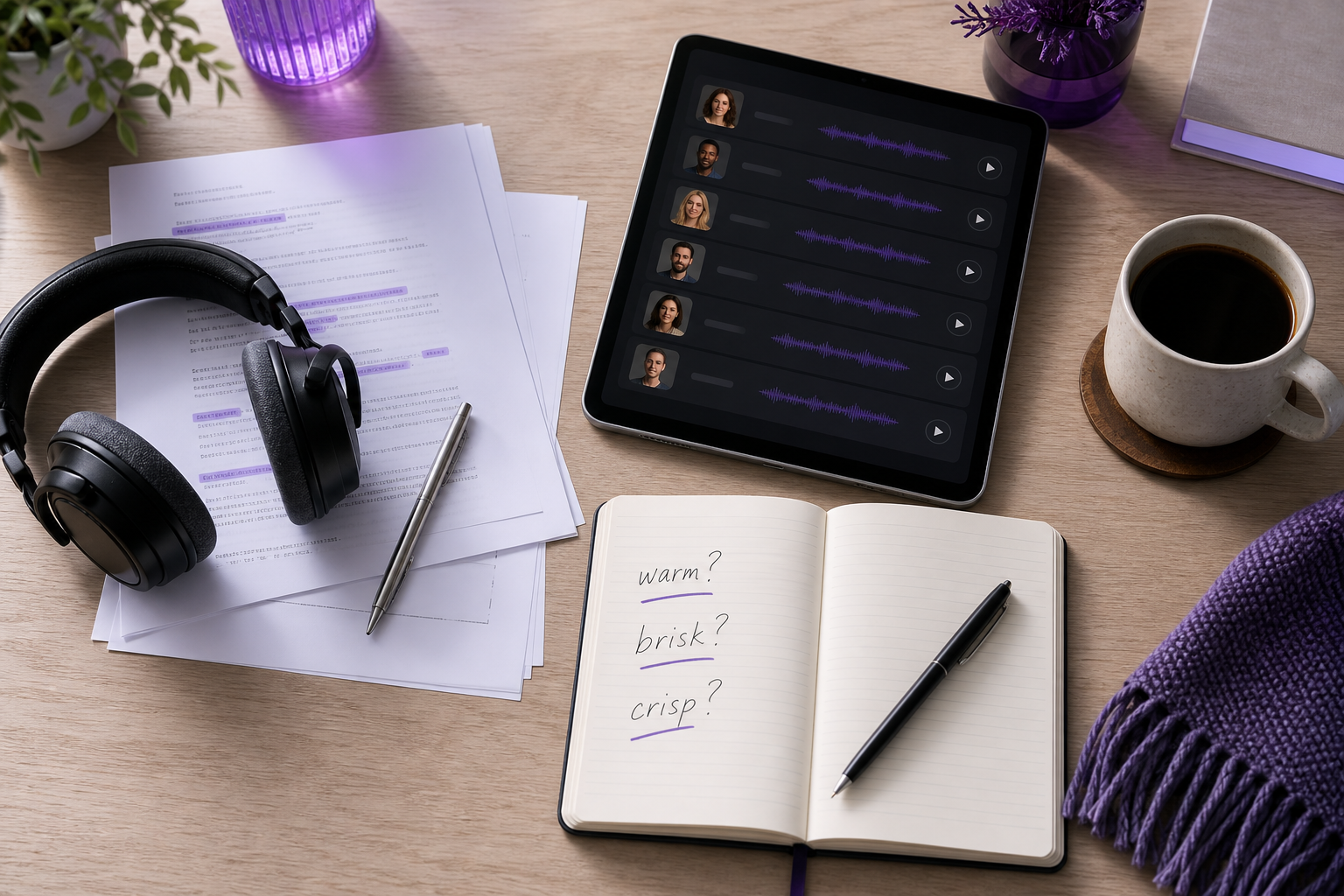
Sebagian besar tim audisi suara dengan cara yang salah. Mereka memutar sampel, bereaksi dengan perasaan samar — "tidak, selanjutnya" — dan tidak pernah mengisolasi dimensi mana yang gagal. Proses audit di bawah meminjam dari ITU-T P.800 dan P.808, standar internasional untuk pengujian Mean Opinion Score dari kualitas ucapan, dan menyesuaikan protokol mendengarkan multi-dimensi itu untuk keputusan casting kreatif.
Langkah 1 — Mengisolasi satu dimensi sekaligus.
Jangan mengevaluasi nada, kecepatan, tekstur, identitas, dan nada emosional secara bersamaan. Putar sampel 15–30 detik (cocok dengan panjang naskah audisi standar per praktik industri voiceover). Pada mendengarkan pertama, skor hanya nada: dingin ↔ netral ↔ hangat pada skala 1–7. Putar ulang untuk kecepatan. Putar ulang untuk tekstur. Protokol pengujian ITU-T P.808 menggunakan metode isolasi yang sama persis untuk menjaga penilaian pendengar stabil di seluruh kriteria.
Langkah 2 — Gunakan sampel jangkar untuk kalibrasi.
Jika Anda tidak yakin apa "renyah" terdengar seperti, dengarkan suara referensi renyah yang diketahui terlebih dahulu (pembaca berita jaringan berfungsi dengan baik) dan kemudian nilai kembali kandidat Anda terhadap jangkar itu. Jangkar mencegah melayang yang terjadi ketika Anda telah mendengar selusin suara berturut-turut dan titik referensi Anda telah bergeser diam ke arah apa pun yang terakhir Anda ambil sampel.
Langkah 3 — Uji dalam konteks produksi, bukan isolasi.
Suara yang terdengar "bernapas" terhadap keheningan terdengar "intim" di atas musik underscore lembut. Selalu evaluasi suara dalam campuran realistis: dengan musik intro Anda, pada kekerasan target Anda (EBU R128 menentukan target kekerasan terintegrasi di sekitar −23 LUFS untuk siaran, dengan varian streaming), dan dengan ambien latar belakang apa pun yang akan muncul di bagian akhir. Ketika menguji puluhan suara dalam skala besar, pengujian suara terprogram melalui API memungkinkan Anda membuat skrip yang sama dalam setiap suara kandidat dan mengaudit mereka dalam kondisi campuran yang identik.
Langkah 4 — Dapatkan pendengar independen kedua.
Minta rekan kerja menggambarkan suara sebelum Anda memberi tahu mereka deskriptor Anda. Jika mereka mengatakan "berwibawa" dan Anda menulis "dingin," Anda telah mengidentifikasi kesenjangan perseptual yang akan muncul lagi dengan audiens Anda. Perjanjian inter-rater adalah metode yang divalidasi untuk mengkonfirmasi penilaian suara — ini adalah cara penilaian MOS membangun keandalan ke dalam pengukuran yang secara fundamental subjektif.
Langkah 5 — Dokumentasikan dengan kartu skor yang dapat Anda sortir.
Buat tabel sederhana: ID Suara | Nada (1–7) | Kecepatan (rentang wpm) | Tekstur (deskriptor) | Identitas (kode usia/gender) | Nada Emosional (deskriptor) | Catatan. Sortir menurut dimensi prioritas Anda. Ini mengubah proses subjektif menjadi daftar singkat yang dapat disaring — dan memberi Anda catatan yang dapat Anda tinjau kembali ketika proyek berkembang ke bahasa kedua atau kampanye ketiga.
Daftar Periksa Pengujian Enam Item
- Apakah saya telah mendengarkan setidaknya 15 detik ucapan berkelanjutan, bukan kata-kata atau fonem tunggal?
- Apakah saya telah mendengar suara dengan berbagai kecepatan, jika platform memungkinkan pengambilan sampel kecepatan pemutaran?
- Apakah saya telah mengujinya dengan skrip aktual saya — atau sampel 30 detik yang mencerminkan kepadatan dan daftar konten saya?
- Apakah saya telah mencatat peringkat deskriptor mana yang terasa pasti versus tidak yakin?
- Apakah saya telah memeriksa kontradiksi internal ("hangat tetapi terpisah") dan bertanya mengapa?
- Apakah saya telah menjalankan tiga kandidat teratas melewati pendengar kedua yang belum melihat peringkat saya?
Lima Deskriptor yang Menyesatkan Semua Orang — dan Apa yang Harus Dikatakan Sebaliknya
Lima deskriptor melakukan lebih banyak kerusakan daripada empat puluh lima lainnya digabungkan karena semua orang menggunakannya dan tidak ada yang setuju dengan artinya. "Natural," "profesional," "renyah," "halus," dan "hangat" masing-masing membawa bacaan teknis, bacaan percakapan, dan bacaan emosional — dan ketiganya jarang tumpang tindih. Tabel di bawah membuat kesenjangan eksplisit dan memberi Anda bahasa pengganti untuk melarikan diri darinya.
| Deskriptor yang Disalahgunakan | Apa yang Didengar Insinyur Suara | Apa yang Didengar Sebagian Besar Pendengar | Apa yang Mungkin Anda Maksudkan |
|---|---|---|---|
| Natural | Pemrosesan minimal, tidak ada artefak kompresi, manusia-direkam | Percakapan, bukan robotis, dapat dipercaya secara emosional | "Ini terdengar seperti orang nyata berbicara, bukan membaca" |
| Profesional | Suara terlatih, rentang dinamis terkontrol, rekaman bersih | Formal, berwibawa, mungkin terpisah | "Percaya diri dan kredibel tanpa menjadi dingin" |
| Renyah | Kejelasan frekuensi tinggi, konsonan artikulate, lantai kebisingan rendah | Energik, modern, efisien | "Cukup jelas untuk istilah teknis" — pernyataan tekstur, bukan kecepatan satu |
| Halus | Beberapa konsonan keras, forward-vokal, legato mengalir | Menenangkan, polished, mudah didengarkan | "Meyakinkan dan tanpa gesekan" |
| Hangat | Penekanan frekuensi lebih rendah, serangan lembut, sibilans rendah | Empatik, manusia, sedikit intim | "Dekat secara emosional tanpa menjadi lembut" |
Tes cepat untuk memisahkan lapisan: Untuk natural, putar kandidat di sebelah sampel TTS yang diketahui dan rekaman manusia yang diketahui — yang mana itu cluster dengan? Untuk profesional, tanyakan apakah suara akan bekerja sebagai terapis dan CFO; jika hanya satu, Anda bermaksud sesuatu yang lebih spesifik. Untuk renyah, putar pada kecepatan 0,75x — jika masih renyah, ini tekstur; jika sekarang lamban, Anda membingungkan renyah dengan cepat. Untuk halus, pasangkan dengan kecepatan — halus ditambah lambat membaca sebagai meyakinkan; halus ditambah cepat membaca sebagai mengkilap. Untuk hangat, lepaskan musiknya; jika suara saja masih terasa hangat, itu suaranya, bukan campurannya.
Pola di bawah lima ini: setiap kata mencampur lapisan teknis (apa yang secara fisik ada di audio), lapisan perseptual (apa yang dilaporkan pendengar dengarkan), dan lapisan aspirasional (apa yang penulis brief berharap suara akan lakukan). Ketika lapisan bertentangan, brief gagal diam-diam — bakat suara atau mesin AI dioptimalkan untuk satu lapisan sementara reviewer mengevaluasi terhadap yang lain. Tidak ada yang tahu percakapannya rusak sampai pengambilan ketiga.
Perangkap "natural" adalah yang paling mahal. TTS saraf modern secara teratur mencetak nilai Mean Opinion Score mendekati ucapan natural dalam bahasa Inggris netral penutur tunggal, seperti yang dilaporkan dalam makalah evaluasi Interspeech dan ICASSP — tetapi skor tersebut tidak memprediksi kinerja tugas dalam konteks instruksional atau persuasif. Suara dapat menilai tinggi pada kealamian dan masih gagal untuk mengajar konsep kompleks atau memindahkan pendengar menuju tindakan.
Suara yang mendapat skor tinggi pada kealamian masih dapat gagal mengajar — ganti natural dengan properti spesifik yang benar-benar Anda pedulikan.
Ganti "natural" dengan properti underlying apa pun yang benar-benar Anda pedulikan: kecepatan percakapan, variasi emosi-mikro, intelegilitas dalam lingkungan akustik Anda, dapat dipercaya untuk skrip ini. Setiap pengganti dapat diuji. "Natural" tidak.
Perangkap "hangat" adalah yang kedua paling mahal, terutama dalam lokalisasi. Pemasar berbahasa Inggris Amerika cenderung membriefing "hangat" sebagai pengaturan ramah default. Tetapi penelitian sosiolinguistik Lippi-Green dalam English with an Accent menunjukkan bahwa sinyal kehangatan tidak diterjemahkan secara simetris. Konteks bisnis Jerman dan Jepang dapat membaca "hangat" Amerika sebagai performatif atau tidak profesional. Ketika membriefing di berbagai bahasa dubbing target, beri nama niat dasar — kepercayaan, keterjangkauan, keahlian — dan biarkan pengulas penutur asli menerjemahkannya ke norma vokal lokal. Ketika suara merek itu sendiri perlu melintasi, kloning suara untuk identitas lintas bahasa melestarikan profil deskriptor sambil membiarkan prosodi melokalisasi.
Perbaikannya mekanis. Setiap kali Anda menulis salah satu dari lima kata ini dalam brief, paksa diri Anda untuk menambahkan "karena harus terdengar seperti ___" dengan jangkar perilaku atau akustik yang konkret. "Hangat karena pendengar harus merasa host berbicara kepada mereka, bukan pada mereka." "Renyah karena skrip memiliki enam istilah teknis per paragraf dan pendengar memerlukan setiap konsonan yang mendarat bersih." Jangkar mengubah deskriptor dari keinginan menjadi spek.
Ringasan Deskriptor Suara Anda — Template Isi dengan Contoh Kerja
Gunakan template ini di awal setiap proyek yang melibatkan pemilihan atau pengarahan suara — bakat manusia, perpustakaan suara AI, klon suara. Mengisinya membutuhkan sepuluh menit. Tidak mengisinya menghabiskan jam dalam re-record dan debat Slack yang tidak menyelesaikan apa pun.
Template Brief
1. Konteks Proyek
- Jenis konten: ________ (video YouTube / modul e-learning / podcast / proyek dubbing / demo produk)
- Audiens target: ________ (siapa yang mendengarkan, dalam satu kalimat)
- Panjang per aset: ________ (30 detik / 10 menit / terseri)
- Bahasa yang diperlukan: ________ (bahasa tunggal / daftar bahasa target yang didub)
- Lingkungan akustik: ________ (mendengarkan headphone / speaker mobile / mobil / ruang publik)
2. Nada (Dimensi 1)
- Harus-miliki: ________
- Harus-hindari: ________
- Suara referensi (opsional): ________
3. Kecepatan dan Ritme (Dimensi 2)
- Rentang wpm target: ________ (jangkar: 130–150 e-learning; 150–170 percakapan; 170+ komentar)
- Perilaku jeda: ________ (jeda panjang di perbatasan semantik / propulsif, jeda minimal)
4. Tekstur (Dimensi 3)
- Target: ________ (halus / renyah / hangat-resonan / bernapas-intim)
- Spek akustik: puncak di bawah −3 dBFS, RMS −20 hingga −18 dBFS, lantai kebisingan di bawah −60 dBFS (patokan ACX/Audible)
5. Penanda Identitas (Dimensi 4)
- Pita usia yang dirasakan: ________
- Presentasi gender: ________ (dengan catatan fleksibilitas)
- Pengodean budaya / regional: ________
6. Nada Emosional (Dimensi 5)
- Utama: ________
- Sekunder: ________
- Terlarang: ________
7. Rencana Validasi
- Jumlah pengambilan audisi per kandidat yang masuk daftar pendek: ________ (default industri: 2–3)
- Ulasan pendengar kedua: ya / tidak
- Ulasan penutur asli untuk setiap bahasa yang didub: ya / tidak
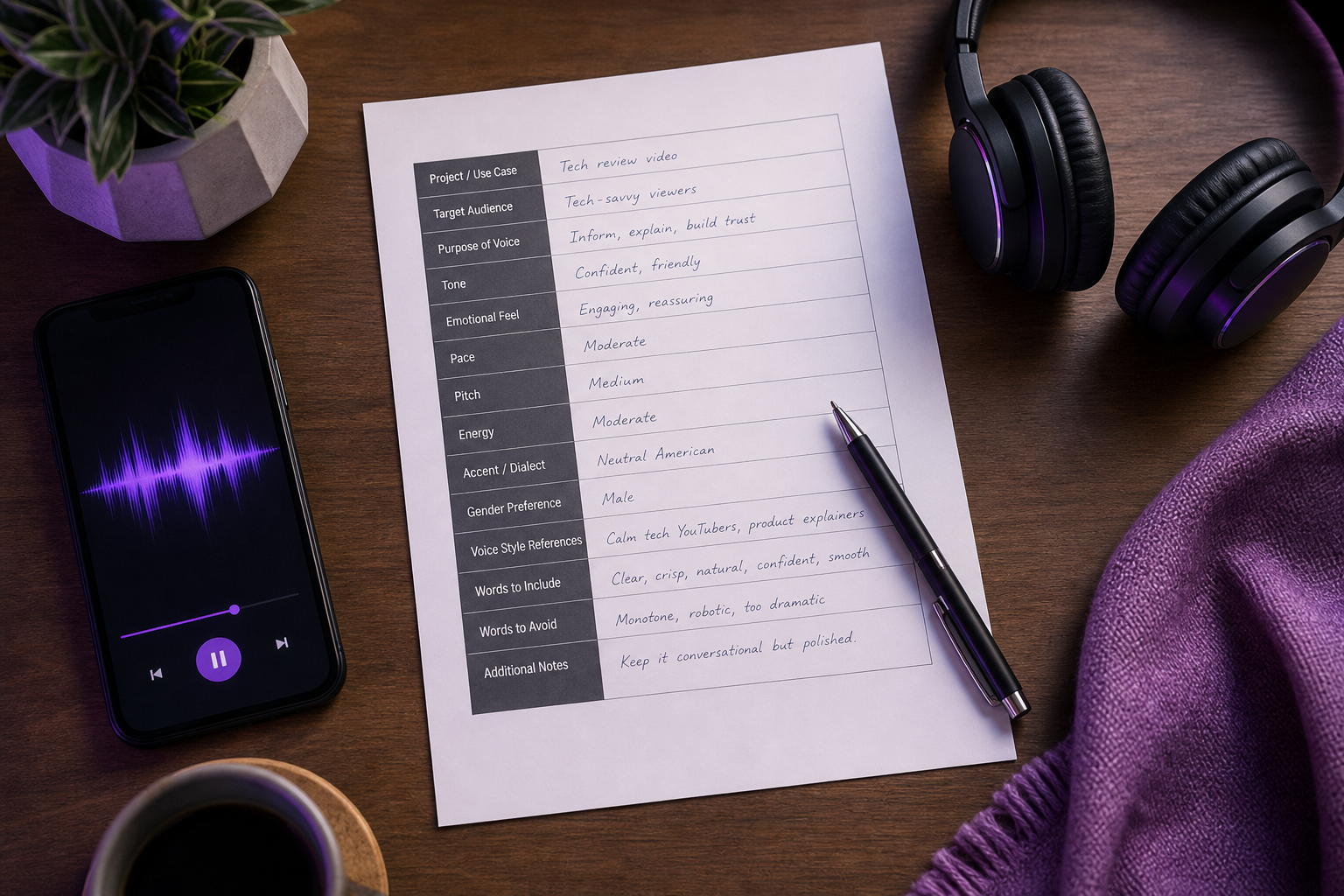
Contoh Kerja — Saluran Ulasan Teknologi YouTube
Konteks. Ulasan teknologi bentuk panjang 12 menit. Audiens: 25–40, sebagian besar pendengar headphone. Didub ke Spanyol, Portugis Brasil, dan Jerman menggunakan kloning suara untuk melestarikan identitas tuan rumah.
Nada. Harus-miliki: berwibawa ditambah percakapan. Harus-hindari: mengajar, penjualan.
Kecepatan. 150–165 wpm. Perilaku jeda: jeda yang disengaja sebelum keputusan, propulsif melalui spek.
Tekstur. Konsonan renyah untuk nama produk dan istilah teknis. Vokal halus. Sibilans rendah — sesi headphone panjang memperkuat kelelahan "S".
Identitas. Usia yang dirasakan 30-an hingga awal 40-an. Presentasi gender selaras dengan tuan rumah. Pengodean regional: netral Amerika Utara untuk bahasa Inggris; dikode asli untuk setiap bahasa yang didub.
Nada Emosional. Utama: percaya diri-skeptis (merek saluran yang adil-kritis). Sekunder: sedikit terhibur pada produk aneh. Terlarang: sinis, hyped.
Validasi. 3 pengambilan per kandidat suara AI pada audisi. Ulasan pendengar kedua internal. Ulasan penutur asli untuk setiap bahasa yang didub sebelum publikasi.
Brief adalah artefak. Isinya untuk proyek berikutnya Anda, jalankan terhadap daftar pendek Anda, dan Anda akan menemukan bahwa mayoritas besar reaksi "ini tidak terasa benar" diselesaikan menjadi ketidakcocokan deskriptor spesifik yang dapat diperbaiki — jenis yang dapat Anda beri nama, brief, dan arahan melawan. Ketika Anda siap menskalakan brief yang sama di berbagai bahasa, API dubbing AI menjaga profil deskriptor konsisten di setiap pasar target.
FAQ
Apakah deskriptor suara berlaku sama untuk suara AI seperti untuk suara manusia?
Ya untuk lima dimensi, dengan peringatan untuk nada emosional. Pendengar menerapkan penilaian sosial pada suara sintetis seperti yang mereka lakukan pada manusia — Nass dan Reeves menetapkan ini dalam The Media Equation — jadi deskriptor nada, kecepatan, tekstur, dan identitas menerjemahkan dengan bersih ke AI. TTS saraf modern mendekati skor MOS manusia dalam kondisi netral, tetapi kesenjangan ekspresivitas muncul dalam bagian yang kompleks secara emosional dan di seluruh bahasa, seperti yang dilaporkan dalam makalah evaluasi Interspeech. Aturan praktis: briefing suara AI menggunakan semua lima dimensi, tetapi harapkan untuk secara manual mengarahkan nada emosional melalui rekayasa cepat, pemilihan pengambilan, atau penyesuaian tingkat SSML.
Berapa banyak deskriptor yang harus muncul dalam satu brief?
Satu hingga dua per dimensi. Lebih banyak menciptakan kelumpuhan keputusan dan tidak memberikan kandidat apa pun kesempatan yang adil untuk memuaskan brief. Jika Anda benar-benar membutuhkan tiga pada satu dimensi — misalnya, "hangat DAN berwibawa DAN ceria" pada nada — peringkat mereka sebagai utama, sekunder, dan tersier, dan terima bahwa tersier mungkin perlu ditambahkan dalam arahan daripada casting. Maksud brief adalah untuk filter, bukan menggambarkan setiap kualitas yang mungkin Anda temukan dapat diterima.
Apa jika tidak ada suara di perpustakaan yang cocok dengan semua deskriptor saya?
Prioritaskan menurut mutabilitas. Penanda identitas dan nada adalah dimensi paling sulit untuk berubah setelah casting; kecepatan dan nada emosional dapat disesuaikan melalui arahan atau, di suara AI, melalui parameter cepat dan SSML. Tekstur duduk di tengah — penyesuaian kecil dimungkinkan melalui EQ dan pemrosesan, tetapi kualitas mendasar seperti kekasaran atau kemenduaran tidak dapat diperbaiki di post. Cast untuk dimensi yang tidak bergerak terlebih dahulu; arahan yang fleksibel nanti.
Apakah deskriptor suara diterjemahkan di seluruh bahasa dalam proyek dubbing?
Sebagian. Deskriptor akustik (tekstur, nada, kecepatan) diterjemahkan langsung. Deskriptor emosional dan nada tidak — norma budaya menggeser apa arti "hangat," "berwibawa," dan "profesional" di pasar yang berbeda, seperti yang didokumentasikan dalam pekerjaan sosiolinguistik Lippi-Green. Untuk dubbing di berbagai bahasa target, brief dengan niat di balik setiap deskriptor, kemudian validasi dengan pengulas penutur asli per bahasa. Kloning suara melestarikan penanda identitas di seluruh bahasa sambil memungkinkan prosodi lokal beradaptasi — menjaga suara merek yang dapat dikenali sambil membiarkan setiap pasar mendengar sesuatu yang terasa asli daripada diterjemahkan.