
Amazon Polly text to speech is an AWS cloud service that turns written text into lifelike speech through an API, built for developers who add narration to apps, IVR systems, and back-end pipelines. DubSmart is a creator-first localization platform where text to speech sits inside a full workflow of voice cloning, dubbing, and subtitles. The right choice depends on how you actually produce content, not on which brand sounds more impressive.
That distinction is the whole game. One tool hands you a precise speech engine and expects you to assemble the rest. The other hands you an assembled pipeline and lets you skip the engineering. Below, we break down what each does, how the technology works, and which working style each one rewards.
Table of contents
- What Amazon Polly and DubSmart actually are
- How text-to-speech synthesis works under the hood
- Voice engines, variants, and where they diverge
- Why the workflow difference matters for creators and teams
- How to judge which one fits your workflow
- Frequently asked questions
What Amazon Polly and DubSmart actually are
Amazon Polly is a text-to-speech service inside Amazon Web Services. You send text to its API, and it returns audio built by deep learning voice models. Its official positioning is a speech-enabling component: something developers wire into applications to add spoken output, read articles aloud, or voice interactive systems. It is not a video tool, a translation tool, or a subtitle tool. It converts text to speech, and it does that job with granular control.
We built DubSmart around a different premise. It is an all-in-one AI media creation and localization platform that combines AI Dubbing, Voice Cloning, Text to Speech, Speech to Text, Speech Separator, Text to Image, and Image to Video in one place. Our Text to Speech product focuses on human-like AI voices with unlimited voice cloning, and it connects directly to dubbing and subtitle generation so a single project can move from a script to a fully localized video without leaving the workflow. More than 500,000 users work inside that platform, most of them content creators, YouTubers, e-learning producers, and small marketing teams.
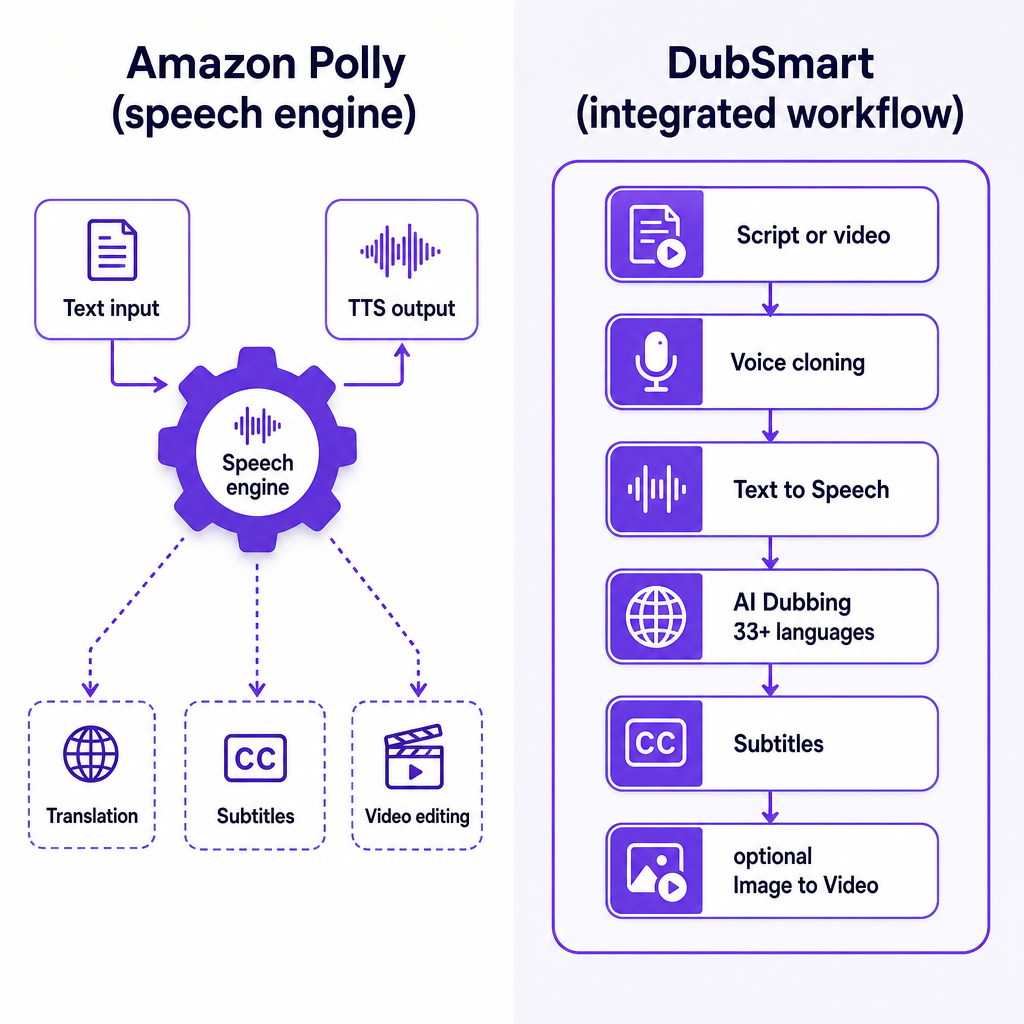
The cleanest way to hold the two in mind: Polly is a speech engine you integrate; DubSmart is a production environment you work inside. Polly assumes an engineer will handle everything around the speech. DubSmart assumes a creator or a lean team wants the surrounding work already handled. Both generate speech from text. What they surround that speech with is where they part ways.
How text-to-speech synthesis works under the hood
Modern text to speech is not a lookup table of recorded words. According to AWS documentation, Polly uses deep learning to synthesize speech: it takes input text, normalizes it by expanding numbers and abbreviations into full words, converts that normalized text into phonemes, and then generates audio waveforms through its voice models. That normalization step is why a well-built engine reads "Dr." as "doctor" in one context and "drive" in another, and why it can voice "$5" as "five dollars."
On top of that pipeline, Polly supports SSML, the Speech Synthesis Markup Language. SSML lets a developer wrap text in tags that control prosody such as pitch, speaking rate, and volume, insert deliberate pauses, add emphasis, or force a specific pronunciation. This is the fine-grained layer that makes Polly attractive for custom applications: if you need a phone system to pause exactly half a second before reading an account number, you can specify that.
The underlying mechanism is broadly similar across strong TTS providers, including the engine behind our own Text to Speech. Text is analyzed, normalized, mapped to sound units, and rendered as natural audio by neural models trained on large speech datasets. The practical difference for you is rarely the raw synthesis quality on a single clean sentence. It shows up in everything wrapped around that sentence: how you feed text in, how you shape delivery, whether you can reuse a specific voice, and what happens to the audio next.
One more mechanism worth knowing is streaming. An AWS engineering blog describes bidirectional streaming in Polly, where text is sent and synthesized audio is received over the same connection at the same time, reducing total processing time versus a traditional request-and-wait cycle. That matters for conversational AI and live narration, where a caller cannot wait for a full paragraph to render before hearing the first word. For most pre-recorded content, batch synthesis is fine; for interactive systems, streaming is the feature that makes the experience feel responsive.
Voice engines, variants, and where they diverge
Polly ships more than one kind of voice. AWS documents several voice engines, and knowing them clarifies what "a Polly voice" even means. Standard voices use traditional synthesis techniques. Neural voices use neural networks for noticeably more natural prosody. Long-form voices are tuned for extended content such as audiobooks, where consistency across many minutes matters. Generative voices apply generative AI to produce more expressive, engaging audio aimed at storytelling, marketing, and media. Each engine spans multiple languages, and each language typically ships with named male and female voices identified by voice IDs.
Those variants exist so a developer can trade cost, expressiveness, and use case against each other. A high-volume automated notification might use a lighter engine, while a marketing narration reaches for the generative one. This is a menu of speech quality tiers, and choosing among them is part of building on Polly.
DubSmart approaches variety from the creator's side of the problem. Instead of asking you to pick a synthesis engine, our platform provides 300+ natural-sounding voices as a ready library, plus unlimited voice cloning so you can create a custom voice from an audio sample and reuse it. The Voice Cloning product lets that cloned voice carry across projects, and because it feeds the same workflow, the voice you clone can narrate a script, dub a video, or appear in multilingual output without being rebuilt each time. Our first-party materials on top text-to-speech tools describe this localization-led setup as spanning many languages for TTS and subtitles, framing DubSmart as a localization solution rather than only a speech generator.
The deeper divergence is voice identity across languages. A named Polly voice is a fixed asset in Polly's library. With voice cloning inside a localization pipeline, the goal shifts: keep one creator's or one brand's voice recognizable while the language changes. That is a fundamentally different feature than choosing a stock voice per request, and it is central to why multilingual channels and course libraries lean toward an integrated platform.
Why the workflow difference matters for creators and teams
The title asks which tool fits your workflow, and workflow is exactly where the abstract comparison becomes concrete. Consider a YouTube creator expanding a channel into several languages. With an integrated platform, they can clone their own voice, generate multilingual narration through Text to Speech, dub existing videos into additional languages, and produce subtitles, all in one environment. The voice stays theirs across every language, and no code is required to hold it together.
Now picture the same goal built on a raw speech API. Polly would synthesize the audio, and it would do so reliably. But translation is a separate service, subtitle generation is separate, video assembly is separate, and stitching them together typically means combining AWS services such as storage, orchestration functions, and a translation service, then wiring in external editing tools. That is real engineering effort. For a developer or an operations team it is routine. For a solo creator or a two-person marketing team, it is a project in itself.
E-learning producers feel this even more sharply. A course library often needs the same lesson voiced in multiple languages, with matching subtitles and consistent narration across dozens of modules. Our platform is positioned for exactly this: multilingual TTS and subtitles alongside dubbing into 33+ languages, so a single lesson can become a localized set without a developer chaining tools. The AI Dubbing product ties the spoken output directly to the video, which is the step a standalone TTS engine leaves entirely to you.
Small businesses producing multilingual ads or explainers sit in the same bracket. They rarely have an in-house engineer to manage cloud infrastructure, and they value predictability over low-level control. An integrated environment lets them go from script to finished, localized asset while keeping brand voice intact. That does not make Polly a weaker product. It makes it a product optimized for a different operator: one who is building software, not publishing content.
How to judge which one fits your workflow
Skip the question of which tool is globally better, because it has no answer. Ask instead how you create, localize, and publish. A few honest questions separate the two cleanly.
Are you building an application, or producing content? If you are a developer embedding speech into an app, an IVR flow, or a bespoke learning platform, and you want SSML-level control and streaming synthesis inside code, Polly's API-first design fits that intent. If your output is videos, courses, ads, or podcasts, an integrated production environment removes work you would otherwise do by hand.
Are you already living in AWS? Teams with existing AWS infrastructure, identity management, and pipelines gain from Polly slotting into what they already run. If you are not on AWS and have no appetite to adopt it, that advantage evaporates and the surrounding assembly becomes overhead.
Do you need translation and dubbing, or only speech? This is the sharpest divider. Text to speech alone does not translate or dub; a speech API returns audio in the language you feed it. Localization requires translation plus voice plus timing plus subtitles. Our platform treats that as the core job, while a raw engine treats speech as the finish line and leaves localization to other tools.
How important is one consistent voice across languages? If brand or creator voice must stay recognizable as the language changes, cloning inside a connected workflow is built for it. If you simply need clear narration and any suitable stock voice will do, a stock voice library covers you.
Do you want convenience, or maximum control? Polly rewards teams that want to tune prosody, orchestrate services, and own every layer. DubSmart rewards teams that want an end-to-end path with the option to drop into code when needed. Developers are not locked out of the convenient route either: our Text to Speech API and AI Dubbing API expose the same capabilities programmatically, so you can script generation and dubbing without rebuilding an entire stack around a single cloud engine.
A note on cost thinking without the numbers: Polly bills per character processed, which scales predictably for programmatic use when someone is managing it. Our credit-based model with rollover credits and a free tier ties spend to production units like minutes of dubbing or narration rather than raw character counts. The models suit different mental accounting, and the exact figures belong in a dedicated cost breakdown, not this workflow explainer. Whatever you choose, confirm you hold the rights and consent for any voice you clone and any content you localize, since responsibility for that sits with you regardless of tool.
If your next step is producing localized content rather than writing integration code, the fastest way to test fit is to run a real script through an integrated pipeline and hear the result. If your next step is engineering, the API route gives you the same voices under programmatic control. Either way, the decision is about your workflow, and now you have the criteria to make it. If you would like a tailored suggestion, share your content type, target languages, volume, and whether you prefer a no-code interface or an API, and we can point you to the right combination of voices, dubbing, and subtitles for your project.
Frequently asked questions
Does Amazon Polly translate text into other languages?
No. Polly converts text to speech in the language of the text you supply. It supports many languages with multiple voices each, but translation is a separate task. To localize with Polly you would pair it with a translation service and handle subtitles and video separately. An integrated localization platform combines translation, voiced output, and subtitles in one flow, which is why teams focused on multilingual content lean that way.
Can I keep my own voice consistent across multiple languages?
With voice cloning inside a connected workflow, yes. Our platform lets you clone a voice from an audio sample and reuse it across Text to Speech and AI Dubbing, so a creator's or brand's voice stays recognizable as the spoken language changes. A stock voice library from a standalone engine gives you named voices per language, but keeping one identity across languages is specifically what cloning in a localization pipeline is designed to do.
Is Amazon Polly better for developers than DubSmart?
It depends on the goal. Polly is API-first and fits developers building applications inside AWS who want SSML control and streaming synthesis. Developers who want localization capability without building the whole stack can use our Text to Speech, Voice Cloning, and AI Dubbing APIs instead. "Better" hinges on whether you are engineering an application or producing multilingual content.
What is SSML and do I need it?
SSML is Speech Synthesis Markup Language, a set of tags that control prosody, pauses, emphasis, and pronunciation in synthesized speech. Polly supports it for fine-grained voice design. You need it when your application demands precise delivery control at the code level. For most content production, choosing a natural voice and adjusting delivery inside a production interface covers the need without hand-writing markup.
Can DubSmart handle full video localization, not just audio?
Yes. Our platform connects Text to Speech to AI Dubbing, subtitle generation, and even optional visual assets through Text to Image and Image to Video. A single project can move from script or original video to dubbed, subtitled, multilingual output in one environment, which is the difference between a speech engine and an end-to-end localization workflow.
Which tool scales better for large content volumes?
Both scale, but along different axes. Polly's per-character billing scales programmatic synthesis when a technical team manages it. Our plan-based and credit-based structure with rollover credits scales content production in units teams recognize, like minutes of dubbing or narration. The better fit depends on whether you are scaling code-driven speech generation or scaling published multilingual content.