TikTok text to speech voices are the AI narrators that read your on-screen script aloud, either through TikTok's built-in text tool or through an external voice platform whose audio you bring into your video. The native option is fast and free; the external option gives you realism, a signature voice, and multilingual reach. At DubSmart AI, we sit in that second camp, turning scripts into human-like narration you can drop into any TikTok.
That distinction is the whole game for creators chasing viral-ready narration. A trend meme can live happily on TikTok's stock voices. A tutorial series, a branded campaign, or a faceless channel that depends on storytelling usually cannot. Understanding what these voices actually are, how they differ, and what to weigh before you commit will save you a lot of re-recording later.
Table of contents
- What TikTok text to speech voices are and how they work
- The three narration setups: native, external, and cloned
- Why voice choice moves the needle on reach
- What to weigh before you pick a voice
- Designing your TikTok narration stack
- Frequently asked questions
What TikTok text to speech voices are and how they work
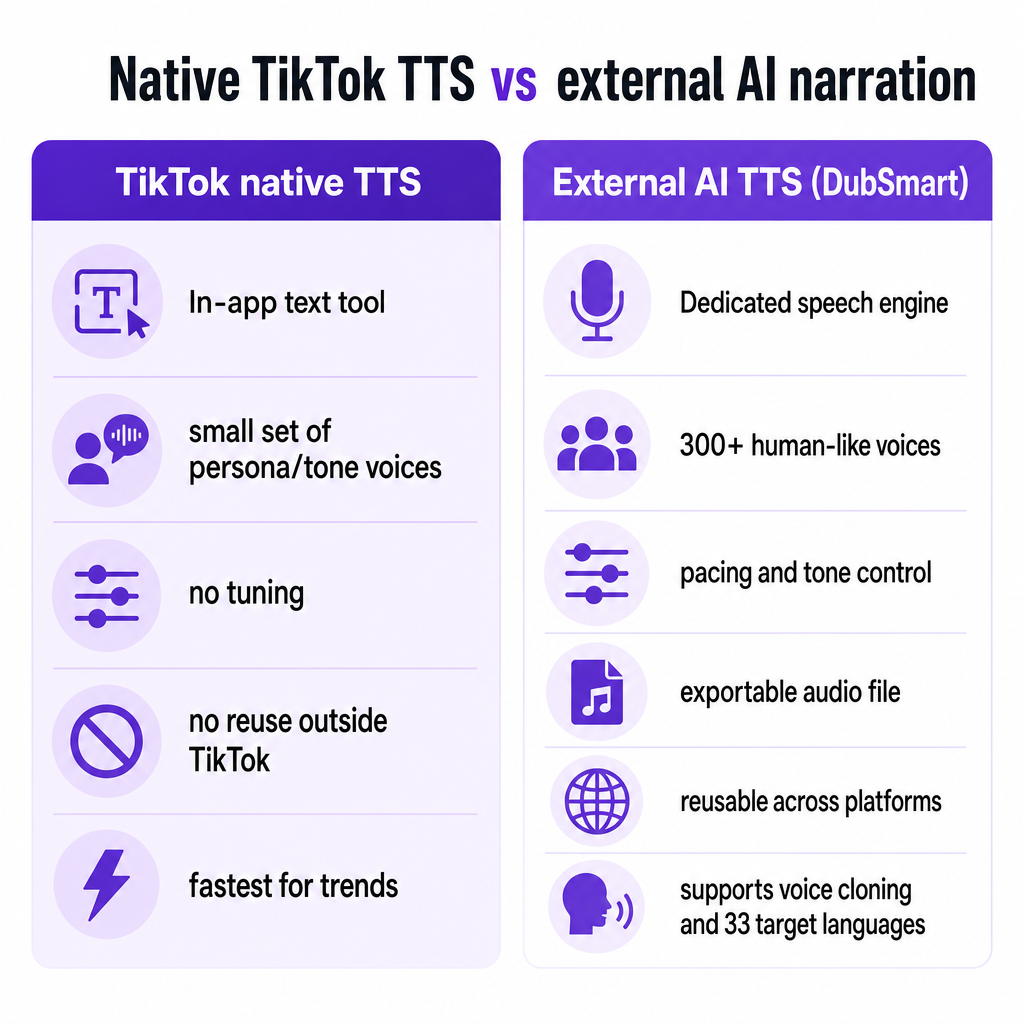
TikTok's native text to speech lives inside the editor. You add a text layer with the "Aa" tool, tap the text-to-speech option, and the app reads what you typed using one of its internal AI voices. TikTok labels these voices by character or tone — names like "Narrator," "Granny," or "Trickster" — and you can tap each to hear a short sample before applying it (Shopify's guide to TikTok's AI voice). Everything happens in the app, with no files to manage. That is exactly why so many creators treat it as the default: a Fluxnote overview calls it the easiest way to add an AI voice to a clip (Fluxnote's rundown of free TikTok voice-over tools).
Under the hood, the mechanism is simple: your typed text is passed to a predefined speech model that produces spoken audio and layers it onto the draft. You get a handful of personas and tones, but you cannot deeply tune them and you cannot reuse that voice anywhere else.
External AI text to speech works differently. Instead of the app's fixed models, your script runs through a dedicated speech engine that draws on a much larger voice library and exposes controls for pacing, tone, and often emotion. The engine outputs an actual audio file — typically an MP3 or WAV — that you then sync with your footage in an editor or add directly to your TikTok (Shopify). Editorial coverage of AI narration tools frames this as the reason standalone platforms win on expressive, realism-heavy content: the model and the parameters are built for narration, not just captions (GPTProto's look at AI TTS for TikTok and YouTube).
This is the layer we occupy. Our Text to Speech engine turns a script into human-like audio you export and use as your TikTok narration. The single extra step — generating audio elsewhere and bringing it in — is what buys you the control the native tool cannot offer.
The three narration setups: native, external, and cloned
Most TikTok narration falls into one of three setups, and the difference between them is control, not just quality.
Native voices are TikTok's built-in AI narrators. They are the quickest path — no exports, no editor, no file handling — which makes them a natural fit for trend participation, meme voiceovers, and low-stakes posts. DIYAI's comparison of TikTok voice generators is blunt about the tradeoff: native TTS is the fastest option for a post that lives entirely inside the app, while dedicated tools give you stronger control over realism, editing, and captions at the cost of exporting and importing media (DIYAI's editorial on TikTok voice generators).
External non-cloned voices come from a dedicated platform. You choose from a large catalog of generic but high-quality voices, generate audio, and bring it into your video. You gain realism, language options, and consistency, but the voice is still one that other creators can use too. Our library of 300+ natural-sounding voices sits here — a wide range of human-like options for creators whose content leans on narration rather than on-camera presence.
Cloned or custom voices are where narration becomes an identity. Instead of picking from a shared catalog, you create a voice that belongs to your channel. With our Voice Cloning you can build a voice from a short audio sample and reuse it across every video. That opens up three practical patterns:
- Your own voice, cloned so you never have to re-record, keeping narration consistent even on days you cannot pick up a mic.
- A branded character voice that followers start to recognize as yours, distinct from the millions of accounts sharing TikTok's stock personas.
- Multilingual versions of the same persona, where the timbre stays recognizable as you translate a video into other markets.
That last pattern connects to dubbing rather than plain narration. Our AI Dubbing turns one script into localized versions across 33 target languages, and because cloning preserves the voice, your English original and its Spanish or Portuguese variant can share a recognizable sound. Editorial coverage flags cloning as a defining feature for serious creators who want a signature narration style rather than a borrowed one (GPTProto).
Why voice choice moves the needle on reach
Narration is not decoration on a TikTok — it is often the retention mechanism. The first few seconds decide whether a viewer keeps watching, and a flat, robotic read can stall a hook that would otherwise land. A voice that carries rhythm and emphasis pulls a viewer past the scroll threshold, which is exactly why coverage of narration-driven formats keeps returning to realism and expressiveness as the qualities that separate storytelling content from casual clips (GPTProto).
There is also a memorability effect. When your voice sounds identical across dozens of videos, it becomes part of how followers recognize you before they even see your handle. TikTok's native voices work against this by design: they are shared across millions of accounts, so they cannot distinguish your channel. A consistent, custom voice is a small branding asset that compounds over a content series.
Clarity matters just as much for the practical niches — tutorials, product reviews, explainers. When someone is following instructions or weighing a recommendation, a natural, well-paced voice reads as more trustworthy than a choppy synthetic one. DIYAI's comparison makes the point that TikTok's own voices are well-suited to casual trends but less ideal for long-form, professional, or emotional narration (DIYAI). For creators whose entire format depends on the voice doing the heavy lifting, the upgrade from stock personas to human-like voices is less a nicety and more a foundation. It is one reason more than 500,000 users have brought their narration into our tools.
What to weigh before you pick a voice
Choosing a narration approach is a judgment call, not a checklist. A few dimensions matter more than the rest.
Audience and niche. A comedy account riding trends has different needs than an educational channel or a branded campaign. If your posts are casual and disposable, the fastest voice wins. If your content is a repeatable format that people subscribe to, invest in a voice worth recognizing.
Tone and realism. Ask how much your message depends on the delivery. Emotional storytelling, sincere reviews, and calm explainers all suffer under a robotic read. This is where a larger, human-like catalog earns its place — you can audition options until one matches the mood of the content instead of settling for the one persona that is close enough.
Language and localization. Native TikTok voices support a limited set of languages, so creators reaching beyond a single market quickly hit a wall. If your growth plan includes Spanish, Portuguese, Hindi, or other TikTok audiences, you want a voice approach that travels. We support dubbing from 60+ source languages into 33 target languages, which lets a proven English format become region-specific versions with matching narration.
Workflow: speed versus control. Be honest about your bottleneck. Native voices remove every file-handling step, which is genuinely valuable when you post several times a day on trend cycles. External narration adds one import step in exchange for real control (DIYAI). For volume teams and tools, that step can be automated entirely — our Text to Speech API and Voice Cloning API let agencies and developers build narration into an automated pipeline rather than clicking through it each time.
Commercial use and scalability. Monetized channels, advertisers, and brands care about rights and reuse. Editorial comparisons stress that professional AI voice platforms emphasize commercial usage rights, and that this matters more as content becomes revenue-linked (GPTProto). TikTok's built-in TTS covers use inside the app, but it does not hand you a reusable voice asset for a cross-platform campaign. Because policies and license terms change, review TikTok's latest guidelines and our own licensing documentation before using AI-generated voices in sponsored or regulated content, and treat any regulated category as a case-by-case check.
The common misconception worth naming here is that TikTok's built-in voice is good enough for everything. It is genuinely good enough for a lot — casual, fast, trend-based posts. It is not built for a narration-dependent channel that wants a signature sound, multilingual reach, and reusable assets, and pretending otherwise usually shows up as flat retention on your most ambitious videos.
Designing your TikTok narration stack
Think of your narration as a small stack you assemble around the content you actually make, not a single tool you switch to forever. A useful way to sequence the decision:
Start by experimenting with voices. Run a few scripts through our Text to Speech to hear how different human-like voices carry your hooks before you commit to one. Once a format proves itself and you want a sound followers recognize, move to a signature voice — cloning your own or building a branded channel voice you can reuse indefinitely. When a format works in your home language and you are ready to expand, layer in AI Dubbing to produce localized versions without rebuilding the whole video, and consider our AI Dubbing API if you are dubbing at volume across many uploads.
Because we consolidate these tools into one workflow — narration, cloning, dubbing, and supporting media like thumbnails and short clips — you can go from script to voiced, localized TikTok without stitching together separate subscriptions. The right narration setup is the one that matches your posting rhythm and your ambitions for the channel, and it is fine to begin with a single voice and grow the stack as the content earns it.
For the exact hands-on sequence of generating audio and getting it into a TikTok, follow the how-to tutorial in this cluster once it is the step you need; this explainer is here to help you choose the approach first.
Frequently asked questions
Are TikTok's built-in voices enough for serious creators?
For casual trend posts and meme voiceovers, yes — they are the fastest option and everything stays inside the app. For narration-driven content such as tutorials, reviews, or branded series, the native voices are limited in realism, cannot be tuned deeply, and cannot be reused elsewhere. Creators whose format leans on the voice usually outgrow them and move to a dedicated platform for more control and a recognizable sound.
Can I use the same AI voice across TikTok, YouTube, and Reels?
Native TikTok voices only exist inside TikTok, so they cannot follow you to other platforms. A cloned or custom voice created on an external platform is an exportable audio asset, which means the same voice can narrate your TikToks, YouTube Shorts, Reels, and long-form uploads. That consistency is one of the main reasons creators build a signature channel voice rather than relying on shared stock personas.
How fast can I get a cloned voice ready for TikTok narration?
Our voice cloning builds a custom voice from a short audio sample — roughly 20 seconds of clean audio is enough to get started. Once the voice exists, generating narration is a matter of running your script through it, so the setup happens once and every future video reuses it. For teams producing high volumes, the Voice Cloning API lets you automate the whole narration pipeline.
Do AI voices work for non-English TikTok audiences?
Yes, and this is where external platforms clearly outpace native TTS. TikTok's built-in voices support a limited language set, while we support dubbing from 60+ source languages into 33 target languages. A creator can take a proven English video and produce Spanish, Portuguese, Hindi, and other regional versions, each with natural narration — and with voice cloning the voice can stay recognizable across those languages.
Will using AI narration help or hurt my reach?
Reach depends far more on the content and the hook than on whether narration is AI-generated. What matters is delivery: a natural, well-paced voice supports retention in the crucial opening seconds, while a flat read can stall an otherwise strong hook. Because platform policies evolve, check TikTok's current guidelines for any sponsored or regulated content, but expressive AI narration is a common and accepted part of many creators' workflows.
What's the difference between text to speech and AI dubbing for TikTok?
Text to speech turns a written script into spoken narration in one language — you write, you generate audio, you add it to your video. AI dubbing takes existing content and produces it in additional languages, translating and voicing it so the same video reaches new markets. On TikTok you would typically use text to speech to narrate an original clip and AI dubbing to localize a format that already works.