Whisper text to speech is the generation of soft, low-intensity, breathy AI narration from written scripts — the hushed delivery you hear in ASMR, meditation tracks, bedtime stories, and late-night commentary. It is not a separate engine. It is a style of output produced by a text-to-speech voice, either a naturally gentle preset voice or a cloned whisper of your own.
That distinction matters more than it sounds, because the word "whisper" carries a second, unrelated meaning in the AI world. We build our Text to Speech, Voice Cloning, and AI Dubbing tools around the delivery meaning: the sound of someone speaking quietly, close to the microphone, with the vocal folds barely engaged. Below we explain how that sound is actually produced, what variants exist, and the judgment calls worth making before you commit a channel or a product to a whispered voice.
Table of contents
- What whisper-style text to speech actually is
- Whisper the delivery vs. Whisper the transcription model
- The three routes to a whispered AI voice
- Why soft voices matter for creators, teams, and developers
- What to weigh before you commit to a whisper voice
- Choosing your next move
- Frequently asked questions
What whisper-style text to speech actually is
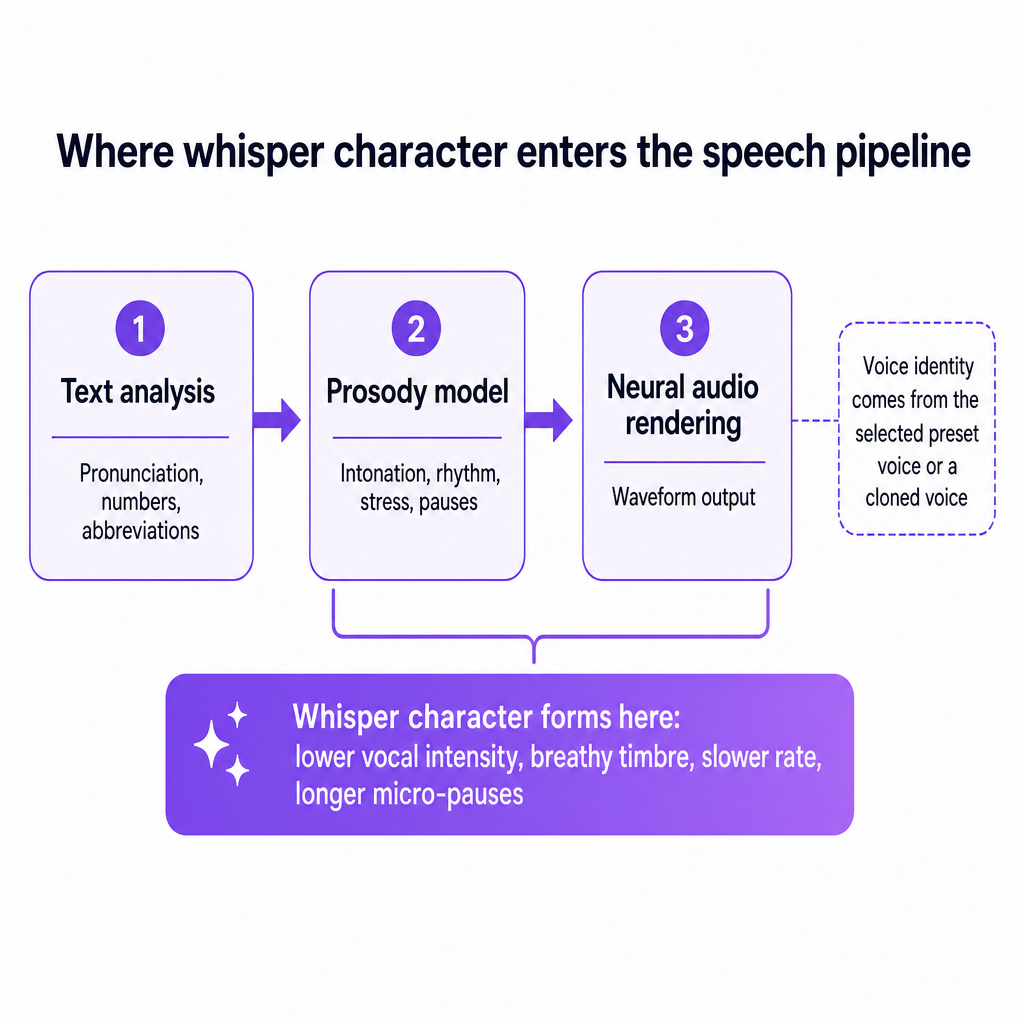
A modern speech synthesizer does three things in sequence. It reads and normalizes the text, deciding how to pronounce numbers, abbreviations, and ambiguous words. It models prosody — the intonation contour, the rhythm, the stress placement, the length of pauses. Then a neural component renders that plan as an audio waveform. The public OpenAI text-to-speech API guide shows the practical shape of this in an interface: a request carries a model, the text to be spoken, and a voice identifier, and audio comes back. That three-input pattern is broadly how the category works, ours included.
Whisper-style output lives almost entirely in the second and third stages. A true physiological whisper has no vocal fold vibration at all — it is turbulent air shaped by the mouth and throat, which is why it has no pitch melody in the usual sense. Most "whisper" voices you hear in commercial content are not that extreme. They sit in a softer band: reduced vocal intensity, audible breath, a slower speaking rate, and more frequent micro-pauses, with just enough voicing left to keep consonants crisp and words legible.
That is the engineering tension in one sentence. Push toward a literal whisper and intelligibility drops, especially on phone speakers and in noisy rooms. Stay too far back from it and the result is simply a quiet voice, not an intimate one. The convincing middle is a breathy timbre carried at low energy without the muffled quality that comes from stripping out high-frequency detail.
Our Text to Speech engine approaches this from the voice side. With more than 300 voices in the library, a meaningful portion of them already read gently by default — narration voices, calm conversational voices, voices with a naturally warm and low-energy character. Those are the sensible starting points for whispered content, because you are asking the model to lean further into a quality it already has rather than fighting a bright, projecting voice into a hush it was never trained to produce.
Whisper the delivery vs. Whisper the transcription model
Search for "whisper text to speech" and you will hit two entirely different technologies wearing the same name. Sorting them out early saves a lot of wasted evaluation time.
OpenAI's Whisper is an automatic speech recognition model — it turns audio into text. It was introduced as a system trained on 680,000 hours of multilingual audio, built for robust transcription across accents, technical vocabulary, and background noise. A practitioner guide to Whisper AI describes it as an open-source recognition model covering 99 languages, available either as a local install or through a hosted transcription API. Microsoft documents the same model inside Azure for transcribing audio files and translating other languages into English. Nothing in that lineage produces speech.
The direction of travel is the whole difference. Whisper takes sound and gives you words. Whisper-style text to speech takes words and gives you sound — quietly.
There is one genuine bridge between the two ideas, worth knowing if you enjoy the architecture side. The open-source WhisperSpeech project describes itself as a text-to-speech system built by inverting the Whisper model, which shows that a recognition architecture can be turned around and used for generation. It is an interesting proof that the two families share underlying representations of speech. It is not, however, what a creator means when they ask for a whispering voice, and it does not change the practical evaluation in front of you.
The reason we labor this point is that the confusion drives real mistakes. Teams have gone looking for a whisper voice in a transcription product, concluded the feature does not exist, and abandoned an entire content format. What you actually want is a speech synthesis voice with soft delivery, and that is a well-supported thing to ask for.
The three routes to a whispered AI voice
There are three distinct paths to whisper-style narration, and they differ in effort, in how personal the result feels, and in how well they hold up across a long catalog.
Preset soft voices. You select a voice from the library that already speaks gently and use it as-is. This is the fastest route and the one most people should try first, because it costs nothing to audition several candidates against your actual script. Audition with a passage that contains the hard cases — a long sentence, a list, a number, a proper noun — rather than a single tidy line, because that is where a voice either keeps its softness or breaks character. The limitation is identity: a preset voice sounds like a good voice, not like you.
Delivery-shaped voices. Here you take a base voice and push it toward a hush by adjusting the qualities that define soft speech: slower pacing, reduced energy, longer breaths between clauses, gentler emphasis. Script writing does real work at this stage too. Shorter sentences, more commas, and deliberate line breaks give the prosody model natural places to slow down. A script written for an energetic explainer will resist whispering no matter what settings sit on top of it. The practical test is whether the same script, read aloud by a person in a quiet room, would sound natural at low volume. If it would not, the text is the problem rather than the voice.
Custom whisper clones. This is the route that produces a voice nobody else has. Our Voice Cloning tool builds a custom voice from roughly 20 seconds of audio, and the character of that sample is what the clone inherits. Record 20 seconds of your normal speaking voice and you get a clone of your normal voice. Record 20 seconds of a deliberate, close-mic whisper and the clone carries that softness into every script you feed it afterward. Because you can create more than one clone, keeping a standard voice and a dedicated whisper persona side by side is a reasonable way to run a channel that mixes formats — an energetic intro in one voice, the long hushed body in the other.
| Route | Voice identity | Best suited to | Main trade-off |
|---|---|---|---|
| Preset soft voice | Library voice | Fast tests, utility narration | Not distinctive to your brand |
| Delivery-shaped voice | Library voice, softened | Consistent series with a chosen voice | Depends heavily on script pacing |
| Custom whisper clone | Your own voice | Creator channels, brand narration | Quality is set by the source sample |
One caution on clones: the sample defines the ceiling. Guidance published alongside the OpenAI voice creation workflow recommends recording in a quiet space with minimal echo, using a professional XLR microphone, and holding a consistent seven-to-eight-inch distance from it. That advice is aimed at voice creation generally, and it applies with extra force to whispering, because a whisper is a low-amplitude signal. Room tone, HVAC hum, and desk vibration that would hide under a normal speaking voice sit right on top of a whispered one. The same logic argues against processing the sample before you submit it — noise reduction and heavy compression applied to a faint recording tend to smear exactly the breath detail that makes the whisper read as a whisper.
Why soft voices matter for creators, teams, and developers
Soft narration is not a novelty format. It anchors some of the most durable content categories on video and audio platforms, and each of our audience segments meets it from a different direction.
For YouTube creators, whispered delivery is the format signature for ASMR, sleep and bedtime content, guided relaxation, and low-key commentary. These are watch-time-heavy niches where the voice is the product. The recurring problem is volume of output: a channel publishing several long soft-spoken pieces a week is asking a human throat to whisper for hours, which is genuinely tiring and inconsistent across sessions. Fatigue does not just make recording unpleasant — it changes the sound, because a tired whisper drifts louder and rougher as a session runs on. A cloned whisper voice reads episode fifty exactly the way it read episode one.
For small businesses and marketing teams, the use case is quieter in a different sense. Product walkthroughs, calm brand films, in-store ambient audio, and wellness or self-care positioning all benefit from narration that does not shout. Booking voice talent for every script revision is where these projects usually stall, and synthesis removes the scheduling problem from the edit cycle. That matters most for the copy that changes often: seasonal variants, regional disclaimers, and A/B versions of the same spot.
For e-learning and corporate training producers, soft narration reduces listener fatigue across long modules. A calm voice over a compliance course lands differently from a bright promotional read, and consistency across dozens of modules is easier to hold with a synthesized voice than with multiple recording sessions spread over months. It also makes maintenance cheap: when one policy paragraph changes, you regenerate one passage instead of rebooking a session to match a two-year-old take.
For independent filmmakers and podcasters, whispered voice is a dramatic device — inner monologue, letters read aloud, intimate framing devices. Being able to iterate on a take without recalling an actor changes how freely you can experiment in the edit, and it lets you test a hushed alternative against a neutral one before committing the scene.
For developers and agencies, the interesting property is that soft delivery can be produced on demand inside a product. Our Text to Speech API exposes the voice library and cloning capability programmatically, so an application can request a specific voice and receive audio for arbitrary text without a human in the loop. A meditation app that lets each user narrate in their own whispered voice is an integration problem, not a research problem: the app collects a short sample, registers it as a voice, and calls the same generation path for every session script thereafter.
The multilingual layer is where soft content most often breaks, and it is worth naming plainly. A channel built on hush has a tonal contract with its audience. Localize it with a bright, projecting dubbed voice and the contract is broken — the words are right and the feeling is wrong. Our AI Dubbing works across 33 target languages from more than 60 source languages, and because it can use a cloned voice as the output voice, the softness and pacing that define the original can carry into the translated versions rather than being reset by a stock read.
What to weigh before you commit to a whisper voice
This is a judgment stage, not a procedure. Five criteria decide whether whisper-style synthesis will hold up for your specific project.
Intelligibility across playback conditions. Whispered audio has less energy and less low-frequency support than normal speech, so it survives headphones far better than it survives a phone speaker on a bus. If your audience listens on earbuds at night, you can push the softness. If your content plays in cars, on TVs, or in open offices, keep more voicing in the delivery and expect to manage levels in the mix rather than in the generation. A useful discipline is to check every finished piece once on the worst device your audience plausibly uses; anything that survives that check will survive the rest.
Source sample quality, if you are cloning. For a whisper clone this is the single highest-leverage variable. Quiet room, close and consistent mic distance, no processing on the way in, and a sample that actually whispers rather than merely speaking quietly. A polished script with a compromised sample sounds worse than a plain script with a clean one, and no amount of downstream tuning recovers detail that was never captured.
Language footprint. Decide early whether the whisper needs to be your voice in every language or whether a native-sounding soft voice per market is acceptable. Clone-based dubbing preserves identity across languages; library voices give you native accent character. Both are defensible, and the choice shapes how you build the asset from the start — if identity is the priority, the clone has to exist before the catalog does.
Integration shape. Teams working entirely in the web interface do not need to think about this. Teams building a product should decide whether generation happens synchronously inside a user interaction or as batch jobs over a catalog, since that affects how you queue work and how you handle failures. Our AI Dubbing API is built for the batch case, where whole libraries move into new languages with a consistent output voice, while interactive features tend to favor short requests generated on demand.
Consent and disclosure. Voice cloning touches personal likeness, and intimate whispered content makes that more sensitive rather than less. The consent pattern published for OpenAI's voice creation workflow is instructive as industry practice: it requires a consent recording alongside the sample recording, from the same speaker. Whether or not any particular rule binds you, obtaining explicit, documented permission from the person whose voice is cloned is the defensible default, and cloning a third party's voice without permission is not something to attempt. Platform policies on synthetic media and disclosure continue to change, and requirements around voice likeness and biometric data differ by jurisdiction — for a large deployment, verify the current rules that apply to your markets rather than relying on a general summary.
Choosing your next move
The decision in front of you is really a choice between three commitments, and the right one depends on what you are protecting.
If you are testing whether a soft format works for your audience at all, start with a preset gentle voice and a real script. You will learn more from one full-length piece in a library voice than from a dozen short auditions, because the qualities that make or break a hushed read — pacing over ten minutes, breath placement, whether the tone gets monotonous — only show up at length.
If the voice is the brand — a creator channel, a recognizable series, a founder-narrated product — the whisper clone is the asset worth building, and the recording session that produces the sample deserves genuine care. It is a short session that determines the sound of everything you publish afterward.
If you already have a soft-spoken catalog and the growth question is geography, the work is dubbing with voice identity preserved, so that the calm you built in one language survives the translation into the next.
Not sure which of the three fits? Tell us the format, the languages you are targeting, and roughly how much content you expect to produce each month, and we will map it to the right combination of Text to Speech, Voice Cloning, and AI Dubbing before you commit any production time to it.
Frequently asked questions
Is whisper text to speech the same thing as OpenAI Whisper?
No. OpenAI Whisper is an automatic speech recognition model that converts audio into text, trained on 680,000 hours of multilingual audio and used for transcription and translation into English. Whisper-style text to speech works in the opposite direction: it converts written text into spoken audio delivered in a soft, breathy style. Same word, opposite job. The practical consequence is that you will not find a whispering voice inside a transcription product, because that product has no speech output at all.
Can I clone my own whispering voice?
Yes. Our Voice Cloning creates a custom voice from around 20 seconds of audio, and the clone reflects the character of whatever you record. Provide a whispered sample and the resulting voice reads scripts in that hushed style; provide a normal speaking sample and you get a normal voice, no matter how the script is written. You can maintain multiple clones, so a standard voice and a whisper persona can coexist on the same account and be selected per project.
Will a whispered AI voice still be understandable on phones and TVs?
It depends on how far you push the softness and how you mix the final audio. Whispered speech carries less energy than normal speech, so it holds up best on headphones and can lose detail on small speakers in noisy environments. Keeping some voicing in the delivery, avoiding heavy background beds, and setting levels for the worst likely playback condition all help. If most of your audience listens on earbuds, you have far more room to lean into the hush than a channel watched on living-room televisions does.
Can a soft voice be carried into other languages?
Yes. Our AI Dubbing localizes content into 33 target languages from more than 60 source languages, and it can use a cloned voice as the dubbed output voice. That is how the pacing and tone of a soft-spoken original stay recognizable in the translated versions instead of being replaced by a louder stock read. The alternative — a native soft voice chosen per market — is also reasonable if local accent character matters more to you than keeping one recognizable voice everywhere.
Do I need studio equipment to record a good whisper sample?
A studio is not required, but the recording environment matters more for whispering than for normal speech. Published guidance for voice creation recommends a quiet space with minimal echo, a professional XLR microphone, and a consistent seven-to-eight-inch mic distance. A quiet room and a decent microphone will get most people a clean sample; a noisy room will not, because the noise floor sits close to the whisper itself. Soft furnishings, a time of day with less traffic outside, and switching off ventilation usually do more for the result than upgrading hardware.
Is publishing synthetic whisper narration allowed on video platforms?
Major platforms permit synthetic voices in content while maintaining evolving rules on disclosure, impersonation, and synthetic media generally. Those policies change and vary by platform, so check the current terms for wherever you publish. As a baseline, clone only voices you have documented permission to use, and consider stating in your description or channel information that the narration is synthetic if your audience would reasonably expect a human voice.