
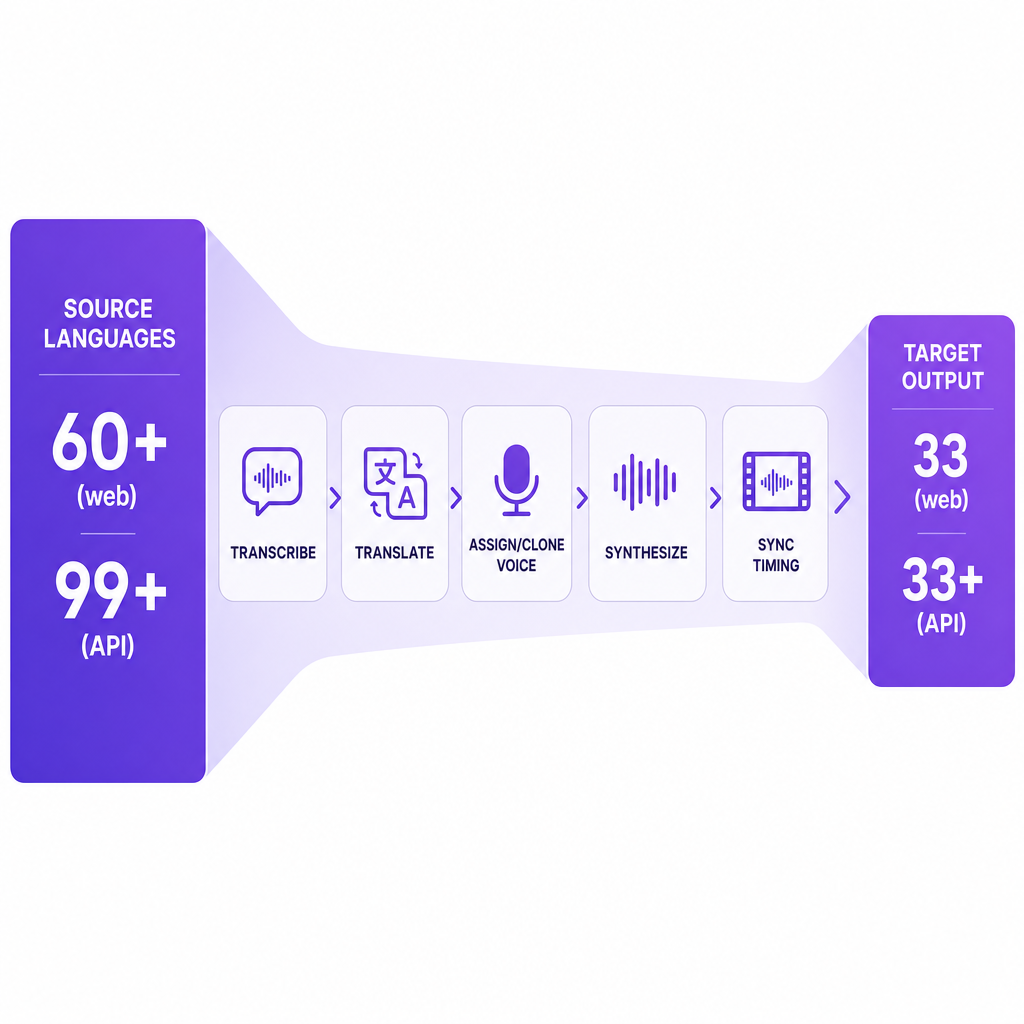
If you are weighing a multilingual expansion, the first thing worth settling is what languages can AI dub into with the platform you actually plan to use. The honest answer has two halves: AI dubbing can recognize spoken content in a long list of languages, but the languages it can produce as finished dubbed audio are a shorter, more decisive list. With DubSmart AI, we dub content from 60+ source languages into 33 target languages, and our AI Dubbing API can detect and process content from 99+ source languages while generating 33+ target-language outputs. Those are not the same number, and treating them as interchangeable is the most common planning mistake we see.
Before you lock a production schedule around a flag count, it helps to understand what the numbers mean, which languages are named, how multilingual output actually works, and what still needs human review in every language.
Table of contents
Source languages versus target languages
The single distinction that governs the whole topic is the gap between input and output. A source language is whatever is spoken in your original file. A target language is what the finished dub speaks. A platform can almost always recognize more source languages than it can generate as polished output, because transcription and translation are easier to extend than a full library of natural-sounding voices with correct timing behavior.
That gap is visible in our own figures. The web AI Dubbing product states 60+ source languages into 33 targets, while the API documentation describes processing content from 99+ source languages into 33+ target outputs. These figures reflect different product surfaces rather than one interchangeable statistic, so plan around the target list, not the larger recognition number.
| Category | What it means | Public evidence |
|---|---|---|
| Source language | Spoken in the original file | 60+ (web), 99+ (API) |
| Target language | Generated for the dub | 33 (web), 33+ (API) |
| Dialect / variant | Regional accent or vocabulary | Supported broadly; no full public list |
| Voice language | What a chosen or cloned voice can speak | Depends on voice and project setup |
The practical takeaway: if your original is in a less common language, recognition is rarely the bottleneck. The question to confirm is whether your intended output language, and the specific regional variant, is available for the voice you want.
Which target languages DubSmart names
We publicly advertise dubbing into 33 target languages, and the API documentation explicitly names a core set while noting "and many more." The named languages are English, Portuguese, Spanish, French, German, Chinese, Japanese, Korean, Russian, Arabic, and Hindi. These are confirmed examples, not the entire catalog.
What we do not publish on the public pages is the complete 33-language roster or an exhaustive dialect inventory. So the accurate, non-inflated answer to the core question is this: we can dub into 33 target languages, with the eleven above confirmed by name. For any less common language or a specific regional variant, confirm availability inside the platform before you commit a production timeline to it.
AI dubbing can produce 33 target languages here, including English, Portuguese, Spanish, French, German, Chinese, Japanese, Korean, Russian, Arabic, and Hindi. Verify a less common language or dialect in the project before scheduling around it.
That verify-first habit matters more than the headline number. A language appearing on a list does not promise identical voice counts, accents, or expressive styles across every entry.
Which languages make sense first for creators
For a US-based YouTube channel, the right first languages come from your audience analytics, not from the longest possible list. A handful of targets carry most of the early opportunity.
Spanish is usually the logical first test because it reaches the United States, Mexico, Spain, and much of Latin America. Decide early whether you are aiming at Latin American or European Spanish, since vocabulary, humor, and references diverge. Portuguese opens Brazil and Portugal, and Brazilian Portuguese is typically the scale choice for a US creator. French spans France, Canada, Belgium, Switzerland, and parts of Africa, though idioms and pronunciation preferences shift between those markets.
German suits educational, software, business, and technical content, with one caveat worth planning for: translated German phrases often run longer than the English original, so timing may need adjustment. Hindi can be strong for educational and entertainment content targeting India and global Hindi audiences, but watch mixed Hindi-English expressions and technical terms.
Chinese, Japanese, and Korean matter for East Asian expansion, where honorifics, writing conventions, and delivery style decide whether the result sounds native. Arabic and Russian each cover several regions, and Arabic in particular carries a real distinction between Modern Standard Arabic and regional varieties. A language match alone never guarantees the right register.
How one project becomes several languages
A modern workflow produces a separate localized version per target language rather than one blended track. In our API, a single request carries multiple target codes, for example Spanish, French, and German as ["es", "fr", "de"], and the response returns separate group projects for each language. That structure is what lets an agency or business turn one master file into several market-ready versions without re-uploading.
Within a multilingual project you can mix approaches: a standard synthetic voice everywhere for consistency, a different native-sounding voice per market for naturalness, a cloned voice where you hold rights, or per-language timing and pronunciation adjustments. The choice usually comes down to one trade-off: brand consistency versus local authenticity. A cloned voice preserves speaker identity across markets; a market-specific voice can simply sound more at home to a particular audience.
If you are planning this across many assets, our guide to scaling content production with AI covers how one master becomes many localized outputs without multiplying your tool stack.
Can the original speaker's voice carry across languages?
Yes, within limits and with responsibilities. Our AI Dubbing can clone each speaker's voice, and the AI Dubbing API supports voice cloning inside the dubbing workflow, analyzing qualities such as tone, pitch, accent, and speaking style. That is what keeps a YouTube host recognizable in every language, a course instructor consistent across localized modules, or a single spokesperson coherent across markets.
The responsibility part is non-negotiable. Clone only audio you own or are authorized to process. For branded, commercial, or public-facing content, keep records that the speaker approved the clone and its intended uses, especially when employees, actors, customers, or public figures are involved. Voice availability by language also varies, so confirm that a cloned or chosen voice actually speaks your target language before you build a season or a course around it.
What actually changes dubbing quality by language
Language availability is the first filter, not the finish line. Several factors interact to decide whether a dub sounds native or merely accurate.
Translation context is where literal output fails. Humor, idioms, slogans, and specialist terms often need an editor to revise the translated script before audio is generated. Pronunciation of names, acronyms, product terms, and locations frequently needs manual correction; a transcript can be grammatically perfect and still sound wrong aloud.
Timing and speech rate matter because translated sentences rarely match the original duration. Our web workflow includes editable timings, and the Dubbing Studio lets you stretch or compress audio to fit. Speaker identification keeps interviews, panels, and films coherent; a misassigned voice damages continuity even when the translation is right. Dialects and accents are not guaranteed by a language label, and our public pages do not enumerate every dialect. Finally, cultural adaptation reaches beyond the voice track: review examples, currencies, on-screen text, and calls to action separately.
High-stakes material deserves extra care. For medical, financial, legal, safety, or compliance content, add human review in the target language rather than trusting the first generated pass.
Matching a language strategy to your content
The best plan depends on your audience, content type, and review resources more than on raw coverage. The table below maps common situations to a sensible approach.
| Situation | Recommended approach |
|---|---|
| Testing demand | Launch one or two high-potential languages; compare retention and viewer geography |
| US creator going global | Test Spanish first, then add Portuguese, French, German, or an analytics-backed language |
| Global e-learning | Prioritize languages in the learner base; review terminology with a subject expert |
| Marketing video | Localize script, on-screen text, and landing page, not only the voice |
| Multi-speaker podcast | Confirm speaker detection, voice assignment, and background handling first |
| API localization at scale | Verify language codes, voice availability, limits, rights, and error handling |
Two cluster-level choices sit underneath almost every plan. First, dubbing versus captions: dubbing wins for multitasking viewers, instructional content, and immersive local-language branding, while subtitles win when the original performance matters or you need fast, low-impact coverage across many languages. Our breakdown of dubbing vs subtitles for video covers that decision in depth. Second, for teams running repeatable launches, a video localization checklist keeps language, variant, timing, terminology, and consent reviewed every time rather than ad hoc.
Before releasing any dub, confirm the target language matches the market, the regional variant fits, names and technical terms are correct, speakers are assigned consistently, timing avoids rushed or stretched delivery, on-screen text is localized, the voice owner has granted permission, and a native-level reviewer has signed off. The published language count is a coverage signal, never a quality guarantee.
Frequently asked questions
What languages can AI dub into with DubSmart?
We publicly support 33 target languages, including English, Portuguese, Spanish, French, German, Chinese, Japanese, Korean, Russian, Arabic, and Hindi. The complete 33-language list and full dialect inventory are not published on our public pages, so confirm a less common language inside the platform.
Can one video be dubbed into several languages at once?
Yes. Our API accepts multiple target codes in a single request, such as Spanish, French, and German, and returns a separate localized project for each language from one master file.
Does AI dubbing support dialects and regional accents?
It can, but availability varies by language and voice. We support a broad array of languages and dialects and continue expanding, without publishing a complete dialect list. Have a native reviewer check pronunciation and register before scaling.
Is AI dubbing the same as text-to-speech?
No. Text-to-speech turns supplied text into audio. AI dubbing starts from existing video or audio and adds transcription, translation, speaker handling, voice generation, and synchronization in one workflow.
Are all AI dubbing languages equally accurate?
No. Quality varies with dialect, voice, audio quality, speaker count, terminology, and translation complexity. Treat the target-language count as coverage, then verify the exact voice and variant for your specific project.