
A video localization project is ready to publish when your team has confirmed the right to adapt the source, approved the translated script and voice, checked accessibility and platform disclosures where they apply, and tested every exported version. This video localization checklist works as a release gate for teams shipping multiple language versions at once—not as a claim that every legal step applies to every clip you touch.
Before you treat any single item as mandatory, run a quick applicability check. Copyright permissions depend on what your team owns or has licensed. Accessibility obligations depend on the organization, service, and context. Platform disclosure rules depend on the content and the platform. So the first move is practical: identify the source owner, the intended markets, the distribution channels, and whether the video is advertising, public-sector content, or realistic AI-altered media. That framing decides which sections below carry real weight for your release.
Table of contents
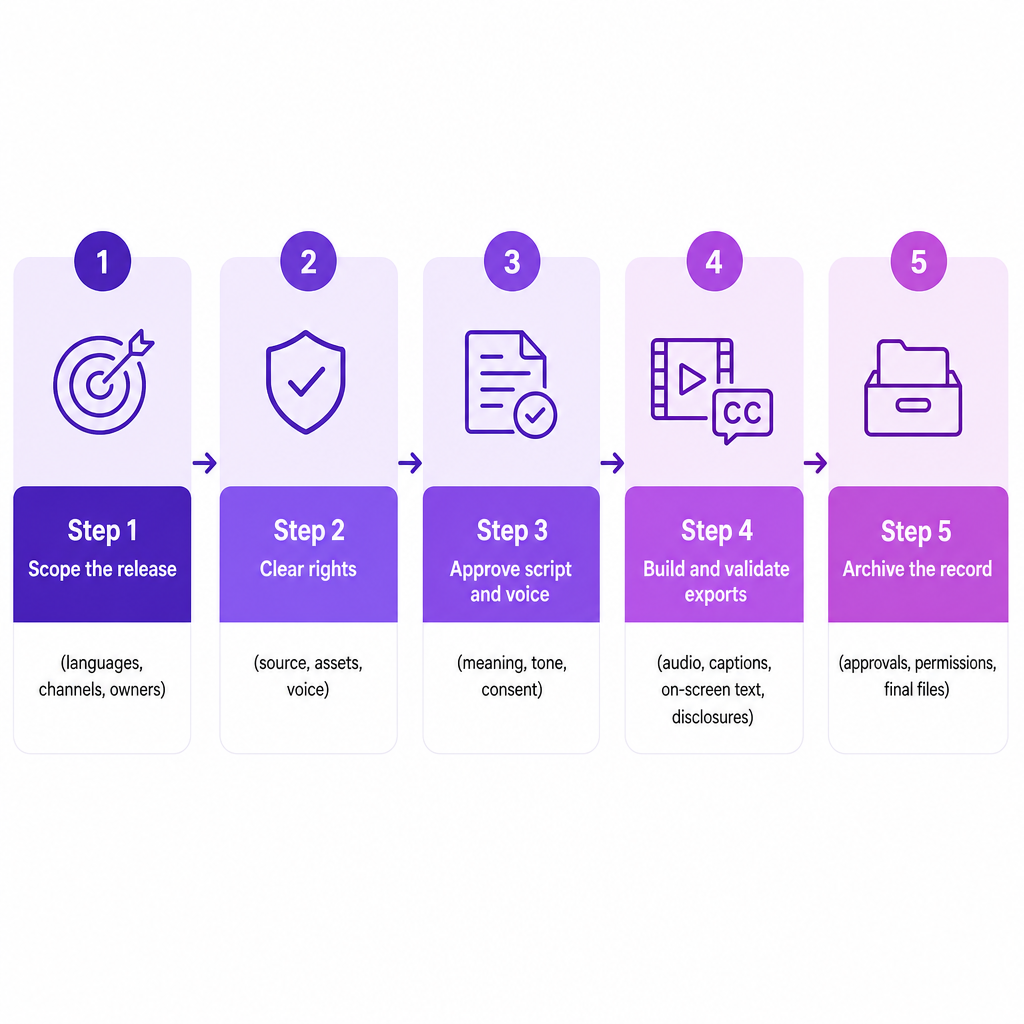
Master video localization checklist
This is the top-level gate. Each line below gets expanded in its own section with scope and consequence, but a team lead can read this block alone and know whether a release is close to ready.
- Define the release: Name the source video, target languages and regions, audiences, channels, and publication date.
- Confirm adaptation rights: Check that the team can translate, dub, edit, distribute, and monetize the video in each intended market.
- Inventory assets and permissions: Record rights or permission status for footage, music, graphics, scripts, performances, trademarks, and voices.
- Prepare a reliable source: Use the approved final cut and a clean transcript; flag names, numbers, technical terms, jokes, and on-screen text.
- Approve the localized script: Have a qualified reviewer check meaning, cultural fit, tone, terminology, and any regulated claims.
- Approve voice use: Use a voice the team is authorized to use, and retain evidence of any required permission for a cloned voice.
- Build each language version: Match the approved voice, timing, subtitles or captions, graphics, and disclosure plan.
- Check accessibility and platform requirements: Review the requirements that apply to the organization, content, and distribution channel.
- Run a language-by-language quality check: Review audio, captions, timing, on-screen text, pronunciation, and the final export.
- Archive the release record: Keep the approved script, permissions, review notes, final files, and publication details together.
Scope the release before production
Applies to: Every team preparing one or more localized versions.
Unclear scope is where localization budgets quietly leak. A team ships the wrong regional variant, forgets a distribution channel, or discovers after recording that the "final" cut was not final. Settle the boundaries first.
- Identify the source video and mark the exact version approved for localization.
- List each target language and, where relevant, regional variant—Brazilian Portuguese versus European Portuguese, for example.
- Specify the intended audience, platform, and use: a public YouTube channel, a paid campaign, or internal training.
- Assign an owner for rights, script approval, language review, technical quality, and final sign-off.
- Set a release decision rule: approve, approve after named fixes, or hold.
Scale the review to the content, audience, and risk. A single-language social clip can move through a lighter path; a long training course, a multi-country advertising campaign, or a film release needs tighter ownership on every line above.
Confirm rights before adapting the video
Applies to: Teams using copyrighted material they did not create or do not control.
Translation and dubbing are adaptations, and adaptations can implicate the copyright owner's exclusive rights. The U.S. Copyright Office identifies translations as derivative works and explains that the copyright owner has the right to authorize them. That is the reason this step sits before production, not after.
- Confirm who owns or controls the source video and its component assets.
- Check whether existing licenses cover translation, dubbing, edits, target territories, platforms, and monetization.
- Obtain and retain permission where your current rights do not cover the planned adaptation.
- Check third-party music, stock footage, images, fonts, and performances separately; clearing the video does not automatically clear every embedded asset.
- Record the scope and duration of each permission, plus any attribution or usage restrictions.
Do not assume that owning a copy, having permission to post one language, or making substantial changes authorizes a localized version. Exceptions and license terms are fact-specific; get legal advice when rights are unclear. For more on where dubbing and subtitles diverge as adaptation choices, see dubbing versus subtitles for video.
Check voice and performance permissions
Applies to: Teams reusing a real person's voice, recording a new performance, or creating a voice clone.
Permission to use a recording for one purpose may not cover cloning that voice or generating new speech from it. The applicable rules can depend on the facts, the agreement, the state, and the intended use—which is why voice gets its own gate rather than being folded into general rights.
- Identify the speaker and the source of any voice sample.
- Confirm permission for the intended use of the recording and, if relevant, for voice cloning and generated speech.
- Define the approved languages, content types, channels, duration, and any limits on reuse.
- Keep consent or license records with the project and restrict access to voice samples as appropriate.
- Give a human reviewer the chance to check output for mispronunciations, unintended meaning, and identity or tone concerns.
Treat written, specific permissions as a practical safeguard, not a universal legal form, and keep a record of exactly what the speaker approved. In our workflow, Voice Cloning is the relevant tool, but using a tool never replaces permission or legal review.
Prepare the source and approve the localized script
Applies to: Any project in which spoken content, captions, or on-screen language will change.
Errors in names, numbers, or technical wording survive automated processing and get more expensive after recording or publishing. A clean source is cheaper than a re-dub.
- Start with the final approved video and a transcript checked against the audio.
- Mark speaker names, pronunciation notes, acronyms, product names, figures, and phrases that must stay consistent.
- Identify jokes, idioms, examples, cultural references, and claims that need adaptation rather than literal translation.
- Preserve meaning and intent; do not silently change product claims, safety instructions, prices, or legal terms.
- Have a fluent reviewer approve the script for each target audience before you generate or record the final voice track.
When the source audio is hard to hear, clean or separate the speech before transcription, then verify the transcript against the original. We offer Speech to Text as a workflow option, and the resulting transcript still needs a human read.
Make the accessibility review specific to the case
Applies to: Teams whose organization, content, or service is subject to accessibility obligations, and teams that want localized videos usable by more viewers.
U.S. Department of Justice guidance says video captions should be synchronized and accurate and should identify speakers. The relevant obligations and standards depend on the organization and context; DOJ guidance discusses ADA responsibilities for state and local governments and businesses open to the public. Translate the intent into the review, but do not universalize a single technical standard across every release.
- Check whether the organization and distribution context trigger accessibility requirements.
- Review captions for accuracy, synchronization, speaker identification, and readability in every language.
- Confirm that captions do not obscure important on-screen information.
- Consider audio description or another way to communicate important visual information when the audience and context need it.
- Test caption display and playback in the destination player.
This checklist is a production safeguard, not a legal determination that every video must follow the same standard. For covered public-sector web content, separate rules may specify standards and compliance dates; verify the rule that applies to your entity and release.
Review platform disclosures and advertising claims
Applies to: Videos on platforms with disclosure policies, and videos that include endorsements or marketing claims.
Disclosure requirements depend on what the video communicates, the relationship between the parties, and the platform. A dub or a cloned voice does not, by itself, settle whether disclosure is required—so assess the actual content.
- If the video includes a paid, gifted, employment, or other material connection relevant to an endorsement, check the applicable disclosure guidance.
- For video endorsements, the FTC says the disclosure should be in the video, not only in the description; make it understandable in the language of the endorsement.
- Check the publishing platform's current rules for altered or synthetic content before upload.
- For YouTube, assess whether the video meets the platform's criteria for disclosing realistic altered or synthetic content, and complete the upload disclosure step if it does. Do not assume every use of AI triggers the same disclosure.
- Recheck platform rules at publication time, especially for ads, endorsements, or realistic synthetic media.
These policies change, so the recheck at upload is not optional busywork—it is the only way to catch a rule that shifted between production and release.
Validate each localized export
Applies to: Every language version, including versions built from the same source video.
A correct script can still ship a poor release if the audio, timing, captions, or graphics are wrong. Run this pass per language, not once for the batch.
- Listen to the full localized track while watching the video.
- Check pronunciation of names, brands, numbers, acronyms, and specialist vocabulary.
- Confirm speaker assignments, tone, and consistency across scenes.
- Check that dialogue timing works with the edit and that no important speech is cut off.
- Review subtitles and captions against the approved script and final audio.
- Inspect titles, lower thirds, labels, charts, and end cards for untranslated or clipped text.
- Confirm the correct language, file, thumbnail, title, description, and disclosure are paired for upload.
- Have a second reviewer approve the final export where the content or audience warrants it.
For a short product video in two languages, the reviewer might verify the translated product claim, the voice track, caption timing, and the sponsored-content disclosure in each version. For a training course, the same team would also check terminology consistency across lessons and accessibility in the player.
Keep a release record and a hold point
Applies to: Teams that need repeatable reviews, auditability, or clean handoffs.
A recorded approval makes it easier to show what was checked and to fix or withdraw a specific version later. The hold point is what stops a half-cleared version from going live.
- Save the approved source version, localized scripts, and final exports.
- Store rights and voice permissions, reviewer approvals, and any platform disclosure decisions.
- Record the language, version, publication channel, owner, and release date for each file.
- Document any known limitations or deferred corrections.
- Put a version on hold if rights, meaning, disclosure, or a critical technical defect remains unresolved.
Case-dependent variables to resolve before sign-off
Two releases can share this checklist and still demand different work. These variables decide which sections above carry weight for your specific project.
| Variable | What the team should verify |
|---|---|
| Source ownership | Who controls the video and whether adaptation, distribution, and monetization are covered. |
| Third-party assets | Whether music, footage, images, or performances carry separate license terms. |
| Voice use | Whether the recording, cloning, or generated speech is within the speaker's permission. |
| Organization and audience | Whether accessibility obligations apply to the organization, program, service, and context. |
| Content type | Whether the video is an endorsement, ad, training, public information, or synthetic media. |
| Destination platform | Current disclosure, upload, and media requirements for that platform and format. |
| Target market | Local language, regional variant, terminology, and any market-specific legal review. |
Turn this checklist into a project approval sheet
Before production starts, convert this list into a project-specific approval sheet: assign owners, mark which requirements actually apply, and name any unresolved rights or review questions so nothing reaches upload unchecked. That step turns a generic gate into a release your team can defend.
We support dubbing from 60+ source languages into 33 target languages and offer 300+ natural-sounding voices, so the build-each-version steps can move fast once the rights and script are settled—confirm current product details and fit for your workflow on the AI Dubbing page. For the tool-selection side of the decision, our checklist on what to look for in an AI dubbing tool pairs naturally with this release gate.
Video localization checklist FAQ
What is a video localization checklist?
It is a release review covering the source video, adaptation rights, localized script, voice use, accessibility and platform checks where applicable, quality control, and approval records—used as a gate before each language version goes live.
Do I need permission to translate or dub someone else's video?
Often yes, if the planned translation or adaptation is not already covered by your rights or license. The Copyright Office describes translations as derivative works and states that copyright owners have the right to authorize derivative works. The answer depends on ownership, license terms, and any applicable exception.
Does every AI-dubbed video need a disclosure?
No single answer fits every video. Check the platform's current policy and assess the content itself. YouTube, for example, requires disclosure when content meets its criteria for realistic altered or synthetic media.
Do captions have to be included in every localized video?
The obligation depends on the organization and context. DOJ guidance identifies synchronized, accurate captions and speaker identification as accessibility measures, but confirm which requirements and standards apply to your specific release.
What should teams review before publishing each language version?
Check the final audio, meaning, pronunciation, timing, captions, on-screen text, disclosures where applicable, and the correct file-to-platform pairing—then keep the approvals and rights records with the published version.