Speech to speech translation converts spoken words in one language into audible speech in another, so your audience hears the translation instead of reading it. Picture an instructor who recorded a lesson in English and now needs a Spanish version without re-recording anything: the system transcribes the English, translates the meaning, and generates Spanish audio in its place. That shift from reading to listening is the whole point, and it changes how you plan, review, and publish multilingual content.
The real question is rarely whether the technology works. It is which version of it you need: recorded translation for videos, courses, and podcasts; near-real-time translation for meetings and events; voice-preserving output that keeps the original speaker's identity; or an API you can wire into your own application. Each of those paths carries different tradeoffs in quality, latency, and review effort, and this guide maps them so you can choose with eyes open.
Table of contents
How speech to speech translation works
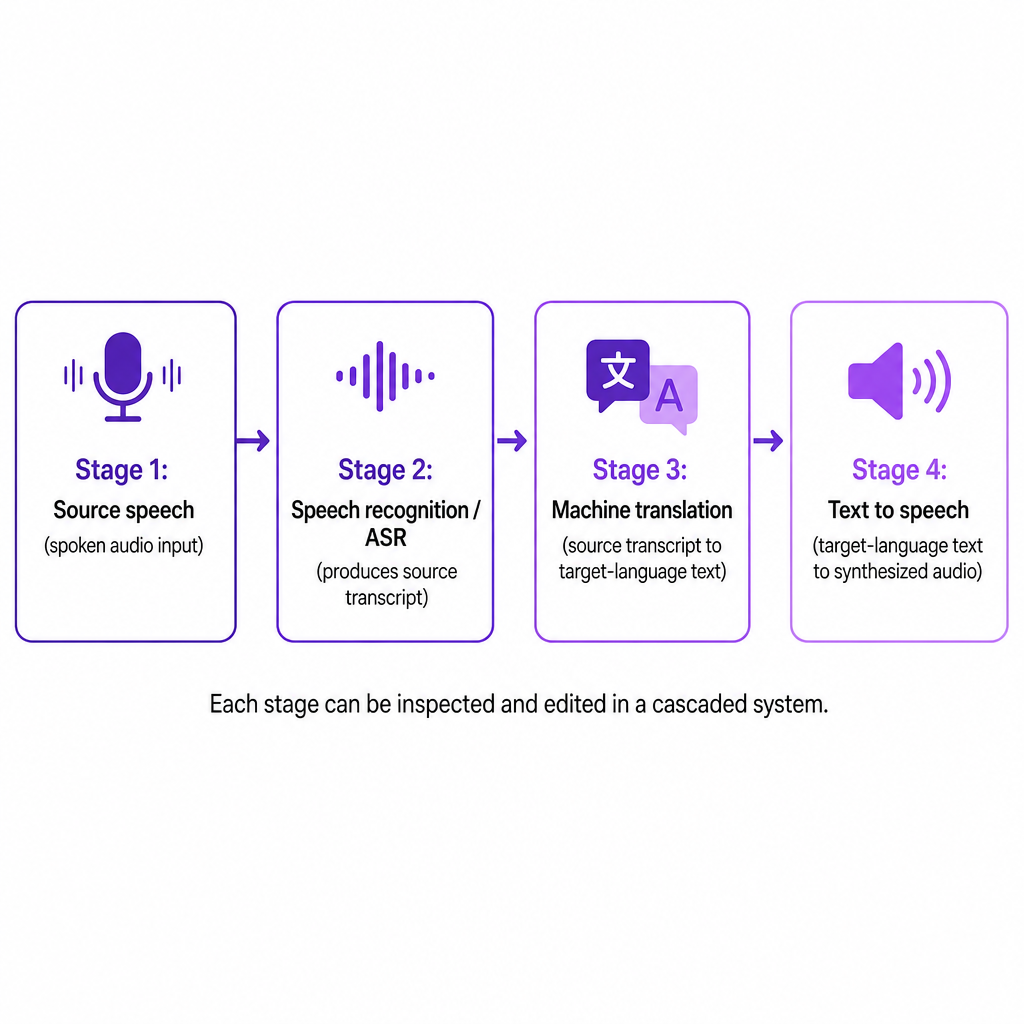
Most systems run a connected pipeline of three technologies. First, automatic speech recognition (ASR) analyzes the source audio and produces a transcript. Next, machine translation converts that source-language text into the target language. Finally, text to speech turns the translated text into spoken audio. The flow reads cleanly as source speech, then recognition, then translated text, then synthesized speech.
Source speech → speech recognition → translated text → synthesized speech
This layered design is called cascaded speech to speech translation, and the NIST publication on speech translation evaluation describes the same structure: ASR builds the source transcript, machine translation produces target-language text, and text to speech generates the spoken output. The advantage of a cascade is that each stage is inspectable, so you can correct a transcript or a translation before the audio is ever generated.
A newer approach trains an end-to-end model to map source audio directly to target-language audio without exposing separate transcription and synthesis stages. Research shared through the DTIC technical report on direct speech translation frames this as a way to reduce delay and preserve more of the original speaker's voice, while noting it still trades off speed, context, language coverage, and output quality. In practice, the cascade gives you more editorial control; the end-to-end approach chases lower latency and voice continuity.
Speech to speech translation versus related tasks
People often blur speech to speech translation with transcription, text translation, and dubbing, but each ends with a different deliverable. Text translation stops at written output. Speech to speech translation ends with spoken output, even though a cascaded system still uses text internally as an intermediate representation. Sorting out the inputs and outputs saves you from choosing the wrong tool for the job.
| Technology | Input | Output | Typical use |
|---|---|---|---|
| Speech to text | Spoken audio | Written transcript | Captions, notes, searchable content |
| Text translation | Written text | Translated text | Documents, subtitles, web pages |
| Text to speech | Written text | Synthetic speech | Narration, accessibility, voice interfaces |
| Speech to speech translation | Spoken audio | Translated speech | Conversations, dubbing, multilingual media |
Dubbing deserves its own distinction. Speech to speech translation focuses narrowly on changing the spoken language. Dubbing is the broader media-localization workflow that wraps around it: translating dialogue, assigning speakers, generating new voices, adjusting timing, mixing translated voices with music and background audio, and exporting a finished project. For a recorded YouTube video, an online course, a podcast, or a film, dubbing is usually the more practical format because it adds those editorial controls on top of the translation. If you are weighing audio against on-screen text, our explainer on dubbing versus subtitles for video walks through that specific choice, and the broader mechanics live in our guide to what AI dubbing is and how it works.
The three components that decide quality
Output quality is not a single number. It is the product of three stages, each with its own failure modes, so it helps to evaluate them separately rather than trusting an overall impression.
Automatic speech recognition identifies the words in the source recording, and its accuracy drops with background music, overlapping speakers, strong accents, fast or incomplete speech, domain-specific terms, poor microphones, and code-switching between languages. A common metric here is word error rate (WER), which compares an automatic transcript against a human reference by counting substitutions, deletions, and insertions. The same NIST publication uses WER as a recognition benchmark, though a low WER does not confirm that the later translation preserved meaning or tone. If your source audio is noisy, isolating clean speech first with a tool like our speech separator can lift recognition accuracy before translation even begins.
Machine translation has to interpret more than individual words. It handles sentence structure, context, pronouns and gender, idioms, humor, formality, cultural references, technical terminology, and differences in word order. A literal translation can be grammatically correct yet sound unnatural or quietly change the intended meaning, which is especially risky for advertising claims, legal instructions, medical information, financial content, and educational material.
Speech synthesis generates the final target-language voice, controlling pronunciation, pauses, speaking rate, intonation, emphasis, emotional tone, voice identity, and accent or language variant. Our Text to Speech product offers more than 300 AI voices, multilingual generation, and voice cloning across 33 languages, with controls for speech rate, emphasis, number reading, and emotional delivery. A technically accurate translation can still land poorly if the delivery does not suit the brand, course, or documentary it belongs to.
Voice cloning in translated speech
Voice cloning is optional, but it is what makes translated content feel like the same creator rather than a stranger reading a script. Instead of assigning an unrelated stock voice to every language, a system can build a target-language performance modeled on the original speaker's vocal identity. That continuity matters for a channel that wants one recognizable voice across languages, a company with a known presenter, a long instructor-led course, a filmmaker needing consistency across dubbed versions, or a podcast host keeping a familiar sound in translated episodes.
It is not a guarantee. Cloning preserves vocal identity, but emotion, humor, pacing, pronunciation, and cultural context still need a human pass before you publish. Equally important is authorization: a responsible workflow confirms that whoever supplied the recording has consented to cloning and that the resulting voice may be used for the intended commercial, public, or geographic distribution. If you are curious about the mechanics behind this, our overview of how voice cloning works goes deeper, and the Voice Cloning tool shows the production side.
Recorded translation versus real-time translation
This is the decision most teams actually face, and the two modes should not be judged by the same yardstick.
Recorded translation is usually the better fit for media production because it gives you time to work. You can correct the transcript, edit terminology, review the translation, identify speakers, adjust timing, regenerate voices, mix background audio, and run human quality assurance before anything ships. That makes it well suited to YouTube channels, e-learning, corporate training, podcasts, product videos, and independent films.
Real-time translation operates under a harder constraint: it must start producing output before the speaker finishes a sentence. More context improves translation quality but adds delay, while shorter delays force predictions or partial translations, and errors are hard to retract once the audio has already played. The DTIC report notes that earlier cascaded systems often ran with four- to five-second delays, accumulated errors across stages, and limited personalization, and that increasing a model's lookahead can raise quality while making the interaction feel less immediate. A live conference feature and a polished multilingual dub are solving different problems, so hold them to different standards.
How to evaluate a speech to speech workflow
Test with a representative sample, not a tidy demo sentence. The checklist below mirrors the real conditions your content will hit, and it keeps the evaluation honest.
- Language and dialect coverage: "Supports Spanish" may not mean the accent, vocabulary, or regional preferences your audience expects. Confirm source and target variants, including U.S. versus other English, Latin American versus European Spanish, and Canadian versus European French.
- Transcript accuracy: A translation cannot reliably fix a transcript that mangles names, numbers, or product terms. Check whether you can inspect and edit the transcript before generating audio.
- Meaning and context: Deliberately test idioms, jokes, calls to action, product claims, and industry terminology. Fluency is not accuracy.
- Speaker handling: For interviews, panels, and films, verify the tool can identify multiple speakers and keep their voices consistent, including when people interrupt each other.
- Timing and synchronization: Translated sentences rarely match the original duration. Look for timing or speech-rate controls, plus dialogue edits, background-audio preservation, volume adjustment, segment regeneration, and visual alignment where needed.
- Voice naturalness: Listen for pronunciation, pauses, emphasis, emotional range, and unnatural rhythm.
- Latency: For live use, measure speaker-to-audio delay. For recorded use, prioritize editing flexibility over raw processing speed.
- Review and export controls: A production-ready tool lets you correct text, regenerate individual segments, adjust timing, and export in a format your publishing workflow accepts.
Run these samples through your shortlist and compare transcript accuracy, translation meaning, pronunciation, voice naturalness, speaker consistency, timing, background-audio quality, review effort, and total cost at your expected volume. The strongest system is not the one with the most voices or languages. It is the one that produces acceptable results for your specific content with a review workload your team can actually sustain.
Risks and limitations worth planning for
Every stage introduces its own kind of error, and a natural-sounding voice can disguise all of them. AI can mistranslate ambiguous expressions, names, idioms, and specialized terms, so human review stays essential wherever accuracy carries legal, safety, financial, or reputational weight. Recognition errors compound the problem: noise, crosstalk, accents, and poor recordings can cause the system to mishear the source, which is why reviewing the transcript before approving the translation is non-negotiable.
Cultural meaning is easy to lose. A direct translation may drop humor, politeness, or references that only survive a rewrite rather than a word-for-word pass. Voice cloning adds consent and impersonation risk, so document who authorized the voice, the usage scope, territory, duration, and whether it may appear in advertising or synthetic public statements. There is also an audience-trust dimension: the DTIC report describes how one translation experience informs users that the translated audio is synthetically generated, a reasonable expectation to plan for in your own disclosures.
Two quieter risks round out the list. Privacy matters whenever audio contains personal information, confidential discussions, customer data, or unreleased content, so review a provider's data handling, retention, access, and deletion terms before uploading. And false confidence is the most insidious failure of all: a polished voice makes an incorrect translation sound authoritative, so never treat fluency as proof of factual accuracy.
Where DubSmart fits
We are most directly relevant to recorded speech to speech translation through AI Dubbing, rather than any claim of universal live conversational translation. Our dubbing workflow accepts audio and video uploads and YouTube links, supports more than 60 source languages and 33 target languages, clones each speaker's voice for the translated version, and lets you edit text, speakers, and timings, regenerate segments, adjust background-sound volume, and download the finished project. That editorial layer is exactly what recorded media production needs.
For teams building their own pipelines, we also offer AI Dubbing, Text to Speech, and Voice Cloning APIs, which suit agencies, media workflows, and applications that need to automate multilingual voice production. The right choice comes down to whether your project wants a finished media editor, an API-driven pipeline, or both. For a short, high-stakes message, professional human translation and recording may still win; for a large, frequently updated content library, an AI workflow scales better with human review focused on the highest-risk material.
Frequently asked questions
Is speech to speech translation the same as interpretation?
No. Human interpretation relies on a trained person listening, understanding, and conveying meaning in the moment. Speech to speech translation is automated: fast and scalable, but it may require review and can struggle with nuance a professional interpreter handles naturally.
Does it always work in real time?
No. Some systems process recorded audio with full editing control, while others provide live or near-real-time output. Live systems constantly balance translation context, latency, and accuracy.
Can it preserve the original speaker's voice?
Sometimes. Systems that use voice cloning or voice-preserving synthesis can model the original speaker's identity, but the result depends on the technology, language pair, audio quality, and authorization to use that voice.
Is AI dubbing a form of speech to speech translation?
Yes. AI dubbing is a recorded-media application of speech to speech translation that adds editing, speaker management, timing, mixing, and export features on top of the core translation.
How accurate is it?
Accuracy varies by language, recording quality, terminology, speaker, and system. Evaluate the transcript, the translation, and the generated audio separately rather than trusting a single accuracy percentage.