If your microphone picks up traffic, café chatter, or a music bed sitting right on top of the dialogue, the question isn't whether the recording is usable—it's how to pull the voice back out cleanly. That's exactly what a speech separator does. In plain terms, a speech separator is an AI-powered audio tool that isolates human speech from everything else in a recording—background noise, music, and other sounds—so you're left with a clean voice track you can transcribe, dub, clone, or remix. For anyone producing multilingual content, that clean track is the difference between dubbing that sounds professional and dubbing that sounds "good enough."
This guide explains what a speech separator actually is, how it works under the hood, when you genuinely need one, and what to weigh before you commit to a tool. We build the Speech Separator into the DubSmart AI workflow precisely because clean speech is the foundation everything else stands on.
Table of contents
What a speech separator really is
In audio research, speech separation is defined as the task of separating target speech from background interference in a mixed recording. More advanced systems go further and split multiple speakers apart from one another, producing an isolated track for each voice.
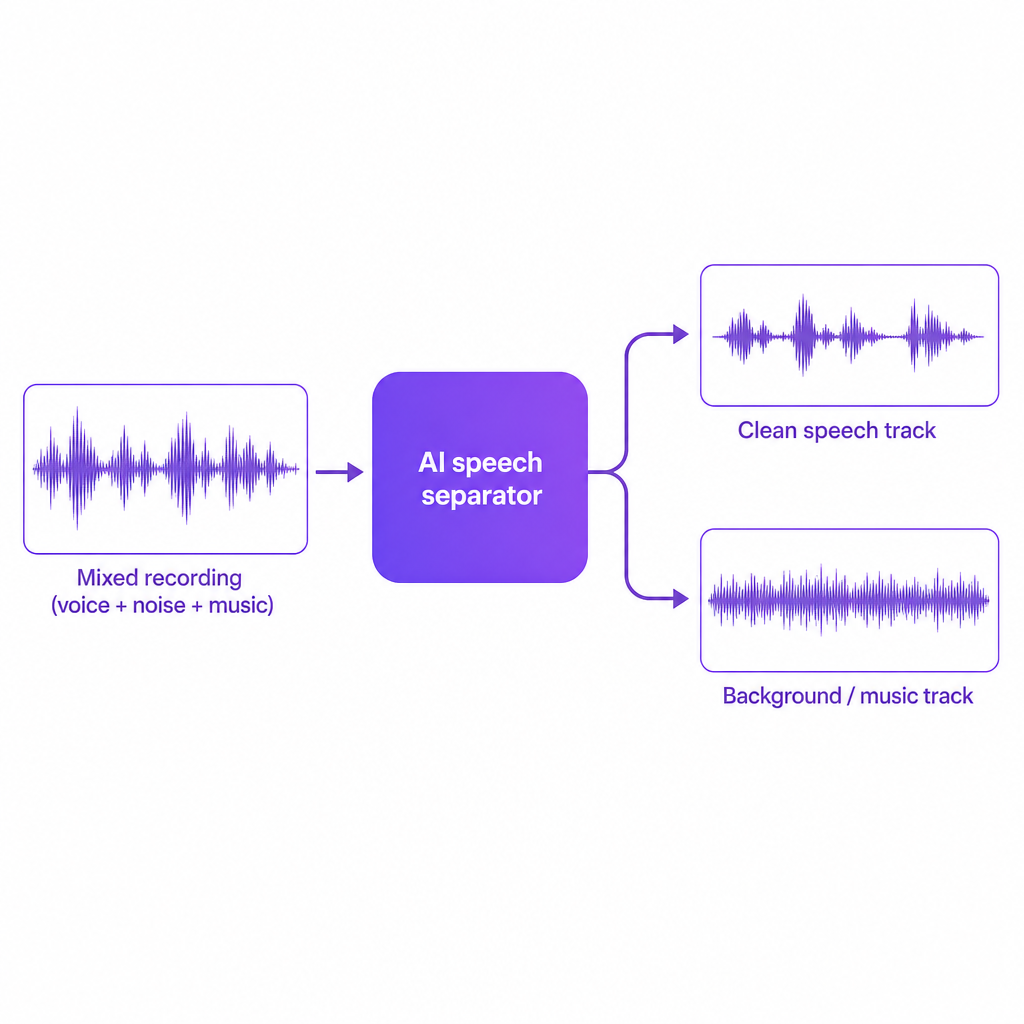
Translated into everyday production work, a speech separator takes a mixed audio file—dialogue plus noise or music—and outputs one or more tracks containing only speech, plus an optional track holding the remaining background audio. Our Speech Separator is built to remove background noise and isolate speech from any recording, which makes it well suited to the post-production of films, podcasts, and interviews. It works on both audio and video files: it can denoise recordings from noisy environments and separate vocals from a backing track so you end up with discrete voice and background stems.
This is where a common misconception trips people up. A speech separator is not the same thing as traditional noise reduction. Noise reduction lowers the volume of unwanted sound. A speech separator actively identifies where speech is present in the signal and reconstructs it as a separate, cleaner stream. That distinction is why a separator can rescue a voice buried under music, while a noise gate mostly just makes the whole recording quieter.
Do you actually need one?
The real decision is whether your work depends on reliable, clean speech audio rather than whatever the microphone happened to capture. If it does, a dedicated separator stops being a nice-to-have and becomes a foundational step.
Several situations make that upgrade obvious. YouTube creators and small businesses often reuse older footage recorded in echoey rooms, cafés, or on the street, where noise makes speech hard to understand and hard to transcribe. E-learning and training teams build multilingual courses from live webinars and lectures, where every downstream transcript and dub inherits the quality of the original speech. Filmmakers and podcast producers frequently need to salvage a great performance captured under imperfect conditions before mixing it back with music and sound design. And developers or agencies feeding user audio into transcription, voice cloning, or dubbing pipelines know that noisy inputs directly drag down model accuracy.
A few concrete triggers signal that a separator is worth adopting:
- You are localizing into multiple languages and want consistent, clear dubbing and subtitles. Clean speech feeds our AI Dubbing and Speech to Text engines far more reliably than a noisy mix.
- You rely on voice cloning for a branded or character voice and want the best possible results by training on denoised, artifact-free samples.
- You regularly receive user-generated or field recordings you didn't control, and you still need them broadcast-ready. A separator gives you a repeatable cleanup stage instead of hand-tuning every file.
The honest exception: if your audio is already recorded in a treated studio, with separate stems for dialogue and music, a separator is a convenience rather than a requirement. For everyone else working with real-world sound, it earns a permanent place in the pipeline.
How speech separation works under the hood
Modern speech separation is built on deep learning and source-separation research, not simple EQ and filters. The underlying task is straightforward to state and hard to solve: given a mixed signal that contains several sources, recover the individual speech signals without knowing them in advance.
Most current systems follow an encoder–separator–estimator–decoder pipeline. The encoder maps the raw waveform or spectrogram into a high-dimensional feature space where speech-relevant patterns like formants and harmonics become easier to detect. The separator—a neural network—processes those features and learns to decouple information belonging to different sound sources, whether that's speech versus noise or one speaker versus another. The estimation stage then either predicts masks that filter out non-speech components or directly estimates the feature representation of each source. Finally, the decoder converts those separated representations back into time-domain audio, yielding one or more clean speech tracks and optionally a residual background track.
These models are trained on large datasets full of speech-and-noise mixtures, learning the discriminative patterns of speech, speakers, and interference from labeled examples. Newer research conditions the separator on speaker embeddings or prompts, which makes it possible to aim the separation at a specific voice inside crowded audio.
The practical takeaway for creators is that a modern separator is not a glorified noise gate. It is a model that has learned what speech looks and sounds like across many conditions, and it can reconstruct a voice even when it's buried under music, crowd noise, or room echo.
The two main separation tasks
In practice you'll meet two flavors of speech separation, and platforms often combine them.
The first is single-speaker speech versus background: extracting one coherent voice track from noise, music, or ambience. This is the task our Speech Separator centers on for films, podcasts, and interviews, because it maps directly onto what most creators need day to day.
The second is multi-speaker separation, where the system produces a separate track for each speaker in a conversation. That's especially useful for diarization and analytics in long-form meetings or panel discussions, where knowing who said what matters as much as what was said.
Consumer tools tend to package these in simple interfaces—upload a song to get separate vocal and instrumental tracks, or isolate dialogue in a video for editing. Our implementation emphasizes speech-versus-background separation because it's the most immediately valuable task for dubbing, transcription, and cloning workflows.
What to weigh before choosing a separator
When you evaluate whether a separator meets professional needs, a handful of criteria matter more than marketing copy.
Start with speech quality and artifacts. A good separator preserves the natural timbre of a voice instead of making it sound metallic, underwater, or phasey, and it avoids introducing musical noise or harsh distortion when it strips out strong background elements like music. Academic surveys flag residual interference and artifacts as the primary challenges, especially in non-stationary noise. The most reliable test is still checking sample outputs on your own material.
Robustness to real-world noise is next. Models trained on clean lab data can struggle with traffic, wind, crowd murmur, reverberant rooms, and content where speech overlaps with loud music or effects. State-of-the-art work targets exactly these complex mixtures, but performance still varies with recording conditions—so test across the environments you actually record in, from offices to streets to home studios.
Handling music and mixed content is a frequent, specific need. Removing a soundtrack to redub, or isolating narration from B-roll, calls for a tool that explicitly supports music-and-voice separation and outputs two usable files rather than a single muffled result. Our separation pipeline detects vocal frequencies, isolates them from the music, and produces separate high-quality files: one with clean vocals and one with the music bed. That's especially useful when you plan to remix, re-score, or redub into other languages.
Integration with downstream tools decides how much time the separator actually saves. Separation rarely lives alone—it feeds transcription models where cleaner input lowers word error rates, voice cloning engines that reward noise-free samples, and dubbing systems that align original speech with translated tracks. Our platform is built around a unified workflow that keeps Speech Separator, Speech to Text, Text to Speech, Voice Cloning, and AI Dubbing in one place, so a single cleaned recording can become multilingual, cloned-voice, fully localized content without rebuilding a pipeline each time.
Latency, scale, and automation matter for anyone with a backlog. Long-form podcasts, courses, and archives need batch processing that handles multi-hour files, reasonable per-file processing times, and automation hooks where separation sits inside your own systems. We provide Text to Speech, Voice Cloning, and AI Dubbing APIs so developers can wire speech processing into end-to-end pipelines.
Finally, privacy and compliance don't disappear once audio is clean. Separating speech from background doesn't remove your responsibility for recordings that may contain sensitive conversations, or for respecting rights when you extract and reuse voices from licensed material. Enterprise teams should confirm clear policies on data retention and use and align any separation workflow with internal compliance guidelines.
Where it falls short
A speech separator can transform a recording, but it isn't magic, and pretending otherwise leads to bad decisions.
Over-denoising is the most common trap. Aggressive separation can strip subtle speech cues—soft consonants, natural room tone—and leave a voice sounding unnatural or fatiguing to listen to. Residual artifacts are the flip side: in difficult conditions a model may leave traces of music or noise in the speech track, or generate musical noise, particularly when interference is strong and constantly changing.
There's also speaker and language bias to account for. Models trained predominantly on certain languages, accents, or speaking styles can perform worse on under-represented voices. And a clean-looking waveform can create a false sense of security: it doesn't guarantee the audio is suitable for critical tasks like forensic analysis or strict compliance contexts.
For creative and localization work these limitations are manageable, but they're a strong argument for testing with representative samples of your own material rather than trusting vendor demos.
The Speech Separator inside our workflow
We treat the Speech Separator as a practical, creator-friendly implementation of this technology, tightly integrated with the rest of the DubSmart AI platform rather than bolted on.
In use, it removes background noise and isolates speech from any recording, producing clean voice suitable for post-production in films, podcasts, and interviews. It extracts clear vocals from mixed tracks and generates separate high-quality files for speech and background music, so you can edit, redub, or remix without fighting the original mix. It works on both audio and video sources—you upload files or use links, run them through the pipeline, and download the finished tracks. And crucially, those outputs are optimized to feed our other tools, so one cleaned recording can be turned into multilingual, cloned-voice, fully localized content.
For YouTube creators, small businesses, trainers, filmmakers, podcasters, and developer teams, that integration changes the role of separation itself. It stops being an isolated "fix the audio" chore and becomes the first standardized step in a larger, automated content creation and localization lifecycle. If you're building a multilingual channel or course library, that's where the real time savings compound.
Frequently asked questions
What is a speech separator, in simple terms?
It's an AI tool that takes a noisy, mixed recording and outputs a track where you mostly hear only the human voice, plus optional background tracks you can keep or discard.
Is a speech separator the same as noise reduction?
No. Noise reduction simply lowers unwanted sounds. Speech separation explicitly identifies and reconstructs speech as a distinct source, usually with higher clarity and more control over the result.
Can a speech separator handle more than one speaker?
Many research-grade systems and some products can separate multiple speakers into individual tracks, though quality varies with overlap and recording conditions. Our Speech Separator focuses primarily on isolating speech from background for common creator workflows.
Will using a speech separator improve my dubbing and voice cloning results?
Yes. Cleaner input audio generally improves speech recognition, alignment, and voice cloning quality, which makes multilingual dubbing and cloned voices more natural and consistent.
Does speech separation work regardless of language?
Most separator models operate on acoustic patterns rather than text, so they can handle many languages. Performance still depends on the training data and how well your accent is represented.