
How to Convert Passive Voice to Active Voice for Stronger Video Scripts
"The dubbing was completed by the AI engine."
"Our AI engine completes your dubbing in minutes."
Same information. Opposite impact. The first sentence drifts past your viewer like background noise. The second puts a doer in the driver's seat and a deadline on the table. If you write video scripts — for YouTube, e-learning, product explainers, or corporate training — that gap is where engagement either lives or dies. And no passive to active voice converter tool will fix it for you automatically, because the hardest part of the conversion is a judgment call no algorithm can reliably make.
Video already accounts for over 80% of consumer internet traffic, according to the Cisco Annual Internet Report, and as much as 85% of Facebook video is watched with the sound off, per Digiday's reporting on Facebook's internal data. Script clarity carries the weight when audio is muted, captioned, or auto-dubbed into a viewer's native language. By the end of this guide, you'll have a four-step conversion workflow, a decision matrix for when passive should stay, and a 10-minute audit checklist for your next script.
Table of Contents
- Why Passive Voice Drains the Energy from Video Scripts
- The 7-Signal Checklist to Spot Passive Voice Before It Hits Your Voice Actor
- The 4-Step Conversion Workflow That Works on Any Passive Sentence
- When Passive Voice Is the Right Strategic Choice — A Decision Matrix
- Adapt Your Active-Voice Rewrites to Survive Dubbing in 33 Languages
- The 10-Minute Script Audit — Apply This Before Your Next Recording
Why Passive Voice Drains the Energy from Video Scripts
For script writers, passive voice has a precise structural definition: a sentence where the receiver of the action sits in the subject position, typically built with a form of "to be" (is, are, was, were, being, been) + a past participle. Professor Scott's English frames it this way and adds the practical implication: passives often place the doer after the verb or omit the doer entirely, which makes the sentence feel vague or incomplete.
Three before/after examples from real creator contexts make the structural problem visible:
- YouTube tutorial: "The export settings can be found in the menu" → "You'll find the export settings in the menu."
- Product explainer: "Your video is dubbed into 33 languages by our engine" → "Our engine dubs your video into 33 languages."
- E-learning intro: "This module was designed to teach project planning" → "This module teaches you project planning."
Each rewrite does three things at once: it names an agent, cuts a word or two, and gives the viewer a doer to track mentally.
The psychology behind this is well-mapped. Steven Pinker argues in The Sense of Style that good prose presents a visualizable scene with clear agents and actions — readers (and viewers) mentally simulate events more easily when the subject is the actor. Bryan Garner, editor of Black's Law Dictionary, makes the same case from a legal-writing angle: active voice reduces ambiguity about who is responsible for what. If active voice is the standard for federal compliance documents and contract drafting, it should be the standard for your YouTube intro.
The localization stakes are where this gets specific to anyone using AI Dubbing in their workflow. CSA Research's "Can't Read, Won't Buy" study found that 76% of consumers prefer to buy products with information in their own language, and 40% will not buy from websites in other languages. A follow-up found that 65% of consumers prefer content in their native language even when quality is lower. And per YouTube Creator Academy data, over 60% of a typical creator's watch time comes from outside their home country.
Passive voice in your source script becomes passive engagement in your dubbed version across all 33 target languages.
Here's why that matters operationally: most AI dubbing engines translate verbatim. A flat, agentless English sentence becomes a flat, agentless Spanish, Mandarin, or Arabic sentence. The weakness compounds across every language you ship. Worse, a subtitling line capped at ~42 characters with a ~17 characters-per-second reading speed — the Netflix Timed Text Style Guide standard — leaves no room for wordy passive constructions. They overflow the frame, get auto-truncated, or force your viewer to read uncomfortably fast.
The U.S. Plain Language Guidelines make this the law of the land for federal communication: agencies are explicitly required to use active voice for clear communication with the public. If government compliance documents lean active, your product explainer definitely should.
The 7-Signal Checklist to Spot Passive Voice Before It Hits Your Voice Actor
Before you can convert, you have to recognize. Passive voice hides in plain sight — especially in second drafts, where you've already smoothed sentences for tone but not for structure. Use these seven diagnostic signals to scan your draft. For several of them, Ctrl+F (Cmd+F on Mac) does the work for you.
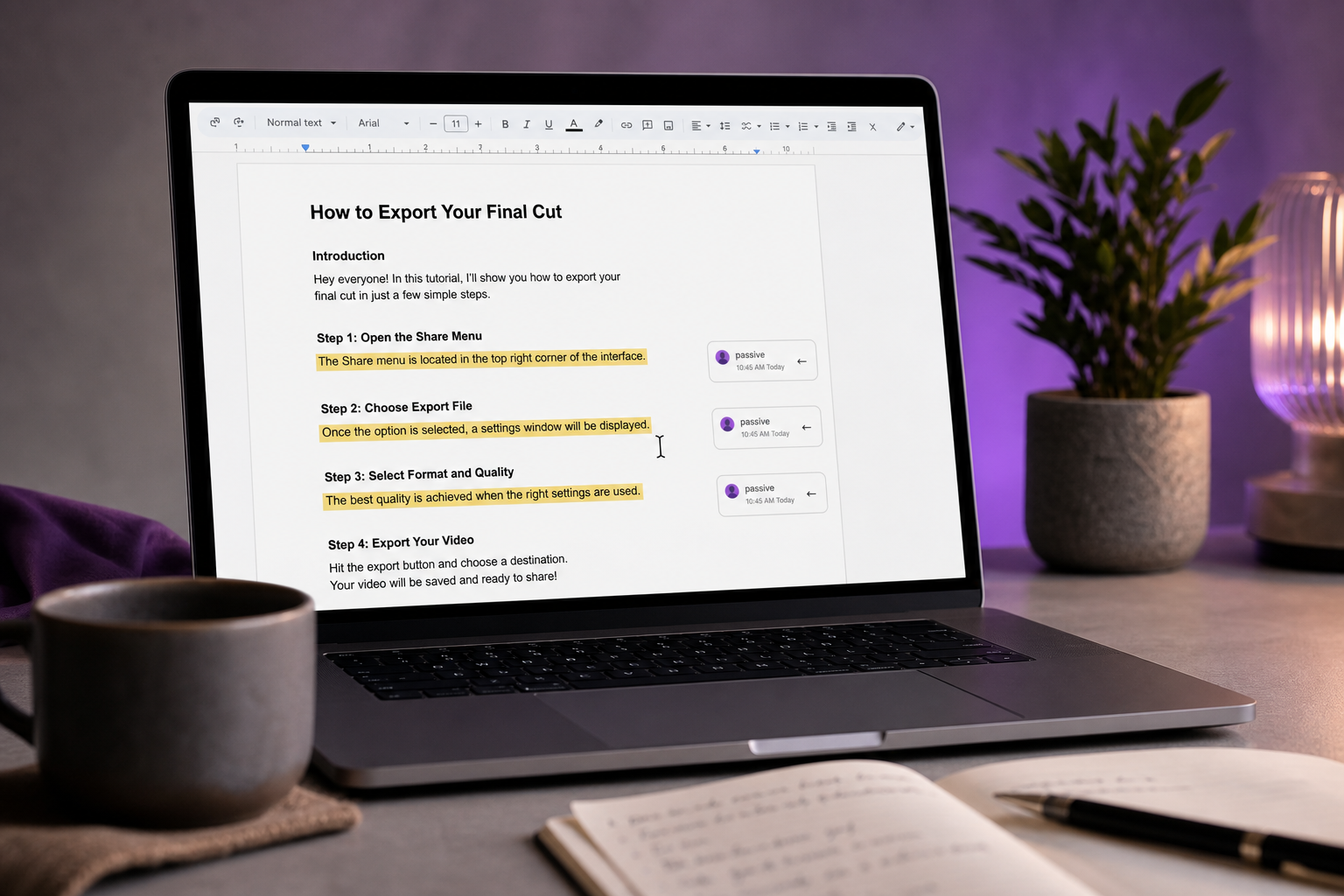
- "To be" + past participle pattern. Search for is, are, was, were, be, been, being followed by a verb ending in -ed or -en. Examples: "was completed," "is rendered," "are uploaded." This is the single most reliable diagnostic — Screenwriter's Cheat Code recommends it as the first thing to scan for in any script audit.
- The "by [agent]" tell. If you see "by" followed by a noun that's clearly the actor, the sentence is almost certainly passive. "The script was approved by the client." Flip it: "The client approved the script."
- Missing agent entirely. "Mistakes were made" — by whom? When the doer is invisible, you're either intentionally hiding responsibility (sometimes valid; see the decision matrix below) or accidentally vague. Most of the time, it's the second.
- Hidden passives with "got" or "gets." "The video got edited overnight" is passive in disguise. Look for got + past participle. These often slip past spell-checkers and even passive-voice plugins because they don't use a form of "to be."
- Nominalizations masking action. "There was an evaluation of the footage by our team" buries the verb in a noun ("evaluation"). Active rewrite: "Our team evaluated the footage." You've cut from 9 words to 5 and surfaced both the agent and the action.
- Sentence length over 25 words with no clear subject in the first 8 words. Long sentences without an early subject signal passive drift. If your viewer doesn't know who's acting by word 8, they're already drifting too.
- Modal + "be" + past participle. "This step can be skipped," "Your file should be saved," "The form must be completed." Modal passives weaken instructions — and instructions are exactly where you can't afford weakness.
Run your draft through these seven signals before sending it to your voice actor, Text to Speech engine, or dubbing workflow. The fewer passives in your source script, the less editing your localized versions will need across every target language you ship.
The 4-Step Conversion Workflow That Works on Any Passive Sentence
Most passive-to-active voice converter tools — Junia, QuillBot, Grammarly — automate Steps 2 and 3 reasonably well but fumble Step 1, the most important one. Run this manual workflow first; use tools as a second pass.

Step 1: Identify the agent (who or what is doing the action)
The question is always: Who did this? Who is doing this? If the answer isn't in the sentence, you have to add it before rewriting — otherwise the active version will be grammatically correct but factually empty.
- Template: [Action receiver] was [past participle] by [AGENT] → AGENT = subject of your new sentence
- Script example: "The thumbnail was redesigned overnight." Who redesigned it? Add the agent: "Our editor redesigned the thumbnail overnight."
- Failure case: Skipping Step 1 produces "Someone redesigned the thumbnail" — technically active, narratively useless. According to Junia's tool documentation, reviewers should always "restore or clarify the agent" after a machine pass — confirmation that even the vendors building these tools know the agent-identification step is the human's job.
Step 2: Move the agent to the subject position
Once you know the agent, put it at the front of the sentence.
- Template: [AGENT] + [verb] + [receiver]
- Script example: "The car was hit by the truck" → "The truck hits the car." Word count drops from 6 to 4 — about a 33% cut, per the worked example in Screenwriter's Cheat Code.
Step 3: Replace the "to be" + past participle with a strong active verb
"Was hit" becomes "hits" or "slams." "Was redesigned" becomes "redesigned" or "rebuilt." Pick the verb that shows the action visually — Pinker's "visualizable scene" principle applies here directly.
- Template: "was [participle]" → [present or past tense active verb]
- Script example: "The car was driven by Sarah" → "Sarah drove the car." Six words become three, a 50% reduction.
Step 4: Trim the leftover prepositional phrases
After flipping, you'll often have orphaned prepositions: by, for, to, in. Cut what doesn't add meaning. This is where you reclaim words for your WPM budget — 140-160 WPM for general marketing and 120-140 WPM for e-learning, per Voices.com's voice-over guidance.
- Template: Remove "by [agent]" phrases and any prepositional flotsam left behind after restructuring.
- Script example: "The new security protocols were implemented by our engineering team last quarter" (12 words, would overflow a single 42-character subtitle line) → "Our engineering team implemented new security protocols last quarter" (9 words, fits comfortably under the Netflix per-line ceiling).
Run these four steps in order. Any passive-to-active voice converter on the market will do Steps 2–4 mechanically. None will reliably do Step 1. That's why the human pass matters — especially for scripts you're about to push through an AI Dubbing API into dozens of target languages.
When Passive Voice Is the Right Strategic Choice — A Decision Matrix
Geoffrey Pullum, co-author of The Cambridge Grammar of the English Language, has argued that "avoid passive voice" advice is often overblown and based on misidentifying passives in the first place. Mignon Fogarty ("Grammar Girl") similarly cautions against replacing every passive — sometimes the passive is the right tool. Use this matrix to decide.
| Scenario | Keep Passive? | Why | Active Alternative |
|---|---|---|---|
| Actor is unknown ("Your account was compromised") | Yes | You don't know who did it; inventing an agent misleads | "Someone compromised your account" — weaker, no info gain |
| Recipient is the point ("The CEO was promoted to chair") | Yes | The story is the recipient, not the promoter | "The board promoted the CEO" — shifts focus away |
| Policy language ("Refunds are processed within 14 days") | Yes | Institutional phrasing; reads as standard policy | "We process refunds within 14 days" — fine, optional |
| Softening blame ("Mistakes were made") | Sometimes | Strategic ambiguity in PR or apology contexts | "We made mistakes" — stronger, commits to accountability |
| Scientific methods ("Data were collected over 6 months") | Yes | APA and STEM convention; procedure-focused | "We collected data over 6 months" — accepted but optional |
| Marketing CTA ("Your video can be dubbed in minutes") | No | Robs the product of agency; weakens the offer | "Dub your video in minutes" — punchier, action-forward |
| YouTube intro hook | No | Energy matters most in the first 8 seconds | "You're about to learn…" — viewer-as-subject |
The pattern: passive earns its place when the receiver genuinely matters more than the doer, or when the doer is unknown, irrelevant, or politically sensitive. For most creator contexts — YouTube intros, product explainers, course CTAs, marketing voiceovers — active wins.
Calibrate by content type:
- YouTube and short-form social: Aggressive rewriting. Cut all but the most strategically necessary passives. Engagement windows are short and the algorithm rewards retention in the first 30 seconds.
- Corporate training and e-learning: Selective rewriting. Keep passives in procedural steps where the learner's action matters more than the agent ("The form is submitted electronically"), but flip every CTA, every motivational line, every "what you'll learn" framing.
- Documentary or narrative video: Mixed. Passive can convey distance, mystery, or historical weight ("The treaty was signed at dawn") — keep it where the tone demands it.
The best rewrite isn't always the most active one — it's the one that preserves your intent while moving your viewer.
The rule isn't "kill all passives." The rule is: every passive in your script should be a deliberate choice, not a default. Pullum's critique lands here. If you can articulate why a passive is staying, keep it. If you can't, flip it.
Adapt Your Active-Voice Rewrites to Survive Dubbing in 33 Languages
Active voice is a starting point, not the finish line — especially if your script will be dubbed. A punchy English line can break when translated into a language with different word order, formality conventions, or idiomatic shorthand. Here's how to write active voice that travels.
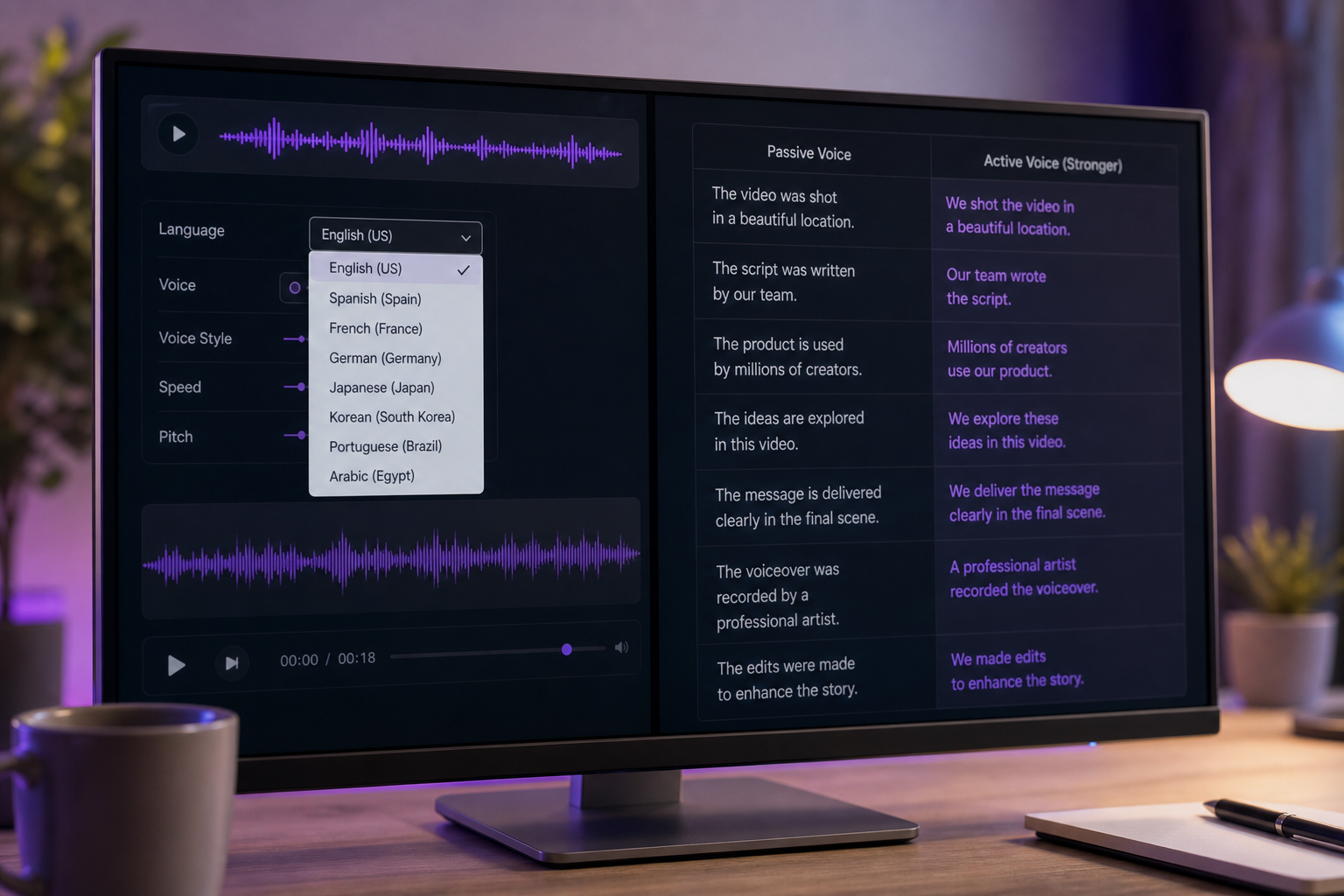
- Keep sentences under 15 words where possible. Subtitling reading speed caps at about 17 characters per second with about 42 characters per line. Shorter active sentences fit subtitle frames cleanly across languages — and they hit voice-over pacing targets of 140-160 WPM for marketing and 120-140 WPM for e-learning. A 22-word sentence in English often becomes 28-30 words in Spanish or German after translation, blowing past your timing budget.
- Avoid idiomatic active constructions that don't translate. "I'm going to knock your socks off" is active and energetic in English, but it produces nonsense in a literal Mandarin or Arabic dub. Replace with universal verbs: "I'll show you something incredible." Active and portable. The same logic applies to "nail it," "crush it," "kick things off," "circle back" — idioms that read like noise in machine translation.
- Prefer second-person subjects ("you") over first-person plural ("we"). "You'll save three hours" dubs more naturally than "Three hours will be saved by you" — and avoids the formal/informal pronoun split (tu/usted, du/Sie, tu/vous) that complicates direct address in many languages. Second-person also gives you a built-in agent for every sentence.
- Match active voice to speaker clarity in voice-over. Voices.com notes that voice actors need a script with "internal rhythm and appropriate places to breathe." Active sentences with clear agent-verb-object structure give voice actors natural breath points. Passive constructions force unnatural pauses mid-clause, which dub artists then have to fight against in their reads. This applies whether you're working with a human or a Text to Speech API.
- Test your rewrite with TTS before final recording. Run the revised script through a text-to-speech engine to hear timing, rhythm, and stress patterns before you commit a voice actor's hour or a Voice cloning session. If it stumbles in TTS, it'll stumble worse in dubbed languages with different prosody — Japanese, for instance, frequently inverts subject-verb-object order relative to English.
- Account for syntactic emphasis in target languages. Mandarin, Arabic, Japanese, and Turkish each have different SOV/SVO/VSO conventions. An active English sentence may need a passive structure in the target language to preserve emphasis. Plan for this in localization review, not in source-script writing. Your job in English is to make the agent and action unambiguous; your localization editor's job is to preserve that intent in the target language.
An active-voice sentence that's too idiomatic for your target language defeats the purpose of localization — rewrite for universality, not just activity.
The 10-Minute Script Audit — Apply This Before Your Next Recording
You have a finished draft and a deadline. You don't have time to rewrite the whole thing — but you have 10 minutes. Run this audit. It surfaces every high-impact passive construction worth fixing and tells you which ones to leave alone.

Pre-audit (answer before scanning)
- What is the core action of this video? (Watch, buy, sign up, learn, click.) Your active rewrites should align with this single verb.
- Who should the viewer perceive as the agent? (You? Them? Your product?) This is your default subject for every CTA and instructional line.
- What's the longest sentence in your script right now? If it's over 20 words, it's a likely passive candidate. Start there.
The 8-item Ctrl+F audit
- Search "was" and "were." Flag every instance followed by a past participle. Most will be passive; some will be legitimate past-tense uses of "to be" as a linking verb ("she was tired"). Judge each one.
- Search " by " (note the spaces). Most hits will reveal passive constructions with explicit agents — the easiest to flip.
- Search "is being," "are being," "was being," "were being." Continuous passives — almost always rewritable and almost always wordier than they need to be.
- Search "has been," "have been," "had been." Perfect-tense passives, common in corporate scripts and product documentation.
- Search "can be," "should be," "must be," "will be." Modal passives — usually weakening instructions or CTAs. "Your file can be exported" is a marketing miss compared to "Export your file in one click."
- Search "got" and "gets." Catch hidden passives like "got delivered" or "gets uploaded."
- Search "there is," "there are," "there was." Expletive constructions that bury action in nouns. "There are three steps in the process" → "The process has three steps" or, better, "You'll complete three steps."
- Read your first sentence and last sentence aloud. These have outsized impact on retention and recall. If either is passive, rewrite — even if you keep passives elsewhere in the script.
Mini case example
A creator's draft opens with: "In this video, the process of exporting your final cut will be explained, and the most common errors will be addressed." That's 24 words, two passives, no agent in sight.
Run the audit:
- "Will be explained" → passive (modal + be + participle)
- "Will be addressed" → passive (same pattern)
- No clear agent — "by [whom]?"
Apply the 4-step workflow:
- Agent: I (the host)
- Subject position: "I'll"
- Active verbs: walk you through, fix
- Trim: cut "In this video"
Rewrite: "I'll walk you through exporting your final cut — and fix the three errors most creators make."
Sixteen words. Two active verbs. Viewer benefit explicit. The agent (you, the host) is clear. The promise (fix three specific errors) is concrete. And the line fits a single subtitle frame without truncation.
That's the audit. Run it once per script — 10 minutes, every time. Your voice actor will read more naturally. Your subtitle frames will hold. And every version you push through a Voice Cloning API or dubbing pipeline will carry the same crisp agent-action structure into every target language you ship.