
A deeper voice usually comes down to three things working together: slower vocal-fold vibration, relaxed but not collapsed voice production, and stronger resonance. So the real answer to how to make your voice deeper depends on what you actually need. Are you trying to change your everyday speaking voice, polish a single recording, or produce narration from a script? Each goal points to a different safe method, and some popular shortcuts can leave you hoarse instead of authoritative.
This guide separates healthy technique from quick audio fixes and from AI-generated narration, so you can pick the route that fits your project without straining your throat.
Table of contents
What actually makes a voice sound deep
Pitch gets most of the attention, but it is only part of the impression. The vocal folds vibrate as air moves through the larynx, and their size, shape, tension, and vibration rate set the fundamental pitch. The throat, mouth, and nasal passages then act as resonating spaces that shape tone and timbre. Relaxing the vocal folds generally produces a lower sound, while added tension pushes pitch up, according to the National Institute on Deafness and Other Communication Disorders.
That is why a voice can read as deep for several reasons at once:
- Lower pitch: the fundamental frequency drops.
- More resonance: low and mid frequencies carry more weight.
- Cleaner closure: a less breathy, less strained sound feels fuller.
- Slower delivery: measured speech is often perceived as more authoritative.
- Better support: efficient airflow keeps the speaker from squeezing the throat.
Low pitch alone does not create a convincing deep voice. Drop the note without the resonance, articulation, and support behind it and the result tends to sound muddy, weak, or strained.
Safe ways to deepen your natural speaking voice
If you want to change the voice you use every day, work with your anatomy instead of against it. The target is a comfortable pitch slightly below your habitual level, not the absolute bottom of your range.
Start with a relaxed breath and speak normally, letting the sound feel easy and stable. If your throat tightens, your tone turns rough, or you need extra force to hold the pitch, you have gone too low. Return to your normal range and try a smaller drop.
Breath support does a lot of the quiet work here. Voice begins with airflow from the lungs, and a steady breath lets you produce a fuller sound without pressing the folds together. Keep an upright posture, relax your shoulders, and let the breath carry the speech rather than pushing from the throat. These habits improve control, stamina, and consistency; they do not enlarge the vocal folds or permanently lower your pitch.
Resonance often matters more than the note itself. The goal is a sound that feels forward and spacious rather than squeezed. Gentle exercises used in voice therapy, such as humming on a comfortable note, lip trills, tongue trills, straw phonation, and smooth glides across your range, are used to improve airflow efficiency, vocal coordination, and strength without unnecessary strain, as described by Cleveland Clinic voice therapy guidance.
Delivery seals the impression. A slightly slower rate, purposeful pauses, and complete breath groups make narration sound grounded and mature, even though they do not lower the folds. One caution: do not drop the pitch at the end of every sentence. That constant downward inflection sounds unnatural and tends to invite throat tension.
Treat this as gradual training rather than a one-session transformation. Record short samples at your normal pitch, a slightly lower pitch, a lower pitch with relaxed resonance, and a lower pitch with slower delivery. Keep the version that sounds clear and sustainable, not simply the lowest one.
Techniques that can harm your voice
Many "instant deep voice" tricks trade long-term vocal health for a short-lived effect. The following habits can cause hoarseness or lasting damage:
- Forcing the voice into an unnaturally low register
- Speaking loudly to seem more powerful
- Growling or vocal-frying for long stretches
- Whispering for extended periods
- Practicing while hoarse, sick, or vocally tired
- Smoking or using irritants to manufacture roughness
- Talking over loud music or background noise
Speaking too high or too low, shouting, and overusing the voice can all contribute to hoarseness, and NIDCD guidance recommends avoiding vocal extremes and supporting speech with good breathing rather than relying on the throat alone.
There is also a line where a pitch problem becomes a medical one. Seek evaluation if hoarseness lasts longer than three weeks, or if you have pain, difficulty breathing or swallowing, a neck lump, coughing of blood, or complete voice loss. Those symptoms point to a possible voice disorder rather than a technique you can practice away.
Deepening your voice in a recording
When you only need depth for a podcast, video, ad, game, or film, audio processing is often more practical than retraining your everyday voice. The catch is that editing shapes a recording; it does not rebuild the resonance and articulation of a naturally deep speaker.
Pitch shifting is the obvious lever. Lowering a take by a small amount usually sounds natural, while large reductions drift into a slow, hollow, digitally altered result. Equalization can help more than you expect: ease back harsh high frequencies carefully, add body in the low-mids only when the recording supports it, and remove muddiness instead of endlessly piling on bass. Check the result on headphones, laptop speakers, and a phone, because too much low-frequency energy makes consonants hard to follow.
Moderate compression keeps the voice consistent and present, and de-essing tames sharp "s" sounds that processing can exaggerate. Neither should be used to cover distortion, clipping, or poor mic technique. The biggest gain comes before any plugin: a quiet room, a stable microphone position, and a consistent distance. Room noise and clipping only get louder once you lower or amplify a voice.
Using AI to create a deeper-sounding voice
When the deliverable is narration from a script, AI often gives a cleaner result than editing a finished take. There are three practical routes: pick a naturally lower stock voice, generate speech with an authorized voice clone, or create a new voiceover from scratch instead of modifying an existing recording.
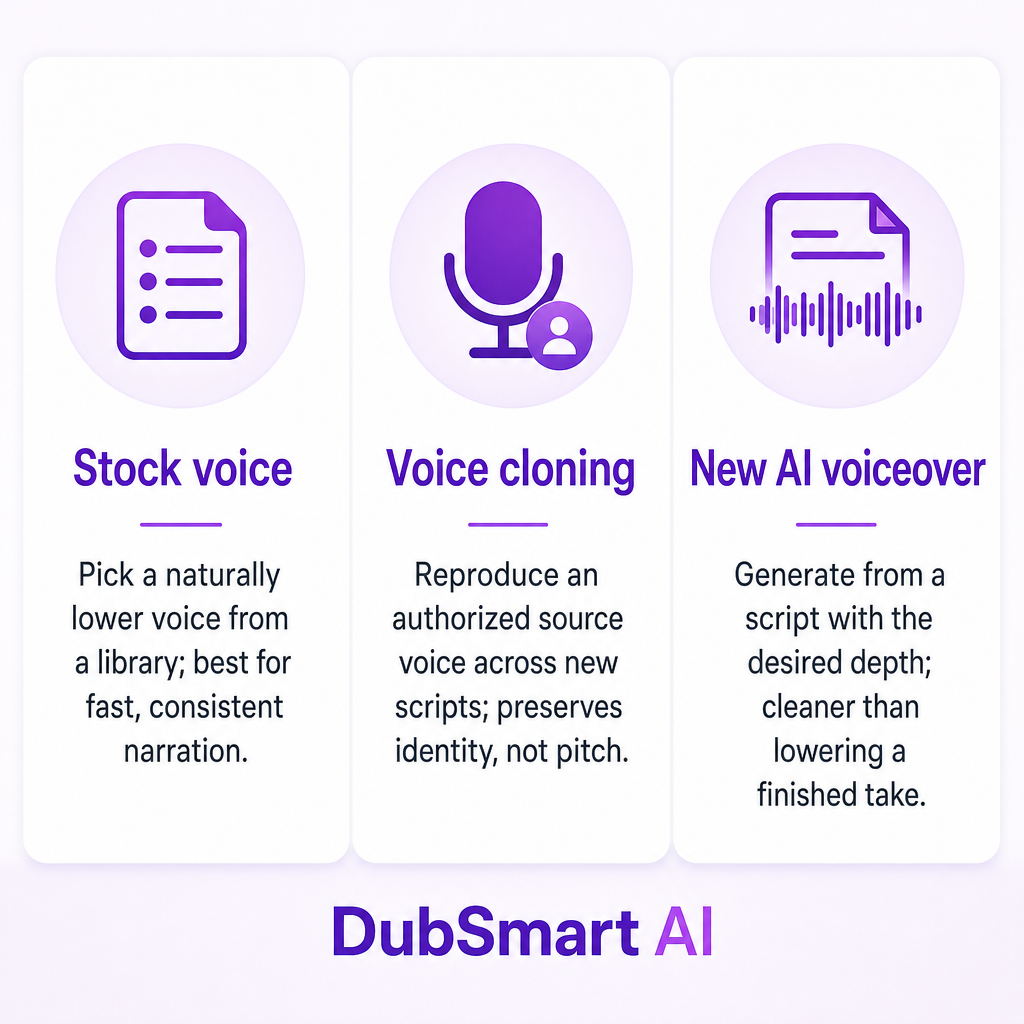
The third route tends to be the cleanest. Instead of lowering a completed recording and chasing artifacts, you select a voice whose pitch, resonance, age, accent, and delivery already fit the project. Our Text to Speech tool converts a script into generated speech and offers more than 300 AI voices, including male, female, and neutral options, with voiceovers in multiple languages and voice cloning across 33 languages.
For a deeper result, choose a voice that already carries the character you want rather than assuming a pitch tweak will fix everything. Compare candidates using the same short script and listen for natural low-end resonance, clear consonants, comfortable pacing, suitable age and tone, appropriate emotional delivery, accurate pronunciation of names and technical terms, and consistency across several sentences. Our stated workflow keeps this simple: enter text, select a speaker, generate the speech, edit the project, and download it in the format you need, with speech-rate adjustment and dialogue tags available to guide emotional tone.
In practice, a creator could audition a short intro three ways: a low, calm narrator for a documentary; a fuller, authoritative voice for business education; and a warm, lower-register voice for a podcast. The best pick is the one that stays intelligible and natural after a few paragraphs, not the one with the lowest apparent pitch.
Voice cloning is a different tool with a different job. Our voice cloning is for keeping a consistent version of a speaker's own voice across new scripts, videos, or localized content; it aims to preserve identity, not to redesign it. Clone only your own voice or one you have clear permission to use, and never imitate a real person for deception, fraud, impersonation, or unauthorized commercial use. If the source voice is naturally high, cloning will tend to carry that identity forward rather than transform it into a convincingly deep voice. In that case, a suitable stock voice or a purpose-built custom voice is the better creative choice. Review current terms, consent requirements, and disclosure expectations before you publish.
Choosing the right method for your goal
Match the method to the outcome you actually want. The table maps common goals to a sensible starting point.
| Your goal | Best starting point | Why |
|---|---|---|
| Make your everyday voice fuller | Relaxed technique, breath support, coaching | Builds control without aggressive pitch forcing |
| Sound deeper in a finished recording | Mild pitch shift and careful EQ | Changes the take, not your natural voice |
| Create YouTube or podcast narration | Select a naturally deep AI voice | Produces a consistent result from a script |
| Preserve your identity in new narration | Authorized voice cloning | Keeps a recognizable voice across recordings |
| Produce multilingual versions | AI dubbing or multilingual TTS | Localizes narration in one workflow |
| Fix persistent hoarseness | Medical or speech-language evaluation | Symptoms may signal a disorder, not a pitch issue |
If your plan is multilingual from the start, our AI Dubbing can carry a chosen vocal character into localized versions so you are not re-solving the depth question for every language.
Making a deeper voice sound natural
A convincing deep voice is about more than a low note, whether you speak it, edit it, or generate it. A few checks keep the result credible.
Prioritize intelligibility first. Listeners should catch every word without raising the volume, so trim excessive bass the moment it blurs consonants. Match voice to content next: a dramatic, cavernous voice suits a trailer but feels wrong in a children's lesson or a conversational vlog, so align vocal age, energy, accent, and emotional tone with the audience.
Keep pitch changes moderate. Extreme lowering, whether from your throat or a plugin, usually exposes artifacts, and a slightly deeper but clear voice reads as more real than an exaggerated one. Then test for long-form consistency, because a voice that dazzles in a five-second preview can grow tiring over ten minutes. Run a representative paragraph with numbers, names, pauses, and emotional shifts before you commit.
Finally, handle disclosure responsibly. If an AI-generated or cloned voice could reasonably be mistaken for a real person, follow the platform's disclosure rules and any applicable legal or contractual requirements, keep consent records for cloned voices, and retain the original source files and approvals.
Frequently asked questions
Can I permanently lower my voice naturally?
Training can improve control, resonance, and delivery, but it cannot guarantee a permanent anatomical change. Avoid forcing your pitch lower, and consider working with a qualified voice professional to stay in a safe range.
Does drinking water make your voice deeper?
Hydration supports vocal comfort and healthy function, but it does not permanently lower pitch. It can reduce dryness and make speaking feel easier.
Is vocal fry a safe way to sound deeper?
Occasional vocal fry is part of normal speech for many people, but deliberately sustaining it can cause fatigue or discomfort. It should not replace relaxed, supported speech.
Can AI make my voice deeper?
AI can generate narration using a naturally lower stock voice, modify a recording, or create authorized voice-cloned speech. The most natural option is usually selecting a voice that already has the depth you want rather than applying an extreme pitch shift.
When should I see a doctor about my voice?
Seek medical advice for hoarseness lasting more than three weeks, pain, difficulty swallowing or breathing, coughing of blood, a neck lump, or complete voice loss.