AI speech separation is a deep-learning process that pulls a human voice out of a noisy mix and hands back a clean speech track, ready for transcription, dubbing, or voice cloning. That single capability answers the question most creators actually have: can I salvage this recording without re-shooting it? Understanding how ai speech separation works helps you decide when to lean on it, when to record cleaner in the first place, and how a clean voice track quietly improves everything downstream. This guide walks through the mechanism, the difference between enhancing one speaker and splitting many, where the process fits into a localization pipeline, and what it still cannot fix.
Table of contents
The decision behind speech separation
Any real recording captures far more than the speaker. Vlogs, webinars, training videos, and podcasts pick up street noise, room ambience, music beds, keyboard clicks, and overlapping chatter that can bury the words that matter. A speech separator exists to untangle that mixture: it takes one mixed file and returns a track containing mostly human speech, plus an optional track holding the leftover background audio.
That clean voice track becomes the foundation for whatever comes next: accurate speech-to-text, multilingual dubbing, high-fidelity voice cloning, or simply a better-sounding original. So the real decision is not technical, it is practical. Do you trust your current audio enough to build multilingual content on top of it, or do you want AI to clean and separate the speech first? And do you want a standalone cleanup utility, or a separator embedded in a broader creation and localization platform so you are not juggling several apps?
We designed our Speech Separator to act as the first AI gate in a unified workflow. It sits before speech-to-text, text-to-speech, voice cloning, and dubbing, so every downstream system sees the clearest possible voice signal instead of inheriting whatever noise was in the room.
The mechanism: from waveform to clean voice
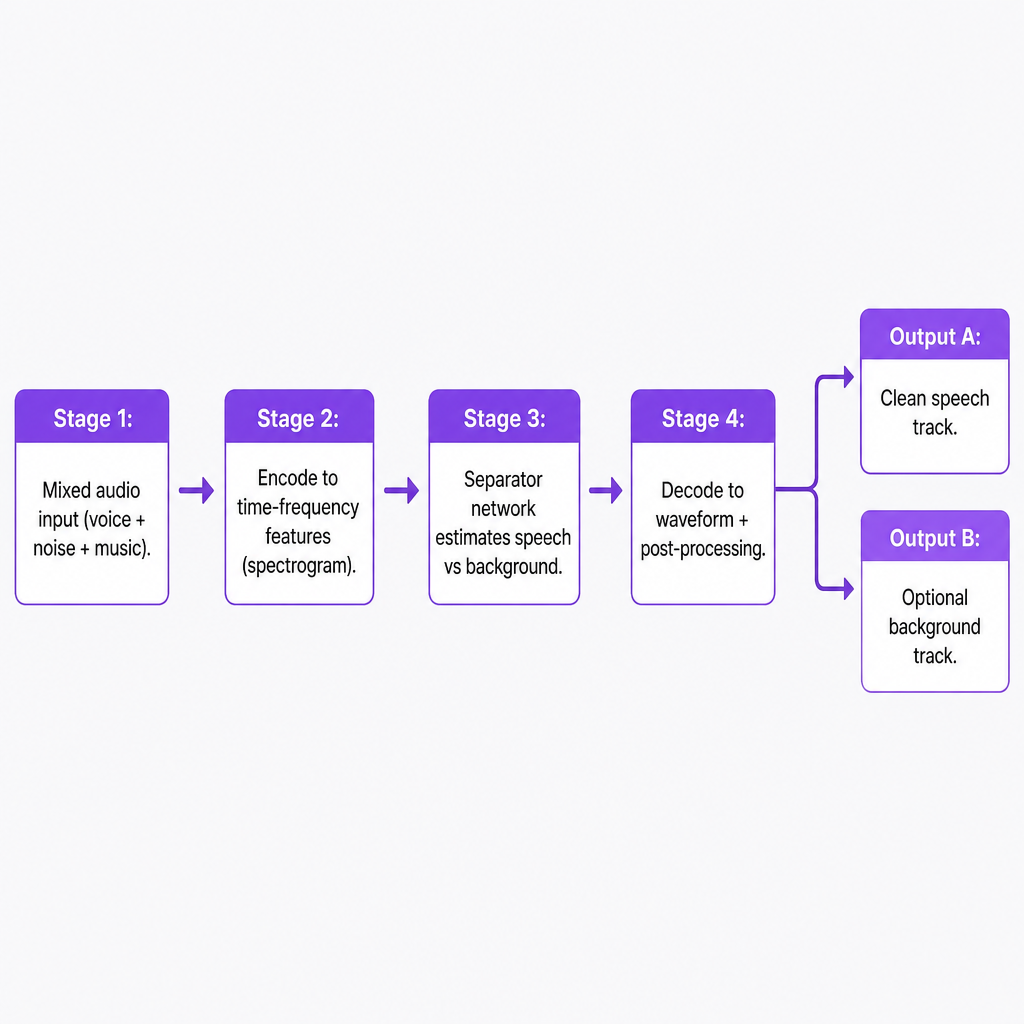
Modern AI speech separation follows a four-stage pipeline: encode the signal, separate sources in a learned feature space, estimate the clean speech, and decode it back to audio.
From waveform to features
Most systems first convert the raw waveform from your microphone into a time-frequency representation such as a spectrogram, which shows how energy in different frequency bands changes over time. That view makes it easier for a neural network to see the patterns that correspond to human speech versus noise or music. An encoder network then maps the input into a high-dimensional feature space where different sound sources become more distinguishable, emphasizing speech traits like formants, harmonics, and temporal structure while suppressing irrelevant background content.
Separator networks and masks
The core of the process is the separator network, a deep model trained to judge what belongs to the voice and what does not at each time-frequency point. Two strategies dominate. Mask-based separation predicts a mask for the spectrogram that keeps speech energy and attenuates everything else; when applied to the original spectrogram, background noise and music drop sharply while speech remains. Direct source estimation instead predicts the clean speech spectrogram itself, and sometimes a residual background, which is then decoded back to audio.
More specialized approaches exist for harder cases. Deep clustering learns an embedding for each time-frequency bin so that bins from the same source cluster together, after which standard clustering separates speech from other sources. Other models use permutation-invariant training so they can separate several speakers without assuming which speaker is output one versus output two.
Training with supervised examples
These models learn from example mixtures paired with ground-truth clean speech, adjusting themselves to minimize the gap between their output and the reference. Training targets can be masks, clean spectrograms, or reconstructed waveforms, and the loss functions are often tied to perceptual quality measures like signal-to-distortion ratio. Fed many diverse samples across accents, microphones, and environments, the network internalizes robust cues that separate human speech from background content and generalizes to recordings it has never seen.
Decoding back to audio
Finally the system maps the separated speech representation back to a time-domain waveform through an inverse transform, followed by post-processing such as denoising and loudness normalization. The result is a speech-dominant track that can stand alone or be recombined with a controlled amount of background for naturalness. Our Speech Separator follows exactly this pattern: it ingests your uploaded audio or video, runs the separation pipeline, and returns a speech-focused track plus optional background so you decide how dry or ambient the final mix should be.
Single-speaker enhancement vs multi-speaker separation
There is an important line between enhancing one dominant speaker and truly splitting several overlapping voices, and it shapes what you can realistically expect.
Single-speaker enhancement isolates one main voice from background noise, reverberation, and non-speech sounds so intelligibility jumps. This works especially well for vlogs, webinars, lectures, and talking-head content, where the problem is ambient noise or a music bed rather than crosstalk. Our Speech Separator is optimized for this case: it treats human speech as the primary source and everything else as background, delivering a cleaned voice track and an optional background track.
Multi-speaker separation is a different task: splitting a mixture of several people talking at once into individual streams, one per voice. Research models have separated up to five voices from a single microphone by training different networks for different speaker counts and picking the best fit for each sample. Techniques like deep clustering and multi-microphone neural beamforming push performance further in far-field and multi-channel settings, but they are more complex and computationally heavy. In practice these systems still target specialized scenarios such as meeting transcription, call centers, and smart devices rather than everyday creator workflows. For most of our users, running YouTube channels, marketing teams, or course libraries, the biggest practical win comes from strong single-speaker enhancement and speech-versus-background separation, not full multi-voice splitting.
Where separation sits in a localization workflow
Separation is the bridge between noisy real-world recordings and high-quality AI voice work. A typical path runs cleanly through several tools.
A creator uploads an audio or video file, and the separator isolates the speech track and optionally the background. That clean speech feeds into speech-to-text, so transcription and translation operate on a clear signal, which improves accuracy and reduces hallucinated words caused by heavy music or noise. The resulting text and translations then move into text-to-speech and AI dubbing, which generate new language versions using cloned or synthetic voices; because the source speech was clean, temporal alignment is more precise and mixing artifacts like pumping are reduced.
Voice cloning depends on the same clean input. Models need relatively noise-free examples to learn a speaker's timbre, prosody, and articulation reliably, and separation reduces the background contamination that can distort a cloned voice. Our Spanish-language guide to separation captures the everyday experience well: upload a file, let the AI split voice from background, then download either the clean voice track or the isolated background for further editing, dubbing, or narration, all inside one workflow. That consolidation is the point for small teams, who otherwise bounce between separate noise-reduction plugins, transcription tools, dubbing services, and cloning platforms.
Choosing and using AI speech separation
When you decide how to adopt separation, a handful of practical criteria do most of the work.
Audio conditions and content type. With a single primary speaker and moderate background noise or music, separation is highly effective and low risk. With heavy overlap, far-field microphones, or very low-quality input, expect diminishing returns and pair the AI with better recording rather than relying on it to rescue everything.
Integration with downstream tools. A separator that flows directly into transcription, text-to-speech, and dubbing reduces friction and cumulative artifacts compared with exporting and re-importing between apps. We connect the Speech Separator to the rest of our localization tools for exactly this reason, which matters more when your goal is multilingual publishing rather than one-off noise reduction.
Control over background audio. For brand storytelling you often want to keep some ambience or music for emotional impact. Systems that output both a clean speech track and an isolated background give editors more room than tools that only produce a single denoised mix. Our separator supports this speech-plus-optional-background paradigm so you can remix deliberately.
Speed, simplicity, and scale. For creators and small teams, usability rivals raw performance. One-click separation through a browser or API, with automatic handling of common formats, beats complex plugin chains that assume audio-engineering expertise. Once you are managing hundreds of videos or course modules, batch processing and automation stop being luxuries.
Reliability and artifacts. A strong model improves intelligibility without adding obvious distortion, metallic ringing, or breathing artifacts. Demos can flatter a system, so test with your own representative recordings before you make any separator a fixed part of your pipeline.
Privacy and compliance. Separation operates directly on voice data that may include sensitive information. Enterprise teams should confirm how audio is stored, whether it is used for model training, and what controls exist for retention and access, especially for regulated industries and internal training content.
Weighing these criteria against your actual use cases, whether channel expansion, training, marketing, narrative work, or an API product, tells you whether an integrated separator with downstream voice tools fits how you operate.
Risks, limits, and what it cannot fix
Even strong models have hard edges worth knowing before you commit.
- Extreme noise or very low signal-to-noise ratio. When speech is buried under loud noise or music, the model may fail to recover every word, producing dropouts or muffled output.
- Heavy speaker overlap. People talking at exactly the same time challenge even advanced multi-speaker systems and can cause speech to bleed between separated streams.
- Over-separation artifacts. Aggressive masking can introduce musical noise or a robotic timbre, most noticeably on sustained sounds and sibilants.
- Training-to-reality mismatch. Models tuned on certain microphones, languages, or environments can underperform on very different recordings, which then drags down transcription and dubbing accuracy.
- Ethics and rights. Cleanly separated speech is easier to transcribe, analyze, and remix, so teams must respect consent and rights when reusing voices in new languages or contexts.
The honest takeaway is that separation is a powerful enhancement, not a replacement for reasonable recording habits. Good microphones, sane levels, and mindful location choices still pay off, and AI then multiplies those choices by making the content far more flexible for localization and reuse. If you are exploring how to fit this into a larger publishing setup, our explainer on what a speech separator is covers the fundamentals in more depth.
Frequently asked questions
What is AI speech separation in simple terms?
It is an AI process that takes a mixed recording and isolates the human speech, giving you a clean voice track and, optionally, a separate background track you can keep or discard.
How is our Speech Separator different from basic noise reduction?
Traditional noise reduction mainly attenuates steady-state noise. Our separator uses deep learning to recognize speech patterns and pull them from a broad range of background sounds and music, which usually yields cleaner and more natural dialogue.
Can it handle multiple speakers?
Our Speech Separator is optimized for isolating human speech from non-speech backgrounds, which works best with a primary speaker in the mix. Splitting several overlapping voices is an active research area, and specialized models exist, but they typically target meetings or call centers rather than general creator workflows.
Why does speech separation matter for multilingual dubbing?
Localization relies on accurate transcription and timing. A clean speech track reduces recognition errors and helps translated voiceovers align with the original video, cutting audible artifacts when new voices are mixed with retained music and effects.
How much technical knowledge do I need to use it?
Very little. You upload an audio or video file, let the AI process it, and download the separated speech and background tracks for editing, dubbing, or automation, with no manual parameter tuning required.