
What Content Marketing Roles Actually Look Like Now
Your content marketing job posting has been open for three months. The candidates that arrive have portfolios of AI-generated case studies. Your current team spends 40% of their time on tasks that didn't exist in 2022. The job you hired for last year doesn't look the same anymore.
So what does a content marketing role actually require in 2026, and how do you hire — or stay hired — when the skills demanded shift quarterly? The answer matters whether you're a hiring manager looking at a stack of resumes, a content team lead trying to forecast next quarter's headcount, or a writer watching your responsibilities mutate around you. The pressure isn't theoretical. It's already showing up in pay bands, job titles, and the diagnostic questions interviewers are starting to ask.
What follows is a current map of the content marketing jobs worth tracking in 2026 — the roles, skills, salary shifts, and hiring filters that matter — grounded in primary research from the Content Marketing Institute and recruiter-side labor data, not vendor hype.

Table of Contents
- What Content Marketing Roles Actually Look Like Now
- The Core Skills That Are Non-Negotiable
- Three Emerging Job Categories
- Why AI Tool Literacy Is Replacing Platform Experience
- The Salary Paradox
- Two Diagnostic Checklists
- The Questions Hiring Managers and Creators Are Actually Asking
Scroll LinkedIn or Indeed in late 2025 and the job titles still read Content Writer, Social Media Manager, Copywriter, Blog Editor. The descriptions still list "5+ years writing experience, AP style mastery, WordPress proficiency, ability to manage editorial calendar." Mid-level salary bands. Standard benefits. Tidy.
Then the candidate starts the job. By week three, the actual workload has surfaced: operating an AI dubbing workflow that turns one video into eight, briefing a voice-cloning pipeline so the brand sounds consistent across markets, deciding which of 33 target languages a flagship piece gets localized into, and reporting cost-per-asset metrics to a CMO who used to ask about engagement rate and now asks about unit economics. The job description and the job have parted ways.
Three hybrid-role patterns now dominate content marketing jobs in 2026:
The Writer-Producer. Hired as "Senior Content Writer." Actual workload splits roughly: drafts long-form articles (40% of time), turns each article into a script for a TTS-narrated YouTube video (25%), oversees translation and dubbing into 4–6 languages (20%), reports performance through a dashboard (15%). The "writing" job is now a publishing operations job. The person who thrives in it spends less time perfecting sentences and more time deciding which sentences are worth the production cost of being heard in six languages.
The Copywriter-Localization Strategist. Hired as "Brand Copywriter." Actual workload: writes the English source asset once, then makes structural decisions about which markets get full dubbing versus subtitle-only, which voice clones represent the brand in Spanish versus Portuguese versus Japanese, and how cultural adaptation differs from literal translation. The copywriting still happens. It's just no longer the bottleneck.
The SMM-Analytics Hybrid. Hired as "Social Media Manager." Actual workload: less posting, more dashboard interpretation. Decides which AI-generated variants get promoted, kills the underperformers within 48 hours, briefs the AI tool on the next iteration. The job has shifted from "post things" to "decide what survives."
The content marketing job in 2026 isn't write better articles. It's produce, localize, and distribute content across markets at half the cost and double the speed.
The Content Marketing Institute's 2026 Career and Salary Outlook puts a sharp point on the disconnect. According to Stephanie Stahl, Managing Director of CMI, "AI promised to free up time for marketers to focus on higher-value work. Instead, marketers report feeling overworked and underappreciated, as they're expected to adapt to the furious pace of change, often without adequate training and support." The new job isn't smaller. It's bigger. It just wears the old job's name tag.
Why haven't the titles caught up? HR systems, salary bands, and recruiter taxonomies are slow-moving. Hiring managers write the description that matches their org chart, not the work. Compensation committees benchmark against published 2023 surveys. The result is an "invisible skill gap" that shows up in retention data, not in job ads: candidates who can produce content arrive in volume; candidates who can orchestrate content production across 15 languages and 3 platforms simultaneously are rare, and they're getting poached within 18 months of a hire.
The rest of this article maps what to do about it — the skills that actually predict performance, the new role categories worth budgeting for, the salary shifts already underway, and the diagnostic checklists for both sides of the hiring table. The framing throughout is AI content creator roles as orchestration roles, not production roles. That distinction is where almost all of the leverage lives.
The Core Skills That Are Non-Negotiable
There are skills that have moved from "nice to have" to "non-negotiable" in roughly 24 months, and others that have inverted entirely. The matrix below is what hiring managers should be screening for and what individuals should be developing if they want their content marketing skills 2026 stack to remain competitive.
| Skill | 2024 Importance | 2026 Importance | Trend |
|---|---|---|---|
| SEO copywriting | Critical | High | Slight decline |
| Prompt engineering | Emerging | Critical | Sharp rise |
| Data interpretation | Medium | Critical | Sharp rise |
| Video/multimedia production | High | Critical | Maintained |
| Multilingual content strategy | Niche | High | Sharp rise |
| Grammar and style mastery | Critical | Medium | Decline |
| Platform-specific tactics | High | Medium | Decline |
| Workflow design / tool chaining | Rare | Critical | Sharp rise |
The pattern is clean once you see it. Skills declining are the ones AI does well: mechanics, basic on-page optimization, platform-specific tactical execution. Skills rising sharply are the ones AI enables but cannot perform — judgment about what to make, in which language, for which market, evaluated against which ROI metric. SEO copywriting hasn't disappeared; the on-page mechanics have just become a five-minute task rather than a five-hour one, which means the strategic layer (search intent design, topical authority planning) is where the human hours now sit.
For hiring, the practical implication is direct: a candidate without prompt engineering or workflow design literacy is now junior-level regardless of years of experience. A candidate with 3 years of experience plus tool fluency outperforms a 10-year writer who's still asking "which CMS do you use?" in the first interview. The years count for less than the muscle memory of chaining tools together.
For individuals, the highest-leverage 60 hours you can spend in the next quarter is not another writing course or another SEO certification. It's learning how to chain tools end-to-end — drafting a script in your CMS, generating narration via Text to Speech, dubbing that narration into target markets, and tracking performance back to a single dashboard. AI content marketing jobs are filtering candidates on whether they can describe that chain from memory, not on whether they can list the tools in it. Listing tools is a resume exercise. Chaining them is a skill.
Three Emerging Job Categories
These three roles barely existed as line items in 2022. By late 2025 they're appearing across job boards under hybrid titles, and the pay bands are climbing fast. Hiring managers should know what to call them. Candidates should know what they're really being evaluated on. The list below is the practical taxonomy of emerging content roles worth budgeting for now.
AI Content Operations Manager. Did not exist as a discrete job category three years ago. Owns the content production workflow itself: tool stack, quality gates, batch-processing pipelines, creator handoffs, cost tracking. The hiring signal is experience with project management tools (Asana, Monday, ClickUp) plus demonstrated knowledge of API integrations or no-code workflow builders. The real diagnostic test: hand them a 12-minute YouTube video and ask how they'd turn it into 12 localized versions for 12 markets within a week. They should sketch a workflow involving transcript extraction, AI dubbing, voice cloning for brand consistency, QA checkpoints, and a distribution schedule — without writing code, and ideally on a whiteboard in under ten minutes. The role exists because consolidated platforms now handle the steps; companies need someone to operate the platform, not build it. AI content operations jobs at growth-stage companies are now budgeted alongside engineering hires.
Localization Content Strategist. This is not a translator role. It's an editorial-strategy role with a P&L attached. Decides what gets localized, which of 33+ target languages to prioritize, when to launch each market, and how cultural adaptation differs from literal translation. The hiring signal is candidates who articulate a market-prioritization framework — for example: "we localize into Spanish first because audience size and CPM combine to clear a $2 cost-per-localized-asset threshold within 30 days." The diagnostic test: ask how they'd choose between dubbing a flagship podcast into 6 languages versus producing 6 net-new localized assets in priority markets. The answer reveals whether they think in unit economics or in volume. Content localization jobs at this strategic level are paying meaningfully more than traditional localization manager roles because the decision surface has expanded from "translate this" to "decide what's worth translating, and to whom."
Creator Studio Manager. Sits between content creation and operations. Manages the in-house team plus 5–50 freelance creators producing at AI-amplified velocity. The hiring signal is whether they can describe how they 10x output without 10x headcount, with specifics: batch templates, creator briefing standards, AI-assisted first drafts that humans edit, quality frameworks that scale. The diagnostic test: ask how they'd onboard a freelancer in a week to produce assets indistinguishable from in-house output. The answer reveals whether they understand systematized briefing or rely on hands-on review. The latter doesn't scale, and the candidate who gives that answer will become the bottleneck they were hired to remove.
Three years ago, content operations didn't exist as a job category. Today it's where the fastest-growing teams are hiring.
Why AI Tool Literacy Is Replacing Platform Experience
A 2022 job description specified "5 years Hootsuite experience" or "expert in HubSpot Marketing Hub." A 2026 job description increasingly says "demonstrated ability to learn new content tools quickly" or "fluency with at least two AI content platforms." The shift is not cosmetic. It reflects a market reality that no content tool now has a 3-year stability horizon — the feature set you mastered 18 months ago has been replaced by a feature set you've never seen.
What does AI tool literacy actually look like in practice? Three components separate the genuinely fluent from the resume-fluent.
Output quality discrimination across tools. A literate candidate can listen to two TTS samples and tell you which one fails on prosody at sentence boundaries. They can watch two AI-dubbed videos and identify which one has lip-sync drift in the second half. They notice when an AI image generator is producing visually similar but compositionally weak outputs and adjust the prompt structure rather than re-rolling. Tool-specific knowledge ages out in 12–18 months. Quality discrimination is durable across platforms because it's grounded in what good output looks like, not in which menu item produces it.
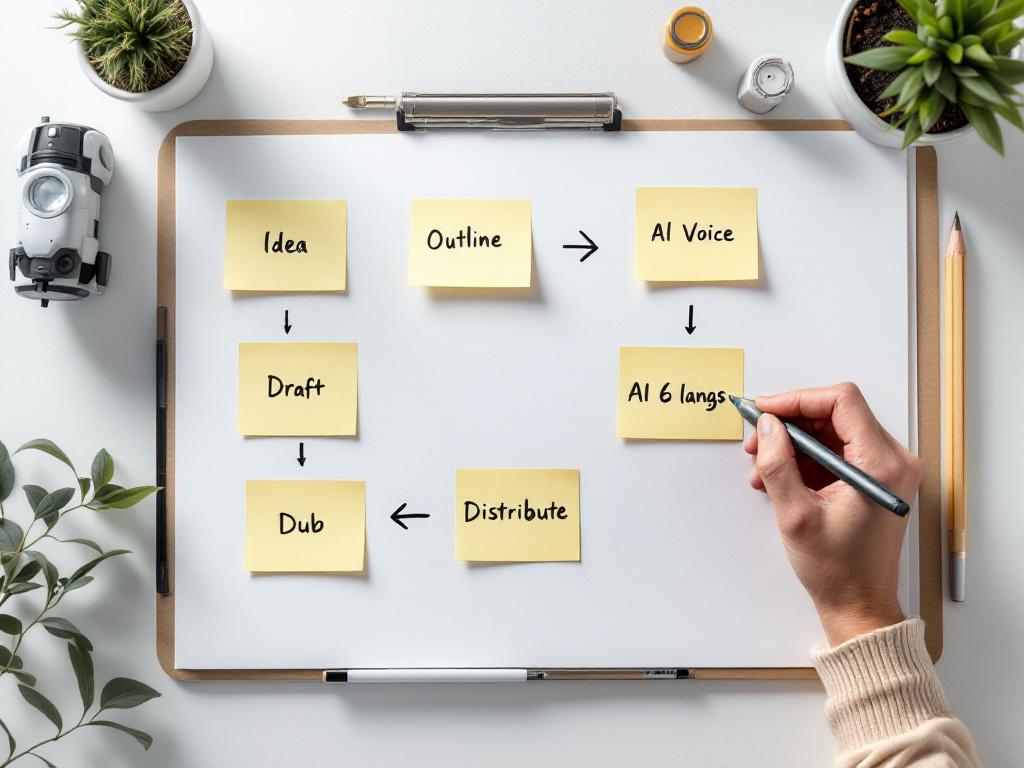
Workflow chaining. Understanding that the value isn't in any single tool — it's in the connection. A representative chain: an article draft → key visuals generated via an AI image generator → those images animated into short clips → a TTS narration layered in → the whole package dubbed into 6 languages → distributed across YouTube, LinkedIn, and TikTok with platform-native cuts. The candidate who can describe that chain end-to-end is rare. The one who's actually executed it on a live project is rarer still, and that's the candidate worth interviewing twice.
Knowing when NOT to automate. Mature tool literacy is recognizing the 20% of work where human craft outperforms — usually the brand-voice-defining hero asset, the executive thought-leadership piece, the high-stakes customer story where a single off-key sentence kills credibility. Junior tool users automate everything and ship slop at scale. Literate users automate selectively and protect the assets that compound brand equity over years.
The risk to current job holders is direct: platform-specific expertise is a depreciating asset. The 5-year HubSpot specialist is more vulnerable than the 2-year generalist who's used HubSpot, Marketo, and an AI content stack — because the generalist's meta-skill (learning new tools fast) is what's actually being hired for. The CMI 2026 research surfaces the same dynamic from the workforce side: marketers report being expected to adapt without adequate training and support. The market response is increasingly to hire candidates who don't need training because they've internalized tool patterns across categories.
The practical framing for individuals is simple. The goal is not to learn any one platform as a discrete skill. The goal is to use 2–3 platforms in the same category — for example, three different dubbing tools — notice the structural similarities (project setup → asset upload → language and voice configuration → output → review), and develop the muscle memory that makes the next platform learnable in a weekend rather than a quarter.
For hiring managers, the strategic implication closes the loop. Stop screening on platform names in resume bullets. Start screening on workflow descriptions in cover letters. A candidate who writes "I reduced our localization turnaround from 14 days to 36 hours by chaining transcript extraction, AI dubbing, and a parallel review process" is more valuable than one who writes "Expert in [specific platform], 6 years." The first sentence describes orchestration. The second describes button-pressing. Content marketing skills in 2026 are weighted toward the first.
The Salary Paradox
Many people expect AI-driven productivity gains to compress wages across the board. The assumption sounds reasonable: if AI does more of the work, workers must be worth less. The labor market keeps refusing to behave that way.
What's actually happening is bifurcation, not collapse. Some segments are compressing dramatically. Others are inflating. The same job title can sit on either side of the gap depending on which version of the work it covers, which is why aggregate "content marketer salary" averages tell you almost nothing about your specific market value. The table below maps the content marketing salary 2026 picture by role segment.
| Role Segment | 2024 Median | 2026 Range | Pressure |
|---|---|---|---|
| Content writer (commodity) | $48K–$62K | $38K–$50K | Downward |
| Content strategist with AI fluency | $65K–$85K | $75K–$105K | Upward |
| Senior content operations lead | $80K–$110K | $95K–$130K | Upward |
| Freelance creator (per asset) | $200–$800 | $150–$600 | Downward |
| Localization specialist | $60K–$80K | $72K–$98K | Upward |
| Generative AI content strategist | New category | $100K–$155K | New ceiling |
| AI marketing automation director | New category | $140K–$200K | New ceiling |
Salary ranges drawn from Murray Resources 2026 AI Marketing Jobs report and the CMI 2026 Career and Salary Outlook. Figures reflect recruiter-side and survey data; readers should validate against BLS data and live job postings in their region before negotiating.
Why haven't wages fully collapsed despite the productivity gains? Demand for output volume is growing faster than the supply of AI-fluent professionals who can manage it. A company that previously published 4 articles per week now wants 20 — across 6 languages, with video versions, with localized social cuts, with measurement dashboards. The bottleneck isn't writing. It's orchestration. People who can orchestrate are scarce, so they get paid.
The bifurcation is worth naming explicitly. Low-skill content production work is depreciating roughly 15–20% in real terms. High-skill operations and strategy work is appreciating roughly 15–25% in the same window. The collision happens in the middle, where mid-career writers either reposition into orchestration or watch their market value erode. There is no neutral position. Standing still is moving down.
Job security in 2026 is not about protecting your writing ability. It's about becoming the person who uses AI to multiply output.
There's a counter-narrative worth holding alongside the optimistic one. The CMI research finds that even marketers in the appreciating segment report higher workloads, not better lives. Wage gains are real. Quality-of-work gains are not yet showing up in the data. The "ghost workforce" critique — that AI efficiency claims have produced rising layoffs and rising hours for the survivors — is honest about what the bargain has actually been. Readers in this market know the difference between "I got a raise" and "I'm not burned out."
The implication for content marketing jobs salary strategy is straightforward. Career security in 2026 is not about protecting writing ability. It's about positioning into the orchestration layer — the layer that uses AI to multiply output rather than competing with AI on output. The salary data points one direction. The workload data points another. Both are true simultaneously.
Two Diagnostic Checklists
These are diagnostic, not aspirational. If you're hiring, run candidates against the first list before extending an offer. If you're staying employed, run yourself against the second list this quarter — not next year. The gap between the two timelines is where careers are made and lost.
Checklist A — If You're Hiring
- Can they demonstrate live competency with at least two content creation tools? Specific tools don't matter. Speed of demonstration matters. Fumbling for 10 minutes on what they claim is a familiar interface is the signal you needed.
- Do they ask integration questions or feature questions? Candidates who ask "how does this connect to your distribution stack?" are operations thinkers. Candidates who ask "does the platform have feature X?" are tool users. The difference compounds across two years on the team.
- Can they cite a specific bottleneck they identified and solved? Watch for measurable outcomes. "Reduced localization turnaround from 14 days to 36 hours" beats "improved efficiency" every time. Adjective-heavy answers describe ambition, not execution.
- Can they articulate why output quality matters more than output speed? AI makes speed cheap. Candidates who default to volume metrics signal they'll flood your channels with mediocre assets and damage brand equity in pursuit of dashboard wins.
- Do they have evidence of managing work at scale? Briefing 8 freelancers, batching 40 assets per week, running parallel QA loops — these are different skills than producing well alone. Solo excellence does not predict team excellence.
- Can they explain localization strategy beyond "translate it"? Test by asking which 3 markets they'd prioritize for a hypothetical product launch and why. Vague answers reveal vague thinking. Specific answers — referencing audience size, CPM differences, platform mix — reveal a strategist.
- Can they articulate the unit economics of a content operation? Cost per asset, time-to-market, quality-acceptance ratio. If they can't, they'll consume budget without explaining return, and you'll be defending their headcount in the next budget cycle without ammunition.
Checklist B — If You're Protecting Your Role
- Become genuinely fluent in 2–3 major AI content platforms within 90 days. Pick one for dubbing and voice, one for image and video generation, one for written content. Use them on real projects, not tutorials. Tutorials teach features. Real projects teach judgment.
- Trace one of your existing assets through a full multi-language workflow. Take a published article, plan how you'd turn it into a TTS-narrated video dubbed into 6 markets, and document the steps and costs. This becomes a portfolio piece you can show in interviews — and a reference architecture you can reuse internally.
- Identify your team's biggest production bottleneck and propose an AI-assisted solution. Bring data: current cost, current time, projected savings. Memos that include numbers get budget. Memos that include adjectives don't.
- Build a before/after portfolio entry showing output multiplication and cost reduction. Specific format: "Before: 4 assets/week, 1 language, $X cost. After: 12 assets/week, 4 languages, $Y cost." This is the artifact that wins interviews because it's the artifact hiring managers are scanning for.
- Develop a localization point of view. Pick one non-English market relevant to your industry. Understand its content consumption patterns, dominant platforms, and how cultural adaptation differs from translation. Most candidates have no opinion here. Having one moves you up a tier.
- Learn to read a content performance dashboard and make a workflow recommendation from it. This is the skill that promotes writers to strategists. Practice on your current data weekly, not quarterly. Pattern recognition comes from frequency.
- Get fluent with at least one API or developer-friendly content tool. You don't need to code. You need to know enough to brief an engineer or operate a no-code automation. This is the skill ceiling that separates senior operators from senior writers, and it's where the new pay bands are concentrated.
The Questions Hiring Managers and Creators Are Actually Asking
These are questions that surface in hiring panels, performance reviews, and Slack DMs that didn't fit cleanly into the sections above.
Should I hire a "content writer" or an "AI content operations specialist" in 2026?
The job title matters less than skill composition. A strong operations specialist can oversee writers and manage AI tools; a strong writer alone cannot manage workflows. If your budget allows only one hire and your team is producing under 10 assets per week, hire the writer — coordination cost isn't your bottleneck yet. If you're producing 30+ and struggling with consistency or localization, hire the operations mindset, even if their writing is only good rather than great. The breakeven point is roughly the moment your team's coordination cost exceeds its writing cost. Most teams hit that threshold faster than they expect, then spend two quarters in denial about it. Use the diagnostic checklist in the previous section to assess either candidate against the actual work, not the job title.
Is my job as a content marketer going to exist in five years?
It depends on which version of the job you currently hold. Pure first-draft writing roles are depreciating fast — CMI's 2026 research documents rising layoffs alongside the efficiency claims. Roles combining creative direction with process automation are thriving and paying more. The shift is already happening, not coming. The direct answer: your title will probably exist; the work behind it will not. Reposition now by taking on one orchestration responsibility this quarter — managing a freelancer pool, owning a localization pipeline, or building a workflow document that other people on your team actually use. Don't wait for it to be in your job description. By the time it's in the description, it's already in someone else's.
What's the difference between a "prompt engineer" and a "content marketer who knows AI"?
Prompt engineering is a tactic. AI-fluent content marketing is a discipline. A prompt engineer optimizes a single instruction to produce a single output. An AI-fluent content marketer designs the system: which prompts feed which tools, how outputs get reviewed, where humans intervene, how performance feeds back into the next iteration. Hiring a prompt engineer for a content team is like hiring a typographer for a publication — useful in narrow contexts, insufficient as the lead role. If you're staffing the team yourself, hire the marketer who understands prompts; don't hire the prompt specialist who doesn't understand marketing. The former scales with your team. The latter creates a dependency you'll regret in 18 months.
How do I build the business case for AI tools and training instead of more headcount?
Show the math explicitly. Three writers at $60K plus benefits and overhead lands near $210K annually all-in. Two writers plus a consolidated AI content platform plus $2K in training lands around roughly $130K–$140K all-in. Break-even arrives in about 6 months. Output velocity doubles or better, especially if you're localizing — a single platform handling text-to-speech, voice cloning, and dubbing across 33 languages eliminates the cost of separate vendors and the integration overhead of stitching them together. Bring the comparison to budget meetings as a one-page memo with three numbers: current cost per localized asset, projected cost per localized asset, payback period. Skip the technology evangelism. Finance teams approve numbers, not enthusiasm.
I'm a hiring manager. The candidates I'm interviewing all sound the same — they all claim "AI fluency." How do I separate real from rehearsed?
Three filters. First, ask for a tool demo, live, on a problem you describe in the moment — not a prepared portfolio walkthrough. Real fluency shows in keystroke speed and recovery from errors. Watch how they handle the moment when something doesn't work. That's where rehearsed candidates freeze and fluent ones improvise. Second, ask for the workflow they'd design for a hypothetical 10x output increase, then probe the weak points: what breaks at scale, what quality gates fail first, where coordination costs spike. Rehearsed answers collapse on the second probe because they were memorized as monologues, not understood as systems. Third, ask which AI tool failed them recently and why. Candidates who can name a specific failure with specific reasons have used the tools at production scale. Candidates who claim every tool works flawlessly have used them in demos. The honest answer about failure is the most reliable signal of fluency you'll get in a 45-minute interview.