Record twenty seconds of clean speech, and modern systems can generate that same voice reading a script it has never spoken, in a language the speaker may not even know. That is the practical promise behind ai voice cloning, and it is no longer a research demo. For creators, marketing teams, educators, and developers, the more useful question is what to do with it: how to turn a short recording into a reusable voice you can drop into dubbing, narration, and product audio without stitching together five separate tools. DubSmart AI was built around exactly that gap, consolidating voice cloning, text to speech, and AI dubbing into one workflow so a cloned voice recorded on Monday can be voicing localized videos by the afternoon.
This piece explains what voice cloning actually is, why short samples are now enough, and how DubSmart turns the underlying technology into something you can run without writing code, plus what developers get through the APIs.
Table of contents
- What AI voice cloning actually is
- How a voice gets cloned in minutes
- Inside DubSmart: cloning, dubbing, and TTS in one workflow
- Use cases for creators, businesses, and educators
- Building voice-driven products with DubSmart APIs
- Ethics, consent, and responsible cloning
- Frequently asked questions
What AI voice cloning actually is
Voice cloning is a set of deep learning techniques that analyze a short audio sample to capture a speaker's unique vocal fingerprint, then generate entirely new speech that sounds like that person saying anything you type. The key word is generate. A clone is not a collage of trimmed and reassembled recordings. Instead, the system learns a mathematical representation of how the voice behaves and produces fresh audio that matches it, which is why a good clone can say sentences the original speaker never recorded.
That representation captures more than pitch. Systems model timbre, cadence, accent, pronunciation, prosody, and the spectral characteristics that make a voice recognizable. They pick up formant frequencies, rhythmic tendencies, and the small inflections that signal emotion. When those learned traits are paired with a modern neural text-to-speech engine, the result is speech that reads as natural rather than robotic. The distance between a passable clone and a convincing one lives almost entirely in how well the model reproduces those subtle patterns under new words and phrasing.
It helps to separate two ideas that often get blurred. Text to speech is the broader capability of turning written text into spoken audio using any voice, including generic library voices. Voice cloning is the step that creates a specific target voice from a sample, which you then feed into text to speech or dubbing. In practice they work as a pair: you clone once, then reuse that voice across as many scripts and languages as you need. For background on the underlying mechanics, industry explainers such as Resemble AI's overview of how voice cloning works and ElevenLabs' technical notes on voice cloning describe the same generate-from-a-model approach.
The reason this matters commercially is repeatability. Once a voice model exists, it becomes an asset. A YouTuber has a consistent narrator across every localized upload. A company has a brand voice that sounds the same in an ad, a webinar recap, and an in-app announcement. That consistency is difficult to achieve with human voice talent across dozens of scripts and languages, and it is where a cloned voice earns its keep.
How a voice gets cloned in minutes
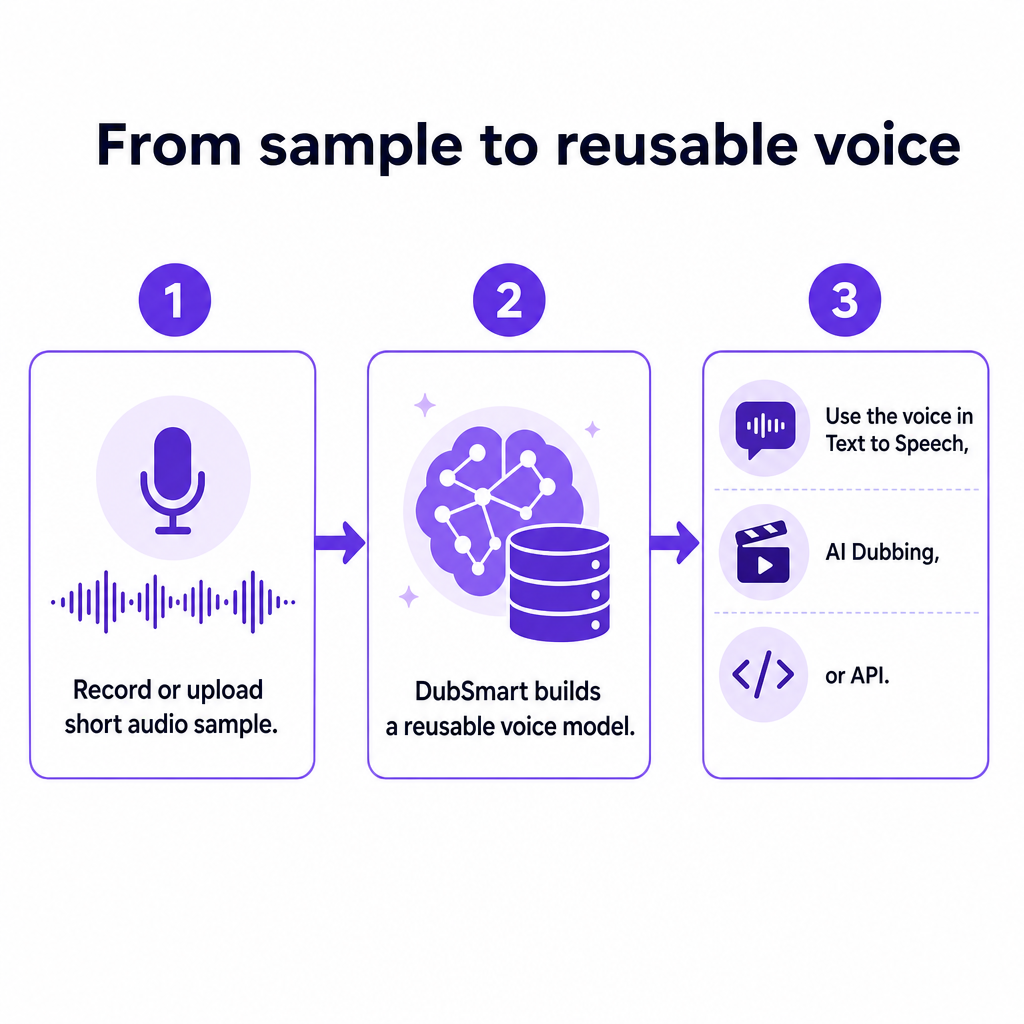
The headline claim of recreating a voice in minutes rests on a shift in how these models are trained. Older approaches needed hours of studio audio to build a single voice. Newer few-shot methods adapt from very short samples because the heavy lifting has already happened. The model has learned general speech from enormous datasets, so a new clone only needs to be conditioned on what makes one particular speaker distinct rather than learning speech from scratch.
Most descriptions break the work into a handful of stages. Understanding them makes the speed less mysterious and helps you judge sample quality before you upload.
- Audio collection and analysis. The system ingests your sample and extracts speaker embeddings, a compact numeric summary of pitch, tone, rhythm, and accent. This is where recording quality pays off: clean, consistent audio produces a cleaner embedding.
- Model adaptation. A neural text-to-speech model is conditioned on those embeddings so it can render the target voice. Because the base model already knows how to speak, this step is fast rather than a full retraining.
- Speech synthesis. Given new text, the adapted model generates audio in the cloned voice. This is the part you interact with when you type a script and hear it back.
- Refinement. Better platforms let you preview and adjust expression, pacing, and tone so the output fits the context, whether that is an energetic ad read or a calm training module.
On sample length, the market has converged on "short." Security research has demonstrated recognizable clones from only a few seconds of audio, consumer tools advertise instant cloning from one to five minutes, and beginner tutorials show usable experimental clones from roughly ten seconds. DubSmart's positioning around fast cloning from about twenty seconds of audio sits comfortably inside that range. Twenty seconds is enough to capture stable vocal characteristics while still being trivial to record on a phone or headset.
That said, short does not mean careless. A twenty-second clip of clear, evenly paced speech in a quiet room will outperform a longer clip full of background music, clipping, or wild volume swings. If you want a clone that holds up across many scripts, treat the sample the way a voice actor treats a session: one speaker, minimal noise, natural delivery, and consistent distance from the microphone.
Inside DubSmart: cloning, dubbing, and TTS in one workflow
Where DubSmart differs from treating voice cloning as an isolated trick is that the cloned voice becomes a shared asset across the whole platform. DubSmart AI is an all-in-one media creation and localization platform headquartered in Boca Raton, Florida, and it deliberately consolidates the tools you would otherwise assemble from separate vendors. Instead of a standalone cloning app, a separate narration engine, and yet another dubbing service, the voice you create lives in one place and feeds directly into the tools that use it.
The voice cloning workflow is the entry point. You record or upload a short sample, DubSmart builds the voice, and you can preview it before committing to a project. The product is designed to clone any number of voices, so a creator can hold a personal narrator voice alongside character voices, and a business can keep several brand voices for different product lines. Because the clone is stored as a reusable voice rather than tied to a single output, you are not re-cloning every time you start something new.
From there, the same voice flows into Text to Speech, which pairs your cloned voice with a library of 300+ natural-sounding AI voices and unlimited voice cloning. This is where scripts, captions, intros, and ad reads become audio. Write or import text, pick your cloned voice or a library voice, and generate. Because cloning is unlimited within the tool, you are free to build out an entire cast rather than rationing voices.
The localization side runs through AI Dubbing, which localizes content across 33 target languages and supports dubbing from 60+ source languages. The workflow is upload your video, choose the languages you want, and apply a cloned voice so the localized versions can carry the original speaker's voice rather than swapping in a stranger. For a channel expanding internationally, this is the difference between sounding like the same host in every market and sounding like a generic dub. DubSmart's own value proposition leans on this consolidation: cloning, dubbing, transcription through speech to text, source separation through the speech separator, and even image and video generation share one interface. If a project needs a thumbnail or a motion asset, the AI image generator and image to video tool sit in the same environment rather than in a separate subscription.
A note on what is and is not confirmed. DubSmart uses a credit-based pricing model with rollover credits so unused credits carry forward, a free tier for trials and low-volume use, and enterprise plans for higher volume or custom integrations. Exact dollar amounts, credit-to-minute ratios, and per-feature limits are not detailed here and should be confirmed directly on the site. The same caution applies to the exact list of supported languages and the precise minimum sample length for a best-quality clone. The platform is trusted by over 500,000 users, which speaks to adoption, but the specifics of your project are worth checking against the current plan pages before you commit volume.
Use cases for creators, businesses, and educators
The technology only matters through the jobs it does. Below are the flows that map most directly onto DubSmart's toolset, kept concrete so you can picture your own version.
Creators and YouTubers. Record a short, clean sample of your voice, clone it once, then use AI Dubbing to translate and dub your existing catalog into other languages while keeping your voice. Use Text to Speech in that same cloned voice to knock out intros, mid-roll reads, and pickup lines you forgot to record. The payoff is a multilingual channel that still sounds like you, without re-recording narration for every market or hiring a different voice per language.
Small businesses and marketing teams. Build a brand voice through cloning and treat it as a reusable identity. Generate multilingual voiceovers for ads, explainers, and landing-page videos in Text to Speech, then localize webinars and product demos with AI Dubbing. When a campaign updates, you regenerate the affected lines instead of scheduling a new studio session. For teams juggling many small assets across markets, the consistency and turnaround are the real deliverables.
E-learning and corporate training. Clone an instructor or narrator voice once, then produce course modules, updates, and microlearning segments at scale. When a policy or product detail changes, you edit the script and regenerate rather than recalling talent. Combined with dubbing, a single course can ship in several languages with a consistent tone, which matters when learners across regions should get the same experience.
Filmmakers and podcasters. Independent producers use cloned voices to cover multiple characters, patch dialogue, or offer localized versions of episodes. The speech separator helps when you need to isolate voice from music before re-voicing, and the dubbing tool handles the language layer. For a podcast expanding into a second language, a cloned host voice keeps the show recognizable to its audience.
Across all of these, the common thread is that a voice created in minutes becomes a durable production asset. The first clone takes a short recording; everything after that is choosing a script or a video and pressing generate.
Building voice-driven products with DubSmart APIs
For developers and agencies, the platform is not the only surface. DubSmart exposes its capabilities through APIs so voice generation becomes a repeatable part of a pipeline rather than a manual task in a dashboard. This is the layer where one-off experiments turn into automated, programmatic workflows serving many end users.
The Voice Cloning API lets you upload audio samples and create custom AI voices, then reuse those voices across Text to Speech and AI Dubbing. In practice, that means an app can provision a branded or character voice from a client's recording and immediately have it available for synthesis. Games, learning platforms, and agency tools benefit from being able to spin up voices without a human in the loop for each one.
The Text to Speech API converts text to natural speech using 300+ AI voices with unlimited voice cloning and realistic speech generation. This suits dynamic content where the text is not known in advance: e-learning modules assembled on the fly, programmatic ad variations, automated announcements, or accessibility features that read interface content aloud. Because it shares the same voice pool as the cloning tool, a voice you provisioned through the cloning API is directly usable here.
The AI Dubbing API translates and dubs videos into 33+ languages automatically, with voice cloning so localized versions can retain the original speaker's voice or apply a chosen AI voice. For platforms managing large content libraries, this is the difference between manually commissioning dubs and running localization as a scheduled job. Agencies can wrap these three APIs inside their own dashboards and offer voice and localization services to clients under their own brand.
What is not published here matters for planning: exact rate limits, maximum project sizes, and latency figures are not specified in this material, so map them against the current API documentation before you architect around specific throughput. The strategic point stands regardless. The same voice model can move from a dashboard demo to a production API call without being rebuilt, which is what makes DubSmart's consolidation useful to technical teams rather than just individual creators.
Ethics, consent, and responsible cloning
The same capability that helps a creator localize a catalog can be misused, and it is worth being honest about that. Security researchers have shown that convincing clones can be produced from very small samples, which is why voice cloning shows up in fraud and social-engineering cases such as deepfake phone calls impersonating a family member or an executive. That risk does not make the technology wrong to use; it makes consent and clear practice non-negotiable.
The practical guidance from localization and security commentary is consistent. Clone voices you own or have explicit permission to use. Be transparent when audio is synthetic rather than passing it off as a real recording of someone who never said those words. Respect contracts and likeness rights when working with talent voices, and keep a record of the consent behind each voice you create. These are professional habits more than legal formulas.
On the legal side, restraint is the honest position. There is no single global standard for voice cloning, and rules around biometric data, publicity rights, and consent vary by jurisdiction. Nothing here should be read as a claim that a specific practice is universally legal or illegal. If you are cloning voices for a business, the right move is to confirm requirements with your own legal counsel or compliance team for the places you operate, and to build consent into your workflow from the start rather than retrofitting it. Used this way, for localization, narration, and content you have the right to produce, voice cloning is a production tool. Used to impersonate people without permission, it is a liability. The dividing line is consent.
Frequently asked questions
How much audio does DubSmart need to clone a voice?
DubSmart positions its voice cloning around fast setup from roughly twenty seconds of audio, which fits the broader market where few-shot models adapt from short samples. Quality still depends on the recording: clean, evenly paced speech in a quiet space produces a more reliable clone than a longer but noisy clip. The exact minimum for best results and any language-specific guidance are worth confirming on the current product page.
Does a cloned voice work in other languages?
Yes, that is a core reason to clone in the first place. Once a voice exists in DubSmart, it can be used in AI Dubbing, which localizes across 33 target languages and supports 60+ source languages, so localized versions of a video can carry the original speaker's voice. The specific list of supported languages and whether every feature performs identically across all of them should be checked directly, since those details are not fully enumerated here.
What is the difference between voice cloning and text to speech?
Text to speech turns written text into spoken audio using any voice, including generic library voices. Voice cloning creates a specific target voice from a sample, which you then use inside text to speech or dubbing. In DubSmart they are connected: you clone a voice once, then reuse it in Text to Speech and AI Dubbing rather than starting over for each project.
Can developers automate voice cloning and dubbing?
Yes. DubSmart offers a Voice Cloning API for provisioning custom voices from audio, a Text to Speech API for generating speech from text with 300+ voices, and an AI Dubbing API for translating and dubbing videos into 33+ languages. Voices created through the cloning API are reusable across the other two, which lets agencies and platforms run localization and narration as automated pipelines. Rate limits and throughput details should be checked against the current API docs.
Is it legal to clone someone's voice?
The responsible practice is to clone only voices you own or have explicit permission to use, and to be transparent when audio is synthetic. There is no single global legal standard, and rules around consent, biometric data, and likeness vary by jurisdiction, so this is not legal advice. For business use, confirm requirements with legal counsel or compliance for the regions you operate in and build consent into your process.
What does DubSmart's pricing look like?
DubSmart uses a credit-based model with rollover credits so unused credits carry forward, a free tier for trials and low-volume use, and enterprise plans for higher volume or custom integrations. Specific dollar amounts, credit-to-minute ratios, and per-feature limits are not detailed here, so check the current plan pages for exact figures before committing to a volume.