Record twenty seconds of yourself talking, and by the time you finish your coffee your voice could be narrating a video in Spanish, Japanese, or Portuguese. That is the practical reality of ai voice cloning in 2026: not a lab experiment, but a working step in the content pipeline for YouTubers, small marketing teams, course creators, and podcasters who need to publish in more than one language without hiring a studio full of voice actors.
DubSmart AI is built around exactly this moment. It is an all-in-one media creation and localization platform, headquartered in Boca Raton, Florida, that folds voice cloning, text to speech, AI dubbing, speech separation, image generation, and image-to-video into a single credit-based workflow. This article explains what voice cloning actually is now, how it works in plain language, what you can produce once your voice exists as a synthetic model, and how DubSmart turns that capability into finished multilingual content.
Table of contents
- What AI voice cloning actually is in 2026
- How AI voice cloning works, in plain English
- What you can create with a cloned voice
- Inside DubSmart: cloning, TTS, and dubbing in one flow
- Pricing, plans, and who DubSmart fits
- Consent, rights, and responsible use
- Frequently asked questions
What AI voice cloning actually is in 2026
AI voice cloning is the process of creating a digital replica of a person's voice by training machine learning models on recordings of that speaker. Industry explainers describe it as building a synthetic version of someone's voice using AI models trained on audio, then using that model to produce new speech that carries the same tone, pitch, accent, and speaking style as the original. Vendors in the space, such as Resemble.ai's overview of voice cloning, frame it as deep-learning systems that copy vocal traits and idiosyncrasies well enough to emulate the target speaker in generated audio.
The distinction that matters in 2026 is quality. The stiff, robotic text-to-speech many people remember has been replaced by clones that hold natural prosody across long passages, handle emphasis, and keep a consistent identity whether they are reading a two-line ad or a twenty-minute lecture. That shift is what makes cloning useful for real publishing rather than novelty clips.
DubSmart sits directly on top of this capability. Its voice cloning product promises to clone voices with high accuracy and, crucially, to make those cloned voices usable inside its wider toolkit rather than trapping them in an isolated demo. You do not clone a voice for its own sake; you clone it so it can narrate, dub, and localize your actual work.
How AI voice cloning works, in plain English
You do not need to understand neural networks to use a cloned voice, but a short mental model helps you get better results. Modern systems generally move through four stages, and each one has a practical lesson for the person supplying the audio.
The first stage is capture and preprocessing. You provide speech samples, and the platform cleans and normalizes the audio before the model ever sees it. This is why sample quality matters so much: background noise, echo, and inconsistent volume all degrade what the model can learn. Technical explainers of the 2026 pipeline describe this data-collection-and-cleaning step as foundational, because everything downstream inherits its flaws.
The second stage is where the model learns your voice. Acoustic and vocoder models absorb the unique characteristics of your speech, the timbre, pitch contour, and rhythm, and learn how to map written text onto those acoustic features. Contemporary systems lean on advanced deep-learning architectures such as transformer and diffusion models to do this, which is a large part of why the output feels so much more human than earlier generations.
The third stage is fine-tuning with minimal new data. Once a strong base model exists, it can be adapted to a specific new voice with relatively little audio. This is exactly why cloning no longer demands hours of studio recording. Guidance across the industry varies: some tools claim usable clones from only a few seconds, while others recommend thirty seconds or more of clean speech for quality that holds up under scrutiny.
The fourth stage is synthesis and post-processing. When you type or paste text, the model generates speech and then applies cleanup, equalization, compression, and artifact removal, so the result is closer to broadcast-ready than raw model output.
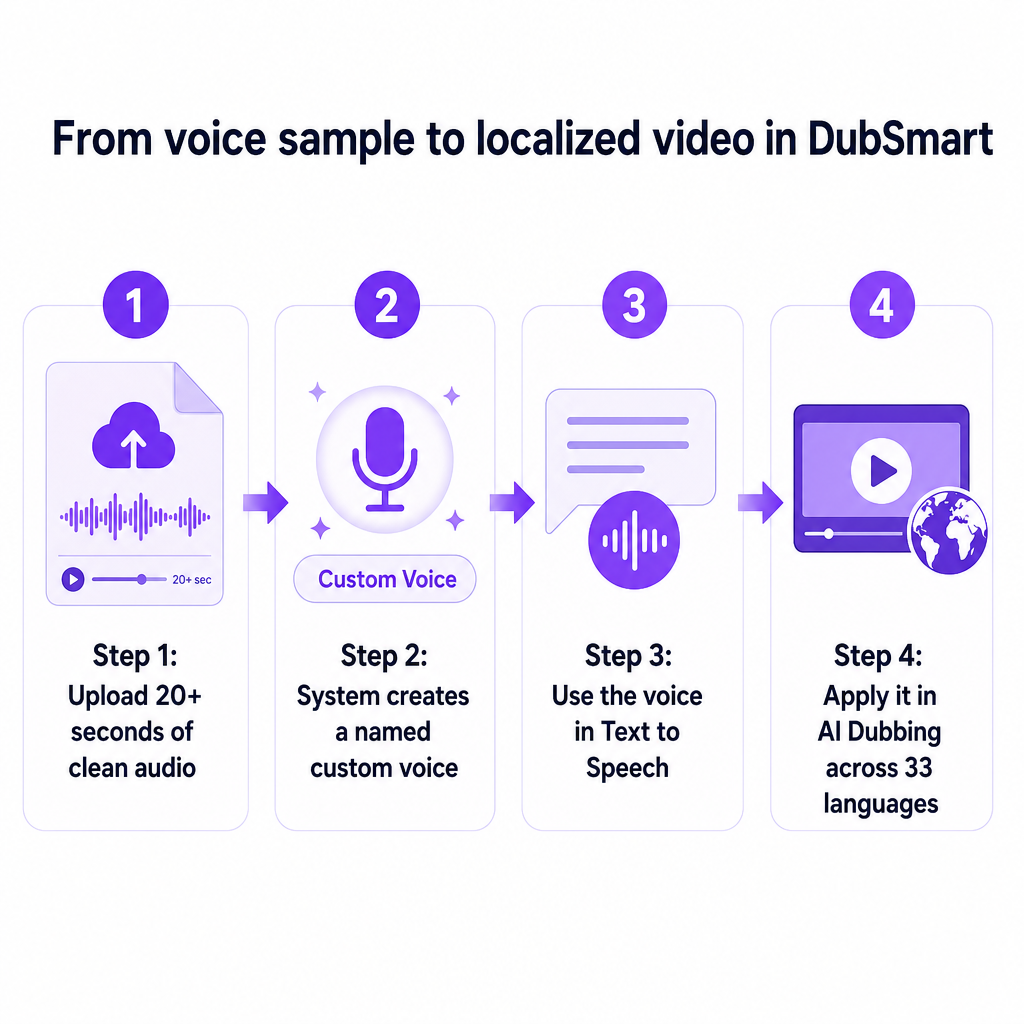
DubSmart's own workflow reflects these best practices. Its documentation asks for an audio file of at least twenty seconds, uploaded to the Voice Clone section, and stresses that the sample should be free of background noise for the best result. Twenty seconds sits comfortably within 2026 norms while erring toward stability and consistent prosody rather than chasing the shortest possible sample. The takeaway for you is simple: give the system a clean, representative twenty-plus-second sample and it has enough signal to reproduce your voice faithfully.
What you can create with a cloned voice
Once your voice exists as a model, the constraint stops being recording time and becomes imagination and script. You can generate effectively unlimited audio in that voice by typing text, which changes the economics of multilingual publishing. Here is where that pays off for the audiences DubSmart is built for.
YouTube and short-form video. Multilingual channels and faceless video formats both depend on narration you can produce on demand. A cloned voice lets a creator publish the same explainer or short in several languages while keeping a recognizable delivery, instead of re-recording each one manually or handing the channel to a different-sounding actor per market.
E-learning and corporate training. Course producers value consistency above almost everything. A single cloned narrator voice can carry across dozens of modules and, when combined with dubbing, across languages, so a learner in one region hears the same steady instructor as a learner in another. That standardization is hard to achieve with rotating human talent and reshoots.
Marketing and localized outreach. Teams use cloned voices for personalized outreach and localized explainer videos, spinning up campaign variants without booking studio time for every edit. When paired with DubSmart's AI image generator for thumbnails and slides, and its image-to-video tool for turning static visuals into motion, a small team can assemble a complete localized asset, visuals and voice, inside one platform.
Film and podcasts. Independent filmmakers and podcast creators use cloning plus dubbing to release across languages while preserving the feel of the original performance, rather than flattening a character or host into a generic read. The goal is not to replace the performer but to extend a single performance into markets that would otherwise never hear it.
Across all of these, the value comes from pairing the clone with the rest of the pipeline. A voice on its own is a component; a voice wired into text to speech, dubbing, and visuals is a production line.
Inside DubSmart: cloning, TTS, and dubbing in one flow
What separates a finished localization workflow from a pile of separate subscriptions is integration, and this is where DubSmart's design decisions matter most. The same cloned voice moves through creation, speech generation, and dubbing without you exporting files and hopping between vendors.
For non-technical creators, the web app path is short. Collect at least twenty seconds of clean speech, upload it in the Voice Clone section, and let the system process it. Once cloning finishes, the new voice appears as a selectable option inside both Text to Speech projects and AI Dubbing projects. From there you paste a script to generate narration, or you let DubSmart translate and dub existing video into other languages while carrying your cloned voice where you are permitted to use it. Because the platform draws on a library of 300-plus stock voices alongside unlimited custom clones, you can mix a personal voice with polished library voices in the same project.
For developers and agencies, the API path mirrors that flow programmatically. DubSmart's documentation describes a three-step cloning sequence: upload an audio file through the Voice Cloning API and receive a file key, submit a voice name plus that file key to create a named custom voice, then reference that voice inside text-to-speech project routes. In practice the Voice Cloning API is tightly coupled to DubSmart's TTS project endpoints rather than running as a standalone model server, and the same custom voices become available to AI Dubbing through internal service integration. That means a developer can register a voice once and consume it across speech generation and localization without managing any underlying machine-learning infrastructure.
The practical upshot is that voice cloning, text to speech, and AI dubbing are not three products you glue together; they are stages of one workflow that share the same custom voices, the same credit balance, and the same interface. DubSmart supports dubbing from 60-plus source languages into 33 target languages, so the cloned voice you register today is the same asset that can front a localized library tomorrow.
Pricing, plans, and who DubSmart fits
DubSmart uses a credit-based pricing model with rollover credits, a free tier for entry-level creators, and enterprise plans, plus dedicated APIs for teams building on top of the platform. Because the model is credit-based, spend tracks usage rather than a fixed per-seat fee, which suits the uneven, project-driven rhythm of content production.
To put that in context without overstating anything, industry pricing surveys for 2026 describe consumer voice tools often starting around eleven to twenty-two dollars a month for basic access, with professional plans that add higher quality, faster generation, and commercial licensing running roughly ninety-nine to three hundred thirty dollars a month. Those ranges are context only, not DubSmart's published prices; for exact credit counts, tier limits, and current numbers you should check DubSmart's live pricing page, since specific figures are not documented in this article.
The more useful question is fit. A solo YouTuber or podcaster testing multilingual reach can start on the free tier, clone one voice, and validate whether localized versions earn views before committing budget. A small marketing team benefits from consolidating separate text-to-speech, dubbing, and visual tools into a single credit pool, which simplifies both billing and handoffs. E-learning and training producers gain a consistent narrator across modules and languages. Developers and agencies use the Text to Speech API and AI Dubbing API to embed cloning and localization inside their own products or internal pipelines, scaling volume without standing up their own models. Trusted by over 500,000 users, the platform is tuned to these exact segments rather than to a single narrow use case.
Consent, rights, and responsible use
A cloned voice is a form of identity, and that carries real obligations. External guidance on voice cloning consistently stresses three things: get explicit consent from any person whose voice you clone, avoid using clones for impersonation, fraud, or deceptive content, and remember that the applicable laws vary by jurisdiction. Rules around right of publicity, biometric data, and deepfakes differ from one country or state to another, and none of the available sources sets out a single uniform global standard.
The practical rule for a business is to treat compliance as shared responsibility. Platform safeguards handle part of it; your behavior handles the rest. Clone your own voice freely, secure documented permission before cloning anyone else's, and be cautious about commercial deployment in unfamiliar markets. Before large-scale or cross-border use, review DubSmart's own Terms and Privacy Policy for how voice samples are handled, and consult legal counsel for anything involving public figures, customers' voices, or regulated content. This article does not claim that any tool is universally compliant, because compliance depends on how, where, and whose voice you use.
Frequently asked questions
How much audio do I need to clone my voice with DubSmart?
DubSmart's documented workflow asks for an audio file of at least twenty seconds, uploaded to the Voice Clone section. For the best result the sample should be clean, with minimal background noise. That twenty-second floor is deliberately conservative compared with tools that advertise a few seconds; a slightly longer, clean sample gives the model more stable prosody and a more consistent reproduction of your voice.
Can I use cloned voices commercially?
Commercial use depends on your rights to the voice and on local law. Industry guidance advises obtaining explicit consent from anyone whose voice you clone and avoiding impersonation or deceptive uses, and it notes that right-of-publicity and related rules vary by jurisdiction. Cloning your own voice for your own content is the simplest case; for others' voices or regulated markets, secure permission and review DubSmart's terms plus applicable regulations first.
How many voices can I clone on my account?
DubSmart positions voice cloning as unlimited custom cloning alongside a library of more than 300 stock voices, and its cloning product describes cloning any number of voices. Actual volume in practice is governed by your credit balance and plan, since the platform runs on a credit-based model, so check your current plan for how usage is metered.
What languages can DubSmart dub my videos into?
DubSmart supports dubbing from more than 60 source languages into 33 target languages. A cloned voice you register can be applied within AI Dubbing so that localized versions of your video retain your chosen voice identity where you are permitted to use it. Live product pages may show updated counts, so verify the current matrix if a specific language is essential to your project.
How does the voice cloning API differ from the web app?
The web app is a point-and-click flow: upload a sample, wait for processing, then pick the voice inside Text to Speech or AI Dubbing. The Voice Cloning API performs the same steps programmatically, uploading audio to receive a file key, creating a named custom voice from that key, and then referencing the voice inside TTS project routes. The API is designed for developers and agencies who want cloning inside their own products or pipelines rather than a manual interface.
How should I protect the voice data I upload?
Because the available materials do not document exact data-retention periods, deletion controls, or consent-verification mechanisms, treat this as something to confirm directly. Review DubSmart's Privacy Policy and Terms for how uploaded samples are stored and whether voices and raw audio can be deleted, and only upload voices you own or have documented permission to use.