Twenty seconds of clean audio is now enough to turn your own voice into a multilingual content engine. That is the promise creators keep testing in 2026, and it holds up: record a short, quiet clip, let the model learn your tone, and you can generate narration, ad reads, and dubbed videos in that voice without ever stepping back in front of a microphone. This is the practical reality of ai voice cloning today, and it is exactly the workflow DubSmart AI built its platform around.
Below, we explain what voice cloning actually is, how modern models produce a convincing replica, and how DubSmart's app and APIs move you from a single sample to finished multilingual content. The goal is not a lab tour of neural networks. It is a clear picture of the decisions a YouTuber, marketing team, or e-learning producer faces, and how DubSmart handles each one inside a single workflow.
Table of contents
- What AI voice cloning means in 2026
- How the technology works under the hood
- Inside DubSmart's voice cloning workflow
- Why creators keep reaching for cloned voices
- Use cases for YouTubers, businesses, and educators
- Getting started: plans, credits, and APIs
- Frequently asked questions
What AI voice cloning means in 2026
At its core, AI voice cloning is the process of creating a digital replica of a specific person's voice using deep learning, then generating brand-new speech that person never actually recorded. Independent explainers describe it consistently: the model studies recorded speech and learns the characteristics that make a voice recognizable, then reproduces them on demand.
Those characteristics go beyond a simple accent. Modern systems capture tone, pitch, accent, and speaking style, so the output sounds like you rather than a generic narrator wearing your name. That distinction matters for creators. A channel's identity often lives in its voice, and a clone that flattens your delivery into something neutral defeats the purpose.
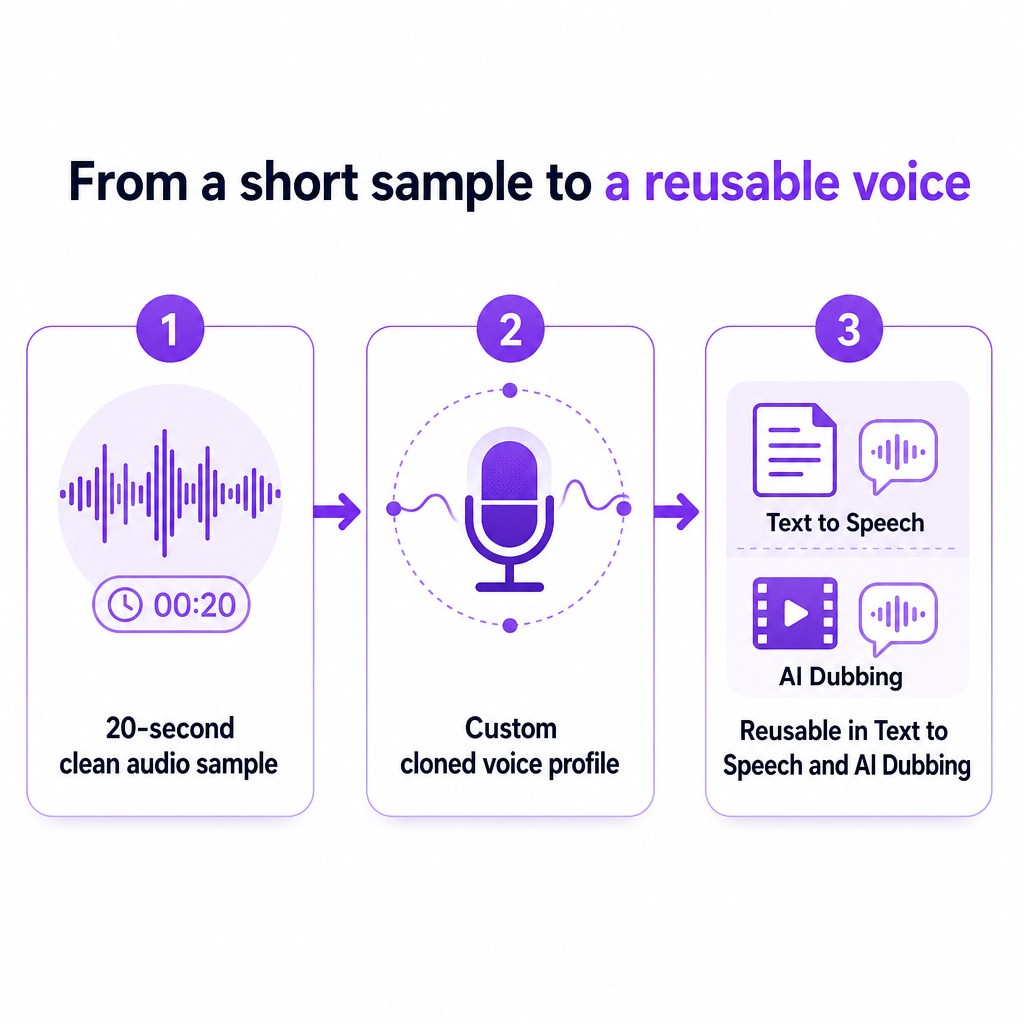
The 2026 version of this technology is notable for how little raw material it needs. General-purpose models are trained on enormous, diverse speech datasets before you ever arrive, so they already understand human speech in a broad sense. When you supply your own sample, the system is fine-tuning that general knowledge to a specific speaker rather than learning language from scratch. Some tools claim to build a usable clone from only a handful of seconds of audio. DubSmart asks for at least twenty seconds of clean speech, which sits comfortably in the range that produces a fast clone while still giving the model enough signal to stay faithful.
How the technology works under the hood
You do not need to build a model to use one well, but understanding the pipeline helps you judge quality and set expectations. Technical guides for 2026 describe a fairly consistent sequence behind the polished output.
It starts with data collection and cleaning. The sample you provide is prepared so the model hears your voice rather than the room around it. This is why noise-free audio matters so much: background hum, echo, and clipping all become noise the system may try to reproduce. Next comes acoustic model training, where the system fine-tunes on your specific speech, mapping the relationship between text and the sounds you would make saying it. A vocoder or synthesis model then converts those learned patterns into an actual waveform you can hear. Finally, post-processing steps such as equalization, compression, and artifact removal push the result toward broadcast-ready clarity.
The architectures doing this heavy lifting have improved sharply. Recent guides point to transformer and diffusion-based models as the reason today's clones carry emotional nuance instead of the flat, robotic cadence that defined earlier text-to-speech. That nuance is the difference between a voice that reads a script and a voice that performs one.
Two practical lessons fall out of this pipeline. First, garbage in still means garbage out: the single most controllable factor in your clone's quality is the cleanliness of your sample. Second, once the voice profile exists, generation is effectively decoupled from recording. You type text, and the model produces speech in that voice as many times as you need, which is where the creator payoff begins.
Inside DubSmart's voice cloning workflow
DubSmart AI is built as an all-in-one media creation and localization platform headquartered in Boca Raton, Florida, consolidating AI Dubbing, Voice Cloning, Text to Speech, Speech to Text, Speech Separator, Text to Image, and Image to Video into one place. Voice cloning is not a bolted-on extra here; it is the connective tissue between those tools.
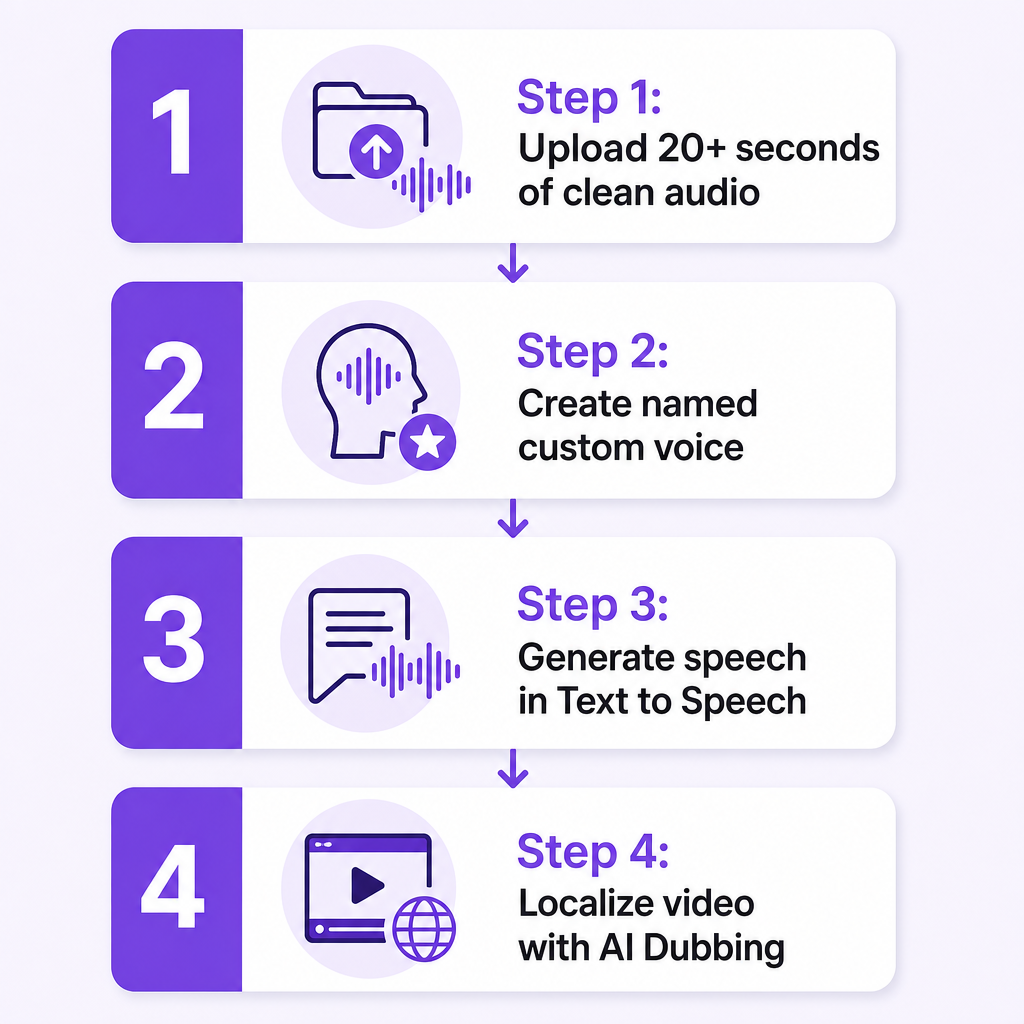
In the app, the flow is deliberately short. You open the Voice Clone section and upload an audio file of at least twenty seconds, ideally free of background noise, and the system processes it into a named custom voice profile. That is the whole gate between a raw recording and a voice you can reuse. DubSmart's own walkthrough of AI voice cloning in 2026 documents this twenty-second starting point directly.
Once the profile exists, it becomes usable across the platform. Inside DubSmart's Text to Speech, you can select your cloned voice, paste a script, and generate audio for intros, explainer segments, or ad reads, alongside a library of 300+ natural-sounding base voices if you want a different sound for a particular market. The same cloned voice carries into DubSmart's AI Dubbing workflow, where you import a video and localize it across the platform's 33 target languages, drawing from 60+ supported source languages.
For developers and agencies, the Voice Cloning API exposes the same capability as a compact three-step pattern. You upload an audio file and receive a file key, create a custom voice by supplying a name and that file key, and then use the resulting voice inside Text to Speech projects through the platform's project routes. That structure makes the clone a reusable asset you can call from your own applications, learning management systems, or localization pipelines rather than a one-off export.
The consolidation is the point. Many published pipelines chain a separate transcription service to a separate synthesis service to yet another dubbing tool, with files exported and re-uploaded at every hop. DubSmart keeps upload, transcription, cloning, dubbing, and export inside one workflow, which is where Speech to Text and the Speech Separator earn their place: cleaning and transcribing source audio before you clone or dub it.
Why creators keep reaching for cloned voices
The appeal is easy to state and harder to overstate: once your voice is cloned, you can generate unlimited audio content in that voice from text, without re-recording anything. That single shift changes how content gets produced.
Speed is the first thing creators feel. A script edit no longer means booking studio time or fighting to match your energy from a session three weeks ago. You retype the line and regenerate. Consistency follows closely. Your voice sounds the same across an intro recorded today and a correction added next month, which keeps a channel's identity stable even when production is spread over time.
Multilingual reach is where the technology stops being a convenience and starts being a growth lever. With DubSmart's dubbing spanning 60+ source languages into 33 targets, a creator can keep their own vocal identity while speaking to audiences in Spanish, Portuguese, Hindi, and beyond. Independent coverage of 2026 voice synthesis lists exactly these use cases, from localization and multilingual dubbing to e-learning voiceovers and podcast narration, as the mainstream applications creators now depend on.
A cloned voice turns one recording session into an unlimited, multilingual production line.
There is also a quieter monetization angle. More language versions mean more addressable audiences from the same underlying script and edit, which spreads production cost across a larger potential viewership. None of this requires you to become a voice actor in five languages; it requires one clean sample and a script.
Use cases for YouTubers, businesses, and educators
The abstract benefits sharpen when you attach them to a real job to be done. Consider how the same cloned-voice capability serves very different producers.
A YouTuber expanding into new markets can clone their signature voice once, then dub existing videos into additional languages while keeping the delivery that regular viewers recognize. Instead of a stranger narrating the localized version, the audience hears the creator, which protects the personal connection that built the channel in the first place. New language channels become a distribution decision rather than a re-recording marathon.
A small business or marketing team can produce localized ad variations at a pace that manual voiceover never allowed. One brand voice, several markets, many script variants tested quickly. Because DubSmart offers 300+ base voices alongside cloning, a team that lacks an in-house narrator can still standardize on a consistent brand voice across campaigns.
E-learning and corporate training producers face a different pressure: volume. Course libraries run to hundreds of modules, and content changes as policies and products do. A cloned narrator voice lets a training team update a single module without re-hiring talent or introducing an audible mismatch mid-course, then localize the same material for regional teams. This is where the API often matters most, because the voice can be wired directly into a learning platform rather than exported clip by clip.
Independent filmmakers and podcasters gain the ability to voice narration, pickups, and localized versions from text, which is valuable when a performer's schedule or budget cannot stretch to endless re-records. Across all of these, the through-line is the same: the recording effort is front-loaded into one sample, and everything after is text.
Getting started: plans, credits, and APIs
DubSmart uses a credit-based pricing model rather than a rigid per-minute subscription. It includes a free tier, rollover credits so unused balance is not lost at the end of a cycle, and enterprise plans for agencies and larger training teams. That structure lines up with how creator workloads actually behave, which is to say unevenly, with heavy production bursts around launches and quieter stretches in between.
For market context without naming competitors, published overviews of 2026 synthetic speech tools describe basic consumer access commonly landing around $11–22 per month, with professional plans offering higher quality and faster generation running roughly $99–330 per month. DubSmart's specific plan names, per-credit rates, and enterprise pricing are not published here, so treat those figures as the surrounding market rather than a DubSmart quote. The relevant takeaway is that a credit model with a free tier and rollover is a familiar, trialable way to start without committing to a fixed monthly ceiling before you know your volume.
A sensible path looks like this. Start on the free tier and test the default voices inside Text to Speech in your own language to gauge quality. Clone your signature voice from a clean twenty-second sample and confirm it sounds like you across a few scripts. Use that voice for real production in Text to Speech, then localize a single video with AI Dubbing to see the multilingual output before scaling. Developers and agencies can skip ahead to a proof of concept with the Text to Speech API, pairing it with the Voice Cloning API to embed cloned voices directly into their own products.
One responsible boundary belongs here. Clone only your own voice or voices you have explicit permission and rights to use. Voice cloning raises real questions around consent, the copyright of recorded performances, and impersonation risk, and those questions do not disappear because the tooling is easy. This article is not legal advice; for allowable-use specifics, rely on DubSmart's own terms and policies and, where a situation is genuinely uncertain, verify it for your jurisdiction and case.
Frequently asked questions
How much audio do I need to clone a voice on DubSmart?
DubSmart's app asks for an audio file of at least twenty seconds uploaded to the Voice Clone section, and the sample should be free of background noise for the best result. Because the underlying models are trained broadly before you arrive, that short, clean clip is enough to fine-tune a faithful custom voice rather than starting from nothing.
Can I use my cloned voice for other languages?
Yes. Once your voice profile exists, it can carry into AI Dubbing, which spans 60+ source languages and 33 target languages. That lets you keep your own vocal identity across localized videos, or switch to one of the 300+ base voices when a particular market calls for a different sound.
What is the difference between the app and the Voice Cloning API?
The app is a no-code experience: upload a sample, create a named voice, and use it inside Text to Speech and AI Dubbing. The AI Dubbing API and Voice Cloning API expose the same capability to developers through a compact pattern of uploading audio, receiving a file key, creating a named voice, and calling it from your own applications and endpoints.
Is voice cloning legal and safe to use?
The technology is legitimate, but responsible use means cloning only your own voice or voices you have clear permission to use. Consent, performance copyright, and impersonation are recognized concerns across the industry. Consult DubSmart's terms and policies for allowable use, and verify anything jurisdiction-specific for your own situation rather than relying on general guidance.
How do the credits and free tier work for cloning?
DubSmart uses a credit-based model with a free tier and rollover credits, so unused balance is not forfeited at the end of a cycle. You can test cloning and generation on the free tier, then scale credit usage as your multilingual output grows, with enterprise plans available for agencies and larger teams.
Can I clone more than one voice?
DubSmart's Text to Speech offering is positioned around unlimited voice cloning, so you are not limited to a single profile. That is useful when a channel features multiple hosts, a business maintains distinct brand voices, or an e-learning team needs different narrators for different course tracks.
When you are ready, the fastest way to judge the fit is to clone your own voice and run one short multilingual test. That single experiment tells you more about quality, consistency, and reach than any spec sheet, and it is exactly the workflow DubSmart is built to make quick.