
AI dubbing almost never charges a flat fee for each language. You pay for the amount of media processed, multiplied by how many target languages you want. So the real question behind how much does ai dubbing cost per language is not "what's the per-language sticker price?" It's "how many localized minutes does my project create, and what's my effective rate per minute?"
With DubSmart AI, AI Dubbing uses 1,000 credits per processed minute. A 10-minute video dubbed into three languages isn't a 10-minute job — it's 30 localized minutes, or about 30,000 credits. Based on our current listed plans, that lands at roughly $0.21–$0.33 per localized minute depending on your tier. Everything else in this guide explains how that number moves, how to estimate your own project, and where the hidden costs actually hide.
Table of contents
The cost-per-language formula that actually works
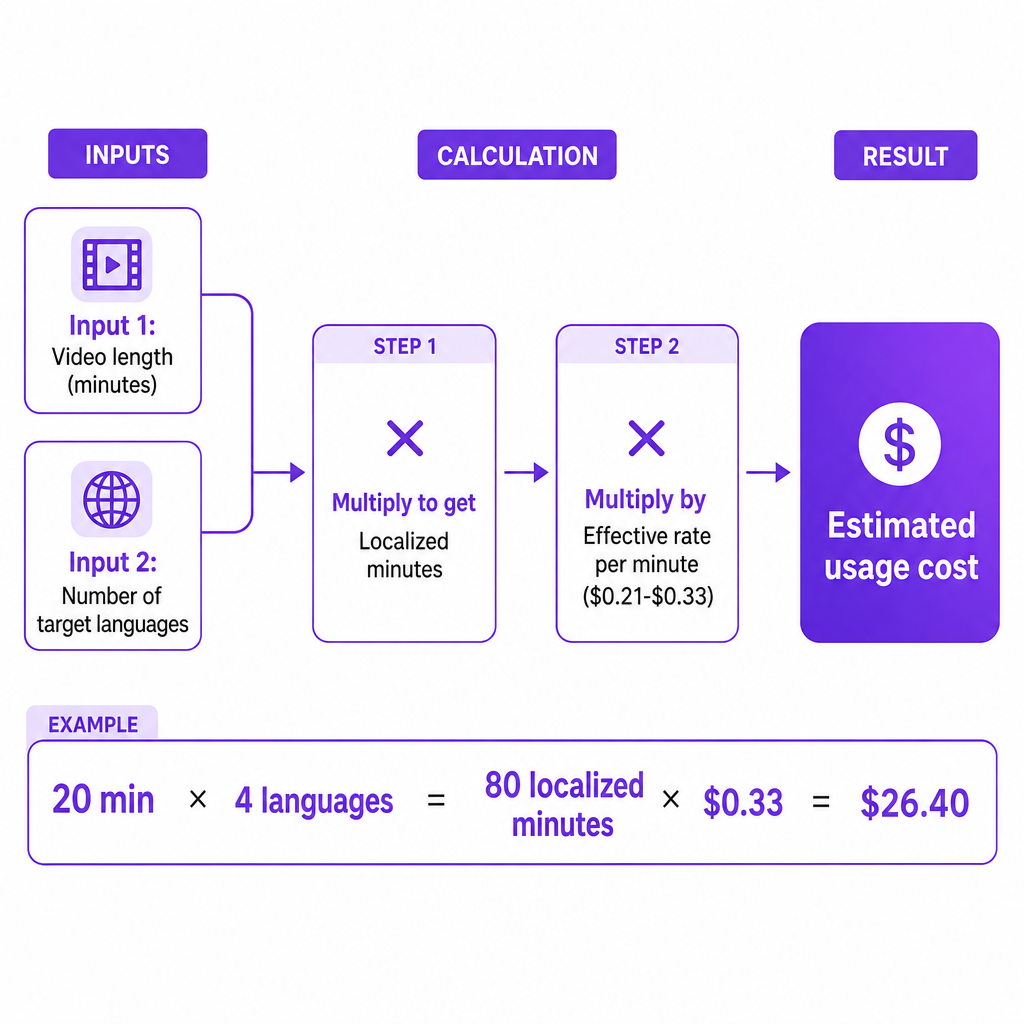
The budgeting unit most people miss is not the length of the original video. It's the total localized runtime. One formula covers every project:
Video length × number of target languages × effective cost per localized minute
Take a 20-minute training video that you want in English, Spanish, French, and German. That's four target versions, so 20 × 4 = 80 localized minutes. At an effective rate of about $0.33 per localized minute, the equivalent usage is roughly 80 × $0.33 = $26.40. This is an estimate built from each plan's price and included minutes, not a separate language charge.
The important nuance: your actual subscription cost depends on whether the project fits inside your monthly credit allowance. If you already hold enough rollover credits, that 80-minute job may not trigger any additional payment that month. The formula tells you how much capacity a project consumes; your plan decides whether you've already paid for it.
Our effective cost per localized minute by plan
AI Dubbing bills at 1,000 credits per processed minute. Each plan bundles a monthly credit allowance that can be spent across eligible tools, so the effective rate per dubbing minute falls as the plan grows. These are effective rates derived from each plan's monthly price divided by its included dubbing minutes — not per-language fees.
| Plan | Monthly price | Included credits | Approx. dubbing minutes | Effective rate/min | Extra credits |
|---|---|---|---|---|---|
| Free | $0 | 2,000 | 2 | $0.00 included | Not listed |
| Starter | $16.66 | 50,000 | 50 | $0.33 | $1.20 / 1,000 |
| Standard | $41.66 | 150,000 | 150 | $0.28 | $1.00 / 1,000 |
| Pro | $83.33 | 350,000 | 350 | $0.24 | $0.50 / 1,000 |
| Enterprise | $208.33 | 1,000,000 | 1,000 | $0.21 | $0.25 / 1,000 |
| Custom | Custom | From 2,500,000 | From 2,500 | By contract | Custom |
The math behind one row makes the pattern obvious. Starter gives 50,000 credits for $16.66. Dubbing burns 1,000 credits per minute, so that's about 50 localized minutes, and $16.66 ÷ 50 ≈ $0.33 per minute. Larger plans drop the effective rate because the price per 1,000 credits falls with volume — Enterprise lists extra credits at $0.25 per 1,000 against Starter's $1.20. Unused credits roll over on the paid plans, which matters if your production comes in bursts rather than a steady monthly stream.
Why more languages means more cost
Yes, dubbing into more languages costs more, because each target-language version consumes credits for the full duration of the media. A 12-minute video scales cleanly:
| Target languages | Calculation | Localized minutes | Credits |
|---|---|---|---|
| 1 | 12 × 1 | 12 | 12,000 |
| 2 | 12 × 2 | 24 | 24,000 |
| 3 | 12 × 3 | 36 | 36,000 |
| 5 | 12 × 5 | 60 | 60,000 |
| 10 | 12 × 10 | 120 | 120,000 |
Stretch that to a full course and the effect compounds. A 60-minute course dubbed into five languages is a 300-minute project for planning: 60 × 5 = 300 localized minutes. At our effective Pro rate of about $0.24 per localized minute, that's roughly $72 of equivalent plan usage, assuming it fits inside the allowance. The lesson is to plan around localized runtime, because that's the figure your credits actually track.
What "per language" actually includes
A single AI Dubbing pass does a lot before you ever touch an edit. Our workflow automates speech-to-text transcription, speaker recognition, timestamp detection, machine translation, speech generation, and subtitle generation in one pipeline. You can then edit text, speakers, timings, audio tracks, and speech rate before downloading — and paid plans list free regeneration of projects.
That said, "per language" is not a promise that every downstream production task is free or unlimited. A realistic budget still accounts for work the software doesn't do for you:
- Manual translation and terminology review
- Pronunciation corrections for brands and technical terms
- Timing and subtitle adjustments against on-screen action
- Regenerating sections that miss
- Human quality assurance before publishing
- Voice or music cleanup and final mastering
We don't publish a separate credit rate for each individual subtask such as translation review or speaker recognition — those are part of the dubbing pass. For a plain-language view of how transcription, translation, voicing, and sync fit together, see our explainer on how AI localization works.
Worked examples for real projects
One 8-minute YouTube video, Spanish and Portuguese. That's 8 × 2 = 16 localized minutes. Starter equivalent: 16 × $0.33 = $5.28. Standard: 16 × $0.28 = $4.48. Pro: 16 × $0.24 = $3.84. If you're already subscribed with credits in hand, it's simply covered by the monthly allowance.
A 30-minute e-learning lesson in English, Spanish, French, and German. That's 30 × 4 = 120 localized minutes, which fits inside the Standard plan's roughly 150-minute allowance if no other tools eat the shared balance. Equivalent usage: 120 × $0.28 = $33.60. Still reserve time for technical vocabulary and stakeholder sign-off.
A multilingual content library — 40 videos averaging 15 minutes, six languages. That's 40 × 15 × 6 = 3,600 localized minutes, well past the listed monthly plans. You'd plan across multiple billing cycles, buy additional credits, or move to a Custom arrangement that starts at 2,500,000 monthly credits with contract pricing. If your catalog looks like this, tell us your title count, average length, and target languages and we'll map it to the right capacity.
What moves your final cost per language
Video length. Longer source media burns more credits per language. A five-minute video across four languages is about 20 localized minutes; a 60-minute course across four is about 240.
Number of target languages. Each language is another full localized version. This is the single biggest reason a multilingual project can cost several times a single-language dub.
Monthly volume. Higher usage earns a lower effective rate because larger plans cut the cost per 1,000 credits. Rollover credits help smooth uneven schedules like quarterly training drops or seasonal campaigns.
Source-audio quality. Clean speech, low background noise, and distinct speakers reduce editing. Noisy, music-heavy, or overlapping dialogue may need cleanup first. For difficult recordings, running our Speech Separator before dubbing can isolate dialogue from music, though that operation consumes credits at its own feature rate.
Voice choice. A preset voice is fine for explainers, ads, and internal training. Voice cloning fits when a presenter's identity and continuity matter — but get permission before cloning a real person's voice and review the output carefully.
Human review. The lowest software-only estimate isn't always the lowest total cost. A poor translation, a mispronounced name, or an off cultural reference can force rework after publishing. For customer-facing campaigns, regulated material, and safety instructions, build review into the budget.
AI dubbing versus traditional studio cost
Traditional dubbing itemizes translation, voice talent, studio recording, direction, editing, mixing, and sync — and each of those can climb with every language and speaker. AI dubbing collapses most of that pipeline into one automated pass, which is why it suits YouTube creators testing international audiences, small businesses localizing product videos, e-learning teams shipping repeated course versions, podcasters entering new markets, agencies processing short-form at volume, and developers wiring dubbing into an app.
Studio dubbing still wins when a project needs celebrity talent, highly nuanced acting, legal precision, deep cultural adaptation, or broadcast-grade quality control. The practical move for most teams is to use AI for scale and reserve human review for the moments that carry brand, legal, or emotional weight.
Choosing a plan by total localized minutes
Pick your plan on total monthly localized minutes, not the original runtime alone. Free covers a short sample so you can evaluate the workflow. Starter suits occasional creators and small projects. Standard fits regular publishing or moderate course localization. Pro supports professional creators, multiple channels, and API-based workflows. Enterprise or Custom makes sense for large libraries, recurring localization, faster rendering, and account management.
Pro and Enterprise tiers list AI Dubbing API access, faster rendering, and account management. If you're deciding between a dashboard and a programmatic workflow, review our AI Dubbing API and Text to Speech API first — repeatable, system-level localization is where the API route pays off over manual exports.
Before you publish any dubbed version, check each language for names, numbers, dates, and product terms; regional expressions and formality; brand and technical pronunciation; speaker continuity; timing against on-screen action; and consent and rights for any cloned voice. Projects can be edited and regenerated inside the workspace, but editorial responsibility stays with you. If your content is sensitive or regulated, confirm your legal, privacy, and voice-usage requirements before uploading recordings or deploying cloned voices at scale.
The cleanest answer to the cost question is a single line: original video minutes × target-language count × your plan's effective rate. Budget about 1,000 credits for every minute in every language, land somewhere between $0.21 and $0.33 per localized minute on current plans, and let rollover credits absorb the uneven months.
Frequently asked questions
Is AI dubbing charged separately for each language?
Not as a flat per-language fee. Cost rises with each language because every target version consumes processing minutes. We measure AI Dubbing at 1,000 credits per processed minute rather than publishing a separate price per language.
How much does it cost to dub a 10-minute video into one language?
Ten localized minutes represent roughly $2.10–$3.30 of included-plan usage depending on your tier, using the effective rates above. The free tier covers about two minutes for testing.
How much does it cost to dub a 10-minute video into three languages?
That's about 30 localized minutes, or roughly $6.30–$9.90 in plan usage depending on the tier you're on.
Do unused dubbing credits expire?
Paid plans list rollover for unused credits, which helps with irregular production schedules. Check the current plan terms before purchase so you know the rollover window.
Is voice cloning included in the dubbing cost?
Paid plans list unlimited voice cloning, but cloning and dubbing draw on the shared credit system depending on the operation. Confirm the current usage rules in your account before processing a large batch.
Is AI dubbing cheaper than hiring voice actors?
For high-volume multilingual content, AI dubbing is generally cheaper and faster than commissioning separate recordings. Human voice talent can still be the better call for premium, highly emotional, legally sensitive, or culturally complex work.