A wiseguy text to speech voice is AI-generated speech built to sound like a witty, confident, slightly wisecracking narrator you can reuse across videos, ads, and training content. It isn't a separate technology. It's a style of voiceover you build on top of ordinary text-to-speech (TTS) and voice cloning: you write a script, pick or create a voice with that street-smart attitude, and generate audio that keeps the same personality from one piece of content to the next. With DubSmart AI, that wiseguy persona can come from a prebuilt voice in our library or from a custom voice you clone from your own recordings.
That distinction matters more than the label. The word "wiseguy" describes a tone, not a button. Everything that makes the voice recognizable comes from three levers you control: the voice you choose, how you write the script, and how you tune delivery. This guide explains what the style really is, how our text to speech produces it, the three practical ways to run it, and when a playful narrator helps versus when it quietly costs you trust.
Table of contents
Is a wiseguy voice right for your project?
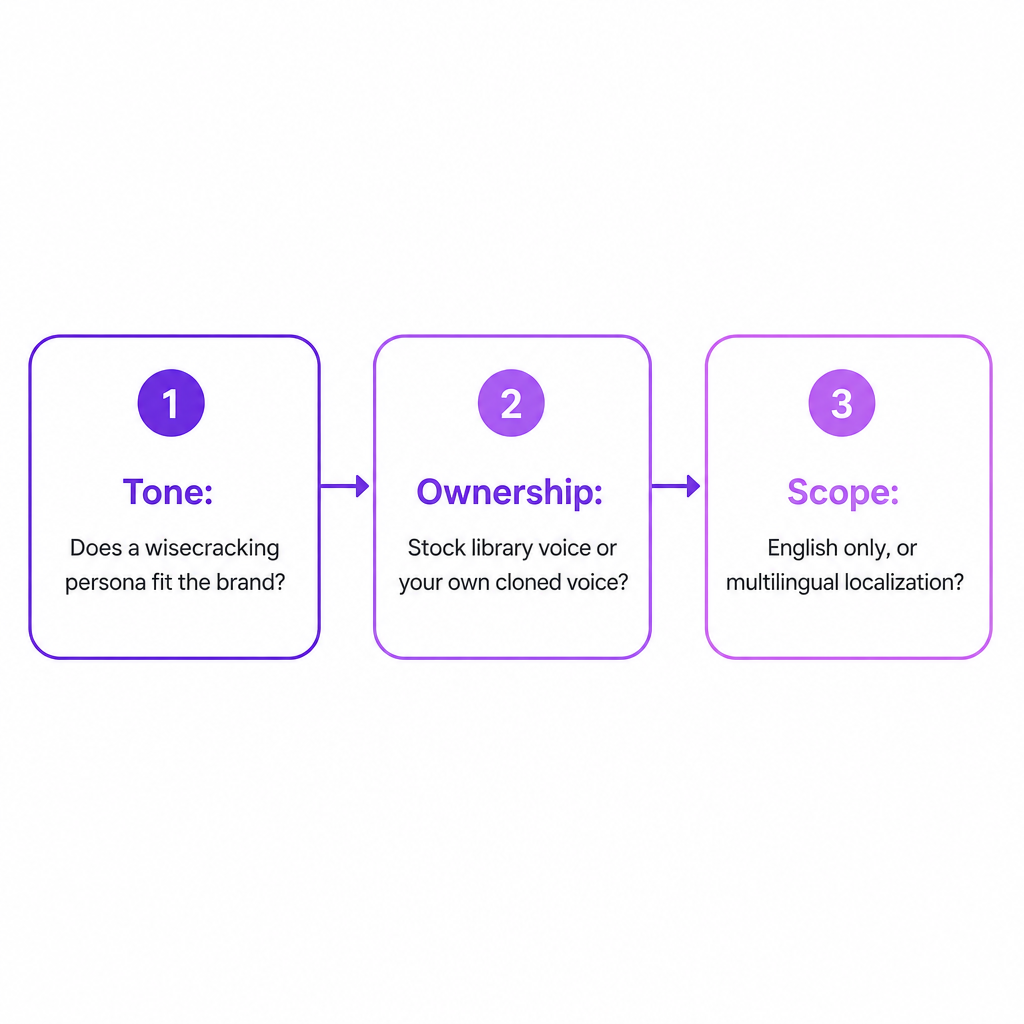
Before you shop for a voice, settle three questions, because they decide everything downstream.
The first is tone. A witty, wisecracking persona can make entertainment, creator content, and informal explainers more engaging. It can also undermine credibility on serious material. If your content lives in health, finance, HR, legal, or compliance, a smart-aleck narrator works against you.
The second is ownership. Do you want a generic AI character that anyone else could also select, or a voice that is unmistakably yours? A stock voice is faster to deploy; a cloned voice gives you a vocal identity no competitor can pull from the same shelf.
The third is scope. If you only need English voiceover today, a single voice choice covers you. If you plan to expand into other languages, you want a persona that can travel, which pushes you toward a platform that handles multilingual output without forcing a tool switch.
When the honest answers are "our brand is playful," "we want a distinctive sound," and "we'll scale into multiple languages," a wiseguy text to speech strategy is a reasonable long-term bet. If any of those answers flips, narrow the plan before you invest in a voice.
How our text to speech creates a wiseguy-style voice
At the core of our text to speech tool, you convert written text into natural, human-like speech and choose from a library of more than 300 voices spanning over 33 languages. That catalog covers a wide range of accents, genders, and tones, which is exactly why a "wiseguy" result is possible without any special mode: you're just selecting a voice that already carries the relaxed, confident feel you associate with that kind of narrator.
The practical flow is short. You pick a voice with the right attitude, feed in your text in the language you need, and generate the audio. From there you can adjust speed, pauses, and sometimes pitch so the delivery reads as informal and conversational rather than flat. The output is an audio file you drop straight into your edit, whether that's a YouTube upload, an e-learning module, or a marketing spot.
What makes this more than a one-off trick is that DubSmart is built as an all-in-one platform. Text to Speech, Voice Cloning, AI Dubbing, Speech to Text, Speech Separator, Text to Image, and Image to Video all sit in one workflow. So the same wiseguy voice can move from narration into a dubbed version of the same video without leaving the tool or rebuilding the persona somewhere else.
Three ways to run wiseguy text to speech
There are three routes to the same style, and they differ mainly in speed, ownership, and automation.
Option 1: A stock voice from the library. The fastest path is choosing an existing voice from our 300+ catalog. For a wiseguy persona, look for a slightly casual or urban accent, a mid-range pitch that reads as confident, and pacing that leans conversational. Because the tool supports content across 33+ languages, you can run that voice in English now and roll out other languages as your channel grows. This route fits you when you need something immediately, you don't mind that other users could pick the same voice, and you care more about tone and language coverage than a unique vocal identity.
Option 2: Clone your own persona. If you want the voice to be truly yours, our voice cloning builds a synthetic model of a specific speaker so new speech can be generated from text in that voice. You record around 20 seconds of clean speech, ideally free of background noise, and upload it into the Voice Cloning tool, which processes it into a named custom voice profile. Once cloning finishes, that voice appears alongside the base library inside both Text to Speech and AI Dubbing, ready for future projects. That means one persona can carry your English commentary, its dubbed versions, and character narration inside training modules. Choose this when your brand centers on a recognizable host, you want a voice no one else can access, and you can record source audio and manage permission for the speaker.
Option 3: Automate through the API. Developers and agencies can wire the style into apps and pipelines with our Text to Speech API, a RESTful service where you send a POST request containing your text and voice preferences and receive natural-sounding speech as an audio file. Those preferences can reference a specific library voice ID or a cloned voice profile you created earlier. That lets a signature narrator power automated video summaries, in-app tutorial voiceovers, or dynamic marketing copy pulled from your CMS. Your back end simply passes text and the voice identifier to the endpoint, and the response is streamed or stored wherever your product needs it. If you also localize at scale, the AI Dubbing API and Voice Cloning API extend the same identity into dubbed video and custom voice creation programmatically.
What happens under the hood
Whether you use a stock or cloned voice, the pipeline follows the same basic AI pattern, and knowing it helps you get better results.
First comes text analysis. The system ingests your script, normalizes numbers and abbreviations, and predicts where emphasis and pauses should fall. This is why punctuation and sentence length shape delivery so much: short, punchy lines naturally produce the clipped, confident rhythm a wiseguy voice depends on.
Next is acoustic modeling. A neural network uses your chosen voice profile to predict what the audio should sound like moment to moment, including pitch, loudness, and timing. With a cloned voice, that model has been fine-tuned to reproduce a specific speaker's characteristics; with a stock voice, you're drawing on a pre-trained profile that already suits a particular style.
Finally, waveform generation. A vocoder model converts those predictions into a high-quality waveform that sounds like natural human speech.
The "wiseguy" quality is not hidden inside that machinery. You steer it through three visible levers: voice choice (library versus clone), scriptwriting (colloquial language and tight sentences), and delivery settings (speed, pauses, and sometimes pitch). Change those, and you change the character.
Decision criteria: when to lean in, when to hold back
Use these tests to decide how far to push the persona.
| Factor | Lean into a wiseguy voice | Choose a neutral voice |
|---|---|---|
| Brand fit | Entertainment, creator, informal explainers | Compliance, medical, legal, HR |
| Audience | Younger, social-native viewers | Enterprise buyers, formal training |
| Language plan | Persona localized carefully per market | Slang that won't translate cleanly |
| Workflow | One platform maintains the voice across assets | Multiple disconnected tools |
| Budget stage | Small experiments before scaling | High-stakes content with no room to test |
A sensible sequence is to test a stock wiseguy-style voice on a small segment of your audience first. If engagement improves and the tone matches your brand, consider cloning your own persona for long-term differentiation. Then use multilingual TTS and AI Dubbing to replicate that persona across localized channels, keeping every script culturally tuned rather than translated word for word. Because DubSmart consolidates these tools in one place, maintaining a consistent character voice across narration and dubbing doesn't force you to juggle separate apps. A credit-based model with a free tier also gives you room to experiment at small scale before you ramp up usage.
Risks and safeguards worth building in
An expressive voice style carries real downside if you deploy it carelessly.
Brand misalignment is the most common failure: overly sarcastic delivery erodes trust in sensitive topics. Cultural missteps are the next, because humor and "wiseguy" attitude rarely translate literally; what reads as playful in one market can sound rude in another. Voice rights matter most of all with cloning. Model a real person's voice only with clear, documented permission, which is critical for commercial projects. And synthetic voices can be misused for impersonation or misleading content when no internal policy governs them.
The safeguards are straightforward. Write brand tone guidelines so the persona has boundaries. Use cloned voices only under explicit agreements with the speaker. Review scripts for cultural sensitivity before any multilingual rollout. And keep wiseguy voices out of content where neutrality and authority are the whole point.
How different creators put it to work
For YouTube creators, a wiseguy voice works well as a recurring channel narrator for intros, commentary, and sponsor reads, while your on-camera presence stays reserved for key segments. That same voice can then be dubbed into other languages using the integrated tools. If you're planning that expansion, our explainer on building a multilingual YouTube channel walks through the wider workflow.
For small businesses and marketing teams, the persona gives product explainers and social ads a memorable twist. Generate English voiceovers via TTS, then localize campaigns by reusing the same voice or a culturally tuned equivalent in other languages.
For e-learning and corporate training producers, reserve the style for informal modules, quick tips, and engagement boosters, and keep neutral voices for compliance and policy content. That split holds attention without compromising seriousness where it counts. Our overview of what media localization involves is a useful primer if you're standing up a multilingual training library.
For filmmakers and podcast creators, cloning a specific character's voice lets it become a signature presence across trailers, teasers, and behind-the-scenes clips. For developers and agencies, wiring the TTS API into your pipeline lets a single narrator read dynamic copy pulled from databases or user-generated content with a consistent identity every time.
Frequently asked questions
What is wiseguy text to speech in DubSmart?
It's AI-generated speech where you choose or clone a voice that sounds like a witty, confident narrator, then use our text to speech to turn scripts into audio in that persona. It relies on standard TTS and voice cloning rather than any separate technology.
Can DubSmart handle wiseguy voices in multiple languages?
Yes. Our text to speech and related tools support content in more than 33 languages, so a wiseguy-style voice can run across international channels. Localize slang and humor per market rather than translating them literally.
Do I need a lot of audio to clone a wiseguy voice?
No. Voice cloning is designed to work from short recordings. Around 20 seconds of clean speech is enough to create a custom voice profile you can reuse in both text to speech and AI Dubbing.
Can developers trigger wiseguy narration programmatically?
Yes. Our Text to Speech API accepts POST requests with text and voice preferences and returns natural-sounding speech. You can reference either a stock voice or a cloned persona by its ID.
Is there a low-risk way to try this first?
A credit-based model with a free tier lets you test the style on sample videos or campaigns before committing larger budgets, which suits creators, small businesses, and agencies experimenting with voice personas.