
If you are searching for daniel uk text to speech, you are almost certainly after the familiar British male computer voice associated with Apple devices: a clear, composed en-GB reader that handles accessibility, narration, and explainers without drawing attention to itself. The short answer is that Daniel is a male British English synthetic voice tied to Apple's speech and accessibility systems, often identified as en-GB.Daniel. The longer, more useful answer is that "Daniel" is not one universal voice you can pull from every text-to-speech platform. The name can point at a specific system voice, a provider's catalogue entry, or a British male voice that merely sounds similar. That distinction decides whether you need the exact original sound or simply a comparable British narrator you can actually license and ship.
Table of contents
What the Daniel UK voice actually is
Daniel is a male British English synthetic voice traditionally supplied through Apple's speech and accessibility stack. On Apple platforms it can appear with identifiers such as en-GB.Daniel, and Apple developer discussions show Daniel used as an en-GB voice inside speech-synthesis applications.
The en-GB tag means English, United Kingdom. It describes the voice's language and regional pronunciation, not the speaker's exact accent, age, personality, or emotional style. That is an important limit: the locale tells you the voice reads in British English, but it does not promise a specific regional accent or a particular warmth.
In practical listening terms, Daniel reads as male, British, clear, and composed. The delivery is neutral to moderately formal, measured rather than theatrical, and built for factual reading and accessibility rather than performance. These are observations about how the voice is perceived, not official acoustic specifications, and the exact sound can shift with the operating system, voice version, and synthesis engine behind it.
Why one voice name produces different results
The single biggest source of confusion is that a search for "Daniel UK text to speech" can land on several genuinely different things. Treating the name as a universal identifier is where most production mistakes start.
| Voice type | What it actually means |
|---|---|
| Apple Daniel | A system voice tied to Apple speech and accessibility features |
| Legacy or desktop Daniel | A version from earlier speech technologies or third-party software |
| Provider-specific Daniel | A commercial TTS service using Daniel as a catalogue name |
| Daniel-style British voice | A different synthetic or cloned voice built to sound clear and British |
| Custom voice clone | An authorised replica of a real speaker, which is not the original Daniel |
Because voice names are provider-specific, two platforms can both list a "Daniel" and still produce noticeably different pronunciation, rhythm, warmth, and emphasis. Microsoft's current Azure catalogue makes the same point from another angle: its UK voices carry provider-specific names such as en-GB-RyanNeural and en-GB-SoniaNeural rather than treating "Daniel" as an industry-wide label. The takeaway for buyers is simple and freeing: a voice preview is more reliable than a name, so judge by ear, not by the word on the dropdown.
What Daniel sounds like and where it fits
Daniel is usually chosen for a controlled, intelligible British delivery, not an expressive one. It works best when the listener needs to absorb information quickly and the voice should stay out of the content's way. Expect pronunciation that clearly signals British English, moderate vocal authority, low-to-moderate emotional intensity, consistent pacing, and crisp consonants that create a professional, instructional impression.
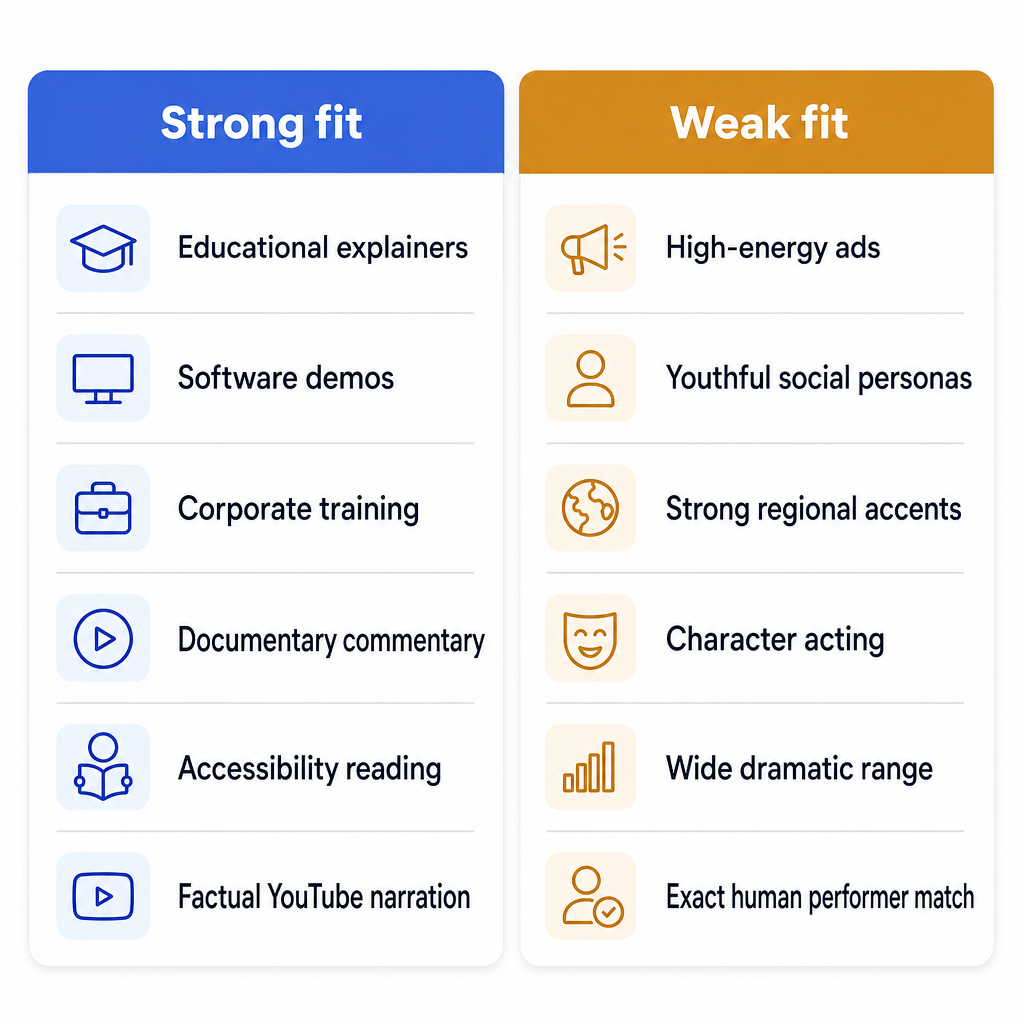
That profile suits educational explainers, software demonstrations, corporate training, documentary-style commentary, accessibility reading, podcast segments, product walkthroughs, and factual YouTube narration. It is a reliable default for British-English localisation where credibility matters more than energy.
The same restraint becomes a limitation elsewhere. Daniel-style voices tend to underperform when you need a high-energy advertisement, a youthful social-media personality, a strongly regional UK accent, layered character acting, wide dramatic range, or a close match to a specific human performer. The decision should follow your content's emotional requirements and audience, not the fact that the voice happens to be British.
Daniel versus a general British English voice
"British English" is a wide umbrella. It covers neutral or standard southern British, London and southeast English, northern English, Scottish, and Welsh accents, while Irish English is usually treated as its own locale. Daniel is normally sought because of a particular familiar voice identity, not simply because it speaks English with UK pronunciation.
If the exact Daniel recording is not available to you, the practical move is to choose a replacement by ear against your real script. Listen for whether the accent sounds recognisably British without turning strongly regional, and whether the register matches the formal, conversational, warm, or authoritative tone you want. Check the age impression against your audience, confirm the pacing can carry your sentences comfortably, and test how the voice handles names, abbreviations, numbers, and technical vocabulary. Then judge its emotional range and, crucially, its consistency across long scripts and multiple videos.
A similar-sounding voice is often the better production choice than a near-identical one when it offers cleaner pronunciation controls, workable commercial terms, API access, or multilingual support. Matching the name is rarely worth losing the controls that let you ship.
Finding a Daniel-style voice in DubSmart AI
Our Text to Speech tool converts written text into generated speech and presents a library of more than 300 AI voices alongside voice cloning. On the Text to Speech page you can enter text, select a speaker, generate speech, edit the project, and download the result in a chosen format.
We want to be precise about one thing: our public Text to Speech page does not list a Daniel voice by name, and we do not claim to reproduce Apple's exact Daniel voice. So rather than assuming any British male voice is "Daniel," use the platform to find the closest option you can actually ship. Choose English (United Kingdom) where available, preview several male British voices, and compare short samples using the same script so differences in rhythm and emphasis become obvious. Run your proper nouns, numbers, abbreviations, and technical terms through each candidate, adjust the speech rate if the read feels too slow or fast, and export a short test before committing to a full video or course.
This gives a creator who does not need the original Daniel identity a practical British-English stand-in while keeping script narration and the rest of production in one workflow. If you are weighing a catalogue voice against recreating a specific speaker, our explainer on voice cloning versus text to speech breaks down when each approach earns its place.
Daniel, catalogue voices, and voice cloning
Catalogue text-to-speech and voice cloning solve different problems, and conflating them is a common reason people chase "Daniel" when they do not actually need it.
Reach for a catalogue voice when you need fast narration, a consistent narrator without recording sessions, a suitable British male style, frequent script updates, or audio for demonstrations and training. Reach for voice cloning when identity is the point: continuity with an existing channel, a recognisable brand narrator, new lines in a previously established voice, or multilingual versions that preserve an approved voice identity.
A voice clone is never automatically Daniel, even when it sounds unmistakably British. It reproduces one specific recorded speaker, and its quality depends on the sample, the underlying technology, and the permissions attached to that voice. For teams building this into an app or pipeline, our Voice Cloning API creates custom AI voices from audio samples and makes them usable in Text to Speech or AI Dubbing. Clone only when you hold the speaker's permission and the rights for your intended use.
Fixing common Daniel UK TTS problems
Most complaints about a British TTS read trace back to the script or the settings, not the voice itself, and each has a direct fix.
When the voice sounds too robotic, shorten sentences, tighten punctuation, and set a moderate speech rate; long clauses and stacked parentheticals make even a good voice sound mechanical. When the accent is British but clearly not Daniel, you have selected a similar en-GB voice rather than the specific system voice, so compare previews and confirm the underlying provider.
Pronunciation issues have their own remedies. If a name is read incorrectly, write a phonetic spelling, add punctuation, or spell it out, and generate a few versions to pick the most natural. If numbers and abbreviations sound awkward, write them in words where appropriate and test dates, percentages, currencies, version numbers, and technical abbreviations in isolation first. Writing for speech matters more than copying article text: a line like "The platform launched its A-P-I in the third quarter" narrates far better than "The platform's API, which was launched in Q3."
Two problems are less about sound and more about judgement. If the voice feels too formal for social media, switch to a more conversational British voice or rewrite with shorter sentences and contractions. And if the result may be unsuitable for commercial use, do not assume a voice available on a device can go into a monetised video, advertisement, audiobook, or client project; confirm the applicable licence before you publish.
Frequently asked questions
What is Daniel UK text to speech?
It generally refers to a British English male synthetic voice associated with Apple speech systems and similar catalogues, usually identified with the en-GB locale and a clear, measured delivery.
Is Daniel a British accent?
Yes. Daniel is presented as an English (United Kingdom) voice. The exact accent, pronunciation, and sound can still vary by provider and voice version.
Is Daniel available in DubSmart AI?
Our public Text to Speech page does not list Daniel by name. It does offer more than 300 AI voices and lets you select a speaker, so check the current in-app catalogue directly and preview the UK English options.
Can I use a Daniel-style voice on YouTube?
You can if the relevant provider's terms permit your intended use. Confirm commercial, monetisation, redistribution, and attribution requirements before publishing.
Is Daniel the same as an AI voice clone?
No. Daniel is a named synthetic voice tied to particular speech systems. A voice clone is generated from an authorised speaker's recordings and represents that speaker's identity.