AI voice cloning is the use of machine learning to build a digital replica of a specific person's voice, one that can read any text you give it on demand. In 2026, that replica often comes from just seconds of clean audio. At DubSmart AI, we turn a short sample into a reusable, multilingual voice you can plug straight into dubbing, narration, and API-driven audio.
That single idea has changed how creators and teams produce spoken content. Instead of re-recording a script for every language, correction, or update, you keep one voice identity and generate fresh audio whenever you need it. Below, we explain what voice cloning actually is, how the underlying pipeline works, the variants worth knowing, and the judgment calls that matter before you clone your own voice.
Table of contents
- What AI voice cloning is and how it works
- Types of voice cloning and where we fit
- What AI voice cloning can do for creators and businesses in 2026
- What to consider before cloning your voice
- Where to go from here
- Frequently asked questions
What AI voice cloning is and how it works
At its core, AI voice cloning creates a synthetic version of a real speaker's voice by training a model on recordings of that person, then using it to generate new speech the person never actually recorded. The clone doesn't just copy words; it captures tone, pitch, accent, and speaking style so the output feels like the same voice reading something new. By 2026, this is best understood as a specialized form of neural text-to-speech, where the goal is transferring one speaker's vocal identity into generated audio.
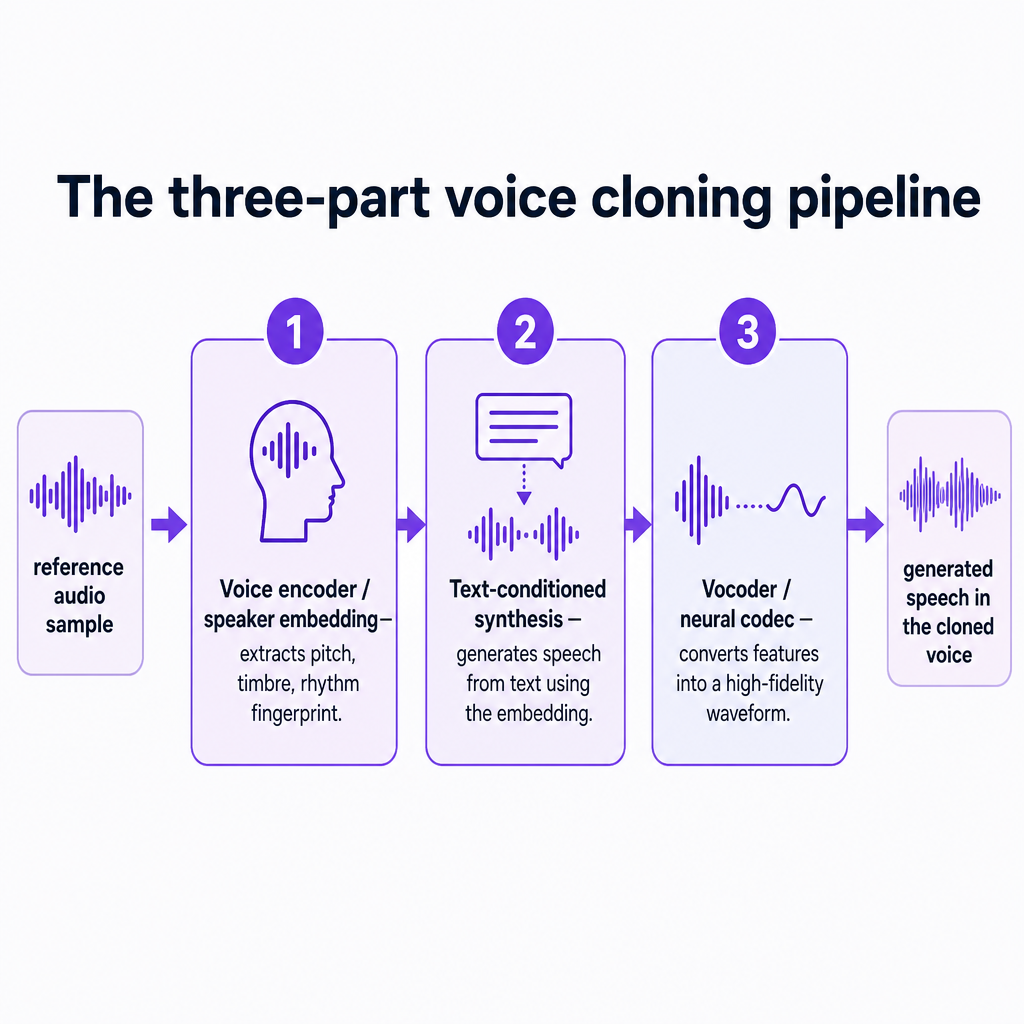
Modern systems, including ours, follow a broadly similar architecture with three functional parts. First, a voice encoder analyzes your reference audio and extracts a speaker embedding: a numerical fingerprint that captures pitch range, timbre, rhythm, and articulation habits. Think of it as a compact mathematical description of what makes your voice yours, rather than a stored copy of the recording itself.
Second, a text-conditioned synthesis model generates speech from written input while being conditioned on that speaker embedding. This is the stage that decides how each sentence should sound in your voice. In 2026, these models are typically transformer-based or diffusion-based, which is a large part of why the prosody and pacing feel human rather than flat.
Third, a vocoder or neural codec converts the intermediate acoustic features into an actual audio waveform, and reconstructs high-fidelity sound efficiently. This final stage is where breathing, inflection, and natural texture come through.
Our own workflow maps cleanly onto this pipeline. It starts with capture and preprocessing: you supply speech samples, and we clean and normalize the audio before any modeling happens, because noisy input degrades everything downstream. From there we encode your voice characteristics, synthesize new speech from your scripts, and apply post-processing to remove artifacts. The result is a reusable voice asset rather than a one-off recording, and it aligns with how independent sources describe the mechanism of a digital voice replica.
Types of voice cloning and where we fit
Not all voice cloning works the same way, and the differences matter when you decide what to expect from a clone. The main distinctions come down to how much data the model needs and what kind of input it accepts.
Zero-shot cloning imitates a voice from a single short sample without any dedicated fine-tuning, often working from only a few seconds of audio. It is fast and convenient, which makes it ideal for getting a usable voice quickly. Fine-tuned or custom-trained voices go further, adapting a model more extensively on one speaker to squeeze out higher fidelity and finer expressive control. The trade-off is straightforward: zero-shot favors speed, fine-tuning favors nuance. Neither is universally better; the right choice depends on whether you value a fast turnaround or the finest possible match to a distinctive delivery.
There is also a distinction in what the model listens to. Text-to-speech cloning takes written text as input and produces audio in the cloned voice, which is the workhorse mode for narration, dubbing, and scripted content. Speech-to-speech voice conversion instead transforms recorded or live speech from one voice into another, sometimes in near real time. Both start from the same underlying vocal fingerprint but serve different production needs: text-to-speech suits scripted, editable work, while speech-to-speech suits performances you want to preserve while swapping the voice identity.
Our platform focuses primarily on text-to-speech cloning integrated directly with dubbing and narration. That focus is deliberate: for the creators and teams we serve, the most valuable outcome is being able to type or import a script and generate polished audio in a consistent voice, then localize it across languages inside the same workflow. Because voice cloning lives alongside our AI Dubbing, Text to Speech, Speech to Text, and other tools, you are not stitching together separate products to move from raw script to finished multilingual audio.
What AI voice cloning can do for creators and businesses in 2026
The practical payoff of cloning is that one voice becomes infinitely reusable across formats and languages. Independent coverage points to the same set of applications year after year: video dubbing and localization, audiobooks, podcasts, virtual assistants, training content, and accessibility uses such as synthetic voices for people who have lost their own speech. That breadth is what makes voice cloning a foundational capability rather than a single-purpose gadget.
For a YouTube creator, that means expanding a channel into new audiences while keeping a recognizable voice across every localized upload. We support dubbing from 60+ source languages into 33 target languages, so a single English video can become a Spanish, Japanese, or Portuguese version that still sounds like you rather than a stranger. The decision criterion here is continuity: audiences follow voices, so keeping one identity across markets protects the relationship you already built.
For small businesses and marketing teams, cloning turns localization from a re-shoot into a re-render. A product explainer, a campaign voiceover, or a social clip can be refreshed and translated without booking studio time for every variation. Because generation is near-instant once a voice exists, updates that used to take days can be produced in seconds or minutes, which matters most when a message changes late and the calendar does not move.
E-learning and corporate training producers gain the most from scale. Large course catalogs, compliance modules, and onboarding content can share one consistent narrator across hundreds of lessons, and stay current when policies or product details change. Instead of rebooking a voice actor for a single edited paragraph, you regenerate only the affected line and keep the rest untouched. Independent filmmakers and podcast creators use the same capability to dub dialogue, patch pickups, or release multilingual editions without reassembling a cast.
Developers and agencies work at a different layer entirely. We expose Text to Speech, Voice Cloning, and AI Dubbing APIs, which wrap the encoder-synthesizer-vocoder chain behind a simple interface. That lets teams submit text and a voice identity and receive audio back, so voice cloning can power in-app narration, automate audio for a learning management system, or feed a marketing automation pipeline directly. Alongside a library of 300+ natural-sounding voices, custom clones give every one of these audiences the same starting point: a durable voice asset that travels across projects.
What to consider before cloning your voice
Before you commit to a cloned voice, a handful of judgment criteria will shape the quality and usefulness of the result. These are decisions, not steps, and they hold true regardless of which platform you use.
Input quality and sample length come first. Clean, single-speaker recordings with minimal background noise are the single biggest factor in a convincing clone. Short samples work; we can build a voice from around 20 seconds of audio, which sits comfortably within current best-practice ranges where clips as short as a few seconds can produce usable clones. More varied speech, covering different phonemes, emotions, and pacing, generally improves expressiveness and stability. The rule of thumb is simple: better input, better clone. If you have to choose, a short clean sample beats a long noisy one every time.
Language coverage and accent realism matter next. Multilingual output depends on models trained across many languages and accents. If your goal is to keep a consistent brand or creator voice while localizing into several languages, you need a system built for that from the start. Our combination of voice cloning and dubbing across 60+ input and 33 output languages is designed so tone and style carry across versions rather than resetting with each language. Ask yourself which languages you actually need now and which you may add later, because a system that already spans your roadmap avoids painful re-platforming.
Integration shape is a real decision. Some teams want a web workflow where they upload, clone, and dub in one place. Others need programmatic control through an API so audio generation folds into existing content pipelines. We support both, which means the same cloned voice can serve a hands-on editor and an automated system without duplication. The deciding question is where the audio has to appear: inside an editing session, or inside another product your team already runs.
Scalability, latency, and reliability deserve weight for anyone producing at volume. High-volume localization of an entire video library or a large course catalog, plus frequent updates to social clips and training refreshes, only works when generation is fast and consistent. Serving over 500,000 users has pushed our underlying pipeline toward that kind of throughput, so a busy release week does not stall on rendering.
Ethics, consent, and disclosure are non-negotiable. Responsible voice cloning starts with cloning only voices you are authorized to use, avoiding deceptive use cases, and being transparent when a voice is synthetic. Independent sources consistently stress explicit consent from the voice owner and the risks around impersonation and fraud that come with highly realistic synthetic speech. Regulations differ by country and use case, and for high-risk or regulated scenarios such as finance, healthcare, or political advertising, it is wise to consult legal counsel. We build for responsible AI media and treat consent and control as part of the product, not an afterthought.
Where to go from here
If you have followed the mechanism this far, the natural next move is to hear your own voice come back to you. The fastest way to understand what a clone can do is to create one from a short sample and generate a line of narration or a dubbed clip inside a single workflow.
Our free tier lets you experiment before committing, and the same voice you build will carry across dubbing, text-to-speech narration, and API-driven generation. For teams weighing volume, our credit-based model with rollover credits is designed to match uneven production cycles rather than penalize a quiet month. If you tell us your languages, content volume, format, and integration needs, we can prepare a recommendation that fits how your team actually works. When you are ready to move from understanding voice cloning to actually building your voice, that is where we take over.
Frequently asked questions
How much audio do I really need to clone my voice?
We can build a voice from around 20 seconds of clean audio, which fits current best practice where even a few seconds can produce a usable clone. That said, more varied speech, covering different phonemes, emotions, and pacing, improves expressiveness and stability. A short, clean, single-speaker sample beats a long noisy one, so prioritize recording quality over sheer length.
Can I use AI voice cloning to dub my YouTube channel into multiple languages?
Yes. Cloning plus dubbing lets you keep one recognizable voice while localizing content into new languages. We support dubbing from 60+ source languages into 33 target languages, so a single video can become several localized versions that still sound like you, rather than requiring a separate narrator for each market.
Is a cloned voice limited to one language?
No. Because our system is built on multilingual text-to-speech trained across many languages and accents, a cloned voice can speak in multiple languages while preserving your tone and style. That is what makes it possible to maintain a consistent brand or creator voice across localized versions instead of switching identity per language.
How natural will my cloned voice sound?
Modern neural synthesis and vocoders produce highly natural prosody, breathing, and emotional inflection. In controlled studies, the best 2026 systems can pass human detection tests the large majority of the time. Realism still depends heavily on clean input recordings, robust models, and post-processing to remove noise and artifacts, which is why input quality is the factor we emphasize most.
What about security and consent when cloning voices?
Responsible cloning means only replicating voices you are authorized to use, avoiding deceptive scenarios, and being transparent when audio is synthetic. Independent sources stress explicit consent from the voice owner as the central issue, more than the technology itself. Regulations vary by jurisdiction and use case, so for regulated contexts, professional legal guidance is sensible. We approach voice cloning as a partner committed to responsible AI media.
Do I need to be a big studio to use voice cloning?
No. SaaS platforms have made voice cloning accessible to individuals and small teams through web apps and APIs, not just large production houses. Whether you are a solo podcaster, a marketing team, a training producer, or a developer integrating audio into an app, the same underlying capability is available through a single workflow.