AI dubbing is the use of artificial intelligence to automatically translate a video's original spoken audio and replace it with a new voice track in another language, while preserving the speaker's tone, pacing, and emotional delivery. If you are asking what is AI dubbing, the short answer is this: it takes what used to be a studio-heavy production job and turns it into a fast, scalable workflow you can run from a browser or an API. Instead of booking voice actors and recording sessions, machine learning models understand the source speech, translate it, and regenerate it as a synthetic voice that matches the original delivery.
That single shift changes who can localize video. A solo YouTuber, a two-person marketing team, or an e-learning producer can now reach audiences in dozens of languages without building regional production teams. This guide explains how the technology works, when it is the right choice, what to watch for, and how we at DubSmart AI fit the pieces together.
Table of contents
- Is AI dubbing what you actually need?
- How AI dubbing works under the hood
- Key options in modern AI dubbing platforms
- Decision criteria for creators and businesses
- Risks and safeguards you should plan for
- Where DubSmart AI fits
- Frequently Asked Questions
Is AI dubbing what you actually need?
Before committing to AI dubbing, most teams are really choosing between three ways to make content work in another language, and each answers a different question about your audience.
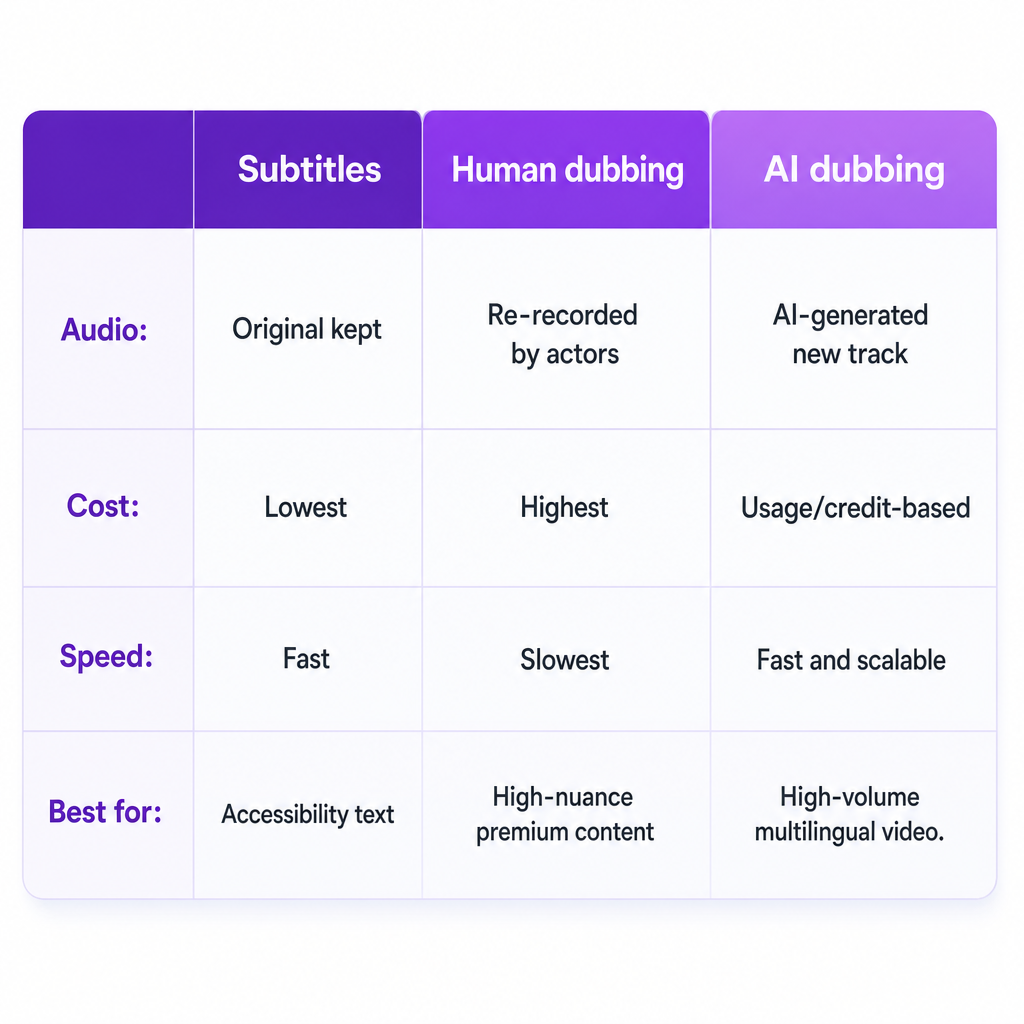
Subtitles keep the original audio and add translated on-screen text. They are the lowest-cost option, but the viewer still hears the source language, which limits accessibility and immersion. Traditional human dubbing hires voice actors and studios to re-record dialogue in the target language, giving the highest control and nuance at the highest cost and slowest turnaround. AI dubbing sits between them: it generates new audio tracks in target languages without studio sessions, while still matching tone and timing.
The practical question for a YouTube channel, a small business, an online course, or an indie film is not which method is best in the abstract. It is whether you need a native-sounding audio experience across several languages, whether you need it quickly and affordably at the scale of dozens or hundreds of videos, and whether your content updates often enough that traditional dubbing would be impossible to keep current. When the answer to those is yes, AI dubbing becomes the sensible default, with human review layered in wherever the stakes or complexity justify it.
How AI dubbing works under the hood
AI dubbing is best understood as a chain of tightly connected technologies. Implementations differ by platform, but the core stages are consistent across the industry, and knowing them helps you judge quality and troubleshoot results.
Speech-to-text: transcribing the original audio
The system first analyzes the source audio and converts speech into text using automatic speech recognition for the source language. In multi-speaker content like interviews or podcasts, speaker diarization detects who is speaking and when. Accurate transcription with timestamps aligned to the video is the foundation for everything downstream: a weak transcript produces weak translation and poor timing. Many modern platforms detect multiple speakers and assign them distinct voice profiles later, preserving conversation dynamics instead of collapsing everyone into one voice.
Neural machine translation: carrying meaning across languages
The transcribed text is then translated with neural machine translation. Strong systems aim past literal word-for-word output toward register and formality suited to the audience, sensible handling of idioms and metaphors, and sensitivity to cultural nuance and brand tone. This is where editable scripts matter: being able to review or approve the translated text before voice generation is especially valuable for marketing, educational, or legal content that must match internal terminology and compliance requirements.
Voice generation: text-to-speech and voice cloning
Once the script is ready, AI generates the new audio. Neural text-to-speech synthesizes natural voices with realistic prosody, emphasis, and pauses. Voice cloning, or speech-to-speech synthesis, goes further by replicating a specific speaker's tone, pitch, and timbre so the dubbed track sounds like the same person speaking another language. High-end systems can preserve the speaker's identity while rendering native-like pronunciation, so the result feels authentic rather than like an unrelated narrator. We pair TTS with fast voice cloning so creators can keep their own voice or brand sound across languages from minimal recorded samples.
Alignment, mixing, and export
Finally, the synthesized audio is aligned back to the video timeline and mixed with the background. Timing and lip-sync are adjusted so the new audio lines up with mouth movements and scene pacing; volume, EQ, and noise control are tuned so the voice sits cleanly over music, effects, and room tone. The finished tracks are exported in formats suited to YouTube, social platforms, learning management systems, or OTT video. Many workflows expose this as an interactive editor where you can tweak segments, swap voices, or correct lines before downloading.
Key options in modern AI dubbing platforms
Tools package these capabilities differently. For a beginner, four choices shape the experience more than any single feature.
Stock voices versus your cloned voice. Most platforms offer libraries of pre-built AI voices across genders, accents, and styles such as conversational, narrator, or announcer. Our library includes 300+ natural-sounding voices usable across text-to-speech and AI dubbing. Voice cloning adds the option to capture your own voice from a short sample and generate multilingual speech that still sounds like you, keeping consistency across YouTube, TikTok, podcasts, and training modules. Creators typically start with stock voices for speed, then move to a cloned voice once they know which tone fits their channel.
Language coverage and localization depth. Platforms advertise both how many languages they can understand and transcribe and how many they can dub into. Our AI dubbing supports 60+ source languages into 33 target languages, which covers major European, Latin American, and Asian markets. Beyond raw counts, look for localized pronunciation of names and technical terms, support for regional variants such as Latin American versus European Spanish, and consistent handling of brand and product terminology across videos.
Web app versus API integration. There are two main ways teams work. Browser-based workflows let you upload a video or paste a link, run dubbing, edit, and download inside a web interface. API-driven pipelines call dubbing, TTS, and voice cloning from your own product, CMS, or automation scripts. We offer both a creator-friendly interface and dedicated APIs for AI Dubbing, Text to Speech, and Voice Cloning, so non-technical creators can start in the browser while developers integrate the same capabilities into their applications later.
All-in-one versus fragmented stacks. Many teams currently stitch together separate tools for captions, translation, text-to-speech, voice cloning, and visual generation. We consolidate AI Dubbing, Voice Cloning, Text to Speech, Speech to Text, Speech Separator, Text to Image, and Image to Video into a single workflow. That removes the friction of moving files between tools and lowers the barrier for creators who do not want to maintain a complex stack.
Decision criteria for creators and businesses
When you decide whether AI dubbing is right for your work, a handful of practical factors matter more than any feature checklist.
Start with the scale and cadence of your content. If you publish weekly or daily, AI dubbing lets you keep pace across languages without hiring regional teams. Our credit-based model with rollover and a free tier supports a gradual ramp-up, so you can test dubbing on a few videos and expand minutes and languages as your audience grows.
Next, consider brand voice. If your voice is central to your identity, the question is whether dubbing can extend that identity rather than replace it. Voice cloning lets a spokesperson, instructor, or creator persona speak additional languages while still sounding recognizably themselves, and a shared voice library across dubbing and text-to-speech keeps intros, outros, ads, and course modules consistent.
Budget and total cost of ownership come next. Traditional dubbing involves studios, talent, and per-minute localization that can become prohibitive for smaller teams. AI dubbing replaces much of that with usage-based pricing, reusable cloned voices and translations, and a lower marginal cost for each added language or video. Our rollover credits reduce waste from unused allocations, which makes experimenting with a new market financially safer.
Content type and risk profile matter too. Low-risk, high-volume material such as social clips, product walkthroughs, and how-to videos is ideal for AI dubbing with light human review. High-risk or heavily regulated content such as medical training, legal explanations, or compliance-sensitive corporate messaging may require human translators and subject-matter experts to review or override AI output. The reliable pattern is to let AI handle routine volume and add editorial checks where a misinterpretation would be costly.
Finally, weigh technical integration and team skills. Teams with existing automation care about available APIs, authentication, rate limits, documentation quality, and how easily dubbing plugs into their current CMS, LMS, or editing workflow. Because we pair a web app with APIs, non-technical creators can start in the browser while technical teams later fold dubbing into automated upload-to-publish pipelines without switching platforms.
Risks and safeguards you should plan for
AI dubbing brings clear benefits, but a beginner should understand the risks and how to reduce them.
Translation quality and cultural nuance top the list. Without human oversight, AI translation can miss cultural context and idioms, misjudge tone and formality, or mishandle sensitive language, which produces awkward or even offensive dubs. Combining AI with human linguists or reviewers is the recommended safeguard wherever cultural sensitivity and brand safety are paramount.
Voice ethics and consent deserve equal attention. Using someone's voice without explicit consent can violate rights of publicity and privacy, and synthetic speech can be misused for impersonation, deepfakes, and fraud. Intellectual property concerns arise when AI recreates distinctive voices or characters without licensing. Responsible practice means enforcing clear consent, never cloning voices you do not own or have permission to use, and following emerging legal guidance on vocal identity.
Data privacy and security follow from the fact that dubbing requires uploading audio and video that may contain sensitive or confidential material. The main risks are breaches that expose voiceprints or proprietary content, indefinite storage of voice samples without clear retention policies, and broad terms that allow reuse of customer data for training. To mitigate, favor platforms that state strong encryption, access controls, and limited retention; review terms of service for training clauses; and avoid uploading particularly sensitive recordings unless they are necessary and properly protected.
Finally, keep bias and broader impact in view. AI systems can inherit biases from training data, producing uneven performance across accents, languages, or demographic groups, and synthetic voices can be used to create misleading content at scale. There are also real concerns about the displacement of voice actors and studio professionals, which is why collaboration models that let human expertise guide and refine AI output tend to produce the strongest, safest results.
Where DubSmart AI fits
We built DubSmart AI as an all-in-one media creation and localization platform for creators, businesses, and developers who want their voice workflows in one place instead of scattered across tools. Our AI Dubbing handles 60+ source languages into 33 target languages with multi-speaker support and editing tools for timing and script adjustments. Our Text to Speech and Voice Cloning generate natural speech from 300+ voices or clone your own voice for consistent branding, and voice cloning works from as little as 20 seconds of audio. Speech to Text and Speech Separator help you transcribe audio and split voice from background noise, which is useful when you are preparing legacy or noisy recordings for dubbing. Text to Image and Image to Video let you create visual assets in the same environment, so a full multilingual campaign can come from one platform.
We run on a credit-based model with rollover credits, a free tier to start, and enterprise plans for higher-volume teams, and we expose APIs for AI Dubbing, Text to Speech, and Voice Cloning for deeper integration into apps, learning platforms, and production pipelines. For YouTubers, small businesses, e-learning providers, filmmakers, podcasters, and developers, that means dubbing is not a bolt-on. It can be one stage in a pipeline that runs from script to localized audio and visuals without leaving the platform.
If you are weighing your first project, the most useful next step is to tell us your language pairs, video length, and content type so we can point you to the right voice approach and plan for your volume.
Frequently Asked Questions
What is AI dubbing in simple terms?
AI dubbing automatically translates the spoken audio in your video and replaces it with a new voice track in another language, generated by AI to match your tone and timing.
How is AI dubbing different from adding subtitles?
Subtitles keep the original audio and add translated text on screen, while AI dubbing changes the audio itself so viewers hear their own language, often in a voice that sounds like the original speaker.
Can AI dubbing keep my own voice in other languages?
Yes. With voice cloning, a platform can learn your vocal characteristics from a short recording and then generate multilingual speech that still sounds like you, preserving your creator or brand identity.
How many languages can DubSmart AI handle?
Our AI dubbing supports dubbing from more than 60 source languages into 33 target languages, with a large voice library and tools to edit scripts and timing before export.
Is AI dubbing safe and legal to use in the U.S.?
AI dubbing is broadly legal when you own or have rights to the content and voices involved, but you must respect consent, intellectual property, and privacy laws and avoid cloning or impersonating voices without permission. Verify case-specific requirements when content is sensitive or regulated.