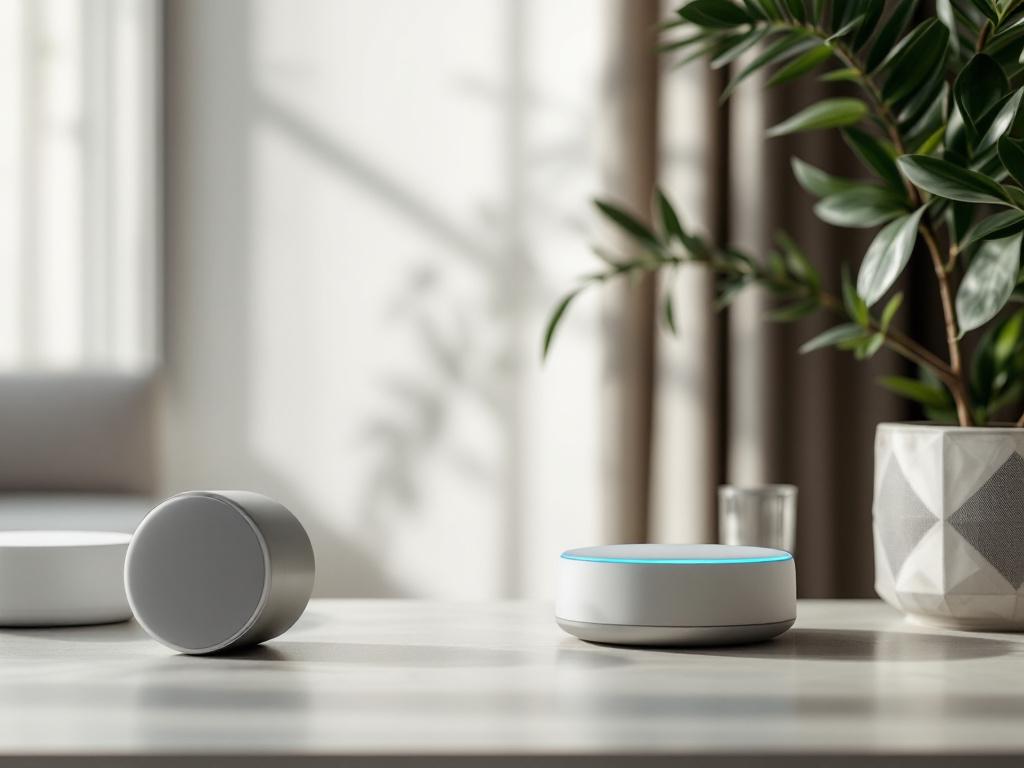
AI voice home automation offers transformative power in managing and operating smart homes. This innovation allows for hands-free control of smart home devices through natural voice commands, seamlessly integrating systems such as lights, security cameras, and thermostats, simplifying everyday life. The growing trend of smart home technologies is becoming increasingly relevant as smart home voice assistants evolve beyond basic interactions. Today, they predict user needs, automate daily routines, and craft more personalized, connected home experiences, underscoring the intelligence AI brings into modern living.
With AI voice home automation at the forefront, smart home voice assistants like Amazon Alexa, Google Assistant, and Apple Siri become central figures in this shift toward a more intuitive home environment. These virtual assistants are not only about interacting with your devices—they are about enhancing how your home functions on a daily basis. They understand the nuances of your preferences and daily patterns, executing tasks without physical input, optimizing convenience and energy use. This blog post aims to delve deep into the world of AI voice home automation and its role in fostering intelligent living spaces. It offers insights into how these technologies operate and inspire smarter living, promoting efficiency and ease in home management.
1. What is AI Voice Home Automation?
AI voice home automation represents a significant leap in how we interact with our living spaces, largely influenced by the integration of AI-driven voice recognition and natural language processing (NLP). This technology empowers users to control various home devices—ranging from lights to every appliance imaginable—via simple spoken commands. Imagine saying, "Turn on the living room lights," or "Lock the front door," and seeing these tasks executed instantly.
The genius of AI voice home automation lies in its ability to process commands with what's known as "context awareness." This means that the systems can handle complex, multi-step tasks while also verifying the user's identity for a more secure and personalized experience. Imagine entering your home and offloading mundane tasks with a single command like, "Hey Google, unlock the door, turn on the lights, and set the thermostat to 22 degrees." Such intuitive interaction elevates the efficiency and enjoyment within our homes.
One of the considerable benefits of AI voice home automation is convenience. By delegating tasks to smart devices, every aspect of home management becomes smoother. The system’s ability to create personalized experiences transforms your home into a tailored environment catering to your preferences. This is particularly beneficial for increasing accessibility, as it provides those with physical challenges a method to independently operate household devices. Moreover, seamless automation through voice inputs boosts operational efficiency, allowing for a life that's both relaxed and secured by cutting-edge technology.
The implementation of AI in smart homes doesn't just stop at convenience; it extends to invaluable additions like personalized alerts that accommodate your habits and preferences. Such integration reflects the future of home automation—one where simplicity meets sophistication.
2. Understanding Smart Home Voice Assistants
Smart home voice assistants have become indispensable in managing our lives with their technical prowess and adaptability in navigating today's complex living environments. Widely recognized models such as Amazon Alexa, Google Assistant, and Apple Siri have stepped up to act not only as intelligent speakers but as the digital architects of our homes, connecting numerous smart devices under one orchestrated operation. These assistants serve the purpose of a central hub, offering you a seamless and hands-free way to execute an array of tasks simply by speaking.
Capabilities extend beyond playing music or telling you the weather. Smart home voice assistants are adept at setting reminders, managing your to-do lists, and sending out hands-free messages. They can control your home’s security by accessing cameras and lights, ensuring that even when away, your home remains safe. As these assistants learn from user interactions, they increase their capacity for proactive service, making each interaction more refined.
A prime example is the ability to create various scenes for your home. With a command like, "Siri, turn on movie night," your assistant can dim the lights, draw the curtains, and turn on your television, set to your favorite streaming service. It’s not just about convenience; it’s about customizing your environment to your specific liking.
Another significant feature is the integration with IoT (Internet of Things) devices, enabling a smooth, orchestrated operation of all your gadgets. No longer is there a need to fiddle with multiple remotes or interfaces—your voice assistant gathers and aligns information and controls a full spectrum of devices, whether it’s starting your coffee machine in the morning or adjusting your smart thermostat before you sleep. By understanding the nuances of this tech-driven companionship, we pave the way toward a more streamlined, intelligent home life, where every corner of your house honors your needs.
3. Benefits of AI in Smart Homes
The integration of AI in smart homes offers numerous benefits that transform how we conduct our personal and household tasks. A notable advantage is the enhanced convenience and efficiency it brings. By automating routines, smart systems allow users to manage daily tasks seamlessly. Imagine your morning routine being activated by a simple voice command: the blinds roll up, soothing music plays, while the coffee brews—all orchestrated without you lifting a finger. Such automation not only saves time but enriches daily productivity by freeing users to focus on more significant activities.
AI is also instrumental in driving energy savings. Voice-activated commands can trigger low-power modes, reducing unnecessary energy consumption. For instance, simply saying, "Alexa, I'm leaving," activates energy-efficient settings, turning off appliances and lowering lights, leading to economical household management. This proactive energy management not only trims monthly bills but fosters a more sustainable environmental footprint.
Another vital area where AI empowers smart homes is security enhancement. With voice-activated locks, the home becomes a fortress by enabling and disabling locks through verbal commands. Biometric voice recognition adds an extra layer of security, distinguishing not just words but the unique characteristics of your voice, ensuring that unauthorized users are barred. This sophisticated mode of protection not only maintains privacy but reassures homeowners of their safety.
Moreover, AI technologies serve in accessibility. For individuals with disabilities, living independently becomes far more achievable when everyday tasks can be operated through simple vocalizations. Whether it's adjusting room settings or communicating with family members via voice assistants, AI ensures that all users, regardless of physical ability, can enjoy the full range of smart home benefits.
AI's integration into smart homes leads to a holistic enhancement of life quality. It promotes a lifestyle that's more efficient, environmentally responsible, and inclusive, harnessing technology's power to support and enrich our lives in multi-dimensional ways, offering peace of mind and redefining comfort and accessibility every day.
4. Voice Technology and Smart Living
Voice technology plays a pivotal role in enhancing smart living, achieving this through conversational interactions that improve the overall quality of life. This technology leverages one's voice not just for commanding tasks but also for engaging in intuitive dialogues that predict and cater to one's personal needs. It facilitates personalized recommendations that align with users' habits, making it akin to having a personal assistant who anticipates what you require before you even realize it.
This interoperability between various smart devices and voice assistants establishes a unified, cohesive control environment. Such technology ensures that each device—from security systems to entertainment centers—speaks the same language and cooperates within the ecosystem of your home, streamlining the control you have over your living space. This integration creates a synergy that elevates everyday routines into sophisticated sequences, such as a voice command that not only turns off your lights but locks your doors and activates your security alarms—all with a single utterance.
Real-life applications of voice technology vividly illustrate its potential. Picture stepping into your home, laden with groceries, and simply saying, "Unlock the door." The system responds, and the door swings open, the hallway lights turn on, and the heating adjusts to a comfortable temperature. As bedtime approaches, you instruct, "Goodnight," and the system prepares the house by dimming the lights, locking the doors, and turning off unused appliances. Such seamless synchronization between devices ensures not only comfort but also significant energy savings and security.
By embracing voice technology, smart living becomes more approachable and intuitive, addressing the demands of modern life through the simplicity of speech. This technology breaks down barriers, inviting a new era of connectivity where entire environments adapt to personal preferences, providing efficient, tailored solutions that enrich the domestic landscape. Smart living, thus, isn't just a futuristic concept, but a current, accessible reality that enhances how we engage with our homes.
5. Integration and Implementation
Setting up an AI voice home automation system involves strategic pairing of voice assistants with smart devices, often facilitated through user-friendly apps. Jumpstarting your smart home begins with understanding which platforms support your ecosystem, whether it's through Google Home, Amazon Alexa, or Apple HomeKit. This foundational step ensures that your devices communicate effectively and respond to commands in unison.
Compatibility is crucial when integrating these systems. Given the myriad IoT standards like Zigbee or the emerging Matter protocol, it’s essential to select devices that effectively integrate without causing silos within your home network. These standards act as universal languages that allow diverse devices to interact smoothly, ensuring cohesive and efficient communication throughout the home environment.
The challenges present themselves in areas such as privacy and data security, which can raise valid concerns among users. These can be mitigated by opting for secure natural language processing services that encrypt communications, safeguarding sensitive information from potential breaches. Furthermore, third-party hubs play a pivotal role in expanding connectivity options, bridging gaps where direct integration might not be possible and enhancing diversity within your smart device collection.
Successful implementation also demands patience in tuning smart systems to user preferences. Tailor your settings to meet individual needs and refine automation loops to ensure practical operations align seamlessly with personal patterns. For instance, adjusting sensitivity to match everyday activities ensures that the system adapts intelligently over time, enhancing the smart home experience without overbearing presence.
In essence, by embracing thoughtful integration and paying attention to compatibility and security, setting up a sophisticated AI voice home automation system can transform living spaces into efficient, intelligent environments. These automated systems provide continuity and coherence, turning anticipation into the hallmark of a smart domicile where technology continuously strives to deliver intuitive performance, matched perfectly with human needs.
6. The Future of AI in Smart Homes
The future of AI in smart homes promises a wealth of advancements that could revolutionize the way we coexist with technology. Central to these prospects is the evolution of natural language processing (NLP) that will enable voice systems to understand and process multilingual, context-sensitive commands with pinpoint accuracy. This enhancement will allow interactions to feel more natural and fluid, akin to conversing with another human.
As personalized experiences become more deeply ingrained in smart home technology, voice assistants will increasingly analyze user data to deliver more customized solutions. The emergence of predictive automation will mean that AI can anticipate needs based on past patterns—whether it’s pre-heating your home before you arrive or preparing morning breakfast settings as soon as you wake up.
Synthetic voices will also transition to more realistic forms, making interactions with digital assistants less robotic and more engaging. This transformation will lead to higher satisfaction and acceptance rates among users as conversations become smoother and more genuine.
Industries predict innovations that foster inclusivity within ecosystems, perhaps supporting a wider array of users and needs. The enhancement of AI could transition to optimizing household functions like self-adjusting washers and smarter cooking setups that manage resources efficiently, bringing forth a scalable smart home ecosystem.
Furthermore, we could see AI voice home automation playing a larger role in community-based applications, from enhancing accessibility in public spaces to fostering energy-efficient cities. As the sophistication of these technologies matures, so too does our capacity to apply them creatively, enriching both personal lives and broader societal functions.
Ultimately, these advancements foreshadow a future where AI is not just present in our homes but fundamentally enriches every corner of our lives, supporting an intelligent, responsive living environment. Through continual development, smart homes promise adaptability and optimization that will continue evolving synergistically alongside human lifestyles.
The impact of AI voice home automation on our lives signifies more than just technological marvels; it embodies a transformative phase in how we conduct everyday activities. By intelligently governing home operations through streamlined voice interactions, we achieve efficiency, refined security, and improved sustainability, ensuring seamless connectivity.
Today's smart homes exemplify environments where the practical meets the engaging, with each system fully integrated to support the user's lifestyle in a more accessible manner. By adopting and embracing AI in smart homes, individuals gain profound benefits—whether it's saving time, conserving energy, or enhancing accessibility for those with physical challenges.
Harnessing the power of AI establishes a new paradigm where homes not only cater to their inhabitants but anticipate and evolve with them, making modern living easier and delightful. Each spoken command or interaction brings a heightened sense of convenience and comfort, underscoring the importance of these systems in creating a harmonious living space.
Call to Action
Stay ahead of the curve by sharing your experiences or questions regarding AI voice home automation in the comments section below. We invite you to explore these technologies by delving into official apps like Amazon Alexa, Google Assistant, and Apple Siri to customize your setup and see how AI adapts to your personal needs. Discover tools such as the Voice Cloning API, Text to Speech API, and AI Dubbing API to enhance your digital interactions further. As our homes continue to evolve, engaging with and understanding these remarkable tools helps us all embrace a smarter, interconnected future.