AI voice cloning is a deep-learning technique that models the unique acoustic fingerprint of a voice from a short audio sample, then generates entirely new speech in that voice from text. For creators expanding across languages, it means your recognizable voice can keep speaking even when the words switch to Spanish, Japanese, or German. At DubSmart AI we build this capability into a single workflow, so a voice you clone once can carry your content across dozens of languages.
This guide explains what happens under the hood, how the main variants differ, why it changes the economics of multilingual content, and where the real judgment calls sit before you clone your first voice.
Table of contents
- What AI voice cloning actually is and how it works
- Types and variants worth knowing
- Why voice cloning matters for creators and teams
- What to weigh before you clone a voice
- Where your decision goes from here
- Frequently asked questions
What AI voice cloning actually is and how it works
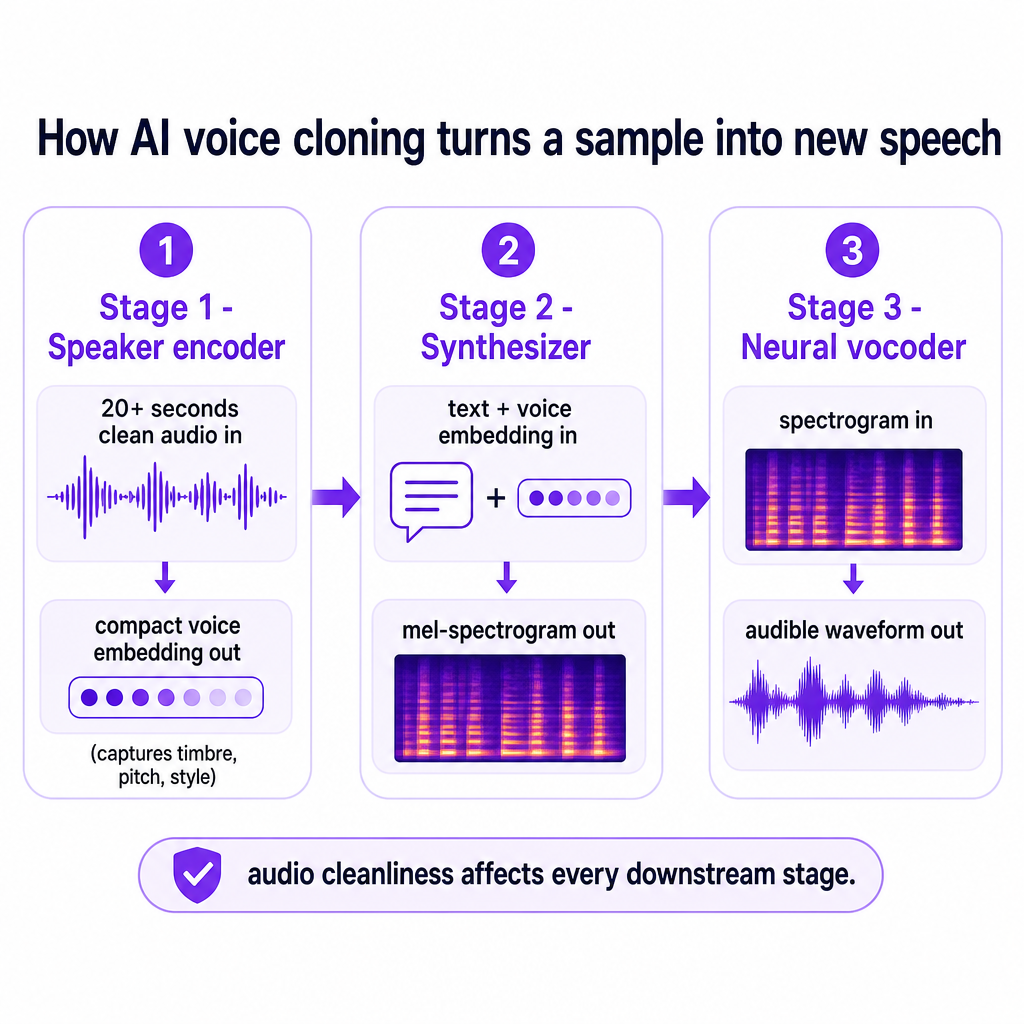
At its core, voice cloning is a chain of three neural components working together. Academic work on deep learning for voice cloning describes the pattern clearly: a speaker encoder listens to a reference sample and compresses it into a compact numerical embedding that captures timbre, pitch, and other identifying characteristics; a sequence-to-sequence synthesizer takes your text plus that embedding and produces a mel-spectrogram; and a neural vocoder converts that spectrogram into an audible waveform.
The reason a short clip can be enough sits in that first step. The encoder does not need to hear you say every possible word. It needs enough clean speech to place your voice accurately in a learned acoustic space, and models trained on many speakers can then generalize that embedding to text they have never heard you speak. Research on real-time cloning frameworks shows systems synthesizing convincing speech from only a few seconds of reference audio, which is why modern tools ask for so little input.
That also explains why audio quality matters more than length past a certain point. On our Voice Cloning page the requirement is at least 20 seconds of clean speech, free of background noise, and the clone is ready in seconds afterward. Twenty seconds is a deliberate balance: enough signal for the encoder to fix a stable voice embedding, short enough that any creator can record it. Feed the same system music, overlapping voices, or heavily compressed audio and the encoder learns a muddier fingerprint, which surfaces later as artifacts or inconsistent timbre.
Types and variants worth knowing
Not all cloning is the same, and the distinctions change what you should expect from output.
The first split is how much reference audio a system needs. Few-shot cloning learns from a short sample, which is the common creator experience. Zero-shot cloning aims to generalize to a completely new speaker with almost no dedicated training on that voice, relying instead on a large multi-speaker model that has already learned the shape of human voices in general. More reference material generally buys more fidelity, but the practical gains flatten once the encoder has a clean, stable read.
The second split is timing. Offline synthesis processes text into audio without a latency budget, which suits dubbing, narration, and any produced content. Real-time synthesis prioritizes low latency so speech can be generated on the fly, which is what interactive or conversational uses demand. The research literature on real-time cloning is largely about meeting that latency constraint without collapsing quality.
The third split is the one creators actually choose between day to day: library voices versus cloned voices. We offer a library of 300+ natural-sounding AI voices alongside custom cloning. A library voice wins when speed and simplicity matter more than identity, since there is nothing to record. A cloned voice wins when the specific persona is the point, such as your own channel voice or a brand spokesperson.
The fourth split is monolingual versus multilingual cloning. A cloned voice can be locked to one language, or the same voice identity can carry into other languages inside a dubbing workflow. Our AI Dubbing API is built to preserve original speaker qualities, analyzing tone, pitch, accent, and speaking style, and then generating that voice speaking in the target language. One caveat worth setting: multi-speaker models follow both your text and the underlying TTS constraints, so a cloned voice in a new language may sound slightly more standardized than your raw original in some contexts.
| Variant axis | Option A | Option B | What decides it |
|---|---|---|---|
| Reference needed | Few-shot (short sample) | Zero-shot (minimal per-voice) | Fidelity vs convenience |
| Timing | Offline synthesis | Real-time synthesis | Latency budget of the use |
| Voice source | Library voice | Cloned voice | Speed vs specific identity |
| Language span | Monolingual | Multilingual dubbing | Whether you localize |
Why voice cloning matters for creators and teams
The payoff is not novelty. It is keeping one recognizable identity across markets that would otherwise each need a different narrator.
For a YouTuber expanding into new languages, the alternative to cloning is a stranger's voice fronting your channel in every locale. That breaks the audience recognition your channel runs on. With a cloned voice reused across languages, a viewer in another country hears something that reads as the same person, which anchors trust the way your original voice already does at home. We support dubbing from 60+ languages into 33 target languages, so a single cloned voice can travel a long way.
For businesses, marketing teams, and e-learning producers, the value is consistency at scale. A brand spokesperson's voice can become a named, reusable asset that appears across dozens of videos and course modules without re-recording sessions. That is the practical meaning of an integrated workflow: clone once, then reference that voice inside both Text to Speech and AI Dubbing projects rather than rebuilding it each time.
For filmmakers and podcasters, cloning removes the scheduling and cost friction of pickups and localized versions, though it never removes the creative judgment about where a synthetic take is appropriate.
For developers and agencies, cloning becomes a building block. Our Voice Cloning API lets you upload an audio sample in formats such as MP3, WAV, AAC, M4A, or FLAC, create a named custom voice, and then reference that voice in TTS or dubbing routes. The important consequences are automation and consistency: an agency can programmatically generate cloned-voice versions of a large catalog, and because each voice lives as a named asset, there is less manual configuration and less room for human error across projects.
What to weigh before you clone a voice
These are judgment criteria, not a setup checklist. The setup itself belongs to a dedicated how-to.
Start with the sample. Length past roughly 20 seconds matters less than cleanliness. A quiet room, a single speaker, and uncompressed or lightly compressed audio give the encoder a stable read. Noise, music, and overlapping voices are what degrade a clone, so the effort is best spent on recording conditions rather than on recording more.
Next, decide whether identity is actually the point. If you only need clear, pleasant narration, a library voice is faster and avoids the recording step entirely. Reserve cloning for cases where the specific voice carries brand or audience value. For multilingual work, also decide up front whether you want the same cloned voice across every language or are comfortable with different library voices per locale; the former feels like one person speaking many languages, the latter creates a distinct character in each.
The heaviest consideration is consent and disclosure, and here the evidence is unambiguous for US content. Analysis of the updated FTC endorsement guides under 16 CFR Part 255 explains that voice clones and deepfake endorsements now fall under the same truth-in-advertising rules as human ones: an AI-generated voice used as an endorsement or testimonial needs clear disclosure that it is AI-generated, plus explicit consent from the person whose voice is cloned. Unauthorized use of a real person's voice for commercial endorsement can trigger right-of-publicity claims and enforcement.
The rules tighten further for calls. A deepfake law tracker reports that FCC ruling FCC 24-17 treats AI-generated human voices as "artificial voices" under the TCPA (47 U.S.C. 227(b)(1)), meaning AI-voice robocalls to residential lines require prior express consent, with enforcement actions reaching into the millions. If a cloned voice ever touches an outbound calling campaign or a voice agent that contacts consumers, that framework applies.
The practical rule that follows is simple to state and worth treating as a design requirement rather than an afterthought: clone your own voice freely for honestly labeled content; never clone someone else's without documented consent; and never use a clone to mislead listeners about who is speaking. Cloning is not inherently illegal, but deceptive impersonation is where the real risk lives. Because state impersonation and deepfake laws are still shifting, campaign-specific or per-state questions deserve current legal review rather than a blanket assumption.
Consent and disclosure are not paperwork bolted on at the end. They are the difference between a clone that scales your brand and one that creates liability.
Where your decision goes from here
The real question is not whether AI voice cloning works, but which of your projects it belongs in. If audience recognition or brand identity travels with a specific voice, cloning earns its place; if you simply need clean narration, a library voice is the lighter choice. And any commercial or public-facing use should be built around consent and honest labeling from the start.
Once you know cloning fits a project, the next move is recording a clean 20-second sample and setting up your custom voice inside our platform, where it becomes reusable across Text to Speech and AI Dubbing in the languages you are targeting.
Frequently asked questions
How much audio do I need to clone a voice?
With our Voice Cloning, at least 20 seconds of clean speech with no background noise. Cleanliness matters more than extra length; noise and music degrade the result faster than a short sample does.
Is AI voice cloning legal?
Cloning itself is legal. The risk is misuse. In the US, cloned-voice endorsements require disclosure and consent under FTC rules, and AI-voice robocalls to residential lines require prior express consent under the TCPA. Deceptive impersonation is where enforcement concentrates.
Can a cloned voice speak other languages?
Yes. A cloned voice can be reused across languages in a dubbing workflow. Our AI Dubbing preserves tone, pitch, accent, and speaking style while generating speech in the target language, supporting 60+ source languages into 33 targets.
What is the difference between a library voice and a cloned voice?
A library voice is a ready-made AI voice, best when speed matters and identity does not. A cloned voice recreates a specific person's voice, best when your channel voice or a brand spokesperson is central to the content.
Can developers integrate voice cloning?
Yes. Our Voice Cloning API lets you upload a sample in formats like MP3, WAV, AAC, M4A, or FLAC, create a named custom voice, and reference it in Text to Speech or dubbing calls, so cloned voices become reusable assets across projects.